Revolutionizing Data Intelligence: Amazon S3 Introduces Powerful Metadata Annotations
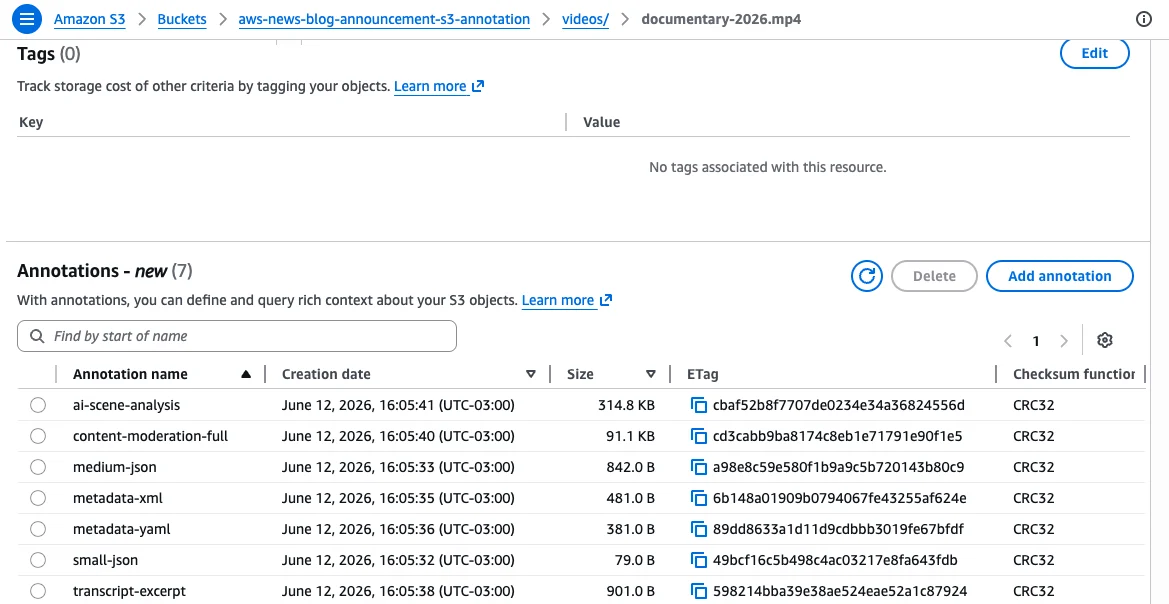
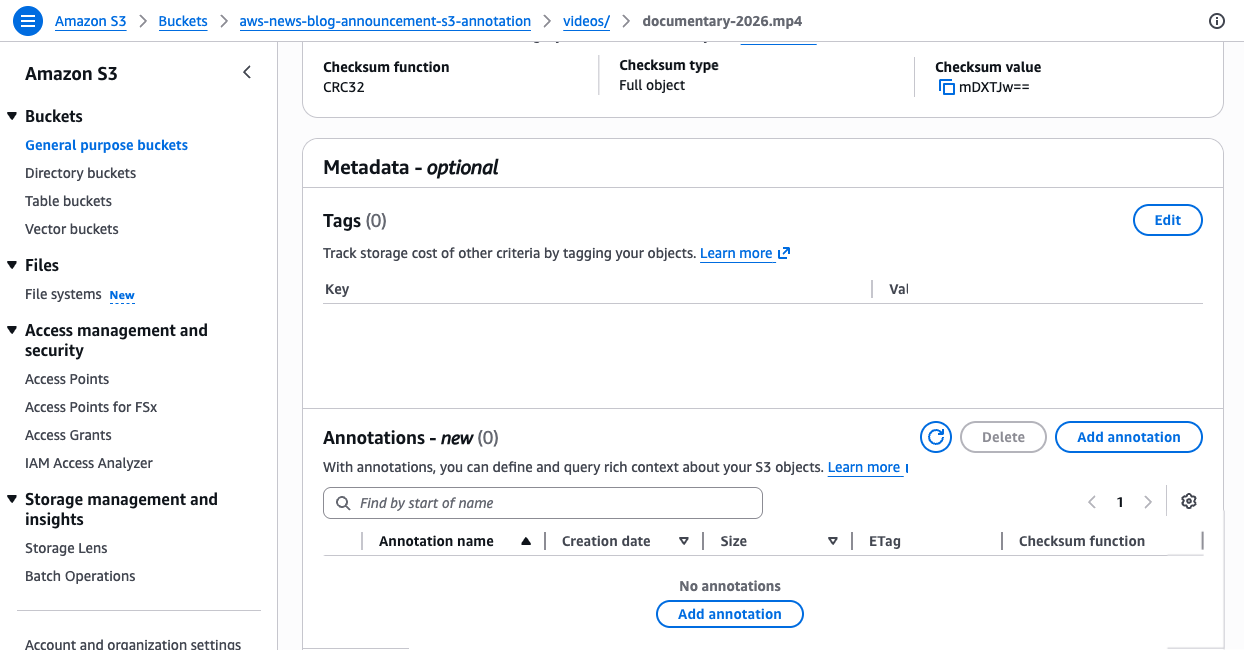
In a landmark update for cloud-native data management, Amazon Web Services (AWS) has announced a transformative new capability for Amazon Simple Storage Service (S3): S3 Annotations. This feature allows organizations to attach massive amounts of rich, granular business context directly to their S3 objects. By enabling users to store up to 1,000 named annotations per object—each reaching 1 MB in size—AWS is fundamentally changing how businesses interact with their unstructured data.
This development marks a departure from traditional, restrictive metadata practices. Instead of relying on external databases, sidecar files, or limited header fields, developers can now embed structured data—such as AI-generated transcripts, technical specifications, or compliance ratings—directly within the S3 ecosystem.
Main Facts: A New Paradigm for Object Metadata
The introduction of S3 Annotations addresses a long-standing "metadata bottleneck" in cloud storage. Historically, S3 users were confined to system-defined metadata (such as file size and storage class), object tags (limited in size and scope), or user-defined metadata (capped at a mere 2 KB).
S3 Annotations break these barriers, offering a highly flexible, mutable, and scalable solution:
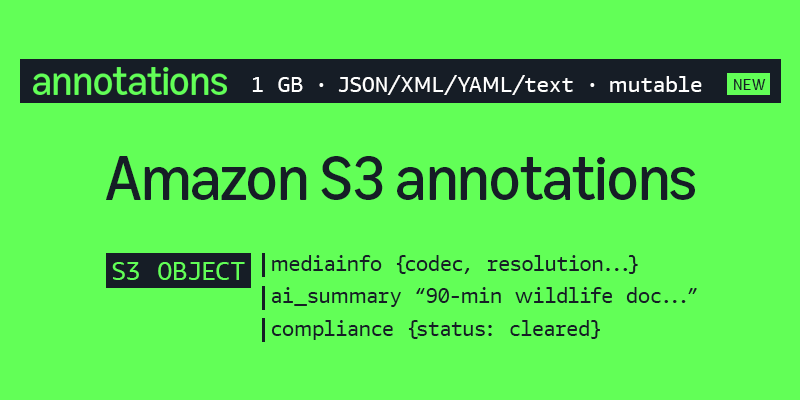
- Massive Capacity: Each object can hold up to 1,000 unique, named annotations, with each annotation supporting up to 1 MB of data. This allows for a total of 1 GB of context per object.
- Format Flexibility: Annotations support multiple formats, including JSON, XML, YAML, and plain text, catering to both human-readable documentation and machine-readable structured data.
- Lifecycle Persistence: Annotations are "attached" to the object. They move automatically during replication, cross-region transfers, and copying. When an object is deleted, the associated annotations are removed, ensuring data hygiene and reducing manual management overhead.
- Queryable at Scale: By leveraging S3 Metadata tables, these annotations are automatically indexed into Apache Iceberg tables. This enables high-performance analytics using Amazon Athena without the need to restore objects from cold storage or pay retrieval fees.
Chronology of Development: The Path to Agentic Workflows
The journey toward S3 Annotations is rooted in the industry’s rapid pivot toward generative AI and autonomous agents. Over the past several years, AWS observed a clear pattern: customers were spending millions of dollars building and maintaining "shadow" metadata databases just to track the content of their S3 buckets.
Phase 1: The Era of External Sidecars
For years, companies managing massive data lakes—such as media houses and scientific research institutes—maintained secondary databases to store information about their files. If a video file was in S3, its technical specs, subtitles, and AI-summary lived in a separate SQL database. This created synchronization nightmares and high latency.
Phase 2: The Need for AI Readiness
With the emergence of LLMs and autonomous agents, the need for "self-describing" data became critical. AI agents require context to act on files without human intervention. Standard metadata tags were too small to hold the prompts or insights generated by AI models, leading to the development of the annotation architecture.
Phase 3: The Launch of S3 Annotations
Today’s announcement marks the culmination of this evolution. By integrating annotation indexing into the S3 storage layer itself, AWS has provided a standardized "interface" for AI agents to understand data at scale. The introduction of the S3 Tables MCP (Model Context Protocol) server now allows AI models to query these annotations using natural language, effectively turning a static storage bucket into an intelligent data repository.
Supporting Data: Comparative Metadata Analysis
To understand the leap in capability, one must compare the new annotation framework with legacy methods. The following table illustrates why S3 Annotations represent a paradigm shift for data architects:
| Capability | Max Size | Mutable? | Primary Use Case |
|---|---|---|---|
| System Metadata | Fixed | No | Storage class, size, creation date |
| User Metadata | 2 KB | No | Small, static key-value pairs |
| Object Tags | 10 tags | Yes | Access control, lifecycle policy |
| S3 Annotations | 1 GB (1k x 1MB) | Yes | Rich context (JSON/XML/YAML) |
This data confirms that Annotations are not meant to replace existing tags or headers, but rather to provide a high-fidelity "context layer" that can evolve in real-time. Because these annotations are mutable, a file can be updated with new AI-derived insights—such as a changing content safety rating or an updated transcript—without the need to re-upload or modify the underlying object.

Official Responses and Strategic Implications
Daniel Abib, a lead engineer behind the project, emphasized the strategic importance of this release for modern enterprise workflows. "Organizations are building AI agents that need to find, understand, and act on data autonomously," Abib stated. "To support these workflows, you need metadata that can evolve alongside the data, scale to petabytes, and remain queryable without expensive retrieval."
The "Agentic" Future
The most significant implication of this release is the empowerment of AI agents. In a traditional environment, an agent looking for "high-resolution nature documentaries" would have to download and scan every video file to determine its properties. With S3 Annotations, the agent simply queries the annotation table in Amazon Athena. It identifies the relevant objects in seconds, drastically reducing compute costs and time-to-insight.
Simplified Compliance and Governance
For industries governed by strict regulations, such as healthcare or finance, S3 Annotations provide a robust way to attach compliance metadata. Because the annotations follow the object through its entire lifecycle—even when moved across regions or archived in Glacier—organizations no longer have to worry about "losing" the context required for regulatory audits.
Implications for Industry Sectors
Media and Entertainment
Media companies manage petabytes of assets. With S3 Annotations, they can attach technical metadata (bitrate, frame rate, audio channels) and editorial metadata (cast lists, summaries, parental ratings) directly to the file. This enables powerful, real-time discovery of assets for production teams and automated streaming platforms.
Scientific Research
In genomics or climate research, data is often voluminous. Researchers can now attach experimental parameters, sensor calibrations, and preliminary findings directly to the raw data files. This turns a data lake into a searchable laboratory notebook, where specific data subsets can be identified for further analysis without manually parsing thousands of files.
Global Data Governance
Because S3 Annotations are fully supported in all AWS Regions, including those with stringent data residency requirements, they provide a consistent way to manage metadata globally. The ability to backfill existing annotations into managed tables means that organizations can upgrade their legacy data lakes to this new standard without starting from scratch.
Getting Started: Implementation and Best Practices
For organizations looking to integrate S3 Annotations, the process is streamlined via the AWS CLI and SDKs.
- Permission Configuration: Ensure your IAM policies include
s3:PutObjectAnnotationands3:GetObjectAnnotation. - Attaching Metadata: Use the
put-object-annotationAPI to attach structured data. For example, a JSON file containing video specs can be attached as a distinct named annotation, independent of any other metadata. - Enabling Queryability: By enabling S3 Metadata tables, users can transition from simple file storage to a query-driven environment. Once an annotation table is enabled, S3 begins the background process of indexing existing and future annotations into Apache Iceberg tables.
Conclusion: A New Era of Data Visibility
The release of S3 Annotations is more than just a feature update; it is a fundamental re-imagining of how cloud storage should function in the age of AI. By collapsing the distance between raw data and the context required to process that data, AWS is enabling a new generation of intelligent, automated, and highly efficient applications.
As businesses continue to migrate their most critical workloads to the cloud, the ability to maintain rich, evolving, and queryable metadata will become a primary competitive advantage. With the introduction of S3 Annotations, the barrier to achieving this level of data intelligence has been significantly lowered, setting a new benchmark for cloud storage providers worldwide.
For developers, data scientists, and systems architects, the call to action is clear: it is time to move beyond the limitations of simple headers and tags. The future of data is annotated, queryable, and, most importantly, ready for the age of autonomous AI.