A Symphony of Circuits: Reimagining "Second Reality" Through Hard Drive Acoustics
Main Facts
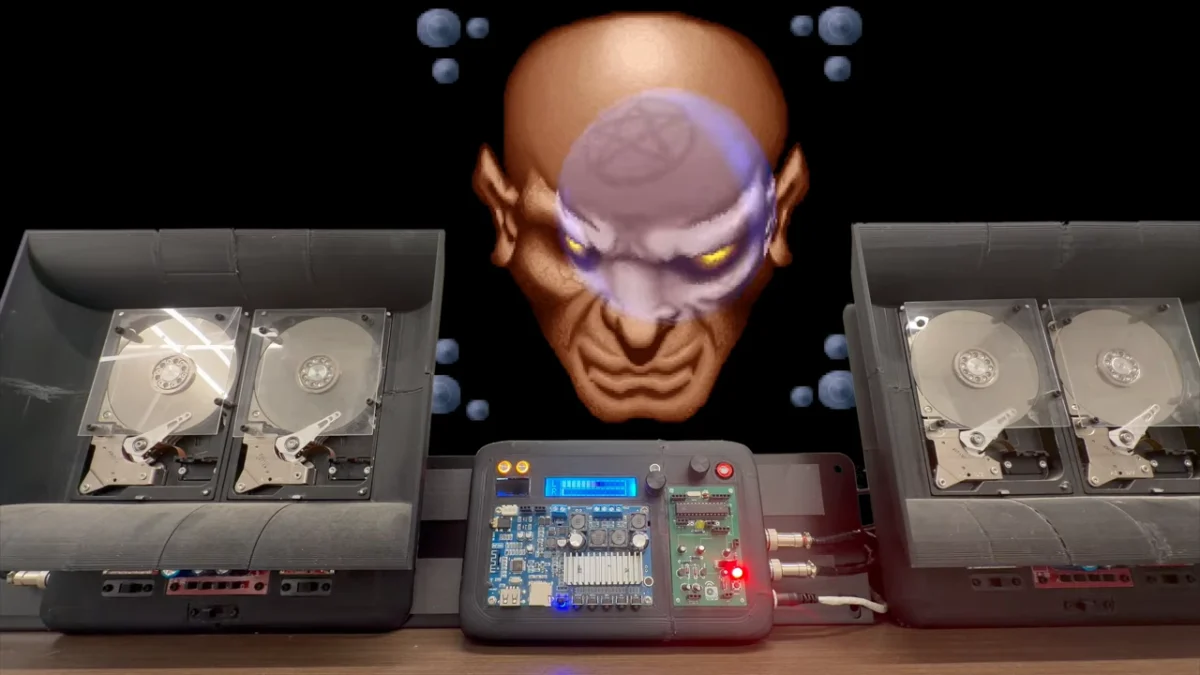
In a remarkable fusion of vintage digital art and modern hardware hacking, engineer Niv Singer has resurrected Future Crew’s legendary demoscene masterpiece, "Second Reality," by playing its iconic soundtrack through an unconventional sound system: an array of repurposed hard disk drives (HDDs). This audacious project not only pays homage to a pivotal moment in computing history but also pushes the boundaries of what constitutes an audio transducer, transforming discarded data storage devices into instruments of nostalgic sound.
"Second Reality," which captivated audiences and won Assembly 1993 with its groundbreaking technical and artistic prowess, remains a benchmark for real-time computer graphics and creative coding. Its intricate visuals and memorable soundtrack, composed by Skaven, are synonymous with the golden age of the demoscene – a subculture dedicated to creating self-contained computer programs that produce audio-visual presentations. Niv Singer’s initiative to reinterpret this classic through the physical mechanics of hard drives is a testament to the enduring appeal of the demoscene ethos: pushing hardware to its absolute limits, often in ways never intended by its manufacturers.
The core of Singer’s ingenious setup lies in exploiting the electromagnetism within the hard drive’s voice coil motor. Typically responsible for precisely positioning the read/write heads across the platters, this coil can be manipulated to vibrate in response to audio signals, thereby generating sound waves. While not designed for high-fidelity audio, this hack transforms the drives into rudimentary speakers, albeit with significant limitations in volume and frequency response. Singer, however, embraced these constraints as part of the creative challenge.
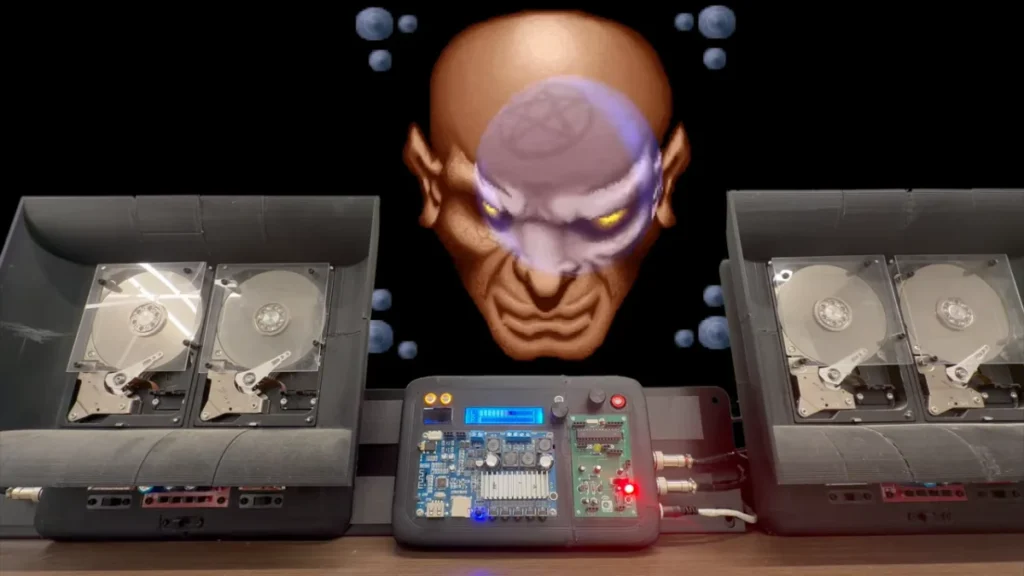
His meticulous design features four Western Digital Caviar 500GB drives, configured in a stereo setup with two drives per channel. Demonstrating a profound understanding of acoustics and electronics, Singer integrated crossovers for each channel, allocating one drive to handle lower frequencies and the other to manage higher ones. This sophisticated approach aims to mitigate the inherent acoustic deficiencies of the HDDs, attempting to broaden their limited frequency spectrum. Beyond mere sound reproduction, Singer added an aesthetic flourish: the platters themselves spin in sync with the music’s beat, a visual spectacle achieved through clever Pulse Width Modulation (PWM) techniques. This integration of visual and auditory elements elevates the project from a mere technical curiosity to a captivating performance art piece, reflecting the multi-sensory nature of the original demoscene productions.
The project not only celebrates the technical mastery of "Second Reality" but also highlights the spirit of DIY (Do-It-Yourself) innovation prevalent in the maker community. By openly sharing the project’s files on GitHub, Singer invites fellow enthusiasts to explore, replicate, and even improve upon his design, fostering a collaborative environment reminiscent of the demoscene’s own open-source roots. This undertaking stands as a vibrant intersection of art, engineering, and digital archaeology, breathing new, albeit scratchy, life into a beloved classic and demonstrating the boundless creativity that emerges when technology is viewed not just as a tool, but as a medium for artistic expression.
Chronology
The Genesis of a Classic: Second Reality (1993)
To fully appreciate the significance of Niv Singer’s project, one must first delve into the historical context of "Second Reality" and its monumental impact on the demoscene. The early 1990s were a vibrant, fertile ground for computer enthusiasts who sought to push the boundaries of PC hardware beyond its commercial applications. This era predated widespread internet access, and digital creativity often manifested in the form of "demos" – self-contained, non-interactive programs that showcased advanced programming techniques and artistic talent. These demos were shared primarily through floppy disks, passed hand-to-hand or via bulletin board systems (BBS).
Amidst this burgeoning subculture, a Finnish group called Future Crew emerged as a powerhouse of innovation. Formed in 1991, their members, including the legendary programmer Grendel (Timo Kiviluoma) and musician Skaven (Janne Puurtinen), quickly gained renown for their technical prowess and artistic vision. By 1993, Future Crew had set their sights on Assembly, a prominent demoparty held annually in Finland, which served as a crucial platform for groups to present their latest creations and compete for recognition.
"Second Reality," released at Assembly 1993, was nothing short of a revelation. Running on a relatively modest 486 PC, it showcased a breathtaking array of cutting-edge computer graphics techniques that were, at the time, typically reserved for high-end workstations or pre-rendered animation studios. The demo featured complex effects such as real-time raytracing, Gouraud shading, morphing objects, sophisticated particle systems, and dynamic camera movements. Its iconic opening sequence, with the futuristic Future Crew logo emerging from a swirling vortex, immediately signaled a new standard in demoscene production. The seamless integration of visuals with Skaven’s evocative electronic soundtrack was critical to its immersive experience, creating a cohesive and emotionally resonant journey for the viewer. "Second Reality" wasn’t just a technical achievement; it was a poetic statement on the potential of real-time computer graphics, influencing countless programmers, artists, and game developers in the years that followed. It won the demoparty competition decisively and cemented Future Crew’s legacy, becoming arguably the most famous and influential demo of all time. Its enduring appeal lies not only in its technical brilliance but also in its ability to evoke a sense of wonder and possibility, a digital artifact that captured the zeitgeist of an era defined by rapid technological advancement and boundless creativity.
The Birth of an Unconventional Sound System (Niv Singer’s Project)
Fast forward nearly three decades, and the spirit of innovation that birthed "Second Reality" finds a kindred soul in Niv Singer. While his specific background isn’t detailed in the initial report, his project clearly stems from a deep appreciation for both the technical artistry of the demoscene and the hands-on experimentation characteristic of the maker community. The conceptual leap from data storage to sound reproduction using hard drives is not entirely new; hobbyists have been experimenting with hard drive speakers for years, fascinated by the inherent potential of their precision electromechanical components. However, Singer’s project distinguishes itself through its specific dedication to a revered piece of digital history and its sophisticated execution.
The inspiration likely arose from a desire to connect with the essence of "Second Reality" in a tangible, almost anachronistic way, moving beyond mere emulation to a physical manifestation of its audio. The challenge was to harness the very components of a hard drive – typically designed for silent, precise data retrieval – and coerce them into producing audible sound. Singer embarked on a journey of deconstruction and repurposing. He meticulously pulled apart a stack of hard drives, carefully exposing their internal mechanisms. The core principle, as he describes, is elegant in its simplicity: by feeding an audio signal to the voice coil that drives the read/write head, the coil vibrates, causing the head to wiggle and displace air, thus generating sound waves.
However, the path from principle to practical application was fraught with engineering challenges. Hard drives are inherently inefficient and acoustically limited as speakers, offering low volume and a severely constrained frequency response. Singer tackled these issues with thoughtful design choices. He selected four Western Digital Caviar 500GB drives, likely chosen for their commonality, ease of modification, or perhaps specific characteristics of their voice coil motors. Crucially, he moved beyond a simple one-to-one mapping, implementing a stereo setup with two drives per channel. This allowed for the introduction of frequency crossovers, a technique borrowed from traditional speaker design, where different drivers (in this case, different hard drives) are assigned specific frequency ranges. One drive could be optimized for lower frequencies, while the other handled higher ones, aiming to create a more balanced and listenable sound, despite the inherent limitations.
But Singer’s ingenuity didn’t stop at audio. Recognizing the visual flair inherent in demoscene productions, he introduced a captivating visual element: synchronizing the spinning platters with the beat of the music. This was achieved using Pulse Width Modulation (PWM), a technique commonly used to control motor speeds by varying the average power delivered to them. By dynamically adjusting the PWM signal based on the audio input, Singer made the platters visibly react to the rhythm, transforming the drives into a kinetic art installation. The entire development process, from initial concept to the finely tuned, multi-sensory experience, represents a significant undertaking in electrical engineering, programming, and creative problem-solving, culminating in a unique tribute to a digital icon.
Supporting Data
Deconstructing the Hard Drive as an Acoustic Instrument
Understanding how Niv Singer transformed a hard drive into a speaker requires a brief primer on the internal workings of these ubiquitous data storage devices. A typical hard drive consists of several key components: rigid, magnetic platters that store data; read/write heads that float microscopic distances above the platters to read and write data; an actuator arm that holds the heads; and a voice coil motor (VCM) that precisely moves the actuator arm. The VCM is essentially a linear motor comprising a coil of wire (the voice coil) situated within a magnetic field generated by permanent magnets. When current flows through the voice coil, it experiences a Lorentz force, causing it to move and, in turn, swing the actuator arm to position the heads over the desired data track.
Singer’s "hack" exploits this fundamental principle. Instead of feeding the voice coil a precise current to move the head to a specific data track, he feeds it an audio signal. An audio signal is an alternating electrical current that varies in voltage and frequency, representing sound waves. When this fluctuating current passes through the voice coil, it causes the coil, and thus the attached read/write head, to vibrate in sync with the audio signal. These vibrations then displace the surrounding air, creating pressure waves that our ears perceive as sound. In essence, the voice coil and actuator arm assembly act as a very small, inefficient loudspeaker driver.
However, the characteristics of a hard drive’s VCM and its mechanical assembly are far from ideal for audio reproduction. The frequency response is typically terrible. A good speaker needs to reproduce a wide range of frequencies evenly. Hard drive mechanics, with their inherent resonances, small surface area for air displacement (the head), and limited excursion range, tend to emphasize certain frequencies while suppressing others, leading to a "tinny" or "muddy" sound. The volume is also extremely limited because the VCM is designed for precision, not power or amplitude. It moves a very small mass (the head) over a tiny distance, making it an inefficient transducer for converting electrical energy into acoustic energy. Distortion is another significant issue; the VCM’s non-linear response to varying audio signals can introduce unwanted harmonics and noise.
This is precisely why Singer’s implementation of crossovers is a crucial technical detail. In traditional audio systems, crossovers separate an audio signal into different frequency bands, sending low frequencies to a woofer (a large driver designed for bass) and high frequencies to a tweeter (a small driver designed for treble). By using two hard drives per channel and assigning one to low frequencies and the other to high frequencies, Singer attempts to optimize the limited capabilities of each HDD "driver." While it won’t achieve audiophile quality, this approach is a sophisticated attempt to mitigate the hard drives’ inherent acoustic shortcomings, demonstrating a deep understanding of audio engineering principles applied to an unconventional medium. The choice of Western Digital Caviar 500GB drives might have been due to their availability, ease of disassembly, or perhaps their voice coil characteristics offered a slightly better response for this specific application compared to other models.
The Art of Synchronization: Platters and Beat
Beyond the challenge of generating sound, Niv Singer added another layer of technical and artistic complexity: synchronizing the hard drive platters’ spin with the music’s beat. This visual feedback elevates the project, transforming it into a more immersive and demoscene-like experience, where visual effects are as integral as the audio.
The platters in a hard drive are spun by a dedicated spindle motor, which typically operates at a constant, high RPM (e.g., 5400, 7200, or 10000 RPM) to ensure quick data access. To make the platters react to the music, Singer needed to gain control over this motor’s speed, which is usually governed by internal drive firmware. He achieved this using Pulse Width Modulation (PWM).
PWM is a technique for controlling the average power delivered to an electrical device by rapidly switching the power supply on and off. The "width" or duration of the "on" pulse, relative to the total cycle time, determines the average power. For instance, a 50% duty cycle (on for half the time, off for half the time) delivers half the average power of a 100% duty cycle. By varying this duty cycle, Singer could effectively control the voltage supplied to the spindle motor, thereby altering its speed.
The creative intent here is twofold: visual feedback and aesthetic enhancement. As the beat drops or the music intensifies, the platters visibly speed up or slow down, creating a dynamic light show that complements the unusual audio. This is particularly effective with "Second Reality," whose soundtrack has distinct rhythmic elements. Achieving this synchronization is a significant technical feat. It involves analyzing the audio signal in real-time to detect beats or changes in intensity and then translating that information into appropriate PWM signals for the spindle motors. This requires precise timing and control, ensuring that the visual effect enhances rather than distracts from the audio.
The "nice touch" of the spinning platters underscores the project’s roots in the demoscene, where visual spectacle is paramount. It demonstrates Singer’s commitment to creating a holistic experience, combining the unexpected auditory output with a compelling visual narrative. This meticulous attention to detail transforms what could have been a simple technical hack into a carefully crafted piece of interactive art, engaging multiple senses and deepening the connection to the original demoscene ethos.
The Demoscene and DIY Culture: A Symbiotic Relationship
Niv Singer’s hard drive speaker project is a quintessential example of the symbiotic relationship between the demoscene and the broader DIY/maker culture. The demoscene’s spirit is fundamentally about pushing the limits of hardware and software, often through unconventional means, to create awe-inspiring audio-visual experiences. It’s a culture of extreme optimization, creative coding, and a deep understanding of underlying computer architectures. Crucially, it’s also a culture of open knowledge sharing; demoscene groups often share their techniques, and the underlying principles are typically well-documented within the community.
Singer’s project embodies this ethos perfectly. He takes a piece of hardware (the hard drive) and compels it to perform a function entirely outside its designed purpose. This act of repurposing, of seeing potential beyond the manufacturer’s intent, is a hallmark of both demoscene and DIY culture. The technical challenge of making HDDs sound halfway decent, implementing crossovers, and synchronizing platters with PWM, aligns perfectly with the demoscene’s love for intricate technical solutions to seemingly impossible problems. The goal is not just to make something work, but to make it work in an unexpected, elegant, and often visually striking way.
The DIY/maker culture, championed by platforms like Hackaday (which featured Singer’s project), shares this spirit of hands-on experimentation, learning by doing, and open collaboration. It encourages individuals to create, modify, and repair things themselves, often using readily available components or "junk" electronics. The project resonates deeply with this community because it showcases practical electronics skills (PWM, audio processing), mechanical ingenuity (disassembling and repurposing drives), and programming ability (for real-time audio analysis and motor control).
Hackaday, in particular, has a long history of featuring such "hacky" audio projects, especially those involving hard drives. The article itself mentions previous hard drive speaker projects, indicating a recurring fascination within the community. This demonstrates a collective curiosity about the hidden acoustic potential of everyday devices. These projects often serve as educational tools, demystifying complex electronics and inspiring others to try similar experiments. By making the project files available on GitHub, Singer further reinforces this open-source, collaborative aspect, inviting others to learn from his work, contribute improvements, or embark on their own unconventional audio adventures. In this way, the project becomes more than just a personal endeavor; it becomes a shared resource and a celebration of collective ingenuity that bridges generations of tech enthusiasts.
Official Responses
Community Reception and Digital Footprint
Given the nature of Niv Singer’s project – a personal endeavor shared online – there are no "official responses" in the corporate or governmental sense. Instead, the "official response" manifests in the vibrant reactions and engagement from the global demoscene, maker, and general tech communities. These responses, largely expressed through comments, shares, and discussions on platforms like Hackaday, Singer’s own blog, GitHub, and YouTube, paint a clear picture of how such ingenuity is received.
The overwhelming sentiment is one of awe, amusement, and profound appreciation for Singer’s technical prowess and creative vision. Viewers and readers are typically captivated by the sheer audacity of the idea and impressed by the meticulous execution. Comments often highlight the cleverness of using crossovers to improve sound quality, the ingenious application of PWM for platter synchronization, and the nostalgic connection to "Second Reality." For those familiar with the demoscene, the project is seen as a fitting tribute, embodying the scene’s core values of pushing boundaries and repurposing technology. For those new to the concept, it serves as an introduction to the world of hardware hacking and the unexpected potential of discarded electronics.
Platforms like Hackaday play a crucial role in amplifying such projects. By featuring Singer’s work, they provide a respected platform for dissemination, reaching a wide audience of engineers, hobbyists, and tech enthusiasts. The article itself acts as a form of "official recognition" within the maker sphere, validating the project’s significance and technical merit. The embedded YouTube video is also a critical component, allowing the project to be experienced directly, letting the "hard drive speakers" speak for themselves, albeit through a recording. The comments section on YouTube videos of such projects is often a goldmine of enthusiastic feedback, technical questions, and shared anecdotes from people who have attempted similar hacks or are simply amazed by the result.
Niv Singer’s own documentation, particularly his blog post (innerlogics.com) and the GitHub repository (nivs/spin-doctor), serves as the most direct "official response" from the creator himself. By openly sharing the project’s code, schematics (implied by "files on Github"), and detailed explanations, Singer contributes valuable knowledge back to the community. This act of open-sourcing is a fundamental aspect of both the demoscene and the broader open-source hardware and software movements. It allows curious individuals to delve into the technical specifics, understand the challenges, and even replicate or build upon the project. This transparency fosters a culture of learning and collaboration, which is a powerful form of "official" endorsement within these communities, signaling that the project is not just a personal achievement but a contribution to a shared body of knowledge. The cumulative effect of these digital interactions forms a robust "response" that celebrates innovation, technical curiosity, and the enduring legacy of digital creativity.
Implications
Redefining "Speaker" and Acoustic Experimentation
Niv Singer’s hard drive speaker project has profound implications for how we perceive and define "speakers" and the very act of acoustic experimentation. It challenges the conventional wisdom that sound reproduction requires purpose-built transducers. By coaxing sound from components never intended for audio output, Singer demonstrates that the potential for acoustic conversion exists in unexpected places. This project encourages a radical shift in perspective: instead of asking "What is this designed for?", it asks "What else could this be designed for?"
This redefinition opens doors for broader acoustic experimentation. It highlights the underlying physics of sound generation – the vibration of a membrane or component displacing air – and shows that this principle can be applied to almost any object that can be made to vibrate. From turning a wall into a speaker using exciters to employing solenoids to tap out melodies on various surfaces, the world is full of potential sound sources. Singer’s work particularly emphasizes the creative use of electromagnetism in this context. It suggests that engineers and artists should look beyond traditional audio components and consider the acoustic properties of materials and mechanisms in new and inventive ways, fostering a spirit of resourcefulness and playful engineering.
The Enduring Legacy of Demoscene Innovation
The project serves as a powerful testament to the enduring legacy and relevance of demoscene innovation. "Second Reality" itself is a beacon of early digital artistry and technical excellence, demonstrating what could be achieved with limited hardware through sheer programming genius. Singer’s project bridges the gap between this historical artifact and contemporary hardware hacking. It keeps the spirit of the demoscene alive by taking its audio component and literally embodying it in a new, physical form.
This connection helps to educate new generations about the demoscene’s contributions to computing, graphics, and music. It illustrates how the drive to push boundaries, inherent in the demoscene, continues to inspire today’s makers. Furthermore, it exemplifies the interplay between retro computing and modern hacking. While "Second Reality" ran on a 486 PC, Singer’s project likely involves modern microcontrollers, audio processing techniques, and digital control systems to manage the hard drives. This fusion of old and new technologies underscores the continuous evolution of computing and the ongoing dialogue between past achievements and future possibilities. The project ensures that the innovative spirit of the demoscene remains vibrant and relevant, continuing to spark curiosity and creativity.
Educational Value and Inspiration for Future Makers
One of the most significant implications of this project lies in its immense educational value and its potential to inspire future makers. For students and hobbyists, it offers a tangible, hands-on example of several fundamental scientific and engineering principles:
- Electromagnetism: How current flowing through a coil in a magnetic field generates force and motion.
- Acoustics: The basic principles of sound generation through vibration and air displacement, and the challenges of frequency response and volume.
- Electronics: The application of audio amplifiers, frequency crossovers, and Pulse Width Modulation (PWM) for motor control.
- Programming: The logic required to analyze audio signals and translate them into control signals for motors.
By demonstrating these concepts in a practical, engaging, and somewhat whimsical context, the project makes learning accessible and exciting. It encourages individuals to experiment with "junk" electronics, to understand what makes things tick, and to imagine new uses for discarded technology. The availability of the project files on GitHub is crucial here, transforming the project into an open-source learning resource. This allows aspiring engineers and artists to delve into the code and schematics, understand the design choices, and even attempt to build their own versions. This shared knowledge fosters a collaborative learning environment, empowering the next generation of innovators to think creatively, solve problems, and contribute to the collective pool of human ingenuity.
Sustainability and Repurposing Old Technology
Finally, Niv Singer’s project also touches upon increasingly relevant themes of sustainability and repurposing old technology. In an age dominated by rapid technological obsolescence and a growing e-waste crisis, finding creative new uses for discarded electronics is more important than ever. Hard drives, once the workhorses of data storage, are often replaced with faster, more efficient solid-state drives (SSDs) and subsequently become electronic waste.
Singer’s project offers a compelling example of how these "obsolete" devices can be given a second life. Instead of contributing to landfills, these hard drives are transformed into components of a unique art installation and a functional (albeit unconventional) audio system. This act of creative recycling aligns with the broader movement towards a circular economy, where products and materials are kept in use for as long as possible. It encourages individuals to look at e-waste not as garbage, but as a potential source of components and inspiration for new projects. This mindset not only reduces waste but also promotes resourcefulness and innovation, demonstrating that valuable components and creative potential can be found in the most unexpected places, contributing to a more sustainable future for technology.