Revolutionizing Certificate Lifecycle Management: AWS Launches ACME Support for AWS Certificate Manager
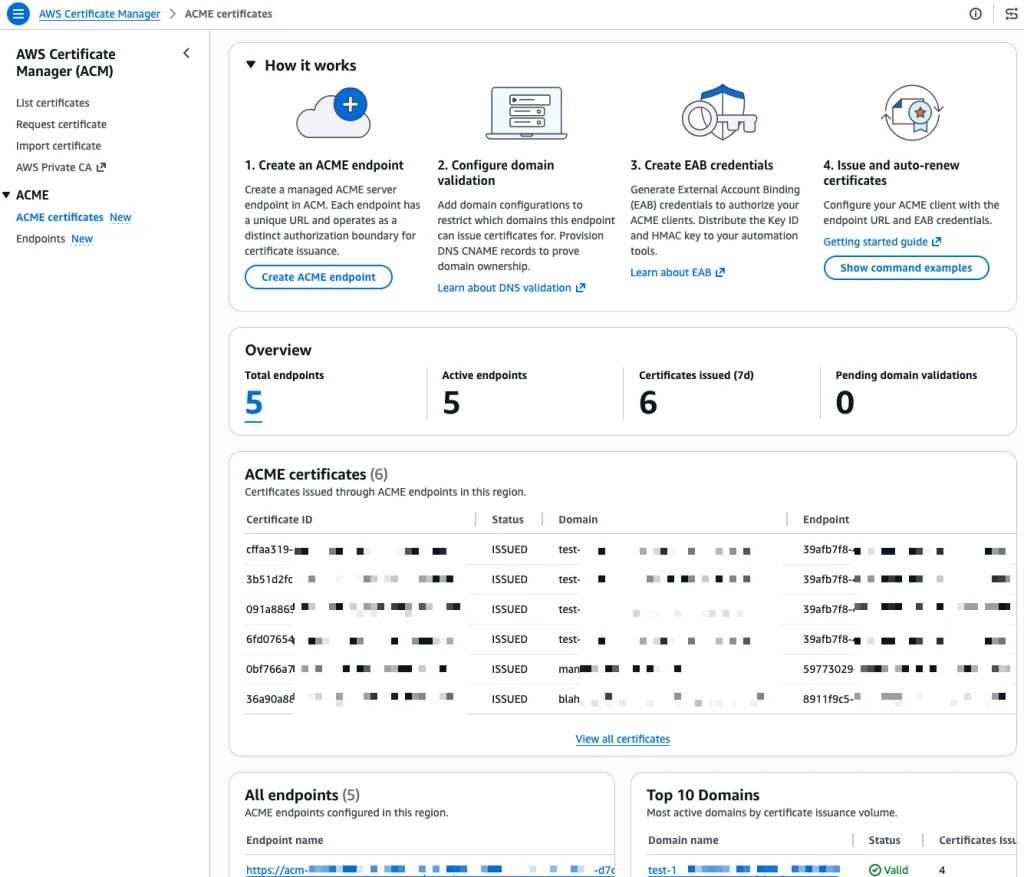
In a significant move to streamline web security and reduce the operational burden of PKI (Public Key Infrastructure) management, Amazon Web Services (AWS) has announced native support for the Automatic Certificate Management Environment (ACME) protocol within AWS Certificate Manager (ACM). This integration empowers organizations to automate the issuance, renewal, and management of public TLS certificates using industry-standard tools, marking a major milestone for developers and security administrators alike.
The Impending Deadline: Why Automation is No Longer Optional
The urgency for this update is driven by evolving industry standards. The Certification Authority/Browser (CA/B) Forum—the body that governs the global standards for TLS certificates—has mandated a aggressive reduction in maximum certificate validity periods. Starting in March 2027, the maximum validity for public TLS certificates will be capped at 100 days, further shrinking to just 47 days by 2029.

For many enterprises, these timelines represent a looming crisis. Historically, manual renewal processes have been the norm, relying on spreadsheets, calendar reminders, and human intervention. As validity periods contract, these manual workflows become not only inefficient but dangerous; a single missed renewal leads to expired certificates, resulting in site outages, broken customer experiences, and potential security vulnerabilities. The industry is reaching a consensus: manual management is no longer tenable. Automation is the only path forward.
What is ACME? The Protocol Behind the Change
The Automatic Certificate Management Environment (ACME) is an open-standard protocol that facilitates the automated interaction between a certificate authority (CA) and a web server. Originally popularized by the non-profit certificate authority Let’s Encrypt, ACME removes the human element from the equation. It allows servers to automatically request, validate ownership of domains, install certificates, and handle renewals without manual intervention.

By bringing native ACME support to ACM, AWS is effectively bridging the gap between its robust, enterprise-grade managed service and the thriving ecosystem of open-source automation tools such as Certbot, cert-manager for Kubernetes, and acme.sh.
Chronology: From Fragmented Management to Unified Governance
Before this announcement, organizations often found themselves in a "fragmented visibility" trap. To leverage the benefits of ACME, many companies were forced to use third-party certificate authorities alongside AWS Certificate Manager. This created a dual-track infrastructure:
- Track A: Certificates issued via ACM, managed through the AWS console.
- Track B: Certificates issued via external ACME-compatible CAs, managed through disparate, often disconnected, command-line interfaces.
This lack of centralization created significant headaches for PKI administrators. It became difficult to audit who requested which certificate, to enforce security policies across the organization, or to maintain a "single source of truth" for the organization’s cryptographic footprint.
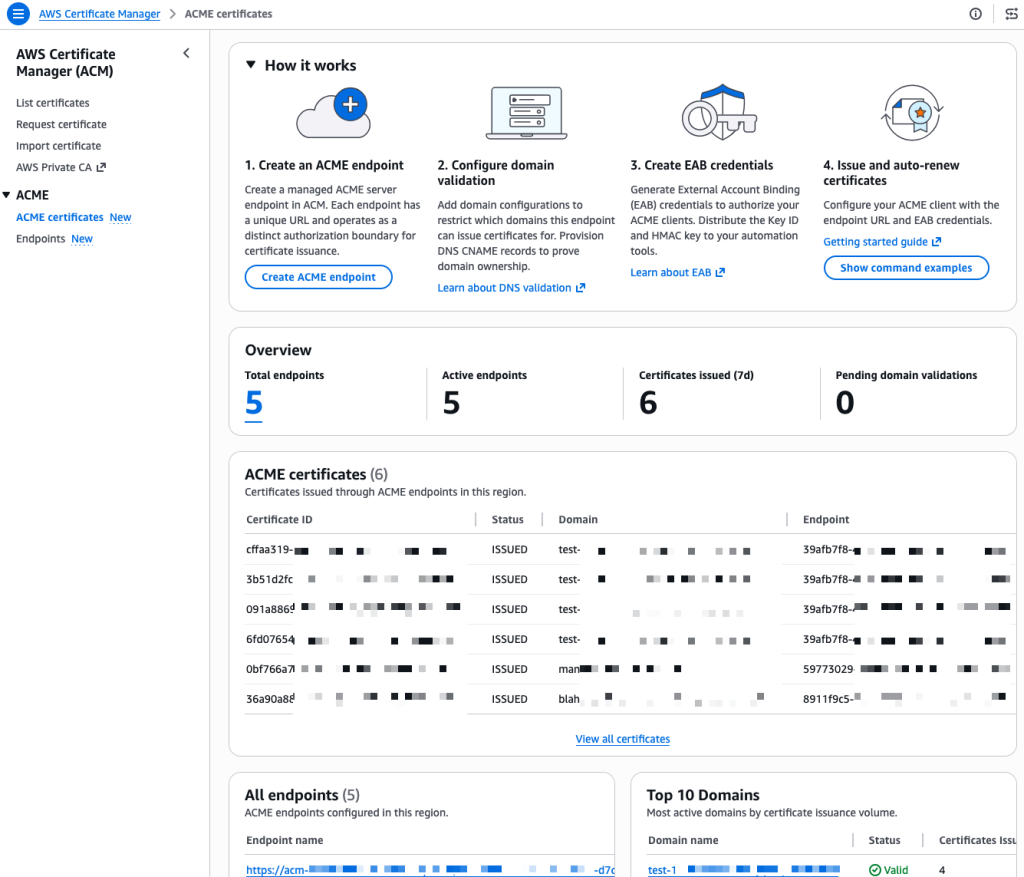
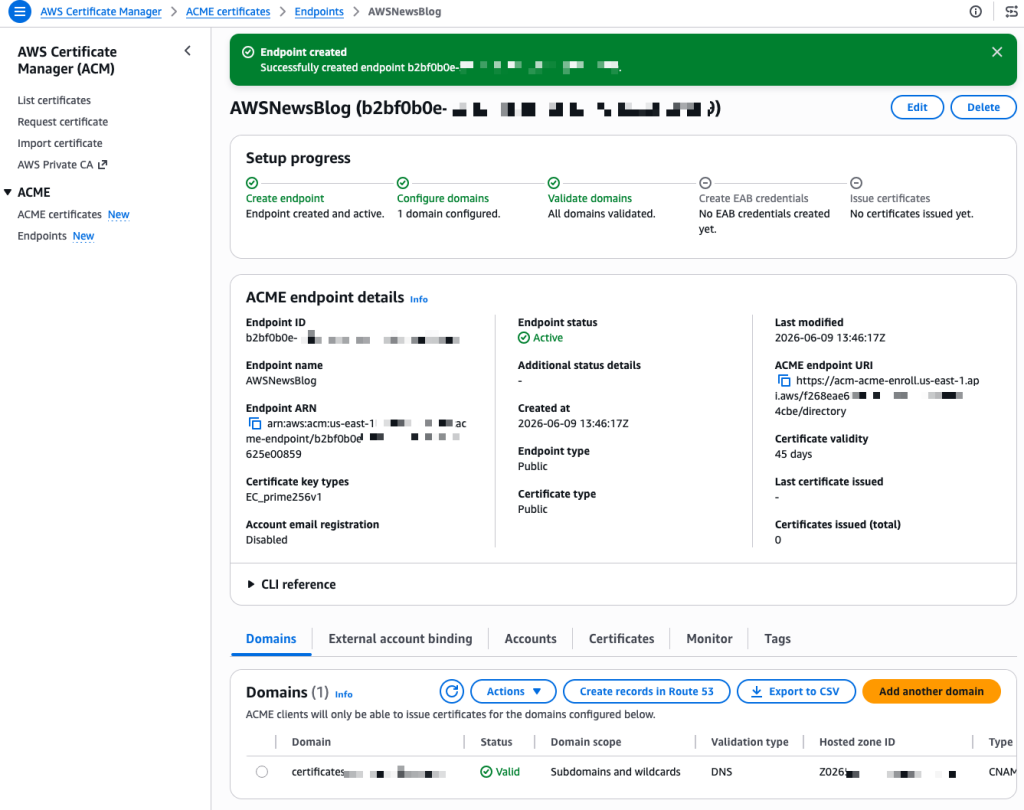
With the new ACME support in ACM, the chronology of deployment changes from a chaotic, multi-vendor approach to a streamlined, centralized flow:
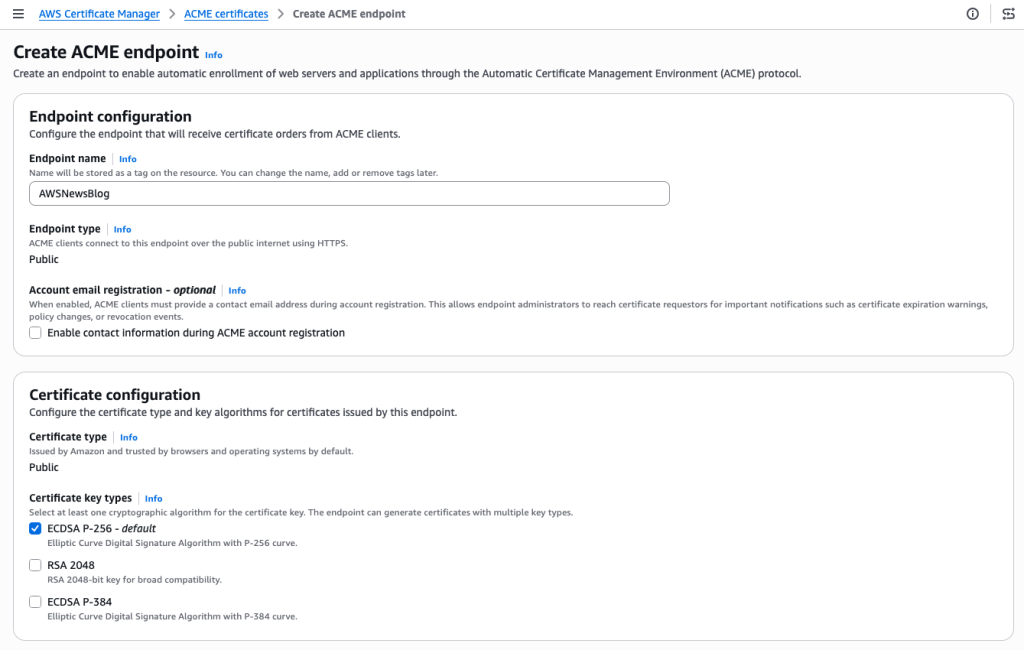
- Creation: An administrator creates an ACME endpoint within ACM.
- Configuration: The administrator defines domain scopes and authorization rules.
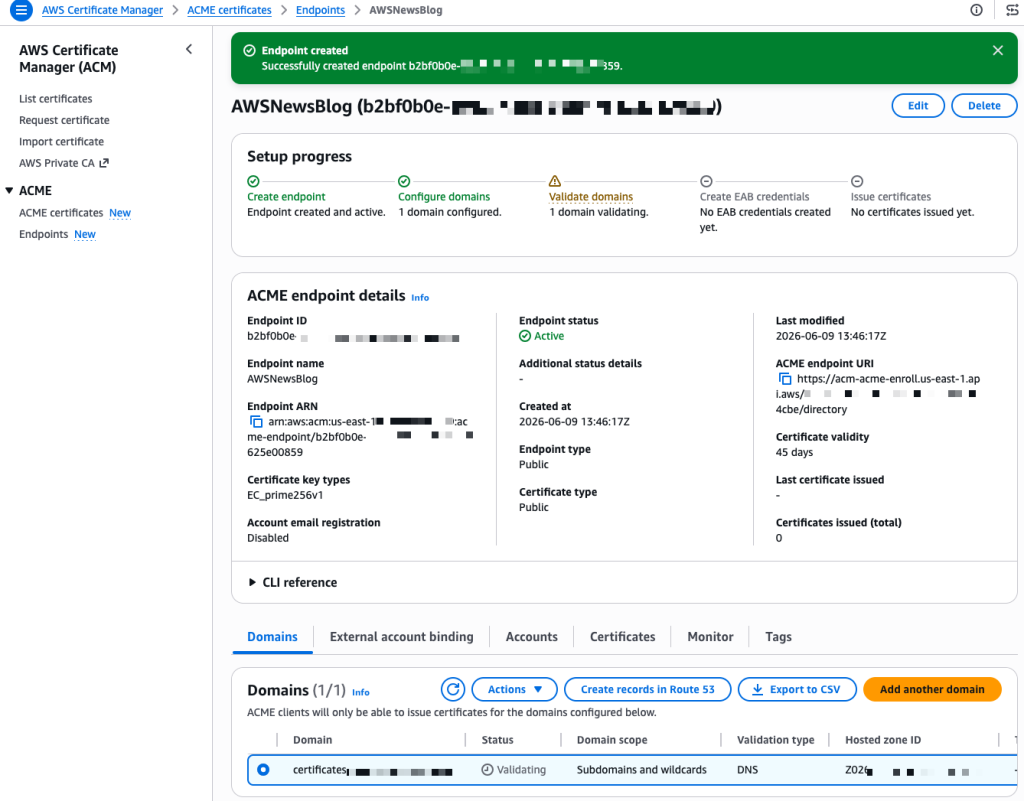
- Authentication: External Account Binding (EAB) credentials are generated to secure the client-server handshake.
- Deployment: Application owners use standard ACME clients to request certificates, which are then governed by the central AWS policies.
- Visibility: All certificates, regardless of how they were requested, appear in the unified ACM console, providing full auditability through AWS CloudTrail and operational monitoring via Amazon CloudWatch.
Supporting Data and Technical Architecture
The technical architecture of this new feature is designed for scale and security. By separating the roles of the PKI administrator and the application developer, AWS has solved a long-standing security challenge: the distribution of DNS credentials.
The Role of External Account Binding (EAB)
EAB is a critical component of this implementation. It provides a key identifier and an HMAC key pair, ensuring that only authorized clients can request certificates from an ACM endpoint. This mechanism prevents unauthorized entities from spinning up rogue certificates under the organization’s domain.
Domain Validation and Security Scopes
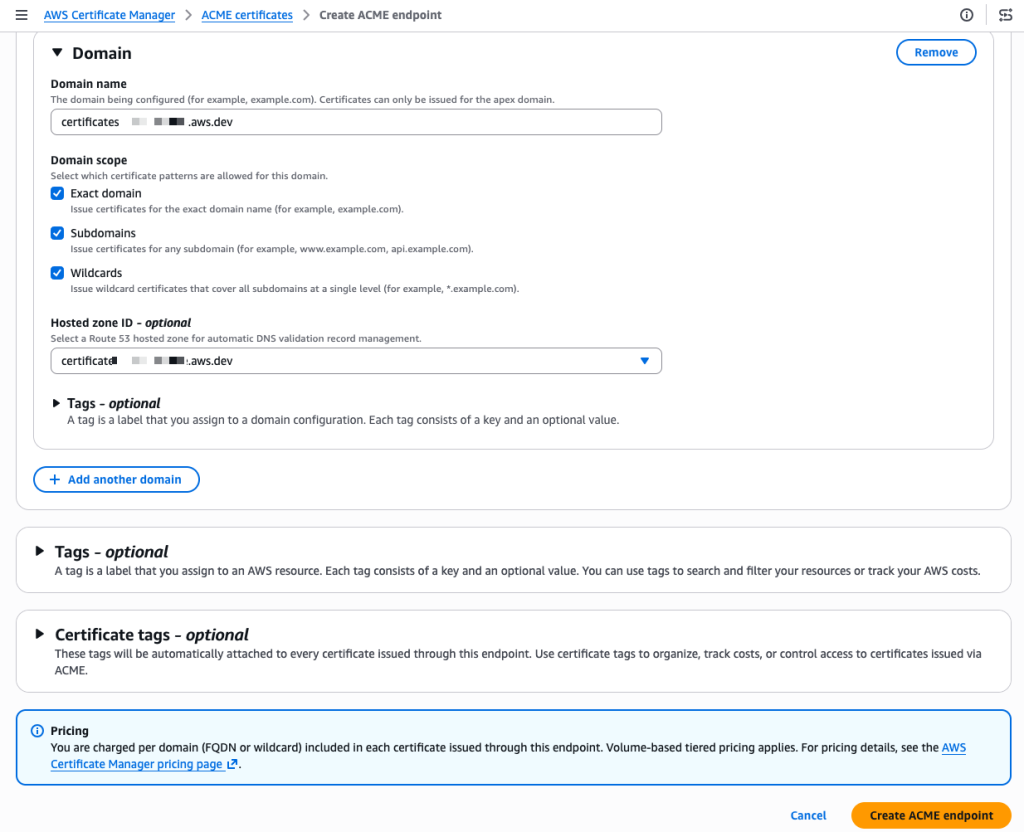
One of the most powerful aspects of the new ACM ACME support is the ability to define granular "domain scopes." When creating an endpoint, an administrator can specify:
- Exact Domain: Limits issuance to a specific FQDN.
- Subdomains: Allows certificates for subdomains (e.g.,
api.example.com). - Wildcards: A high-privilege permission that allows for
*.example.comcertificates.
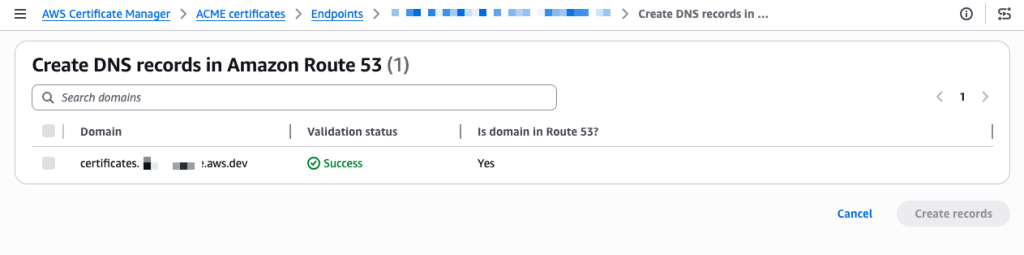
By withholding certain scopes, administrators can enforce a "least privilege" model. For instance, a development team might be granted access to request certificates for dev.example.com without having the authority to request wildcard certificates that could compromise the entire root domain. Furthermore, the integration with Amazon Route 53 allows for seamless DNS validation, removing the need for application teams to manage DNS TXT records manually—a task that historically slowed down deployment pipelines.
Implications for the Enterprise
The shift to ACME-native management has profound implications for enterprise IT operations.
Reduced Operational Overhead
By eliminating the need for separate, custom-built certificate lifecycle management platforms, companies can significantly reduce their technical debt. The ability to use existing, battle-tested clients like cert-manager in Kubernetes means that DevOps teams can integrate certificate management directly into their CI/CD pipelines, making security an inherent part of the development lifecycle rather than an afterthought.
Enhanced Auditability and Compliance
For industries regulated by financial or healthcare standards (such as PCI-DSS or HIPAA), the ability to track every certificate request via AWS CloudTrail is a game-changer. Security teams no longer need to scrape logs from multiple servers or external CA portals to generate compliance reports. Everything is captured within the AWS ecosystem, providing a comprehensive audit trail of who, when, and where a certificate was issued.
A Future-Proof Security Posture
As the CA/B Forum continues to tighten the constraints on certificate validity, the cost of manual management will rise exponentially. By adopting an ACME-first strategy today, organizations are insulating themselves from the technical and operational risks of these future regulatory changes. The infrastructure they build now will be capable of handling 47-day renewals as easily as they handle 90-day ones.
Conclusion: A New Standard for AWS PKI
The introduction of ACME support into AWS Certificate Manager is not merely a feature release; it is a fundamental shift in how cloud-native security is orchestrated. By combining the ease of use of the ACME protocol with the enterprise-grade governance and visibility of AWS, Amazon has provided a solution that addresses the immediate needs of developers while satisfying the strict requirements of security and compliance teams.
As organizations prepare for the transition to shorter certificate validity periods, those who leverage these automated workflows will find themselves at a distinct advantage, maintaining a robust, secure, and uninterrupted digital presence while their competitors struggle with the mounting friction of manual certificate management. With this update, AWS has solidified its position as a primary orchestrator of the modern, automated internet.