From PDF Chaos to AI Clarity: Mastering RAG Deployment with pgEdge Cloud
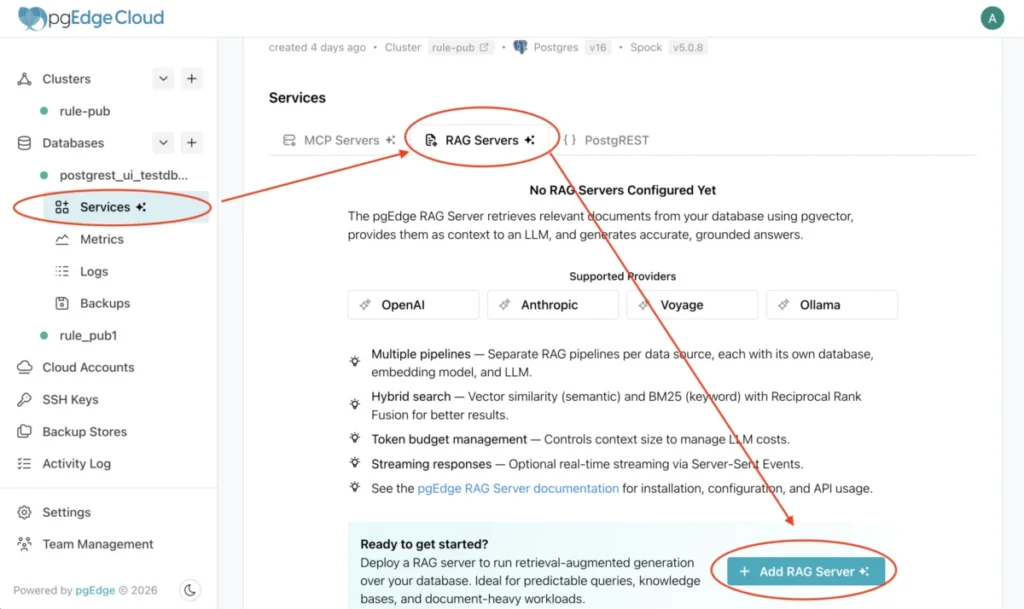
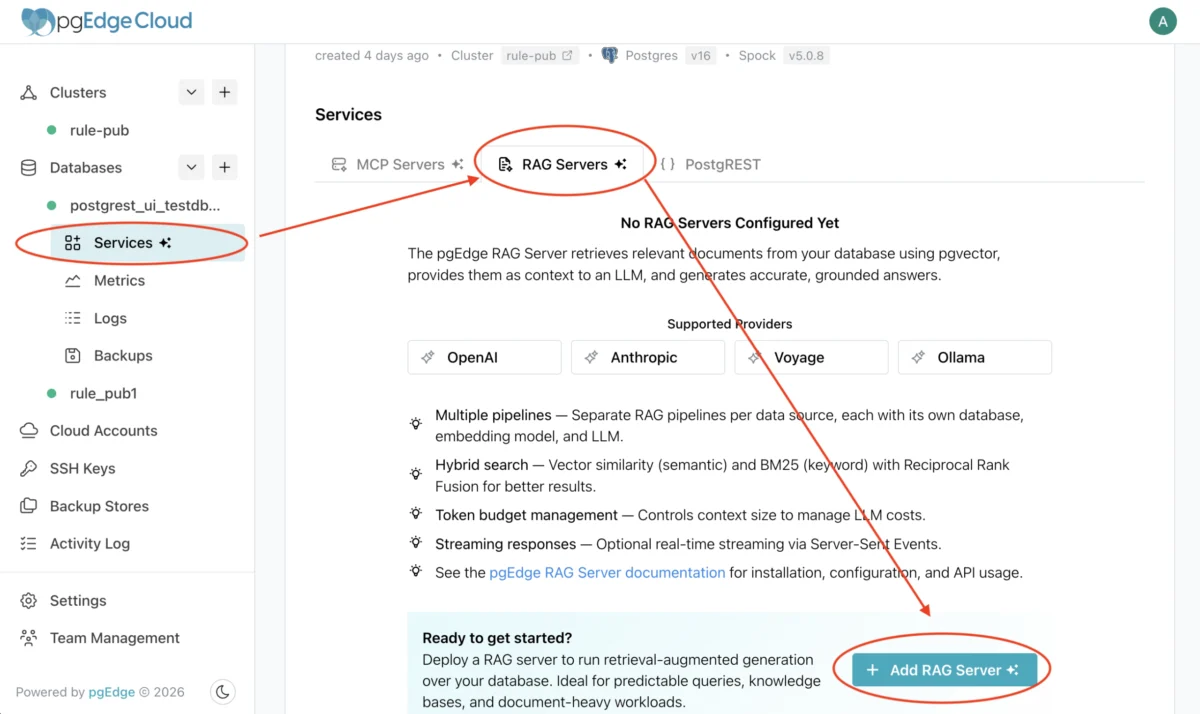
In the rapidly evolving landscape of Retrieval-Augmented Generation (RAG), the barrier to entry has shifted from "how do I build this?" to "how do I scale this efficiently?" For many developers, the complexity of managing vector databases, embedding pipelines, and LLM orchestration creates a formidable bottleneck. However, a new approach—leveraging the pgEdge Cloud API—is proving that building a production-grade RAG server can be as streamlined as it is powerful.
By utilizing a "database-first" architecture, developers can now embed intelligence directly into their PostgreSQL instances, eliminating the need for complex, brittle "glue code." This article explores the technical journey of building a sophisticated RAG server, moving beyond simple GUI walkthroughs to demonstrate the full potential of programmatic infrastructure management.
The Technical Imperative: Why RAG Requires a Native Approach
Traditional RAG setups often rely on external vector stores and middleware, which introduces latency and operational overhead. When an application requires high-fidelity retrieval—such as parsing thousands of pages of complex, interconnected technical documentation—the overhead of shifting data between a database and an external vector service becomes a significant liability.
The pgEdge approach flips this paradigm. By integrating pgvector, pgedge-vectorizer, and vchord_bm25 directly into the Postgres engine, the database itself becomes the orchestration layer. This allows for asynchronous, trigger-based chunking and embedding. As soon as text is inserted into a table, the database handles the vectorization in the background, ensuring that the retrieval layer is always in sync with the primary data.
Chronology of a Deployment: The API-First Path
For teams prioritizing infrastructure-as-code (IaC) and repeatable deployments, the pgEdge Cloud API offers a robust alternative to manual console configuration. The deployment process follows a precise, four-stage lifecycle.
Phase 1: Local Prototyping and Vectorization
Before moving to the cloud, developers should utilize the pgEdge Enterprise Postgres container. This environment provides a turnkey stack, pre-configured with the necessary extensions. The pgedge-vectorizer is the cornerstone here, functioning as an asynchronous worker that monitors database triggers.
When a user inserts raw text—such as hundreds of PDFs—the vectorizer automatically chunks the data, batch-processes the embeddings via a provider like Voyage AI, and populates the vector column. This process is inherently fault-tolerant, utilizing SKIP LOCKED concurrency to ensure that high-volume data ingestion never stalls the application.
Phase 2: Orchestrating the Cloud Infrastructure
Once the local schema is finalized, migrating to the pgEdge Cloud involves authenticating via OAuth2 and provisioning a cluster. The API allows for granular control over network topology, enabling developers to choose between public endpoints or highly secure, private subnets.
The creation of a cluster is an idempotent process that returns a status payload. By polling the /v1/clusters/id endpoint, developers can orchestrate the exact moment the environment transitions to available. Once the cluster is live, the database is instantiated with automated pgBackRest configurations, ensuring that data integrity is prioritized from day one.
Phase 3: Restoration and Service Attachment
The transition from local to cloud is simplified by using PostgreSQL’s custom dump format (pg_dump -Fc). This preserves the schema, indexes, and existing vector embeddings.
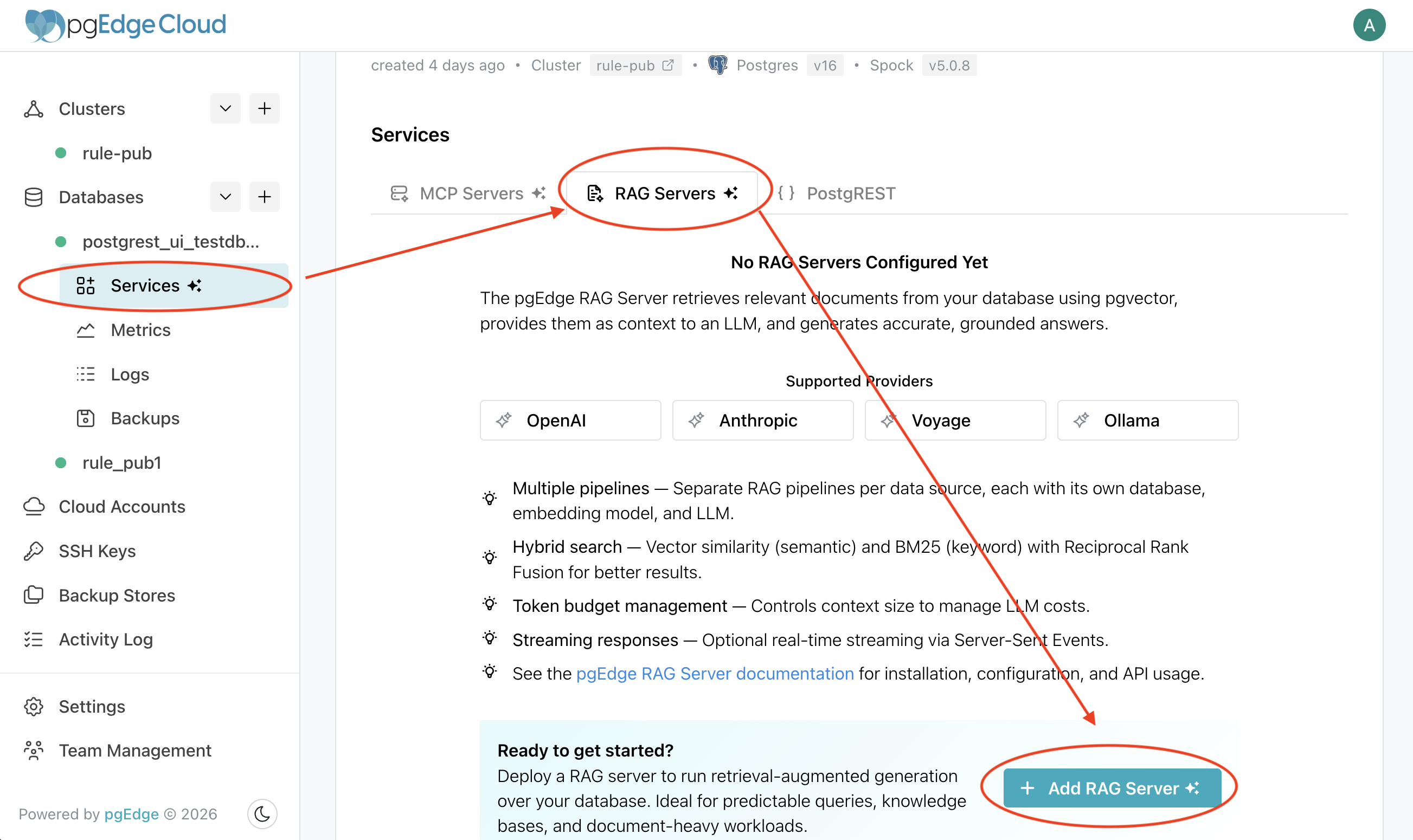
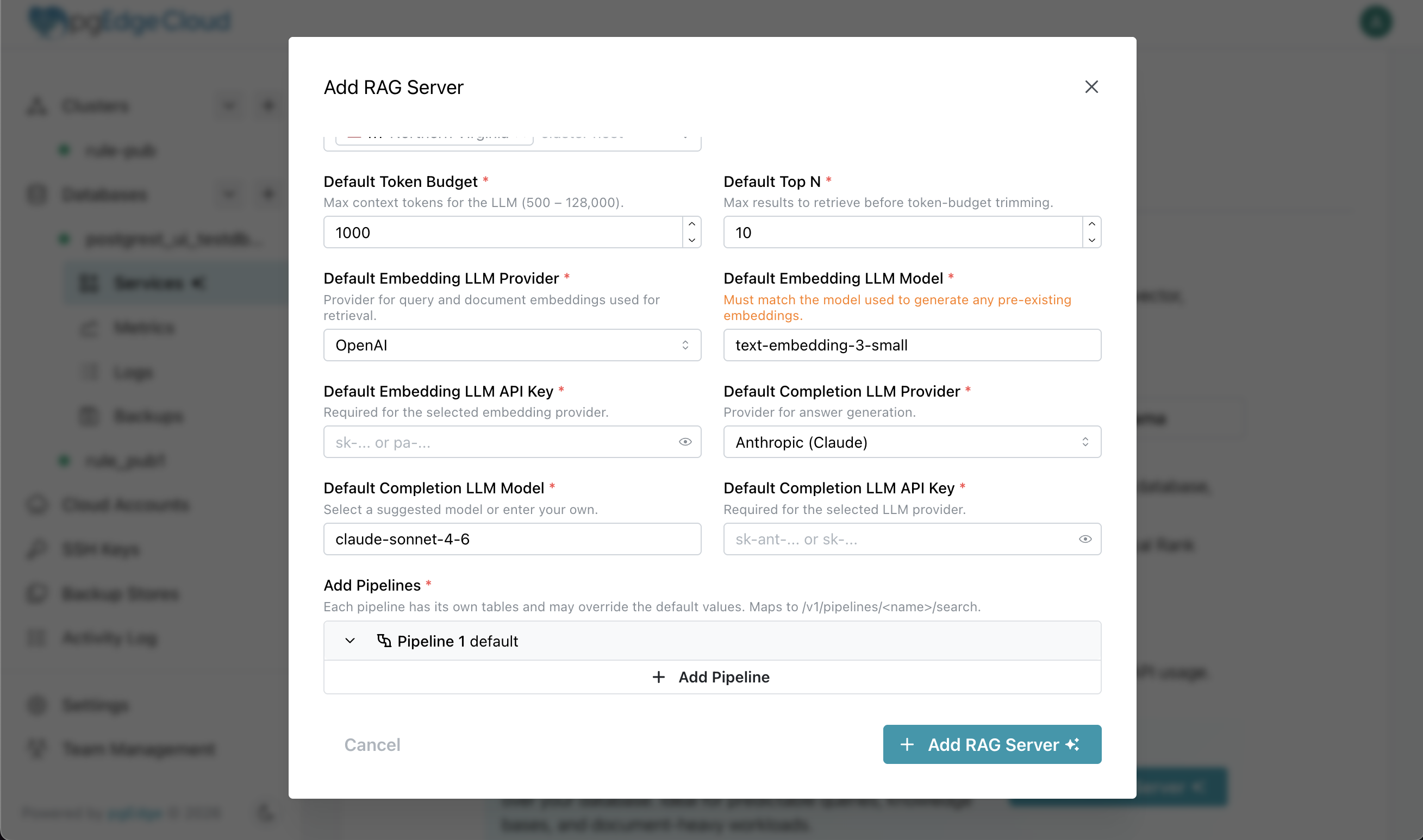
The final, and perhaps most critical, step is the deployment of the RAG server. Rather than provisioning a separate service, developers perform a PATCH request to the database configuration. This command registers the RAG pipeline—linking the text tables, vector columns, and LLM endpoints (such as Anthropic’s Claude)—directly to the database instance.
Phase 4: Querying the Knowledge Base
With the RAG server running, the database exposes a pipeline endpoint. The server handles the complexity of hybrid search, combining vector similarity with keyword ranking (BM25) to provide contextually relevant results. The completion model then synthesizes these results into a natural language response, complete with citations.
Supporting Data: Performance and Scalability
The effectiveness of this architecture is best illustrated by its performance under load. In a production scenario, the "vectorizer" operates as an asynchronous process, which means the primary transaction (inserting data) is decoupled from the compute-intensive embedding process.
Key Performance Metrics:
- Ingestion Throughput: Because embedding calls are batched, the system can process thousands of documents without hitting API rate limits or blocking write operations.
- Query Latency: By keeping the vector index local to the Postgres engine, retrieval times remain sub-second, even when the context window is large.
- Memory Efficiency: Utilizing
r7g.mediuminstances provides a balance of CPU and memory that is optimized for the HNSW index structures used bypgvector.
Implications for Enterprise Knowledge Management
The ability to treat a database as an intelligent, question-answering agent has profound implications for enterprise search. Historically, "Rules Lawyers"—those who rely on precise documentation to settle disputes—have been slowed down by the sheer volume of available information.
By deploying a custom RAG server, organizations can:
- Reduce Search Time: Move from manual index scanning to precise, natural-language query resolution.
- Ensure Citability: Configure the system to provide specific document references, reducing the "hallucination" risk often associated with general-purpose LLMs.
- Cross-Domain Synthesis: Aggregate information from disparate data silos (e.g., technical manuals, legal contracts, and historical logs) into a single, queryable pipeline.
Official Perspective: The Move Toward "Database-Centric AI"
The shift toward native vector support in Postgres, as pioneered by pgEdge, signals a broader industry trend. Developers are increasingly wary of "black box" AI services that require them to move data outside of their security perimeter. By keeping the RAG pipeline within the database, pgEdge provides a compliance-friendly path for organizations that require data sovereignty.
As stated in the technical documentation for pgedge-vectorizer, the goal is to "stop doing work." By automating the lifecycle of embeddings—from chunking to index maintenance—pgEdge allows developers to focus on the application logic rather than the plumbing of machine learning pipelines.
Conclusion: The Path Forward
Whether managing a sprawling library of tabletop roleplaying rules or a mission-critical repository of corporate technical documentation, the requirements for success are identical: high-quality data, reliable retrieval, and a seamless integration path.
The API-first deployment of a RAG server on pgEdge Cloud represents a significant maturity milestone in the AI lifecycle. By removing the friction of manual configuration and leveraging the inherent power of PostgreSQL, developers can transform static data into a dynamic, intelligent resource. As the ecosystem continues to mature, we can expect this "database-as-a-service-as-an-AI-engine" model to become the standard for any organization looking to leverage the full power of their internal knowledge.
For those ready to move beyond the GUI, the path is clear: define your configuration, automate your deployment via the Cloud API, and let the database do the heavy lifting. Your data is no longer a graveyard of PDFs—it is a live, queryable asset waiting to be put to work.