The Voice of an Era: How Modern Engineering Brought the Iconic DECtalk to the Apple II
For a generation of computer enthusiasts who grew up in the 1980s, the dream of "computerized speech" was often met with disappointment. While science fiction promised the fluid, human-like cadence of artificial intelligence, the reality for the average hobbyist was limited to the primitive, robotic chirps of allophone-based synthesizers like the General Instrument SP0256. These devices, while impressive for their time, sounded less like a human and more like a collection of metallic clicks and whistles.
The true "Holy Grail" of speech synthesis during that decade was the DECtalk—a high-end, standalone powerhouse produced by the Digital Equipment Corporation. It was the sophisticated, eerily articulate voice of the future, best known to the global public as the iconic, rhythmic voice of theoretical physicist Stephen Hawking. For the average Apple II owner in 1984, the DECtalk was an unattainable luxury, often costing thousands of dollars and occupying a physical footprint that would dwarf their own machines.
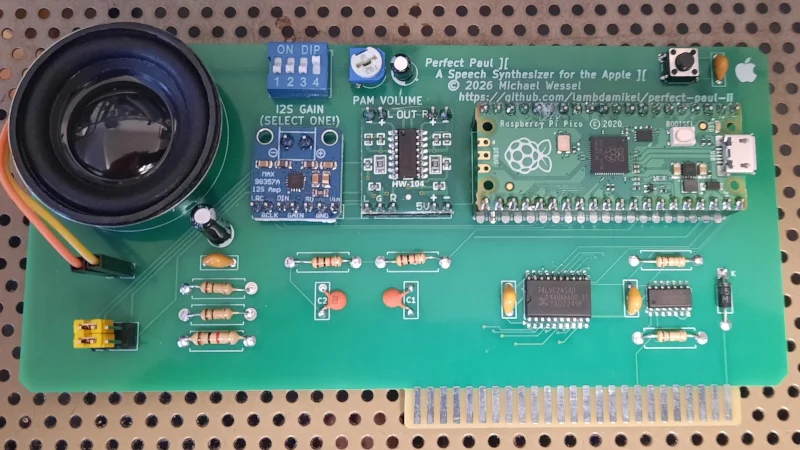
However, the chasm between 1980s 8-bit limitations and 21st-century processing power has finally been bridged. Engineer Michael Wessel has unveiled "Perfect Paul II," a drop-in DECtalk emulator card designed specifically for the Apple II. This modern hardware marvel effectively shrinks the massive, rack-mounted power of the original DECtalk into a sleek, bus-compatible card that brings the unmistakable voice of the 80s into the modern era.
Main Facts: The Anatomy of Perfect Paul II
The Perfect Paul II project is a masterclass in modern retro-engineering. At its core, the device is not merely a simulation; it is a high-fidelity emulation of the original DECtalk’s phonetic engine, powered by contemporary hardware.
The hardware stack is deceptively compact. Wessel has utilized an RP2040-based microcontroller—the same versatile chip found in the Raspberry Pi Pico—to handle the heavy lifting of speech synthesis. This is paired with an I2S digital-to-analog converter (DAC), an integrated amplifier, and a speaker, all managed by custom bus-interface logic that allows the Apple II to communicate with the emulator as if it were interacting with native hardware.
From a software perspective, the integration is remarkably elegant. The card maps itself to a specific range of memory addresses on the Apple II bus. For a programmer, interacting with the card is as simple as executing POKE commands—the bread and butter of Apple II BASIC. By sending DECtalk-standard phonetic strings to these memory addresses, the user can command the emulator to speak with the same inflection, speed, and character that defined the original hardware.
Chronology: From Laboratories to Living Rooms
To understand the magnitude of this achievement, one must appreciate the history of speech synthesis technology.
The Allophone Era (1980–1985)
In the early 1980s, speech synthesis was constrained by memory and processing speed. The SP0256-AL2 chip utilized "allophones"—the smallest units of sound in a language. While these chips were inexpensive and could be crammed into a home computer, they required the programmer to manually chain phonemes together to approximate human speech. The result was a stuttering, monotonous output that rarely sounded natural.
The Rise of DECtalk (1984)
Digital Equipment Corporation changed the paradigm with the introduction of the DECtalk DTC01. Unlike its peers, the DECtalk utilized a sophisticated text-to-speech engine based on the work of Dennis Klatt at MIT. It didn’t just play back pre-recorded sounds; it calculated the nuances of human speech—stress, pitch, duration, and co-articulation—in real-time. It was the first device to sound truly "human," though it maintained an artificial edge that eventually became iconic.
The Digital Dark Ages (1990s–2010s)
As computing power grew, speech synthesis moved from dedicated hardware to software. While this made speech more accessible, it led to the abandonment of the unique, analog-heavy sound profile of early synthesisers. The original DECtalk units became prized collector’s items, with maintenance becoming increasingly difficult as electrolytic capacitors dried out and proprietary chips became impossible to replace.
The Resurrection (2024)
Michael Wessel’s Perfect Paul II represents the current culmination of the "Retro-Computing Renaissance." By using an RP2040 to emulate the original DECtalk software stack, Wessel has effectively immortalized the hardware. This project moves beyond mere emulation, providing a bridge that allows 1980s hardware to speak with the "soul" of the 1980s.
Supporting Data: The Technical Hurdle
Bringing the DECtalk experience to an Apple II is not as straightforward as it might seem. The Apple II bus, designed in the late 1970s, operates at a significantly slower clock speed than the modern RP2040.
- Bus Timing: The Apple II’s 6502 processor runs at approximately 1 MHz. To ensure the DECtalk emulator doesn’t crash the host system, the interface logic must employ a series of handshaking protocols to buffer incoming data.
- Audio Quality: The original DECtalk used a custom Digital Signal Processor (DSP) to generate its unique, somewhat buzzy audio profile. Wessel’s implementation uses I2S (Inter-IC Sound) output to ensure high-fidelity audio reproduction, allowing the emulator to replicate the original’s frequency response and audio artifacts.
- Compatibility: Because the card is designed to appear as a memory-mapped device, it is essentially agnostic to the operating system. Whether the user is running Apple DOS 3.3, ProDOS, or even a modern GS/OS, the card simply "listens" to the bus, making it universally compatible with the Apple II ecosystem.
Official Responses and Community Impact
The retro-computing community has greeted the Perfect Paul II with overwhelming enthusiasm. On platforms like Hackaday and various Apple II enthusiast forums, the project has been hailed as a "missing piece" of the 8-bit experience.
"This is the sort of project that justifies why we keep these old machines running," said one prominent member of the Apple II community. "We aren’t just looking at blinking lights; we are hearing the history of computing. By making the DECtalk accessible again, Wessel has given the Apple II a voice that was previously locked behind a thousand-dollar price tag."
While Digital Equipment Corporation no longer exists—having been absorbed through a series of acquisitions ending with HP—the software architecture of the original DECtalk has remained a subject of intense academic interest. Researchers focusing on human-computer interaction (HCI) have lauded the project for its preservation of the "Klatt" synthesis model, which remains a foundational study in linguistics and audio engineering.
Implications: The Future of Retro-Hardware
The implications of the Perfect Paul II extend far beyond the Apple II. Wessel’s design is modular; the interface logic is distinct from the emulation core. This architecture suggests that the project could easily be ported to other 8-bit giants of the era, such as the Commodore 64, the BBC Micro, or the ZX Spectrum.
Preservation of Digital Heritage
We are currently in a critical window where the original hardware of the 1980s is failing due to component age. Projects like Perfect Paul II offer a "preservation through emulation" path. Instead of relying on fragile, 40-year-old hardware that will inevitably fail, enthusiasts can use robust, modern, low-power components that faithfully replicate the original experience.
Creative Possibilities
The ability to have an Apple II speak with the distinct "Hawking voice" opens up new avenues for homebrew developers. We can expect to see a surge in text-based adventure games that feature full, synthesized narration, or educational software that leverages the DECtalk’s superior articulation to teach reading and phonetics in a way that modern, "too-perfect" AI voices cannot replicate.
Conclusion
The Perfect Paul II is more than a circuit board; it is a bridge across four decades of technological progress. It proves that the limitations of the past do not have to be the end of the story. By combining the aesthetic charm of 8-bit computing with the raw computational efficiency of the Raspberry Pi era, Michael Wessel has ensured that the "voice of the 80s" will continue to echo through our retro-systems for years to come. For those who missed out on the DECtalk experience in the last century, the future of the past has arrived.