NEW YORK — As the crisp energy of mid-September sweeps through New York City—bringing with it the familiar transition to sweater weather, bustling sidewalks, and a renewed corporate tempo—Amazon Web Services (AWS) is matching the seasonal velocity with a rapid acceleration of its own product roadmap.
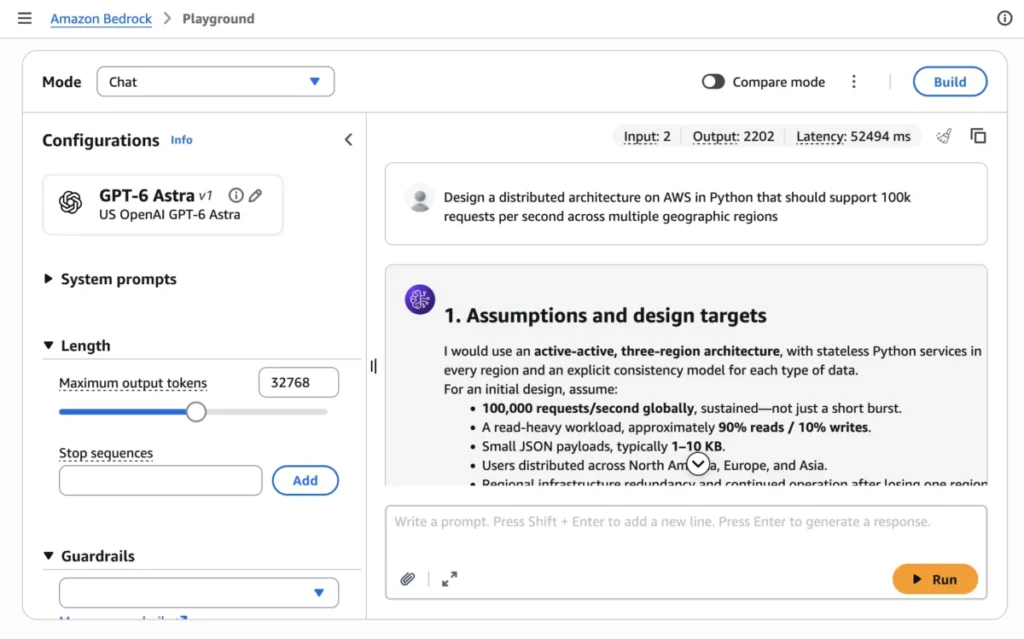
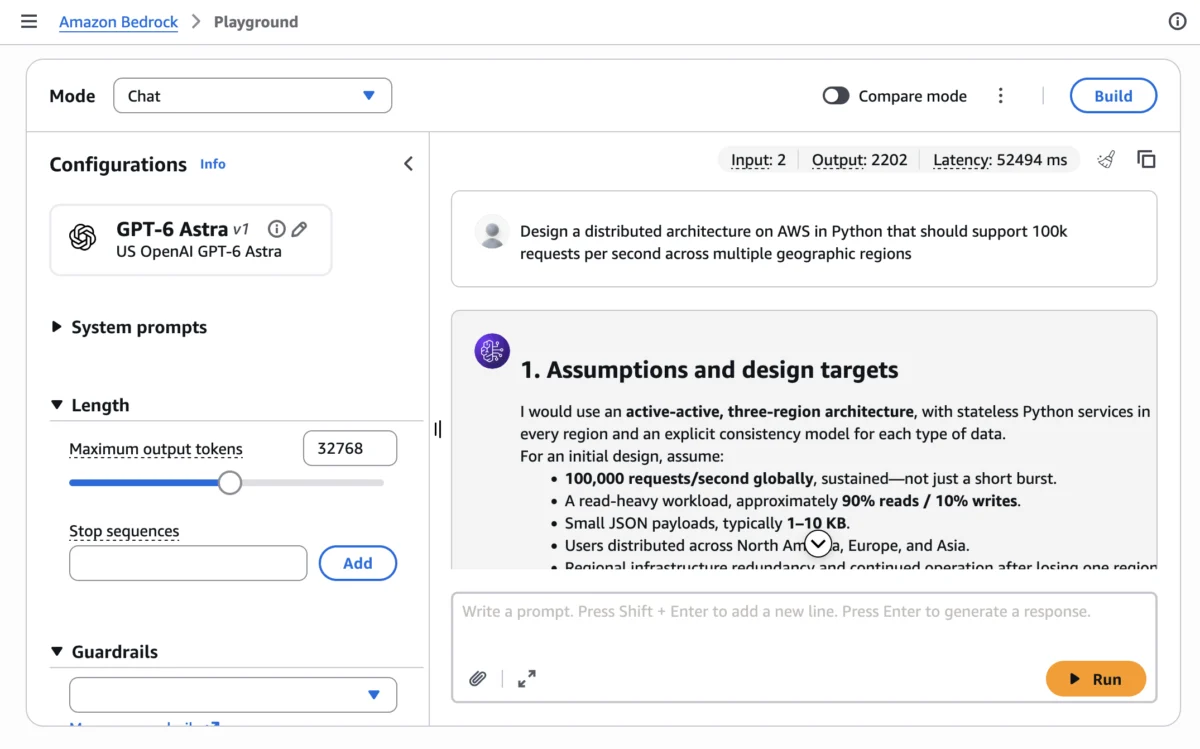
This week’s AWS launch calendar introduces a milestone integration that bridges the gap between frontier artificial intelligence and enterprise-grade infrastructure. The centerpiece of this week’s announcements is the general availability of OpenAI’s flagship frontier model, GPT-6 Astra, directly on Amazon Bedrock.
Beyond this major deployment, the technology landscape continues to evolve as developers and enterprises realize that maximizing the value of AI agents requires more than just superior tooling—it demands a fundamental shift in organizational workflows and operational culture.
Main Facts: GPT-6 Astra Debuts on Amazon Bedrock
The headline announcement of the week is the official arrival of OpenAI’s GPT-6 Astra on Amazon Bedrock, making it accessible to enterprises seeking to scale sophisticated AI applications with robust security and governance.
Advanced Capabilities: GPT-6 Astra stands as OpenAI’s most capable and comprehensive frontier model to date. It delivers profound leaps in deep reasoning, predictive judgment, professional-quality content generation, and advanced computer- and browser-use automation tailored for demanding enterprise workflows.
Massive Context Window: The model supports an expansive context window of up to 1 million input tokens. This technical milestone allows organizations to ingest entire legacy codebases, multi-thousand-page legal contracts, or vast corporate document repositories into a single prompt, enabling the model to reconcile competing inputs and extract holistic insights.
Flexible Integration Paths: Developers can call GPT-6 Astra natively through supported Amazon Bedrock APIs, or easily configure existing developer environments such as ChatGPT Work and Codex to leverage the model directly through the AWS ecosystem.
Enterprise Security and Governance: Leveraging established AWS security paradigms, organizations retain strict control over workloads, granular access permissions, and comprehensive invocation auditing. Crucially, AWS and OpenAI have reaffirmed their privacy commitment: customer inference data is strictly segregated and never used to train foundational models.
Chronology: The Evolution to Enterprise-Grade AI Agents
The journey toward deploying frontier models like GPT-6 Astra within enterprise managed environments has accelerated rapidly over the last several years. Understanding this trajectory highlights why the current AWS integration represents a watershed moment for cloudarchitecture.
Phase 1: Experimental AI and Isolated Models (2023–2024)
During the initial generative AI boom, organizations experimented with foundational models primarily via consumer-facing web wrappers or isolated API endpoints. Data privacy concerns, latency, and compliance hurdles largely restricted these tools to peripheral marketing tasks, creative brainstorming, and non-sensitive prototype development.
Phase 2: Managed Platforms and Security Boundaries (2024–2025)
As enterprises demanded greater control, managed AI services like Amazon Bedrock emerged. These platforms allowed companies to fine-tune and run third-party models within secure Virtual Private Clouds (VPCs). However, context windows were relatively narrow, limiting the ability of models to process massive enterprise datasets natively without complex retrieval-augmented generation (RAG) pipelines.
Phase 3: High-Context Reasoning and Native Automation (2026 and Beyond)
With the introduction of models boasting million-token context windows and advanced computer-use capabilities—typified by the launch of GPT-6 Astra on Amazon Bedrock—the paradigm has shifted from passive text generation to active, autonomous agentic workflows. Models can now operate web browsers, execute multi-step software development tasks, and audit complex contractual ecosystems autonomously while remaining shackled to enterprise compliance frameworks.
Supporting Data and Technical Architecture
To understand the operational impact of GPT-6 Astra on Amazon Bedrock, industry analysts and cloud architects are examining the technical specifications and ecosystem integrations accompanying the launch.
Technical Performance Metrics
Token Processing Capacity: A 1-million-token input window equates to roughly 750,000 words, or approximately 30,000 to 50,000 lines of production-grade source code depending on language overhead.
Latency and Throughput: Through Amazon Bedrock’s managed infrastructure, enterprises benefit from automated scaling, provisioned throughput options, and multi-region resilience, mitigating the latency bottlenecks typically associated with querying massive frontier models.
Ecosystem Plugins: Alongside the core model availability, OpenAI is introducing specialized enterprise plugins for ChatGPT Work. These plugins extend Astra’s browser-use capabilities directly into common business productivity suites, customer relationship management (CRM) platforms, and enterprise resource planning (ERP) software.
Security and Compliance Frameworks
Enterprises operating in highly regulated sectors—such as finance, healthcare, and government defense—frequently struggle to balance innovation with data sovereignty. The integration on Amazon Bedrock addresses these concerns through:
IAM Integration: Fine-grained AWS Identity and Access Management policies governing which internal teams or applications can invoke GPT-6 Astra.
Encryption at Rest and in Transit: Full compliance with AWS KMS (Key Management Service) standards.
Zero-Retention Guarantee: Assurances that input and output payloads are ephemeral and excluded from future training datasets.
Official Responses and Industry Commentary
The release has drawn widespread commentary from cloud computing leaders, AI researchers, and enterprise software strategists.
"The convergence of ultra-long context windows, advanced reasoning, and rigorous cloud security represents the holy grail for enterprise digital transformation," noted a senior cloud infrastructure analyst based in New York. "By bringing GPT-6 Astra to Amazon Bedrock, AWS and OpenAI are removing the friction that previously forced CTOs to choose between cutting-edge AI capability and uncompromised corporate data security."
OpenAI engineering leadership emphasized the collaborative nature of the deployment:
"Astra was built to tackle the world’s most complex cognitive and operational challenges. By pairing our most advanced model with Amazon Bedrock’s robust governance and deployment infrastructure, we are enabling enterprises to move past experimental pilots and deploy fully autonomous, reasoning-driven workflows at a global scale."
AWS product representatives highlighted the cultural shift required by developers utilizing these advanced agentic systems:
"The developers seeing the most dramatic productivity gains aren’t simply adopting better tools—they are fundamentally redesigning how their teams work. AI agents are no longer just autocomplete assistants; they are active collaborators capable of reasoning across massive codebases and operational documents."
Implications: What This Means for Enterprises and Developers
The general availability of GPT-6 Astra on Amazon Bedrock carries profound implications across multiple verticals, reshaping software engineering, legal compliance, customer operations, and enterprise security.
1. Software Engineering and Codebases
With a 1-million-token context window, development teams can upload entire microservice architectures, dependency trees, and documentation libraries into GPT-6 Astra via Bedrock. The model can perform comprehensive refactoring, identify subtle security vulnerabilities across distributed systems, and generate exhaustive integration tests in a fraction of the time previously required.
2. Legal and Compliance Auditing
Corporate legal departments frequently deal with sprawling multi-jurisdictional contracts, regulatory updates, and compliance frameworks. Astra’s deep reasoning and judgment capabilities allow compliance officers to cross-reference thousands of pages of historical agreements against newly enacted legislation instantly, flagging legal exposure and reconciling conflicting clauses with unprecedented accuracy.
3. Business Process Automation (BPA)
The integration of advanced browser-use capabilities through enterprise plugins shifts the definition of automation. Rather than relying on rigid, pre-programmed robotic process automation (RPA) scripts that break when user interfaces change, organizations can deploy intelligent agents capable of navigating dynamic web applications, filling out complex forms, and executing multi-step business transactions autonomously under human supervision.
4. Developer Culture and Workflow Transformation
As Micah noted in this week’s AWS briefing, the most successful engineering organizations are moving beyond tool adoption to workflow reinvention. Developers are transitioning from manual coders to architectural directors—overseeing fleets of autonomous AI agents that handle repetitive boilerplate execution, continuous integration monitoring, and routine debugging.
Looking Ahead: The Road to AWS re:Invent
As September progresses and the tech industry looks ahead toward the autumn conference season—culminating in the annual AWS re:Invent gathering later this year—developers and enterprise leaders can expect a continued acceleration in hybrid cloud-AI capabilities.
Organizations interested in exploring these new capabilities are encouraged to join the AWS Builder Center to connect with peers, share architectural solutions, and access specialized development resources. For ongoing updates, developer-focused events, and deep-dive technical tutorials, practitioners should monitor the official AWS What’s New and AWS Blogs portals.
This post is part of our ongoing WeeklyRoundup series. Check back each Monday for a comprehensive summary of critical news, technical releases, and strategic announcements from across the Amazon Web Services ecosystem.