TensorFlow v2 Unveils Native Distributed Fast Fourier Transform (FFT) Support via DTensor
By Ruijiao Sun, Google Intern (DTensor Team)
Published in TensorFlow Developer Updates
Main Facts
In modern machine learning and high-performance computing (HPC), the Fast Fourier Transform (FFT) remains an indispensable mathematical pillar. Widely utilized for accelerating convolutions, extracting complex signal features, and regularizing deep learning models, FFT operations process massive volumes of multi-dimensional data. However, as machine learning models grow to unprecedented scales—handling massive image-like datasets, high-resolution scientific simulations, and spatial data arrays—engineers frequently encounter a severe computational bottleneck: individual hardware accelerators (such as GPUs and TPUs) possess strictly limited device memory. When a dataset is too massive to fit into a single accelerator’s memory, traditional local FFT execution fails outright, halting model training and inference workflows.
To resolve this limitation, the TensorFlow team has officially announced native support for Distributed Fast Fourier Transform (Distributed FFT) in TensorFlow v2. Powered by DTensor—TensorFlow’s cutting-edge distributed computing extension—this new capability allows developers to seamlessly compute Fourier Transforms across multiple accelerator devices simultaneously.
By utilizing DTensor’s unified Single Program, Multiple Data (SPMD) architecture, the new API abstracts away the extreme operational complexity of manually slicing, distributing, and collecting multi-dimensional tensors. Developers can now scale their FFT operations simply by passing sharded tensors into standard, existing TensorFlow signal processing functions, such as tf.signal.fft2d. While distributed execution introduces a trade-off in communication overhead—primarily due to cross-device data transposes—it successfully breaks past hardware memory barriers, unlocking the ability to train larger, more complex models on massive, high-dimensional datasets.
Chronology
The journey toward native distributed FFT integration in TensorFlow spans several years of architectural evolution, moving from experimental research papers to fully integrated, production-ready framework features.
The Research Foundation (Pre-2021)
Long before native framework support became a priority, the challenge of scaling Discrete Fourier Transforms on modern hardware accelerators was a major academic and engineering hurdle. The foundational step for this work was laid out in a pivotal Google Research paper titled "Large-Scale Discrete Fourier Transform on TPUs" authored by Tianjian Lu. This research demonstrated that Distributed FFT algorithms could indeed be engineered to execute efficiently across large TPU clusters, proving the mathematical and structural viability of parallelized spectral analysis.
TensorFlow v1 Implementation (2021)
Building directly upon the insights of the Google Research paper, the core Distributed FFT algorithm was first brought to life as an external, add-on library implemented specifically for TensorFlow v1. While this library served as a critical proof-of-concept and successfully empowered early adopters to process large-scale workloads, it remained decoupled from the core framework. Using it required specialized boilerplate code, making it difficult to maintain, scale, or integrate smoothly into modern TensorFlow v2 training pipelines.

The Rise of DTensor and Modernization
As TensorFlow shifted its ecosystem focus toward v2 and unified distributed computing paradigms, the framework required a more holistic, native solution. Enter DTensor: an advanced extension designed to bring native, synchronous distributed computing to TensorFlow through SPMD extensions. DTensor unified data parallelism and model parallelism under a single, cohesive API. Recognizing DTensor’s potential to streamline multi-device operations, the TensorFlow team initiated the integration of Distributed FFT directly into the DTensor ecosystem.
TensorFlow v2 Native Integration (Current Era)
Today, the culmination of this engineering evolution is fully realized. Distributed FFT is no longer an isolated, experimental library for legacy frameworks. Instead, it is a fully integrated, native feature of TensorFlow v2. By leveraging DTensor meshes and layout management APIs, developers can invoke distributed Fourier Transforms natively using standard API signatures, marking a monumental leap forward for signal processing and large-scale machine learning workflows.
Supporting Data
To understand the operational realities of TensorFlow v2’s Distributed FFT, developers must evaluate both its memory-scaling advantages and its runtime communication overhead. Comprehensive benchmarking conducted by the DTensor engineering team sheds light on how these systems perform under real-world conditions.
Memory Scaling vs. Communication Overhead
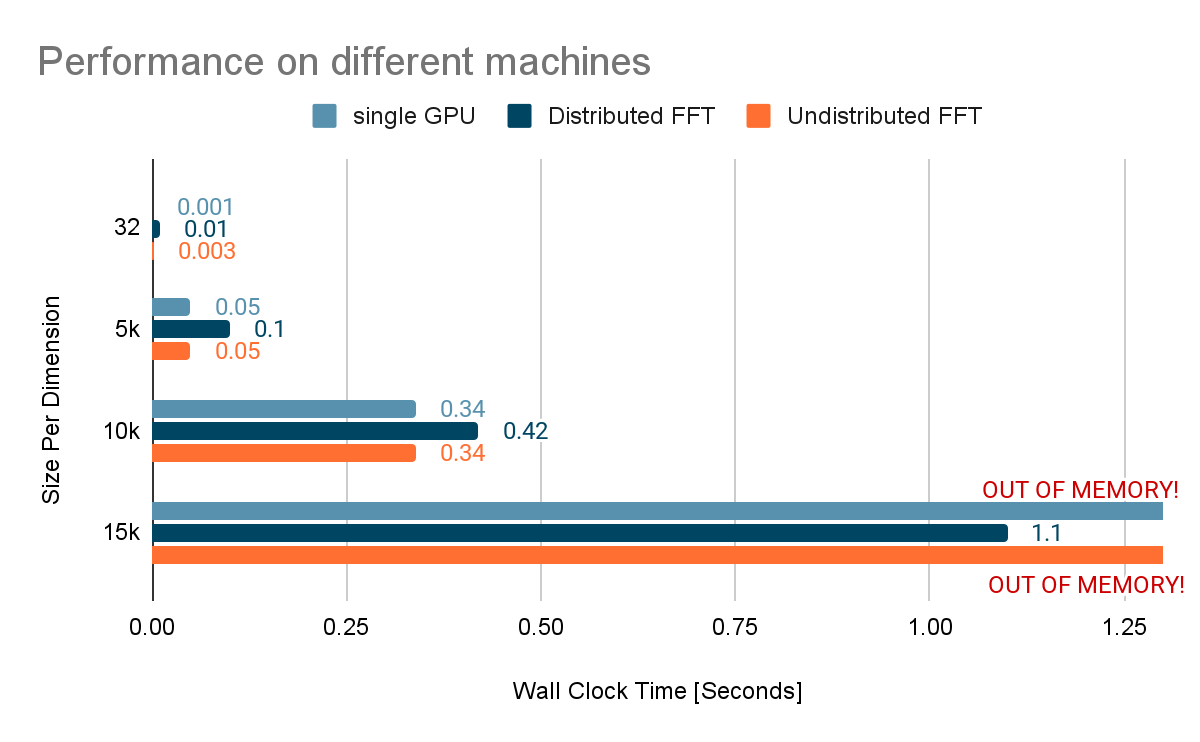
The primary architectural advantage of Distributed FFT is memory democratization. By pooling the high-bandwidth memory (HBM) of multiple accelerators (such as an 8x V100 GPU system), the distributed approach can effortlessly process data volumes that would trigger Out-Of-Memory (OOM) errors on a single hardware device.
However, this memory elasticity comes at a structural cost: execution time. Because multi-dimensional FFT algorithms require global data transposition across axes, devices must frequently exchange massive chunks of data over interconnect networks (such as NVLink or PCIe). Consequently, while undistributed FFT algorithms can compute local matrices rapidly when data fits into memory, they hit a hard wall the moment data scales beyond hardware boundaries. Distributed FFT trades raw, localized calculation speed for infinite spatial scalability.
Profiling Breakdown: The 10K × 10K Experiment
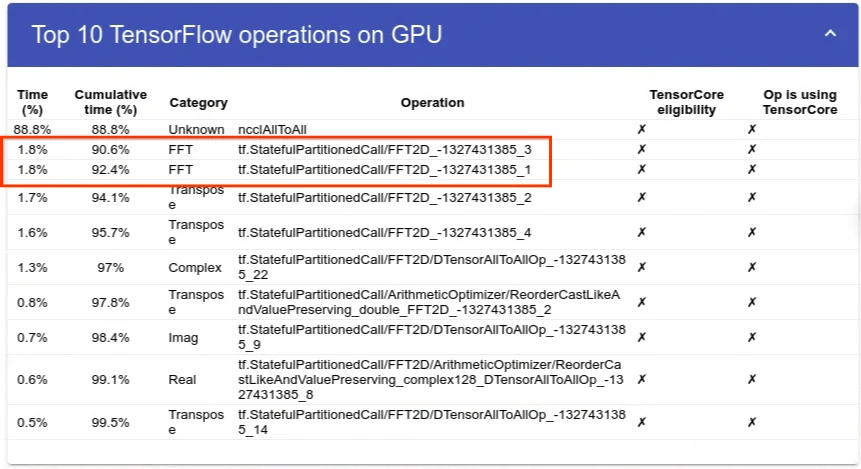
An in-depth performance profile of a 10,000 by 10,000 element distributed FFT experiment—executed on an 8x V100 GPU cluster—reveals exactly where computational cycles are spent. The current implementation adopts a classic, robust "shuffle + local FFT" strategy, mirroring legendary distributed numerical libraries like FFTW and PFFT.
The profiling data highlights fascinating operational metrics:

- The Local Computations: The actual local FFT operations consume a minuscule 3.6% of the total wall-clock execution time (roughly 15 milliseconds). Strikingly, this is approximately one-third of the execution time required by an equivalent, non-distributed
tf.signal.fft2doperation running on a single device, showcasing the raw efficiency of localized parallel math. - The Communication Bottleneck: The vast majority of the total computing time is not spent doing math, but rather moving data. Specifically, framework execution bottlenecks are dominated by data-shuffling overheads, executed via the
ncclAllToAllcollective communication operation.
| Metric / Operation | Percentage of Total Time | Operational Role |
|---|---|---|
| Local FFT Operations | ~3.6% (15ms) | Mathematical computation of spectral transformations |
Data Shuffling (ncclAllToAll) |
~96.4% | Inter-device tensor transposition and mesh communication |
This empirical data clearly outlines the roadmap for future software optimizations: minimizing inter-device communication latency and optimizing transpose schedules will yield exponential performance gains for large-scale distributed signal processing.
Official Responses
The rollout of native Distributed FFT in TensorFlow v2 has been spearheaded by the core engineering and research teams at Google. In official technical documentation and developer community announcements, the DTensor team emphasized the philosophy behind the release.
Ruijiao Sun, Google Intern on the DTensor team and primary author of the feature release, underscored the significance of accessibility:
"Fast Fourier Transform is an essential tool in signal processing, yet engineers working with massive, image-like datasets have long struggled with the physical memory limits of single accelerators. By bringing Distributed FFT directly into TensorFlow v2 through DTensor, we are eliminating the friction of managing complex multi-device pipelines. Users can now leverage existing, familiar APIs while effortlessly scaling their workloads across multi-GPU and multi-TPU clusters."
Furthermore, the TensorFlow core development collective has reached out directly to the global open-source community for collaborative development. Acknowledging that the current implementation utilizes a baseline shuffle-and-compute algorithm, the team stated in an official release brief:
"The feature is brand new, and we have deliberately adopted the simplest, most robust distributed FFT algorithm as our baseline. However, this is just the beginning. We welcome deep-dive technical feedback, performance reports, and architectural proposals on the official TensorFlow Forum. Your real-world input is invaluable as we collaborate to fine-tune and drastically improve future iterations of this feature."
Implications
The introduction of native Distributed FFT via DTensor carries profound implications for the machine learning, data science, and scientific computing communities. By removing hardware memory barriers for spectral analysis, TensorFlow v2 is expanding its footprint well beyond traditional deep learning into rigorous scientific computing and high-resolution imaging domains.
1. Democratization of High-Resolution Scientific Machine Learning
Fields such as computational fluid dynamics (CFD), climate modeling, radio astronomy, medical imaging (MRI/CT reconstruction), and seismic wave analysis rely heavily on massive multi-dimensional grid data where Fourier Transforms are computed iteratively. Previously, researchers in these fields were forced to build fragile, custom MPI-based clusters or rely on fragmented external wrappers to handle distributed spectral math. With native TensorFlow v2 support, these complex scientific workflows can now be integrated smoothly into modern neural network training loops, accelerating the rise of Physics-Informed Neural Networks (PINNs) and neural operators.
2. Streamlining Developer Experience via Uniform APIs
One of the historic pain points of distributed computing has been the steep learning curve required to rewrite codebases for multi-device environments. By making the distributed FFT interface identical to traditional TensorFlow signal processing ops (tf.signal.fft2d), Google has drastically reduced cognitive overhead. Developers do not need to learn an entirely new paradigm or rewrite core model logic; they simply supply a sharded input tensor mapped to a DTensor mesh layout, and the framework automatically handles the underlying orchestration.
3. Guiding Future Hardware and Software Co-Design
The performance profiling data—revealing that 96.4% of execution time is spent on ncclAllToAll communication rather than local math—sends a clear signal to both hardware architects and framework engineers. As AI accelerators evolve, the emphasis must shift toward accelerating collective communication primitives and high-bandwidth interconnects. For TensorFlow, future development cycles will focus on advanced algorithmic optimizations, overlapping communication with computation, and implementing localized, communication-avoiding FFT variants to bypass current bottlenecks.
Getting Started and Community Engagement
As TensorFlow v2 continues to cement its status as a premier enterprise and research framework, features like DTensor-backed Distributed FFT prove its adaptability to ever-growing computational demands. Developers and researchers are strongly encouraged to test the new distributed FFT capabilities in their current pipelines.
To share profiling results, propose algorithmic optimizations, or ask technical implementation questions, engineers can engage directly with the core developers on the TensorFlow Forum. Through active community collaboration, the next generation of large-scale signal processing is set to be faster, more scalable, and more accessible than ever before.