Breaking the Single-Machine Boundary: How openEuler is Redefining AI Cluster Computing
In the modern era of Artificial Intelligence, the bottleneck for innovation has shifted. It is no longer just about the raw power of a single GPU or the clock speed of a CPU; it is about how effectively thousands of these processors can communicate as a single, cohesive entity. For years, the operating systems governing these massive "SuperPoDs"—clusters of tightly coupled compute nodes—have been locked behind proprietary, vendor-specific software.
The landscape shifted significantly in late 2025 with the release of openEuler 24.03 LTS SP3. By introducing the world’s first open-source operating system architecture specifically designed for SuperPoD environments, the openEuler community is challenging the status quo. This evolution promises to democratize large-scale AI infrastructure by replacing "black box" proprietary stacks with an open, high-performance, and unified ecosystem.
Main Facts: The SuperPoD Revolution
At its core, a SuperPoD (or supernode) is a massive, tightly integrated cluster of machines. In traditional server environments, Linux operates within the confines of a single box, managing local memory, local storage, and local compute. When a workload requires more power, engineers wire separate boxes together over a network, creating latency and management overhead.
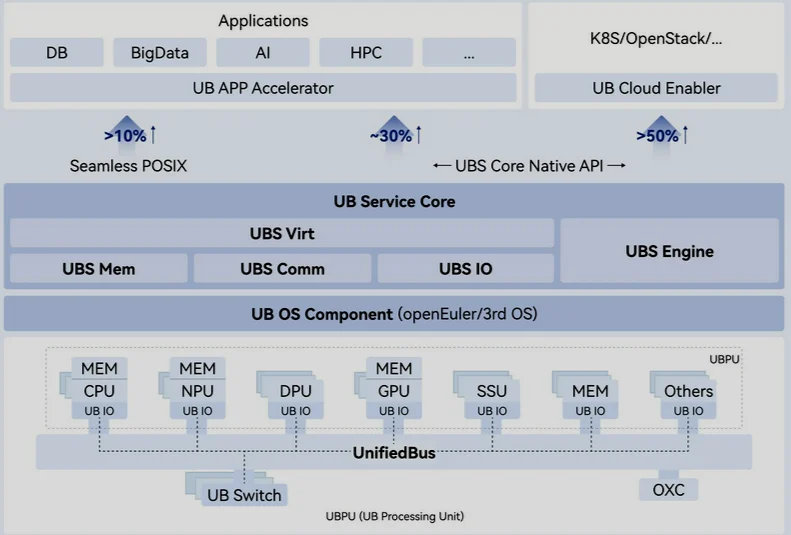
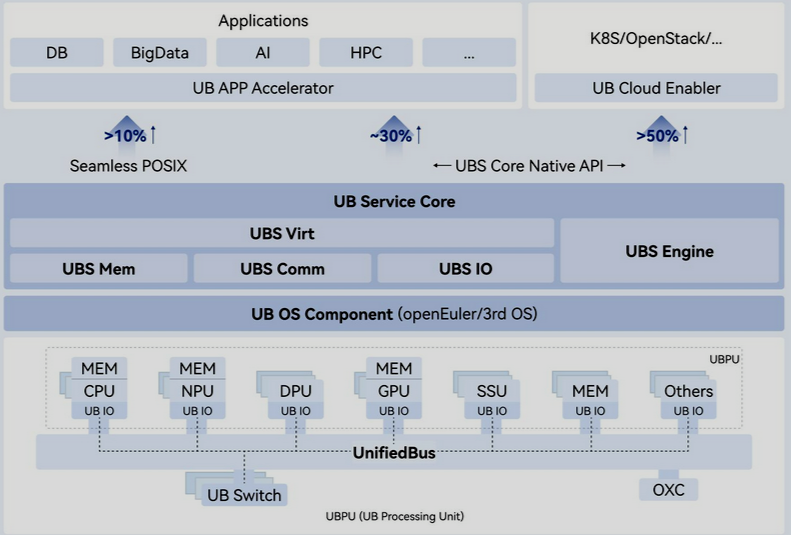
OpenEuler 24.03 LTS SP3 changes this paradigm by treating the entire cluster as a single, unified machine. This is achieved through two primary pillars:
- UnifiedBus: A high-speed interconnect technology that bridges the physical divide between separate nodes.
- UB Service Core: A software layer that enables applications to access memory, accelerators, and compute resources across the entire cluster as if they were local components.
By breaking the "single-machine boundary," openEuler allows for heterogeneous compute fusion—a process where different chip architectures (Arm, x86, RISC-V) can work in tandem to process a single AI workload. The project claims this peer-to-peer design yields a performance boost of 30 to 50 percent in large-scale AI compute scenarios compared to traditional, loosely coupled networking approaches.
Chronology: The Evolution of openEuler
The rise of openEuler is a study in rapid transformation from a proprietary internal project to a global open-source powerhouse.
- 2019: The Genesis: Huawei releases EulerOS as a commercial product. Recognizing the need for a broader ecosystem, the company open-sources the core, forming the openEuler community under the governance of the OpenAtom Foundation.
- 2020–2024: Rapid Expansion: The distribution gains massive traction, moving beyond Huawei’s internal use cases. It establishes support for diverse architectures, including Arm-based Kunpeng chips, x86, and the open-standard RISC-V.
- December 2025: The SuperPoD Milestone: The release of openEuler 24.03 LTS SP3 marks a historic shift. It is the first iteration to incorporate native SuperPoD support, integrating the UB OS Component directly into the Linux distribution.
- Late 2025 – Present: The community pivots toward "Intelligence BooM," a full-stack AI layer designed to simplify the deployment of large language models (LLMs) and training pipelines.
Supporting Data: Efficiency and Performance
The performance gains cited by the openEuler project are not merely theoretical. They are a direct result of how the OS manages "AI plumbing"—the often-overlooked overhead required to keep NPUs (Neural Processing Units) and XPUs busy.
Resource Pooling and Co-computing
In traditional data centers, accelerators often sit idle while waiting for data to transfer across a network. OpenEuler’s UB technology implements:

- Memory Pooling: By allowing memory to be shared across chips and physical machines, the system eliminates redundant data copying.
- Accelerator Partitioning: A single physical NPU can be split into virtual segments, allowing multiple, smaller AI jobs to run concurrently on the same hardware.
- Co-computing: By allowing the OS to schedule tasks that bridge CPUs and NPUs in real-time, the system maximizes utilization rates, which is critical for reducing the high operational costs of AI training.
The 30–50% performance increase reported in their internal benchmarks suggests that the "network tax"—the time lost when machines talk to each other—has been significantly reduced through kernel-level optimization of the UnifiedBus architecture.
Official Perspectives and Industry Implications
The transition of such a complex, high-performance technology into the open-source domain has caught the attention of both academic researchers and enterprise architects.
"The goal is to eliminate the ‘AI Plumber’ role," says a spokesperson from the openEuler community. By moving from a tool-based approach to a "full-stack" approach, Intelligence BooM provides an out-of-the-box solution for AI infrastructure. This covers everything from the low-level scheduling of compute cycles to the high-level management of user-facing AI assistants.
The project’s influence is undeniable. Having surpassed 16 million installations by the end of 2025, openEuler is no longer a niche experimental OS. It is a production-grade infrastructure that provides a viable alternative to proprietary AI stacks.
Implications: The Future of AI Infrastructure
The End of Vendor Lock-in
The most profound implication of this release is the potential end of vendor lock-in for AI supercomputing. Traditionally, if an enterprise bought a proprietary SuperPoD solution, they were forced to use that vendor’s proprietary management software, compiler, and OS. By standardizing the OS layer through an open-source model, openEuler allows companies to mix and match hardware components while maintaining a consistent software interface.
Accessibility for Developers
For the individual developer, the introduction of the DevStation desktop build is a significant development. By including an integrated AI assistant that understands natural language commands for system configuration and environment management, openEuler is lowering the barrier to entry for AI development. Instead of spending weeks configuring CUDA drivers or complex cluster environments, developers can focus on the models themselves.
A Global Shift in AI Governance
It is impossible to ignore the geopolitical shift implied by this development. Most of the cutting-edge, open-weight, and open-source AI infrastructure projects are increasingly originating from outside the traditional Silicon Valley sphere. With Huawei’s Atlas AI systems and the TaiShan 950 SuperPoD serving as the primary hardware targets for openEuler, this ecosystem represents a self-sustaining technological stack that is entirely independent of Western proprietary software chains.
Looking Ahead: The "Intelligence BooM"
The concept of "Intelligence BooM" is the next frontier. By defining a "full-stack AI layer," the community is attempting to commoditize AI infrastructure. When the OS, the cluster management, the memory pooling, and the developer tools are all unified under one open-source umbrella, the cost of training large-scale models decreases significantly.
For the enterprise, this means more efficient use of expensive hardware. For the open-source community, this means that the most powerful AI clusters on the planet will soon be running on code that anyone can audit, modify, and improve.
Conclusion
The release of openEuler 24.03 LTS SP3 is a watershed moment for Linux. By proving that a distributed, cluster-wide operating system can be both open-source and high-performance, the project has effectively opened the "black box" of SuperPoD computing. As the industry moves deeper into the age of massive AI models, the ability to treat a data center as a single, programmable machine will be the defining factor in who can innovate and who will be left behind.
For those looking to explore the future of high-performance computing, the openEuler GitHub repository and community pages serve as the frontline of this shift. Whether you are a systems engineer managing a rack of NPUs or a developer looking for a seamless AI environment, the movement toward a unified, open-source SuperPoD OS is one to watch closely.