Beyond the Bug Fix: Unveiling Android Bench 2.0 and the Future of AI-Driven Software Engineering
The landscape of software development is undergoing a seismic shift. Where once developers relied on AI merely for autocompletion or minor syntax corrections, the modern workflow is increasingly defined by collaborative agentic systems capable of handling significant architectural overhauls. To keep pace with this evolution, the Android developer ecosystem has today unveiled Android Bench 2.0, a comprehensive overhaul of its evaluation framework designed to measure how large language models (LLMs) and autonomous agents tackle the most grueling, long-horizon challenges in mobile development.
By transitioning from simple, isolated bug-fix scenarios to complex, multi-day engineering projects, Android Bench 2.0 provides a mirror to the reality of professional software engineering, where success is defined not by a single passing test, but by architectural integrity, maintainability, and long-term codebase health.
The Evolution of AI Measurement: From Incremental to Long-Horizon
The initial iteration of Android Bench set a high standard for measuring LLM utility by establishing a rigorous, repository-focused environment. However, that framework was primarily tuned for "incremental" tasks—small-scale features, minor refactors, or localized bug fixes. While those metrics were sufficient for the early wave of AI assistance, they failed to capture the nuances of professional-grade development.
As models have grown more sophisticated, the scope of tasks delegated to them has expanded. Engineers are now asking AI to upgrade massive dependency trees, port legacy apps to modern architectural patterns, and even build entire features from the ground up. To address this, the team behind Android Bench has introduced Long-Horizon Tasks (LHTs). These are not merely complex; they are multi-day or even week-long undertakings that require the model to maintain state, navigate vast file structures, and exercise long-term strategic judgment.
This shift marks a departure from the "binary pass/fail" era of benchmarking. In a task requiring the refactoring of 40 separate screens into Jetpack Compose, a model might correctly implement 90% of the architectural requirements but stumble on a single, minor edge-case assertion. Under a binary system, this would be recorded as a failure, a result that provides zero insight into the model’s actual capabilities. Android Bench 2.0 adopts a continuous scoring model, which evaluates functionality, visual fidelity, and the absence of regressions to provide a nuanced, actionable score.
Chronology: Building the New Standard
The development of Android Bench 2.0 did not happen in a vacuum. It follows a deliberate, multi-stage trajectory:

- Phase I (The Foundation): The original Android Bench established the proof-of-concept for measuring AI against real-world, repository-level codebases.
- Phase II (Alignment): The team moved to align the benchmark framework with the Harbor framework, ensuring that the methodology met industry standards for AI safety and performance measurement.
- Phase III (The LHT Milestone): The introduction of the Long-Horizon Task (LHT) dataset. This dataset includes tasks such as migrating entire cross-platform applications to native Android, upgrading outdated frameworks, and implementing complex dependency injection graphs.
- Phase IV (Agentic Integration): The current release, which incorporates agentic evaluation. Instead of testing "raw" models, the benchmark now tests the full agentic stack—including the model and the specific tool-use harness—provided by the model developers themselves.
Data Insights: What the Leaderboard Reveals
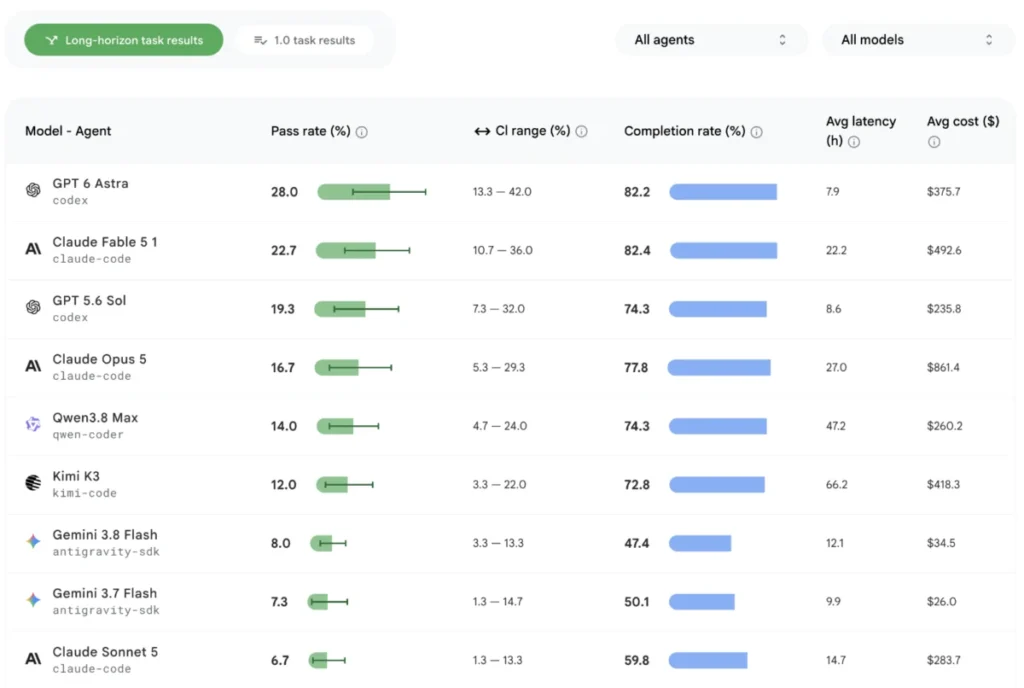
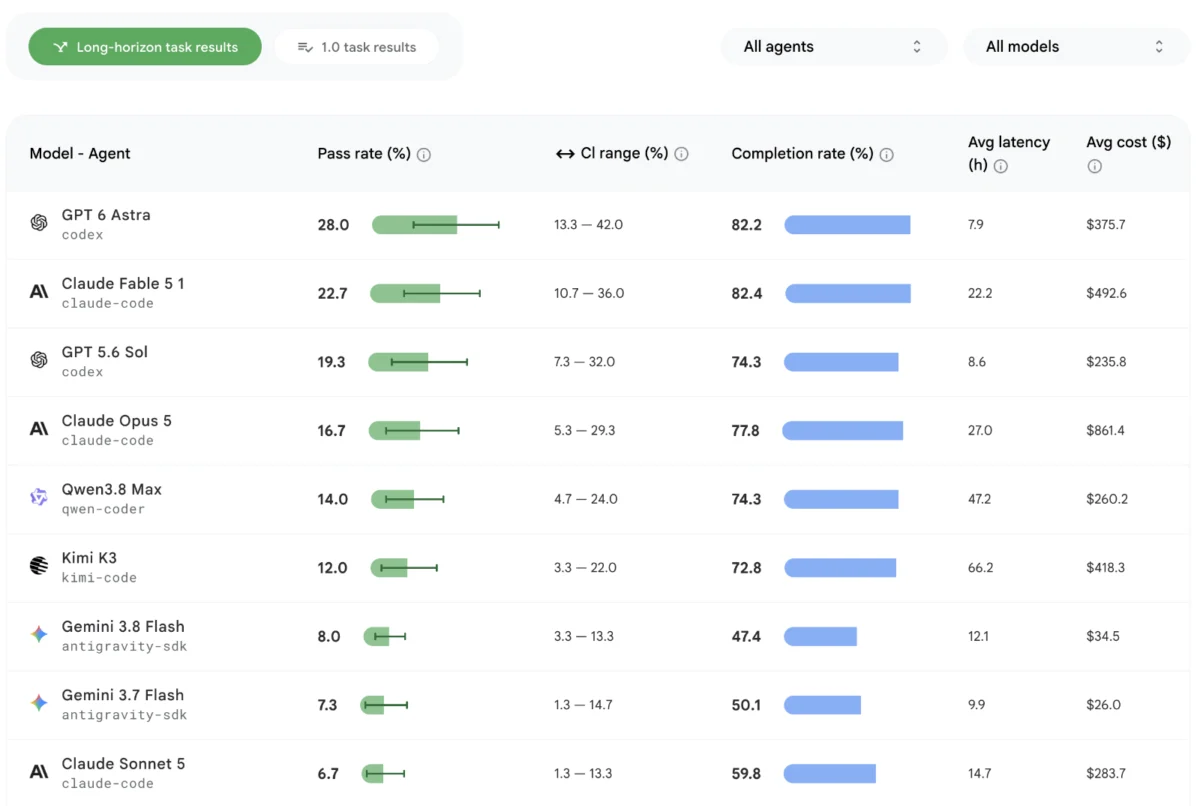
The transition to LHTs has significantly reset the baseline for AI performance. While the original benchmark saw pass rates as high as 91% for simpler tasks, the current LHT pass rate tops out at approximately 28%. This stark drop is a testament to the heightened complexity of the new test suite.
Key Performance Trends:
- The Strength of Creation: Models consistently perform better at writing new code from scratch than they do at modifying or refactoring existing, legacy code.
- Deterministic Success: Models excel at well-defined, repetitive tasks—such as converting Java to Kotlin, swapping Retrofit for Ktor, or standardizing ViewModel layers. Even across repositories exceeding 8,000 lines of code and 125 files, these patterns are applied with high consistency.
- The "Knowledge Gap" Barrier: Models struggle significantly when tasks require runtime validation—such as debugging complex dependency injection graphs—or when they encounter breaking framework changes and unreleased library APIs.
- The Porting Challenge: Porting a cross-platform application to a native Android environment remains the "final boss" for current AI. No model has yet achieved a 100% pass rate, and even top-tier frontier models struggle to exceed an 80% completion rate.
The updated leaderboard, which now includes heavy hitters like OpenAI’s GPT-6 Astra, Gemini 3.8 Flash, Anthropic’s Fable 5.1, Kimi K3, and Qwen 3.8 Max, provides granular data for every model. By clicking into individual model cards, developers can view specific metrics including pass rates, completion rates, and average costs per task. This transparency is intended to move the conversation away from marketing hype and toward empirical utility.
The Shift to Agentic Evaluation
One of the most significant advancements in Android Bench 2.0 is the formal introduction of Agentic Evaluation.
In professional environments, an LLM is rarely used in isolation; it is usually wrapped in a "harness" or an agentic loop that provides the model with tools, memory, and error-handling capabilities. Recognizing this, the Android team has begun testing models in tandem with their official provider-supplied agents. For instance, the framework evaluates OpenAI’s GPT-6 through its specialized "Sol" agent and Gemini 3.8 through the "Google Antigravity" harness.
This shift allows for the measurement of "harness design"—the way an agent organizes tool-use and prompt caching. The early results are promising: advanced agentic design, particularly regarding compact tool windowing, has shown a direct correlation with reduced token consumption and higher completion rates. By evaluating these combinations, the benchmark provides a clearer picture of how different AI "ecosystems" actually perform in a production setting.
Official Perspective and Strategic Implications
The investment in this benchmark is driven by a core philosophy: developer autonomy. The team emphasizes that it is crucial for engineers to have the data necessary to select the model and agent combination that best fits their specific workflow.
.png)
"We invest in this measurement because it’s important for you to be able to use your agent and model of choice for Android development," the team stated in their official release. By providing a standardized, objective playground, the framework aims to push model providers to build more "dependable" coding partners.
The implications for the industry are profound:
- Standardization of Quality: As AI becomes an integral part of the CI/CD pipeline, having a standard to judge "AI-generated code quality" will be as important as code linting or unit testing.
- Architectural Accountability: By focusing on LHTs, the industry is moving away from "AI as a toy" toward "AI as an architect." This encourages the development of models that understand global repository state rather than just local syntax.
- Cost Efficiency: The detailed cost-per-task data empowers engineering leads to make informed decisions about where to deploy high-cost, high-intelligence models versus lower-cost, high-speed alternatives.
Conclusion: The Path Forward
Android Bench 2.0 is not a finished product; it is a living, evolving metric. The team has made it clear that they intend to expand these evaluations to include a broader array of agent-model combinations in the coming months.
For the developer, this means moving toward a future where AI does not just assist, but sustains. As these agents grow more capable of handling long-horizon tasks, the role of the human engineer will increasingly shift from manual code entry to high-level architectural oversight and validation.
For those looking to engage with this new standard, the full methodology is available on the official Android Bench portal. The team is actively soliciting feedback via GitHub, encouraging the community to contribute to the dataset and shape the next generation of AI-assisted development tools. In the race to build the perfect coding partner, Android Bench 2.0 has just set the pace.