Edge AI Revolution: How Cactus Compute’s 14MB Needle 2 Model Brings Local Function-Calling to the Raspberry Pi 5
Introduction and Main Facts
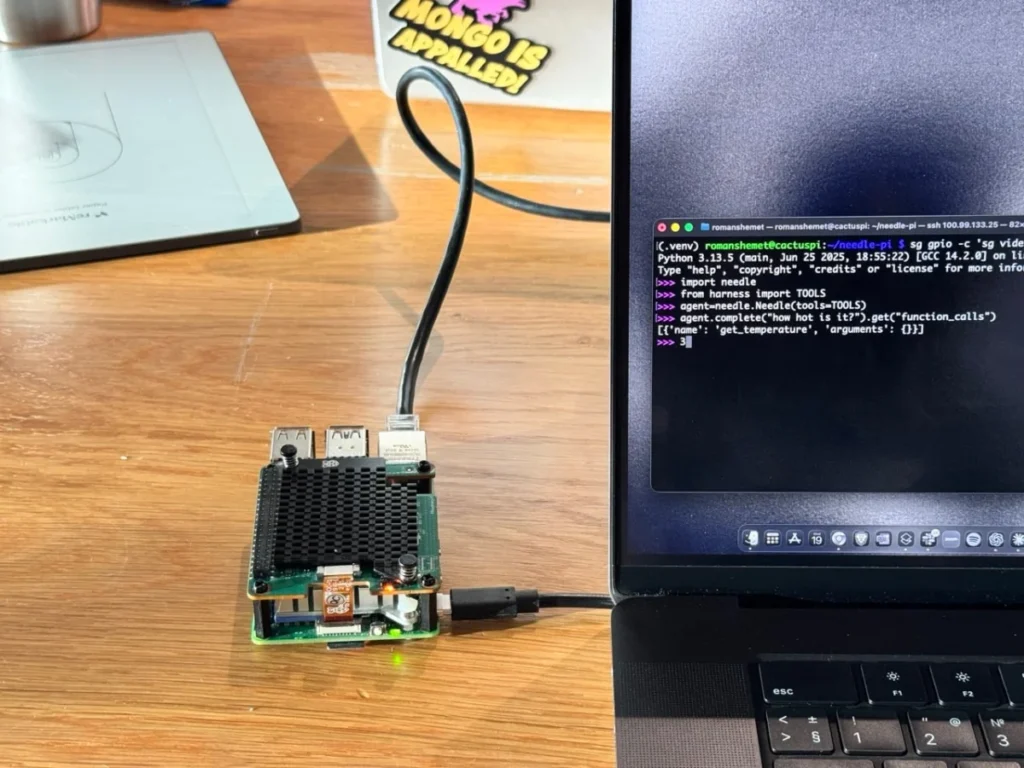
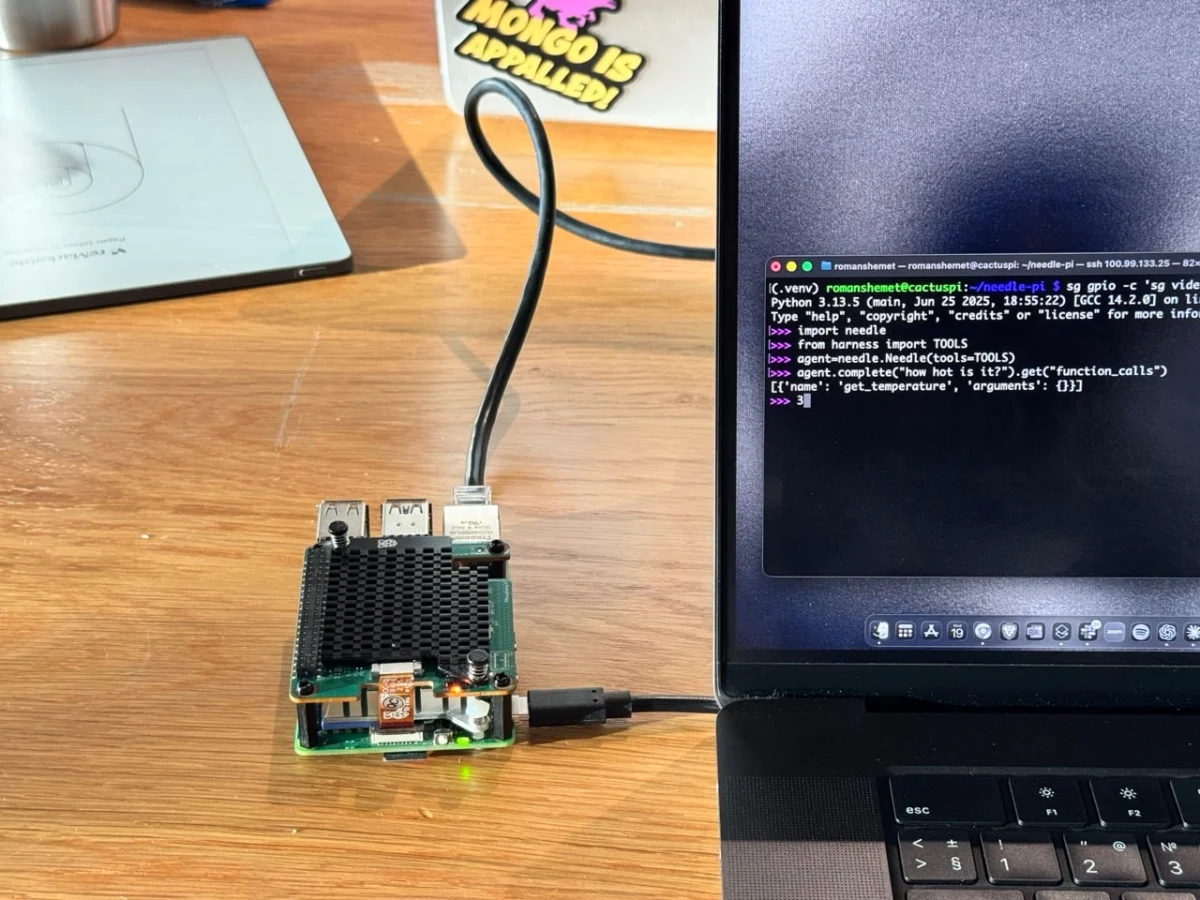
The landscape of edge computing and artificial intelligence has experienced a paradigm shift following a technical showcase by developers at Cactus Compute. The firm has demonstrated how Needle 2—an ultra-lightweight, 14-megabyte function-calling model—can seamlessly translate plain, natural English into precise local hardware actions on a standard Raspberry Pi 5. Operating entirely on the device’s CPU without requiring a specialized AI accelerator, Neural Processing Unit (NPU), or cloud-based API connection, Needle 2 executes commands in a fraction of a second.
Unlike mainstream Large Language Models (LLMs) engineered for open-ended conversation, creative writing, or general trivia, Needle 2 occupies a distinct architectural niche. It is strictly an action-oriented model. When given a prompt such as "Turn the LED on," the model parses the instruction, identifies the corresponding Python function, extracts the necessary arguments, and executes the command in a remarkable 78 milliseconds.
The technical specifications of the implementation underscore a new era of efficiency:
- Model Size: 14MB (with native session memory hovering around 28MB).
- Total Footprint: The complete Python process—including the interpreter and model runtime—peaks between 43MB and 46.4MB of RAM.
- Hardware Requirements: Raspberry Pi 5 (tested on an 8GB model) running Raspberry Pi OS, utilizing the CPU exclusively.
- Speed: Response times for tool selection and argument prefill range from roughly 76ms to 149ms depending on the complexity of the query.
- Licensing: Distributed openly under the Apache 2.0 license, with model weights and code accessible via Hugging Face and GitHub.
The Evolution of Edge AI: A Chronology
To understand the significance of Needle 2, it is helpful to trace the trajectory of artificial intelligence on low-power single-board computers (SBCs).
Phase 1: The Cloud-Dependent Era (Pre-2023)
For years, running AI workloads on devices like the Raspberry Pi was severely bottlenecked by hardware limitations. Early attempts at integrating voice assistants or natural language processing relied heavily on cloud APIs. A user spoke a command, the audio or text was sent to a remote server cluster (such as AWS or Google Cloud), processed by a massive model, and the response was bounced back to the Pi. This introduced critical vulnerabilities: privacy risks, high latency, dependency on continuous internet connectivity, and recurring cloud infrastructure costs.
Phase 2: The Rise of Quantized LLMs (2023–2025)
As quantization techniques and model architectures like Llama, Phi, and Mistral evolved, developers began running compressed language models locally on edge hardware. While revolutionary, running even a heavily quantized 1B to 3B parameter model on a Raspberry Pi 5 CPU proved sluggish. Token generation rates were low, memory footprints often exceeded comfortable limits for multi-purpose SBCs, and general-purpose models suffered from "hallucinations"—frequently failing to output the rigid, structured JSON required for reliable software function-calling.
Phase 3: The Specialized Action Model Breakthrough (2026)
Recognizing that edge devices do not need to compose poetry or chat about philosophy, developers pivoted toward hyper-specialized models. Cactus Compute engineered Needle 2 specifically for deterministic, structured on-device actions. By stripping away extraneous conversational weights and focusing exclusively on intent recognition and tool mapping, the team shrank the model down to just 14MB. This allows it to reside comfortably in cache, executing evaluations at speeds matching compiled native code rather than traditional interpreted AI pipelines. Following the success of Needle 2, Cactus Compute has already moved forward to release Needle 3, pushing local edge capabilities even further.
Technical Deep Dive and Implementation Data
Needle 2 bridges the gap between natural language user interfaces and traditional procedural programming (such as Python scripts interacting with General-Purpose Input/Output (GPIO) pins).
Installation and Setup
Getting started requires a standard Python virtual environment on a Raspberry Pi 5:
python3 -m venv needle-env
source needle-env/bin/activate
python -m pip install cactus-needle
Once installed and downloaded for the first time, the model executes entirely offline. Developers define functional capabilities by using Python decorators (@needle.tool). The framework automatically inspects the function’s name, docstring, and type annotations to construct an internal tool schema.
Code Architecture Example
Consider the following implementation tracking system notes and querying CPU temperature via vcgencmd:
import needle
from pathlib import Path
import subprocess

notes_path = Path("needle-notes.txt")

@needle.tool
def save_note(text: str):
    """Append a note to a local text file."""
    with notes_path.open("a", encoding="utf-8") as notes:
        notes.write(text + "n")
    return "text": text, "path": str(notes_path)

@needle.tool
def get_temperature():
    """Return the current CPU temperature of this Raspberry Pi in Celsius."""
    out = subprocess.check_output(["vcgencmd", "measure_temp"], text=True)
    return "temperature_c": float(out.split("=")[1].split("'")[0])

agent = needle.Needle(tools=[save_note, get_temperature])
response = agent.run("Save a note that says the cooler is working.")
When agent.run() is invoked, Needle 2 processes the natural language prompt and instantly returns a structured function call payload:
  "type": "call",
  "function_calls": [

      "name": "save_note",
      "arguments":  "text": "the cooler is working"

  ]
Performance Benchmarks
Cactus Compute published extensive telemetry data illustrating Needle 2’s efficiency on a standard CPU-only Raspberry Pi 5 (8GB RAM):
| Prompt | Selected Tool | Prefill (tok/s) | Decode (tok/s) | Total Time Taken (ms) |
|---|---|---|---|---|
| "Turn the LED on." | set_led |
488 | 296 | 78 |
| "How hot is this Raspberry Pi?" | get_temperature |
487 | 303 | 149 |
| "Blink the LED 2 times." | blink_led |
475 | 314 | 83 |
| "Take a photo." | take_photo |
461 | 248 | 76 |
| "Save a note that says the cooler is working." | save_note |
475 | 305 | 107 |
| "What is the capital of France?" | (None) | 470 | 297 | 92 |
A critical observation from these benchmarks is the model’s behavior when confronted with out-of-scope queries. When asked, "What is the capital of France?", Needle 2 correctly declines to invoke any tool, returning an empty function call array ( "function_calls": [] ) in 92 milliseconds. For an action model, gracefully refusing unrelated requests is paramount to preventing unintended software behavior.
Official Responses and Industry Reception
The release of Needle 2 and its rapid iteration into Needle 3 has drawn significant praise from industry leaders and the maker community alike.
Eben Upton, CEO of Raspberry Pi, evaluated the software and offered a concise endorsement:
"Needle 2 is rather excellent."
Industry analysts note that Upton’s positive reception highlights a broader shift in strategy for single-board computer manufacturers. For years, hardware improvements in the Raspberry Pi line—such as faster quad-core ARM Cortex processors, increased RAM thresholds, and native PCIe interfaces—were leveraged primarily for traditional desktop computing, media streaming, and embedded automation. The lack of efficient, low-overhead AI frameworks meant that adding voice control or intent parsing required heavy software stacks or external accelerators like Google Coral.
With models like Needle 2 operating natively within a sub-50MB memory ceiling, developers can now embed intelligent, conversational interfaces directly into low-cost automation projects without hardware modifications.
Implications for the Future of IoT and Edge Computing
The introduction of sub-20MB function-calling models carries profound implications across multiple technological sectors:
1. Privacy and Air-Gapped IoT
Smart home automation and industrial Internet of Things (IoT) deployments have long struggled with privacy concerns. Sending audio streams or conversational logs to cloud servers invites telemetry tracking and potential data breaches. Needle 2 processes all commands locally. Security systems, smart thermostats, and factory floor monitors can now understand complex, unstructured natural language prompts entirely behind an air-gapped firewall.
2. Democratization of Hardware Interfacing
Traditionally, interacting with hardware interfaces like GPIO pins, I2C sensors, or camera modules required writing rigid command-line scripts or custom graphical user interfaces with strict menu hierarchies. Needle 2 allows developers to wrap existing libraries (such as GPIO Zero or custom Python packages) inside @needle.tool decorators. Users can then speak or type fluid, conversational commands to control physical devices, significantly lowering the barrier to entry for robotics and physical computing.
3. Resource-Constrained Environments
While high-end edge devices like the NVIDIA Jetson Orin handle heavy neural networks, they are costly and draw significant power. Needle 2’s ability to run fluidly on a bare Raspberry Pi CPU opens up possibilities for battery-powered remote sensors, solar-powered field units, and wearable technology where thermal throttling and power consumption are major constraints.
4. Custom Fine-Tuning and Open-Source Collaboration
Because the model weights and source code are fully open-sourced under the permissive Apache 2.0 license via Hugging Face (huggingface.co/Cactus-Compute/needle2) and GitHub (github.com/cactus-compute/needle), developers are not locked into a proprietary ecosystem. Engineers can easily fine-tune the model locally on standard laptops to recognize specialized industry jargons, custom manufacturing tools, or proprietary API frameworks.
As tools like Needle 2 and its successor, Needle 3, continue to mature, the boundary between rigid software programming and fluid human language continues to blur—proving that artificial intelligence at the edge does not require massive data centers to be profoundly useful.