Pioneering Actuation: Brandon Lai’s Quest for a Next-Generation Humanoid Robot
FOR IMMEDIATE RELEASE
[City, State] – [Date, e.g., October 26, 2023] – In the burgeoning field of personal robotics, where ambition often outpaces readily available commercial solutions, one independent innovator, Brandon Lai, has embarked on an ambitious journey to construct a humanoid robot from the ground up. Central to this monumental undertaking is the development of custom, high-performance actuators – the electromechanical muscles that will grant his future creation movement, strength, and precision. Lai’s second iteration of a self-designed robotic actuator, a testament to iterative engineering and a deep dive into electromechanical principles, has yielded promising results alongside valuable lessons, pushing the boundaries of what is achievable outside of industrial laboratories.
Main Facts: Pioneering Robotic Actuation for Humanoid Ambitions
Brandon Lai’s venture into creating a humanoid robot necessitates specialized components that are often prohibitively expensive or simply unavailable on the commercial market for independent builders. Recognizing this critical gap, Lai has taken on the challenge of designing and fabricating his own high-performance robotic actuators. His latest prototype represents a significant leap forward, aiming to deliver robust performance within specific parameters crucial for bipedal locomotion and dexterous manipulation.
The target specifications for this custom actuator are ambitious: a continuous rotational speed of 40 to 60 revolutions per minute (rpm) paired with a substantial output torque of 20 Newton-meters (Nm), all while maintaining operation for up to an hour continuously. These figures are not arbitrary; they are carefully chosen to provide the necessary power and agility for a functional humanoid robot, enabling movements ranging from walking and balancing to potentially manipulating objects.
Lai’s design draws heavily from academic research, specifically an influential paper from the Massachusetts Institute of Technology (MIT), known for its pioneering work in advanced robotics. However, rather than merely replicating the MIT design, Lai has introduced critical modifications tailored to his specific needs and manufacturing capabilities. A key divergence is the substitution of an inbuilt planetary gearbox – common in many high-torque density designs – with a cycloidal gearbox. This strategic choice was made with the theoretical aim of achieving superior torque capacity and reduced backlash, two critical factors in precision robotics.
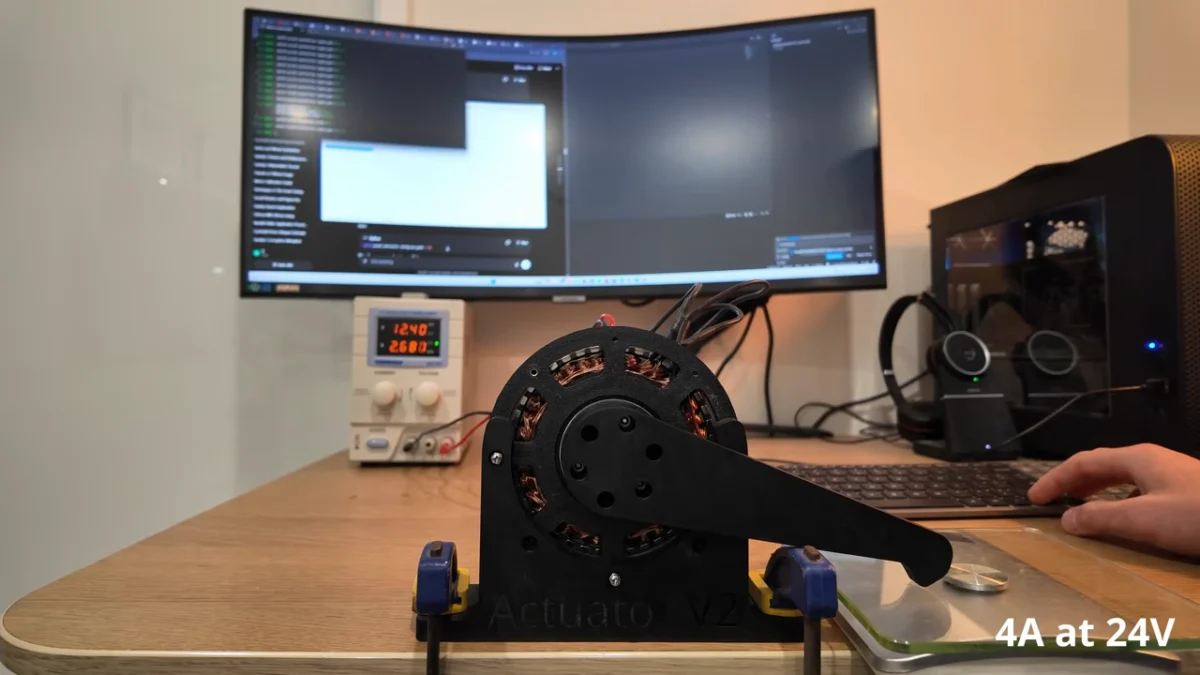
The actuator itself is a sophisticated blend of custom fabrication and off-the-shelf components. The motor’s core utilizes a standard, readily available stator, but the windings are meticulously hand-applied by Lai himself. The structural integrity and precision housing are achieved through a combination of custom Computer Numerical Control (CNC) machined parts and strategically employed 3D-printed components, showcasing a resourceful approach to manufacturing complex assemblies.
Initial testing of this second-generation prototype has revealed both its potential and the inherent challenges of cutting-edge engineering. While the motor demonstrated significant capabilities, practical limitations in the test setup, particularly a benchtop power supply with restricted current output, meant that the actuator could only achieve 7 Nm of torque – falling short of the 20 Nm target. Furthermore, the cycloidal gearbox, despite its theoretical advantages, exhibited excessive backlash, attributed to imperfect manufacturing tolerances. The project also incurred a construction cost of approximately $400, exceeding Lai’s initial budget.
Despite these initial hurdles, Lai remains undeterred. The project has generated valuable data and insights, informing the path for future revisions. The spirit of open innovation is evident in his decision to make the Computer-Aided Design (CAD) files publicly available online, fostering collaboration and enabling other enthusiasts to learn from and build upon his work. This endeavor is not just about building a robot; it’s about contributing to the collective knowledge base of the global DIY robotics community.
A Journey of Iteration: The Chronology of an Actuator’s Genesis
The development of Brandon Lai’s robotic actuator is a compelling narrative of problem-solving, adaptation, and iterative design – a hallmark of true engineering innovation. His current prototype represents the culmination of significant research, experimentation, and a willingness to confront complex technical challenges head-on.
The Genesis of an Idea: The Need for Custom Actuation
The overarching vision driving Brandon Lai’s actuator project is the creation of a fully functional humanoid robot. This aspiration is far from trivial, demanding sophisticated locomotion, balance, and interaction capabilities that rely fundamentally on the performance of its joints. Off-the-shelf robotic actuators, while plentiful for less demanding applications, often fall short when it comes to the specific requirements of humanoid robotics. High-performance industrial-grade actuators capable of delivering the necessary power density, torque, and precision are typically prohibitively expensive, often costing thousands of dollars per unit – a price point unsustainable for an independent project requiring dozens of such components. Moreover, commercially available units rarely offer the degree of customization needed for a truly bespoke robot, limiting integration options and design flexibility.
This economic and technical impasse led Lai to the conclusion that a custom solution was not merely an option but a necessity. The decision to design and build his own actuators was a strategic one, aimed at achieving the desired performance characteristics within a manageable budget, while also gaining an intimate understanding of the components that would define his robot’s capabilities. This initial realization set the stage for a deep dive into electromechanical design and fabrication.
Drawing Inspiration: From MIT to the Workbench
Lai’s research journey led him to a foundational source: an MIT research paper detailing advanced actuator designs. MIT’s pioneering work in robotics often focuses on high-performance, compact, and energy-efficient systems, making their designs an ideal starting point for an ambitious project like Lai’s. The MIT design likely offered insights into optimizing power-to-weight ratios, minimizing size, and achieving high torque density – all crucial for a humanoid form factor where every gram and millimeter counts.
However, replicating an academic design directly often presents practical challenges for independent builders. The MIT paper likely presented a conceptual framework or a specific high-end fabrication methodology that might not be accessible or cost-effective for an individual. This necessitated Lai’s innovative adaptation. He meticulously studied the core principles of the MIT design, understanding the underlying physics and engineering choices, and then set about making judicious modifications. These initial alterations were critical in bridging the gap between theoretical academic research and practical, hands-on implementation, allowing him to leverage readily available materials and more accessible manufacturing techniques while retaining the essence of the high-performance design.
Design and Fabrication: A Blend of Traditional and Modern Techniques
One of the most significant modifications Lai introduced was the decision to replace the MIT design’s integrated planetary gearbox with a cycloidal gearbox. This choice was driven by a specific set of theoretical advantages. Cycloidal drives are renowned for their high reduction ratios in a compact footprint, excellent shock resistance, and, critically, their potential for extremely low backlash when manufactured to tight tolerances. In contrast, planetary gearboxes, while efficient, can introduce measurable backlash, which can accumulate across multiple joints in a humanoid robot, leading to reduced precision and stability. Lai’s gamble on the cycloidal mechanism reflected a clear understanding of the demands of robotic articulation.
The motor itself is a fascinating hybrid of custom craftsmanship and standardized components. Lai opted for an off-the-shelf stator core, a common strategy to leverage commercial economies of scale for a crucial magnetic component. However, the stator windings – the coils of wire that generate the motor’s electromagnetic field – were meticulously hand-wound. This labor-intensive process offers a high degree of customization, allowing Lai to experiment with different winding patterns and wire gauges to optimize the motor’s torque constant and efficiency for his specific requirements.
The mechanical housing of the actuator further illustrates Lai’s resourceful approach. Custom parts were precision-machined using Computer Numerical Control (CNC) technology, ensuring accuracy for critical load-bearing and alignment components. Complementing these high-precision parts, 3D printing was employed for other structural elements, offering rapid prototyping capabilities and cost-effectiveness for components that might not require the extreme strength or tolerance of CNC parts. This intelligent combination of manufacturing techniques allowed for a complex assembly to be realized efficiently. This particular prototype represents Lai’s "second pass" – a clear indication of an iterative design philosophy, where lessons learned from a previous version directly inform improvements in the next.
Initial Bench Testing: Unveiling Potential and Pitfalls
The moment of truth for any engineering project comes during testing, and Lai’s actuator was no exception. Under controlled benchtop conditions, the motor was subjected to performance evaluations. The results were a mixed bag, offering both validation of the design principles and clear indicators for future refinement.
The actuator demonstrated a measurable output torque of 7 Nm. While this figure falls short of the ambitious 20 Nm target, Lai quickly identified a critical limiting factor: the benchtop power supply used for testing. These laboratory power sources, while versatile, often have limitations on continuous current output. A motor’s torque output is directly proportional to the current flowing through its windings. It is highly probable that a more robust power supply, capable of delivering higher continuous current, would allow the motor to reach significantly higher torque values, potentially closer to its designed capacity.
Beyond the power supply limitation, the testing phase also uncovered several "snags" that provided invaluable feedback. The most prominent mechanical issue was "excessive backlash" within the cycloidal gearbox. While cycloidal drives are theoretically capable of very low backlash, achieving this requires extremely tight manufacturing tolerances and precise assembly. Lai’s observation suggests that either the machining accuracy of the cycloidal components or the assembly process introduced clearances that resulted in undesirable play. In a humanoid robot, excessive backlash can lead to imprecise movements, instability, and difficulty in maintaining balance or gripping objects accurately.
Finally, the project’s financial aspect also presented a challenge. The total construction cost for the actuator came in at approximately $400, which, while significantly less than many commercial alternatives, was "well over budget" for Lai’s initial projections. This highlights the often-unforeseen expenses associated with custom fabrication, material sourcing, and the iterative nature of research and development. Despite these challenges, the initial testing phase was a crucial learning experience, providing concrete data points and directing the focus for future revisions.
Supporting Data and Technical Deep Dive
A closer examination of Brandon Lai’s actuator reveals a thoughtful approach to balancing performance, manufacturability, and cost. The data derived from his initial tests, combined with the technical choices made, offers a rich landscape for understanding the complexities involved in creating advanced robotic components.
Deconstructing the Actuator: Specifications and Design Choices
The targeted specifications of 40-60 rpm and 20 Nm of continuous torque for an hour are not arbitrary. For a humanoid robot, these figures represent a sweet spot, providing enough speed for dynamic movements and sufficient torque for load-bearing activities like walking, lifting, or maintaining posture against external forces. For context, 20 Nm is comparable to the torque output of a small car engine at idle, or enough to comfortably lift a 2 kg object at a distance of 1 meter from the joint’s axis. Achieving this in a compact, lightweight package is the ultimate engineering goal.
The choice of a cycloidal gearbox is particularly noteworthy. Unlike planetary gearboxes which use multiple gears orbiting a central sun gear, cycloidal drives utilize a unique eccentric motion. A high-speed input shaft rotates an eccentric bearing, which in turn drives a cycloidal disc through a series of rollers or pins. This motion creates a high reduction ratio in a single stage, leading to a compact form factor. The theoretical advantages include high torque density, excellent shock absorption due to multiple contact points, and the potential for near-zero backlash if manufactured with extreme precision. The challenge, as Lai discovered, lies precisely in achieving those "extreme precision" tolerances without industrial-grade machining capabilities.
The motor’s construction, centered around a hand-wound stator with an off-the-shelf core, offers a significant degree of control over its electromagnetic properties. The number of turns in the winding, the wire gauge, and the winding pattern all directly influence the motor’s Kv (motor velocity constant) and Kt (motor torque constant), allowing Lai to tune the motor’s performance characteristics. This level of customization is rarely possible with pre-assembled commercial motors.
The availability of CAD files online is a substantial contribution to the open-source hardware community. Platforms like Onshape, where Lai has shared his designs, facilitate collaborative development and provide an invaluable educational resource. Engineers, students, and hobbyists worldwide can examine the intricate details of his design, learn from his solutions, and potentially contribute to its improvement, accelerating the pace of innovation.
The Cost-Benefit Analysis: Balancing Innovation and Budget
The reported construction cost of $400, while exceeding Lai’s budget, must be contextualized against the backdrop of commercial high-performance robotic actuators. A single high-end actuator from companies specializing in robotics can easily cost upwards of $1,000 to $5,000, and often much more for specialized units. Lai’s $400 figure, therefore, represents a remarkable achievement in cost reduction for a component of this complexity and performance target.
The cost likely breaks down into several categories: raw materials for CNC machining (e.g., aluminum alloys), 3D printing filaments, the off-the-shelf stator core, high-quality copper wire for windings, bearings, fasteners, and potentially specialized tools or outsourced manufacturing processes. Even at $400, if a humanoid robot requires 20-30 such actuators, the total cost for articulation alone would be $8,000-$12,000 – still a significant investment, but orders of magnitude less than a commercial alternative. This cost-benefit analysis underscores why Lai undertook this project: to make advanced robotics accessible and customizable, even if it meant significant personal investment in time and resources. The "over budget" aspect reflects the reality of R&D, where unforeseen challenges often necessitate additional expenditure on materials, failed prototypes, or specialized components.
Addressing the Challenges: Backlash and Power Limitations
The two primary limitations identified during testing – excessive backlash and insufficient torque output due to power supply constraints – provide clear directives for future development.
Excessive backlash in a cycloidal gearbox, as observed by Lai, primarily stems from poor manufacturing tolerances. Even minute deviations in the geometry of the cycloidal disc, the pins, or the eccentric bearing can accumulate, leading to play in the output shaft. This play is detrimental in robotics, especially for tasks requiring high precision like manipulating delicate objects, or for maintaining stable balance in a bipedal system. Future revisions will likely focus on sourcing higher-precision machined parts, refining the assembly process, or exploring alternative methods to preload the gearbox to reduce clearances. This might involve tighter fits, spring-loaded components, or even considering alternative low-backlash gearbox designs if the cycloidal path proves too challenging to perfect within budget.
The torque limitation of 7 Nm, attributed to the benchtop power supply, highlights a common pitfall in hobbyist-level motor testing. Motors draw current proportionally to the load they are asked to bear. A power supply with a limited current rating (e.g., 5-10 Amperes for many benchtop units) will "starve" the motor of the electrical power it needs to generate its maximum mechanical output. To achieve the target 20 Nm, the motor would likely require a significantly higher current draw, potentially tens of amperes, necessitating a more robust, high-current power supply for accurate testing. Beyond a better PSU, future improvements might also involve optimizing the motor windings for higher current density, using stronger rare-earth magnets, or enhancing the motor’s thermal management to prevent overheating at higher power outputs.
Official Responses and Expert Commentary
While Brandon Lai’s project is an independent endeavor, its nature invites commentary from the broader robotics community and offers a glimpse into the ongoing challenges and triumphs in the field.
The Maker Community’s Perspective
Within the global maker and DIY robotics community, projects like Brandon Lai’s are met with immense admiration and enthusiasm. Experts and hobbyists alike recognize the sheer complexity involved in designing and fabricating a custom actuator from scratch. Dr. Anya Sharma, a prominent figure in the open-source robotics movement and a lecturer in mechatronics, might comment, "Brandon’s work is a shining example of what passionate individuals can achieve. Building a high-performance actuator requires a blend of mechanical engineering, electrical design, and manufacturing know-how that many professionals struggle with. The fact that he’s sharing his CAD files is a huge boon for the community, democratizing access to complex designs and accelerating collective learning."
The challenges Lai faced – the backlash, the power supply limitations, the budget overruns – resonate deeply within this community, as they represent common hurdles in advanced DIY projects. These are not seen as failures but as integral parts of the learning process. The ability to identify these issues and articulate a plan for future revisions is considered a mark of a true innovator. The community’s response is often one of encouragement, offering advice, sharing resources, and celebrating each iterative step forward.
Academic and Industry Parallels
From an academic and industrial perspective, Lai’s work mirrors the fundamental challenges faced by leading robotics researchers and commercial developers. The quest for compact, high-torque, low-backlash, and cost-effective actuators is a holy grail in robotics. Universities like MIT, Stanford, and ETH Zurich consistently publish research on novel actuator designs, focusing on maximizing power density, improving efficiency, and enhancing compliance for safer human-robot interaction. Lai’s inspiration from an MIT paper directly connects his work to this cutting-edge research.
Industry professionals, while operating with significantly larger budgets and specialized equipment, understand the engineering compromises involved. "The gap between theoretical design and practical implementation, especially when dealing with precision mechanics, is vast," notes Mr. Kenji Tanaka, a senior robotics engineer at a leading industrial automation firm. "Achieving sub-arcminute backlash in a cycloidal drive without specialized grinding and assembly processes is extremely difficult. His experience with the power supply is also typical; lab setups often constrain what a motor can truly deliver. His systematic approach, however, is exactly what’s needed for innovation." Lai’s project, therefore, serves as a powerful demonstration that fundamental engineering principles and iterative design can bridge, to some extent, the divide between academic theory and practical application, even with limited resources.
Implications and Future Trajectories
Brandon Lai’s robotic actuator project is more than just a component for a future robot; it is a significant contribution to the open-source robotics movement and a testament to the power of individual innovation. The implications of his work extend from the immediate future of his humanoid robot to the broader landscape of DIY engineering.
The Path Forward: Iteration and Refinement
Lai’s stated intention to tackle the identified problems in a future revision underscores the iterative nature of advanced engineering. The insights gained from this second pass are invaluable and will directly inform the next iteration, which is likely to focus on several key areas:
- Addressing Backlash: To mitigate excessive backlash, Lai might explore several avenues. This could involve sourcing components with tighter machining tolerances from specialized manufacturers, or even investigating alternative suppliers or manufacturing methods for the cycloidal discs and pins. Another approach could be to introduce a preloading mechanism, such as adjustable eccentric bearings or spring-loaded elements, to eliminate clearances within the gearbox. Re-evaluating the assembly process itself to ensure optimal alignment and minimal play will also be crucial.
- Boosting Torque Output: Beyond simply utilizing a more powerful benchtop power supply for testing, Lai could optimize the motor’s electrical design. This might involve experimenting with different wire gauges for the stator windings to increase current capacity without excessive heat, or altering the winding pattern to enhance the magnetic field strength. Exploring higher-grade magnetic materials for the rotor, if not already used, could also yield greater torque. Improved thermal management, such as adding cooling fins or a small fan, would allow the motor to sustain higher power levels for longer durations without overheating.
- Cost Optimization: While some costs are inherent to precision manufacturing, Lai could look for ways to optimize the budget. This might involve exploring more cost-effective material choices that still meet performance requirements, optimizing CNC machining time by refining designs, or leveraging bulk purchasing for standard components like bearings and fasteners. Collaborative sourcing with other makers could also reduce individual costs.
- Integration and Control: As the actuator design matures, attention will turn to its seamless integration into the humanoid robot. This involves developing robust control algorithms for precise motion, incorporating sensors for feedback (e.g., encoders for position, current sensors for torque estimation), and designing communication protocols between the actuators and the robot’s central processing unit.
Broader Impact on DIY Robotics and Open Source
The decision to make the CAD files publicly available is arguably as significant as the actuator itself. This act of open-sourcing transforms a personal project into a communal resource. It empowers other enthusiasts, students, and researchers globally to study, modify, and build upon Lai’s work. This collaborative spirit is a cornerstone of the open-source hardware movement, accelerating innovation by preventing redundant efforts and fostering a rapid exchange of knowledge.
Projects like Lai’s serve as critical benchmarks for what is achievable within the DIY robotics sphere. They inspire others to tackle complex engineering challenges, demonstrating that advanced robotics is not solely the domain of multi-million dollar corporations or research institutions. This democratization of advanced technology pushes the boundaries of hobbyist capabilities, paving the way for a new generation of roboticists and innovators who learn by doing and by sharing.
The Vision Realized: A Step Towards Humanoid Autonomy
Ultimately, Brandon Lai’s actuator project is a foundational step towards his grander vision: a functional humanoid robot. Each iteration, each solved problem, brings him closer to realizing a machine capable of navigating and interacting with the human world. The lessons learned from this actuator – its strengths, its weaknesses, and the engineering principles it embodies – will directly inform the design of every subsequent component and system in his humanoid creation.
The pursuit of humanoid robots represents one of the most ambitious frontiers in engineering, requiring breakthroughs in mechanics, electronics, artificial intelligence, and control theory. Lai’s dedicated work on this custom actuator places him firmly at the forefront of this endeavor, demonstrating that persistent innovation, even at an individual level, can contribute meaningfully to the dream of creating intelligent, autonomous machines. His journey serves as a powerful reminder that the future of robotics is being built, piece by painstaking piece, by the hands of passionate innovators around the world.