Digital Shadows Exposed: Dutch Authorities Dismantle Infrastructure Linked to Russian Cyber-Espionage

In a decisive strike against the digital architecture supporting Russian hybrid warfare, Dutch financial crime investigators have arrested the co-owners of two interconnected internet hosting firms. The operation, executed on May 18, saw the Dutch Tax Intelligence and Investigation Service (FIOD) seize over 800 servers, laptops, and communications devices, effectively pulling the plug on a network accused of facilitating cyberattacks, influence operations, and mass disinformation campaigns across the European Union.
The arrests of a 57-year-old Amsterdam resident and a 39-year-old from The Hague mark the culmination of a protracted investigation into how Western-based IT infrastructure was weaponized to circumvent EU sanctions. The two men, identified in local media reports as key figures behind the hosting entities MIRhosting and WorkTitans BV, are facing serious charges of violating sanctions law by providing critical economic and technical resources to entities already blacklisted by the European Union.
The Nexus of Infrastructure: Stark Industries and the Shadow Network
The investigation centers on a sprawling hosting provider known as Stark Industries Solutions. The entity surfaced with suspicious speed just two weeks prior to the Russian invasion of Ukraine in 2022. Quickly evolving into a "bulletproof" hosting haven, Stark Industries became a primary staging ground for massive Distributed Denial-of-Service (DDoS) attacks targeting European government bodies and critical infrastructure.
Stark’s business model was specifically designed for anonymity, providing proxy services that became a hallmark of Russian-backed hacking collectives. While previous investigative reports—including a 2024 deep-dive by KrebsOnSecurity—exposed how Stark Industries functioned as an "iron hammer in the cloud," the current legal crackdown highlights the complex, shell-game tactics used to keep the network online.
A Chronology of Evasion
- February 2022: Stark Industries Solutions is established shortly before the invasion of Ukraine.
- May 2024: Investigative reports reveal Stark as a major node for Russian cyber-offensives and proxy services.
- May 2025: The European Union formally sanctions Moldovan brothers Ivan and Yuri Neculiti and their company, PQHosting, which provided primary connectivity for Stark.
- May 2025 (Pre-Sanction): Anticipating the EU crackdown, Stark network assets are rapidly migrated to a new entity, the[.]hosting, under the control of the Dutch firm WorkTitans BV.
- September 2025: Analysts identify that despite the PQHosting sanctions, the Stark network remains operational through a secondary conduit: the Dutch ISP MIRhosting.
- November 2025: Evidence emerges linking WorkTitans and MIRhosting to a series of coordinated cyberattacks against Danish government bodies during their municipal elections.
- May 18, 2026: FIOD conducts raids in Enschede, Almere, Dronten, and Schiphol-Rijk, resulting in the arrests of the two primary operators and the seizure of physical server infrastructure.
Profiles of the Accused: From Piano Prodigy to Shadow Operator
The operation’s central figures present a stark contrast to the typical profile of a cybercriminal. Andrey Nesterenko, a 39-year-old Russian native operating out of the Netherlands, is the founder of MIRhosting. Born in Nizhny Novgorod, Nesterenko was once a celebrated piano prodigy. However, his professional trajectory took a darker turn in 2004 when he founded Innovation IT Solutions Corp.
Historical records tie Nesterenko’s company to the hosting of stopgeorgia[.]ru, a notorious website used to organize cyber-strikes against Georgian digital infrastructure during the 2008 Russo-Georgian War. This event is widely cited by cybersecurity historians as the first instance of a physical military conflict being waged in tandem with a coordinated, state-aligned cyber-offensive.
The second individual, Youssef Zinad, a 57-year-old based in Amsterdam, maintained a far lower profile. Reports from the Dutch daily de Volkskrant describe a man who, following the initial exposure of his activities, retreated into near-total reclusiveness. Zinad purged his digital footprint, deleted his LinkedIn profile, and avoided all professional and media inquiries. Despite Nesterenko’s claims that Zinad was merely an external consultant, evidence suggests a much deeper entanglement, including a corporate email address at @mirhosting.com and official listings identifying him as a primary contact for the company’s offices.
The Mechanics of the "Sanctions Gap"
The core of the prosecution’s case lies in the deliberate manipulation of corporate structures to bypass international law. When the EU placed sanctions on the Neculiti brothers in May 2025, the transition of Stark assets to WorkTitans BV was not a standard business acquisition, but a strategic maneuver to maintain a "sanctions-free" lifeline to the global internet.
By utilizing MIRhosting—a legitimate, Netherlands-based ISP—as a gateway, the network was able to hide its malicious traffic behind the veil of a respected European infrastructure provider. This "Sanctions Gap" allowed the malicious actors to continue their operations unabated, shielded by the legal status of the Dutch firms.
The implications for the European Union are profound. The ability of hostile state actors to "rent" local infrastructure within the EU creates a blind spot that standard sanctions regimes struggle to address. The fact that this infrastructure was used to influence democratic processes, specifically the Danish municipal elections of November 2025, underscores that this is not merely a matter of IT policy, but one of national and regional security.
Official Responses and Corporate Defenses
Following the seizure of 800 servers, MIRhosting issued a public statement attempting to distance itself from the allegations. The company claimed that its internal investigation revealed no anomalies in network traffic during the Danish elections and argued that they had terminated their relationship with the Neculiti brothers upon the issuance of the 2025 sanctions.
"There are no indications that the services over which we exercise control were actually used to influence the Danish elections," the company stated. "Had large-scale DDoS attacks occurred, such activity would have been evident."

Nesterenko himself has maintained a posture of innocence, arguing via email that the transition to "the[.]hosting" was a legitimate business consolidation rather than a strategy for sanctions evasion. He characterized the Dutch investigation as a "harmful" overreach that punishes a legitimate business for the misuse of its services by third parties.
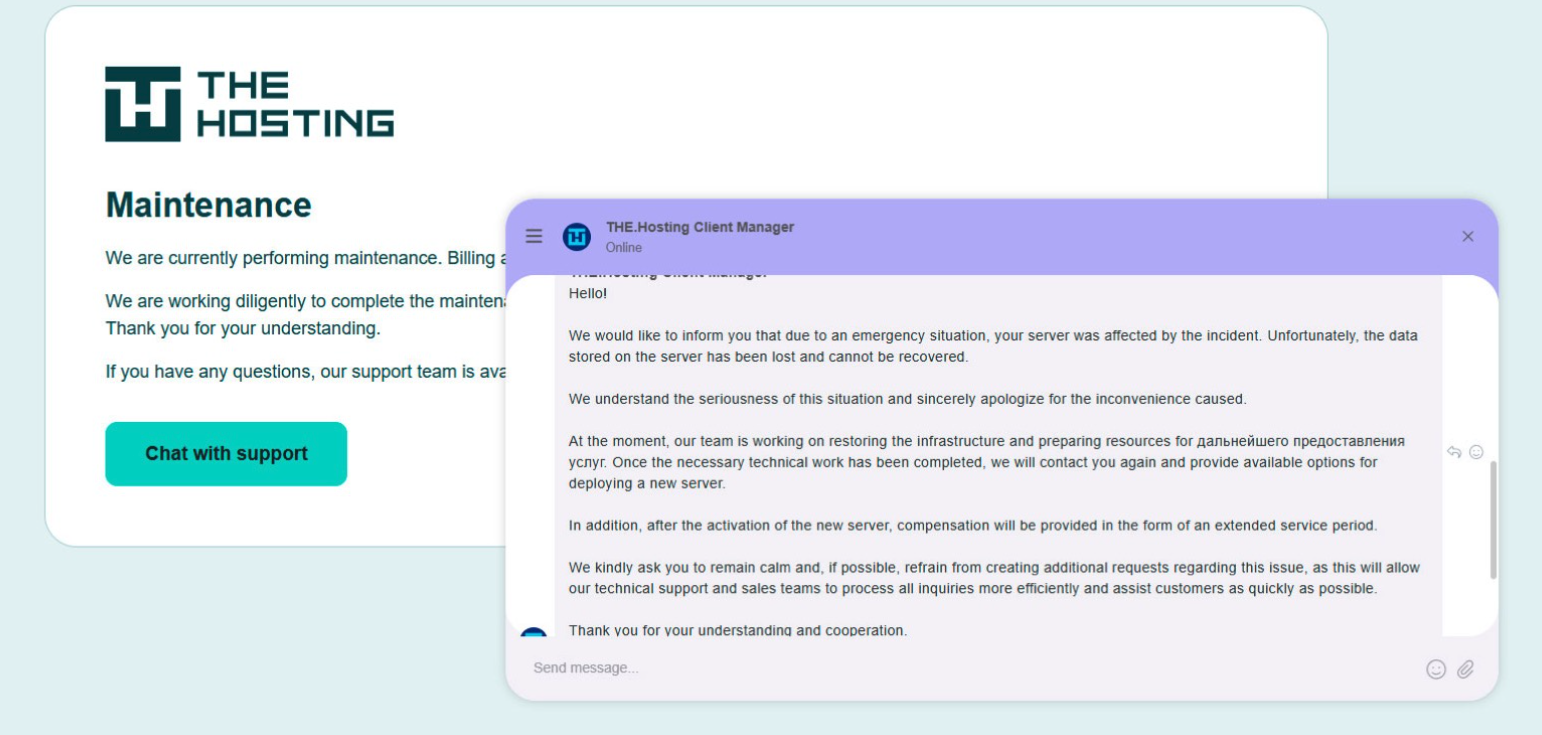
However, the reality of the situation on the ground contradicts these claims. Upon the seizure of the servers, customers of the[.]hosting were met with a stark message: all data stored on the seized hardware had been rendered inaccessible and effectively lost, a common outcome when law enforcement terminates a criminal hosting provider.
Implications for Future Cyber-Governance
The dismantling of the MIRhosting/WorkTitans nexus provides a blueprint for how European authorities intend to handle the weaponization of domestic infrastructure. The case highlights three critical areas for future policy:
- Strict Liability for Infrastructure Providers: There is a growing consensus that hosting providers must exercise greater due diligence regarding the nature of their clients, particularly those operating with clear ties to high-risk jurisdictions.
- Cross-Border Enforcement: The collaboration between the Dutch FIOD and international intelligence partners suggests that the days of "digital safe havens" within the EU are numbered. The investigation relied on granular data analysis of traffic patterns, a testament to the increasing sophistication of state-level cyber-investigators.
- The Human Cost of "Gray Zone" Operations: The case of Youssef Zinad and Andrey Nesterenko demonstrates that those who facilitate state-backed cyber-aggression often exist in the "gray zone" between legitimate business and illicit activity. Their arrests signal that the law will no longer distinguish between the "provider" and the "perpetrator" if the former knowingly facilitates the latter.
As the Dutch justice system prepares to build its case, the international cybersecurity community will be watching closely. The outcome of this trial could set a precedent for how the EU handles the next generation of hybrid warfare, where the front lines are not defined by physical borders, but by the fiber-optic cables and server racks that connect the continent. For now, the silence in the data centers of Dronten and Schiphol-Rijk serves as a temporary, but necessary, disruption to one of Russia’s most resilient digital outposts.