Retro Renaissance: The 8-Bit Guy Unlocks Five-Monitor Magic on a Commodore 128 and EGA PCs
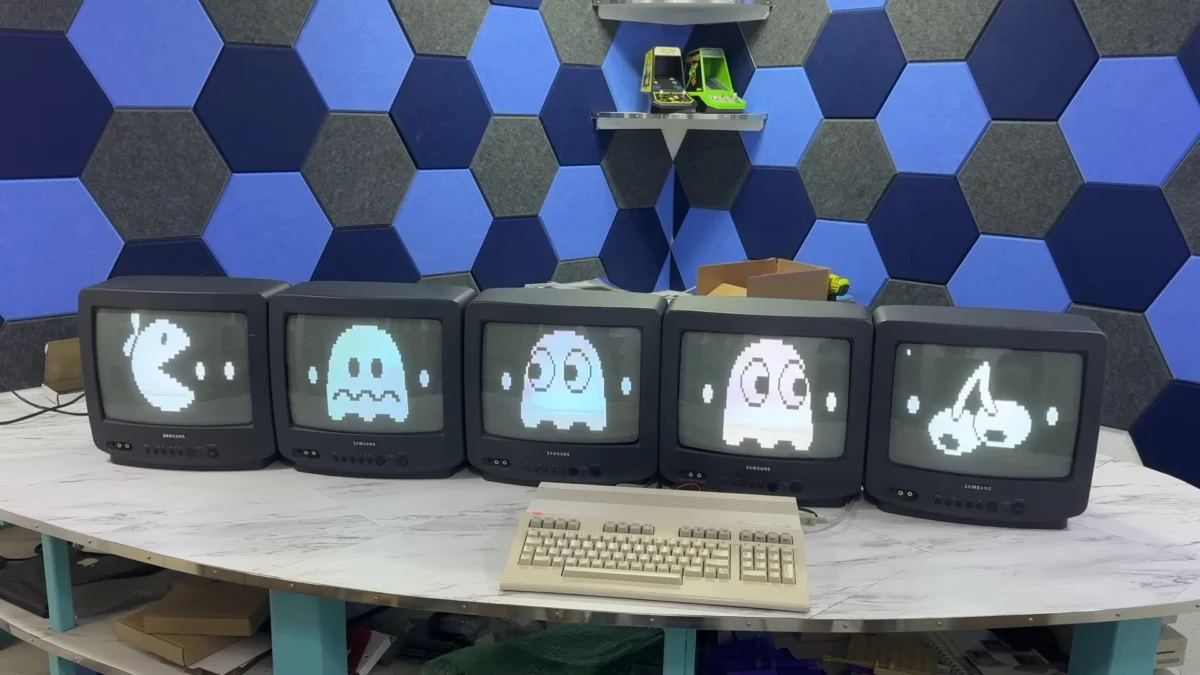
In an astonishing display of retro computing ingenuity, renowned YouTube personality "The 8-Bit Guy" (David Murray) has captivated the vintage tech community by successfully driving five independent monitors from a single, unmodified Commodore 128. This groundbreaking feat, documented in a recent video, not only pushes the perceived limitations of 8-bit hardware but also resurrects forgotten display capabilities, extended further to 16-color EGA systems, challenging long-held assumptions about multi-monitor setups in the early days of personal computing.
The revelation stems from a clever exploitation of the Commodore 128’s RGBI video output and a custom hardware solution known as the "HyperDisplay," designed by Joe Burks. This innovative approach allows the complex RGBI signal, typically used for a single color monitor, to be separated into multiple monochrome composite video feeds, alongside the C128’s inherent composite output. The experiment highlights a fascinating intersection of vintage hardware design, modern engineering, and creative software application, prompting both awe and a collective "why didn’t we think of this?" from enthusiasts worldwide.
A Blast from the Past: Unlocking Multi-Monitor Magic in the 8-Bit Era
The concept of multiple display outputs from a single computer is a modern luxury, often associated with high-end workstations, gaming rigs, or sophisticated professional setups. Yet, "The 8-Bit Guy" has peeled back decades of technological advancement to demonstrate that rudimentary forms of multi-screen computing were, in fact, latent within the very machines that defined the personal computer revolution. His latest video is not just a technical demonstration; it’s a historical re-evaluation, forcing a reconsideration of the capabilities of venerable systems like the Commodore 128 and early IBM PC compatibles.
The 8-Bit Guy’s Daring Experiment
At the heart of Murray’s demonstration lies a seemingly audacious goal: to connect an array of vintage monitors to a single 8-bit machine. For those who grew up in the era of CRT displays, the idea of even having a dedicated monitor for a personal computer was a sign of privilege, often necessitating the use of the family television. The notion of five monitors, however, veered into the realm of science fiction or, perhaps, a computer store display – a spectacle rather than a practical setup. Murray, known for his meticulous restoration and exploration of vintage hardware, took this fantastical concept and grounded it in reality, revealing a hidden versatility within the C128’s video architecture.
The core of the multi-monitor trick involves a clever manipulation of the video signal. While the C128 itself remains stock (barring a modern SD card disk emulator for convenience), the magic happens externally. The computer’s RGBI port, typically supplying Red, Green, Blue, and Intensity signals for a single color display, is intercepted. Through the HyperDisplay hardware, these distinct signals are individually converted into separate monochrome composite video streams. This yields four independent black-and-white outputs. Coupled with the C128’s native VIC-II chip, which provides a standard composite video output, a total of five screens can be simultaneously driven. The result is a striking, albeit monochrome-heavy, multi-display workstation born from 1980s silicon.
Beyond Single Screens: The Vision
This experiment is more than a mere technical stunt; it’s a testament to the untapped potential of vintage hardware and the enduring spirit of innovation within the retro computing community. It challenges the prevailing narrative that multi-monitor setups are a purely modern phenomenon, illustrating how fundamental principles of video signal processing could have, in theory, allowed for such configurations decades ago. The implications extend beyond the Commodore, as Murray also successfully applies a similar, albeit simpler, technique to an IBM PC compatible equipped with an Enhanced Graphics Adapter (EGA) card, yielding a four-screen setup from a 16-color palette. This duality underscores the broad applicability of the signal-splitting principle across different vintage architectures.
A Journey Through Time: The Evolution of Display Technology
Understanding the significance of "The 8-Bit Guy’s" achievement requires a brief delve into the history of display technology and multi-monitor configurations. For decades, personal computing was largely a single-screen affair, driven by economic and technological constraints.
From Monolithic Screens to Desktop Sprawl
In the early days of computing, screens were often integrated into terminals or proprietary systems, with multi-screen setups reserved for specialized applications like air traffic control, scientific visualization, or command centers. As personal computers emerged, cost dictated that a single display output was the norm. Monitors themselves were expensive, and the graphical processing units (GPUs) of the time were rudimentary, often struggling to drive even a single display at reasonable resolutions and color depths.
The 8-bit era, in particular, was characterized by hardware limitations. Graphics chips like the Commodore’s VIC-II or the Apple II’s video circuitry were designed for simplicity and cost-effectiveness, typically outputting a single composite or RF signal for consumer televisions. Even dedicated RGB monitors for systems like the C128 or Amiga were a premium offering. The idea of multiple simultaneous outputs, beyond what a single graphics card could intrinsically manage, was largely unheard of in consumer-grade machines. It wasn’t until the late 1990s and early 2000s, with the advent of powerful GPUs and standardized multi-output interfaces like VGA and DVI, that multi-monitor setups became accessible and commonplace for the average user.
The Genesis of the HyperDisplay: A Modern Collaboration
The path to the five-monitor Commodore was not a solo endeavor. David Murray’s video highlights a crucial collaboration with Joe Burks, the brilliant hardware engineer responsible for designing the "HyperDisplay" adapter. This device is the linchpin of the Commodore 128 setup, transforming a theoretical possibility into a tangible reality. Burks’ design is a modern creation, born out of a contemporary understanding of vintage video signals and component-level electronics.
The HyperDisplay exemplifies the collaborative spirit prevalent in the retro computing community, where enthusiasts pool their knowledge and skills to overcome historical limitations and push the boundaries of what was thought possible. Burks’ decision to open-source the design on GitHub (RetroRemake/HyperDisplay) further empowers the community, allowing others to understand, replicate, and even improve upon the technology. The availability of the device for purchase on Lectronz also signifies a growing market for specialized retro hardware, bridging the gap between historical systems and modern interfacing needs.
The 8-Bit Guy: A Pushing Force in Retro Computing
David Murray, "The 8-Bit Guy," has carved a significant niche in the retro computing landscape. His YouTube channel, with millions of subscribers, is a treasure trove of vintage computer restorations, reviews, and technical deep-dives. Murray’s appeal lies not only in his extensive knowledge and meticulous approach but also in his engaging presentation style, which makes complex technical concepts accessible to a broad audience.
His work often involves pushing the boundaries of what these old machines can do, whether it’s upgrading storage with modern SD card solutions, restoring long-lost peripherals, or, as in this case, exploring novel display configurations. His consistent efforts contribute significantly to the preservation of computing history, inspiring a new generation to appreciate the foundational technologies that paved the way for modern digital life. This latest multi-monitor hack is another feather in his cap, solidifying his reputation as a leading innovator and educator in the retro tech world.
Deconstructing the Display: The Technical Marvels Behind the Screens
The magic of the multi-monitor setup lies in a nuanced understanding and manipulation of vintage video signals. Both the Commodore 128 and the EGA PC leverage different aspects of their respective video architectures to achieve these impressive results.
The Commodore 128: An Unassuming Powerhouse
The Commodore 128, released in 1985, was a sophisticated machine for its time, designed to be backward compatible with the hugely popular Commodore 64 while offering enhanced capabilities. One of its key advancements was its improved video output, featuring a dedicated 80-column mode and an RGBI output port, a significant upgrade from the C64’s composite-only video.
Unpacking RGBI: Redefining Color and Intensity
The RGBI standard (Red, Green, Blue, Intensity) was a common digital video interface in the mid-1980s, notably used by IBM’s CGA and EGA cards. Unlike analog RGB, where color components are represented by varying voltage levels, RGBI uses discrete digital signals for each of its primary colors (Red, Green, Blue) and an additional digital signal for "Intensity." This "Intensity" signal effectively doubles the number of available colors, allowing 8 base colors (2^3 from RGB) to become 16 (2^4 when Intensity is factored in, typically making the 8 base colors brighter versions of themselves).
The brilliance of Joe Burks’ HyperDisplay lies in recognizing that each of these RGB and Intensity signals is, at its core, a distinct digital ON/OFF signal. When these individual signals are converted into separate composite video streams, they each carry a monochrome representation of their respective component. For instance, a screen displaying only red elements will appear entirely on the "Red" output monitor, while blue elements will appear on the "Blue" output, and so on. The challenge then becomes crafting an image on the Commodore 128 that strategically uses these colors to create meaningful, segmented visuals across multiple screens. The four composite outputs derived from the RGBI port – Red, Green, Blue, and Intensity – effectively create four distinct monochrome displays.
The HyperDisplay: Joe Burks’ Ingenious Hardware Solution
The HyperDisplay adapter is the crucial intermediary in this setup. It takes the multi-channel digital RGBI output from the C128’s 8-pin DIN connector and processes each channel independently. Each R, G, B, and I signal is routed through a circuit that converts it into a standard monochrome composite video signal. This involves generating the necessary sync pulses and signal levels required for a composite monitor to interpret the digital ON/OFF state of each color channel as a black-and-white image. The simplicity and effectiveness of this conversion are a testament to Burks’ understanding of vintage video electronics. By open-sourcing the design, he has not only shared the innovation but also fostered a spirit of learning and experimentation within the community.
The VIC-II: Commodore’s Legacy Output
Adding the fifth screen to the Commodore 128 setup leverages its native video capabilities. The VIC-II (Video Interface Chip II) is the heart of the C128’s graphics, inheriting its design from the Commodore 64. It is responsible for generating the machine’s primary display output, including sprites, scrolling, and raster effects. Critically, the VIC-II provides a standard composite video output, which is what would typically be connected to a television or a dedicated composite monitor. This output, unlike the RGBI, carries a full-color signal. By utilizing this existing output alongside the four monochrome feeds from the HyperDisplay, "The 8-Bit Guy" achieves the impressive five-screen configuration, blending a single color display with four monochrome counterparts.
Software Savvy: Crafting Multi-Screen Visuals
While the hardware is ingeniously simple, the software aspect presents its own set of creative challenges. To make effective use of the split signals, the displayed image on the Commodore 128 must be carefully composed. For example, if one wishes to display distinct information on the "Red" monitor, that information must be rendered in red on the C128’s main display. Similarly, data intended for the "Blue" monitor would be rendered in blue.
The video briefly touches upon the thinking behind this, implying that basic programming knowledge (likely in BASIC, given the C128’s nature) is sufficient to encode multi-color images that segment data across the screens. This involves understanding how colors are represented in the C128’s memory and strategically placing pixels to ensure they appear on the desired monochrome output. This transforms a limitation (monochrome split) into a creative tool, allowing for unique information display strategies.
Extending the Vision: EGA’s Multi-Monitor Renaissance
"The 8-Bit Guy" didn’t stop at the Commodore 128. He extended the concept to an IBM PC compatible system equipped with an Enhanced Graphics Adapter (EGA), demonstrating that the principle of signal splitting could be applied to other vintage video standards. EGA, introduced in 1984, was a significant upgrade from the earlier Color Graphics Adapter (CGA), offering higher resolutions and a palette of 64 colors, with 16 displayable at any one time.
EGA’s 16-Color Palette Reimagined
EGA’s 16-color mode is particularly amenable to this trick. The EGA standard, like RGBI, uses a digital signal for its color output, though its implementation is more sophisticated than the C128’s RGBI. By sending the EGA output to multiple monochrome composite monitors, each screen can display a subset of the original 16 colors. In the demonstration, the 16 colors were split across two monitors, resulting in each screen effectively displaying two distinct "colors" (e.g., black and white, or a light grey and dark grey, depending on the original colors’ intensity).
The resulting image, while technically limited, surprisingly benefits from the characteristics of old CRT monitors. The inherent blur and dithering capabilities of Deluxe Paint (a classic graphics program used in the demo) combine with the CRT’s soft display to create visuals that are more appealing than one might expect from such a reductive process. It’s a testament to how creative constraints can sometimes lead to unexpectedly pleasing aesthetic outcomes.
The Right Hardware: Selecting the Optimal EGA Card
A crucial detail for the EGA experiment is the selection of the graphics card. Not all EGA cards were created equal, and some designs blocked the 16-color modes when configured to output IRGB/CGA compatibility signals. "The 8-Bit Guy" specifically notes that a Trident card was used to good effect, implying that certain chipsets or card designs retained the necessary signal integrity for this splitting trick to work. This highlights the intricate and sometimes inconsistent nature of vintage hardware, where subtle variations in design can have significant impacts on compatibility and functionality.
Deluxe Paint: The Unsung Hero of Retro Graphics
The software chosen for the EGA demonstration was Deluxe Paint, a legendary graphics program that first appeared on the Amiga and later found its way to various platforms, including the IBM PC. Deluxe Paint is celebrated for its intuitive interface, powerful pixel-art tools, and advanced features for its time, including sophisticated dithering capabilities. Its ability to create complex pixel-art images with subtle shading and color transitions proved invaluable for the multi-monitor EGA setup. The program’s dithering, in particular, helped to create the illusion of greater color depth on the monochrome split screens, making the resulting images surprisingly robust and visually interesting despite the limited palette. Its enduring legacy, even after four decades, underscores its status as a foundational tool in the history of digital art.
Echoes from the Community: Reactions and Reflections
The unveiling of this multi-monitor hack has sent ripples of excitement and nostalgia throughout the retro computing community, prompting a wave of reactions ranging from amazement to a collective introspection on what might have been.
A Collective Revelation: "Did We Miss This?"
Perhaps the most common sentiment expressed in response to "The 8-Bit Guy’s" video is one of profound surprise, often accompanied by the question: "Why wasn’t this known or widely used back in the day?" For many enthusiasts and even former computer store employees from the 8-bit era, the idea of a five-monitor Commodore 128 was simply unthinkable. The perceived limitations of the hardware, combined with the expense and bulk of multiple monitors, meant that such an experiment was likely beyond the scope of most users or even developers.
The hack’s simplicity, once understood, only deepens this sense of revelation. It highlights how certain functionalities, though technically possible, might have remained obscure due to prevailing market conditions, lack of documentation, or simply a failure of imagination. The "comments section challenge" posed by "The 8-Bit Guy" – inviting viewers to share if they had ever witnessed such a setup in the 1980s – further emphasizes the novelty of this rediscovery. The general consensus suggests that this particular application of video signal splitting was indeed a largely overlooked capability.
The Creators’ Perspective: Innovation and Accessibility
David Murray, through his video, conveys a sense of wonder and satisfaction in uncovering these hidden capabilities. His enthusiasm is infectious, inspiring others to delve deeper into the technical intricacies of vintage machines. Joe Burks’ contribution, the HyperDisplay, further exemplifies a modern approach to retro hardware: making sophisticated solutions accessible through open-source designs and commercially available boards. This democratizes innovation, allowing a wider audience to replicate and experiment with advanced retro hacks without needing specialized fabrication skills. The collaboration highlights a vibrant ecosystem where knowledge sharing and practical application drive continuous discovery.
Fostering a Culture of Experimentation
Beyond the technical achievement, the video fosters a culture of experimentation. It encourages viewers to look beyond the obvious, to question perceived limitations, and to explore the latent potential within old hardware. The act of "The 8-Bit Guy" stepping outside his typical 8-bit comfort zone to demonstrate the EGA trick further broadens the scope of inquiry, inviting enthusiasts to consider how these principles might apply to other vintage systems. This constant push against conventional wisdom is what keeps the retro computing scene dynamic and engaging, ensuring that even decades-old technology can still yield exciting new discoveries.
The Future of the Past: Implications for Retro Computing and Beyond
"The 8-Bit Guy’s" multi-monitor experiment is more than a fleeting viral video; it carries significant implications for the retro computing community and beyond, offering new perspectives on hardware capabilities, educational insights, and creative possibilities.
Pushing the Boundaries of Vintage Hardware
This demonstration fundamentally redefines what is considered possible with machines like the Commodore 128 and early IBM PCs. It serves as a powerful reminder that the true limits of vintage hardware are often not inherent in the silicon itself, but in the interpretations and applications developed over time. By showcasing an entirely new display paradigm, the experiment opens the door for other enthusiasts to explore similar "hidden" features in other retro systems. Could other obscure video standards from the 1980s or early 1990s also yield multi-screen potential through similar signal-splitting techniques? This challenge is implicitly thrown to the community, encouraging further exploration and innovation.
Educational Insights into Display Principles
For those interested in computer science, electronics, or media studies, the video offers invaluable educational insights. It provides a practical, tangible demonstration of fundamental video signal principles: how color information is encoded, how composite video works, and how digital signals can be manipulated. Understanding RGBI as separate components that can be individually processed offers a clearer picture of how early color graphics operated, demystifying concepts that might otherwise seem abstract. This hands-on approach to learning about display technology is a powerful tool for educators and self-learners alike.
New Avenues for Digital Art and Expression
The ability to drive multiple, independently controlled screens from a single vintage machine opens up fascinating new avenues for digital art and creative expression. Imagine multi-screen pixel art installations, interactive retro displays, or even experimental video games designed to utilize these segmented outputs. Artists could create immersive environments using the distinct monochrome feeds, or craft narratives that unfold across a physical array of vintage monitors. This intersection of historical technology and contemporary artistic practice could lead to unique and compelling works, breathing new life into old hardware.
The Call to Experiment: Exploring New Standards
"The 8-Bit Guy" concludes his video with a direct challenge to his audience: to explore how many other retro standards this trick could work on. He specifically mentions the possibility of splitting VGA signals, noting that it would yield only three screens and is "way too new for him." This playful dismissal, however, serves as an invitation for others to pick up the mantle.
The VGA standard, with its analog Red, Green, and Blue signals, presents a different set of challenges and opportunities. While the digital RGBI split is straightforward, splitting analog VGA would require different circuitry, likely involving multiple Analog-to-Digital Converters (ADCs) to separate the channels and then convert them back to composite. However, the potential for driving three independent analog monochrome displays from a single VGA output is certainly intriguing.
Beyond VGA, one could ponder other competing CGA standards from the 1980s, proprietary video systems, or even early grayscale display adapters. Each standard presents its own unique technical puzzle, waiting for an enthusiast to unravel its secrets. The retro computing community thrives on such challenges, and it is highly probable that "The 8-Bit Guy’s" video will inspire a new wave of hardware hacking and discovery.
Conclusion
"The 8-Bit Guy’s" demonstration of a five-monitor Commodore 128 and a four-screen EGA setup is more than just a captivating retro tech hack; it’s a profound statement about the enduring ingenuity of the computing community and the untapped potential residing within vintage hardware. By collaborating with engineers like Joe Burks and leveraging a deep understanding of video signal principles, David Murray has not only entertained but also educated and inspired. He has peeled back layers of technological history, revealing that the seeds of multi-monitor computing were sown far earlier than many had realized. This achievement underscores the dynamic nature of retro computing, where the past continually informs, challenges, and enriches our understanding of the present, ensuring that even decades-old machines can still surprise and innovate. The call to action has been issued: the future of the past awaits further exploration.