The Future of Version Control: Epic Games Unveils "Lore," an Open Source Solution for Massive Data Workflows
In a landmark announcement during the State of Unreal 2026 keynote, Epic Games has officially pulled the curtain back on Lore, an ambitious, in-house developed version control system (VCS) designed to address the specific, high-stakes needs of modern game development and film production. By releasing the project as open source, Epic is positioning Lore not merely as a tool for its own internal pipeline, but as a potential industry-standard replacement for fragmented workflows that currently rely on disjointed patches and proprietary software.
The Core Problem: A Disconnect in Version Control
To understand the significance of Lore, one must first look at the unique technical challenges faced by studios creating high-fidelity digital assets. In modern software development—specifically in the fields of AAA game development and cinematic production—teams are no longer just managing source code. They are juggling a complex, symbiotic relationship between lightweight text-based code and massive, multi-gigabyte binary assets, such as 8K textures, high-poly geometry, and complex animation data.
Standard version control systems, most notably Git, were fundamentally architected for source code. While Git excels at managing text files, it struggles with the sheer weight of binary assets. To bridge this gap, developers have long relied on Git LFS (Large File Storage). However, Git LFS acts as an "add-on" or an external layer rather than a native component, often leading to cumbersome workflows, performance bottlenecks, and increased complexity in managing repository health.
Conversely, the industry has historically leaned toward Perforce for its robust handling of binary assets. Yet, Perforce is a closed, proprietary system. It requires a constant, active connection to a central server, making it ill-suited for remote work, distributed teams with varying internet reliability, or developers who need to work while offline. Furthermore, because it is proprietary, third-party developers cannot extend, modify, or build tools on top of the Perforce ecosystem to customize their pipelines.
Epic Games identified a "trilemma" that none of the existing market leaders could solve: the need for a system that provides native binary handling, offline-first capabilities, and a fully transparent, open-source specification.
Chronology of Development
The genesis of Lore lies in the growing pains of the Unreal Engine ecosystem. As Unreal Engine 5 pushed the boundaries of photorealism, Epic’s internal teams found that existing tools were slowing down iteration cycles.
- Early 2024: Internal teams at Epic Games begin exploring a custom VCS to manage the massive datasets required for high-end digital twins and upcoming game projects.
- Late 2024–2025: The "Lore" project moves from a prototype phase to a foundational tool used internally across multiple departments, including the Fortnite team and the cinematic production division.
- June 2026: During the State of Unreal 2026 keynote, Epic Games CEO Tim Sweeney formally announces the project to the public, confirming the decision to release it as open source to foster community adoption and contribution.
- Present Day: Lore is currently in a pre-stable state (v0.8.3), with Epic inviting developers to test the platform, provide feedback, and contribute to the evolution of the codebase.
Technical Architecture: How Lore Changes the Game
Lore is built from the ground up to prioritize performance and data integrity. By leveraging the Rust programming language for its core library, server, and CLI, Epic has ensured that Lore is memory-safe, highly performant, and capable of handling massive concurrency.
The "Authority" vs. "Local" Paradigm
One of the most innovative aspects of Lore is its hybrid structure. While a central server acts as the "authority" for project permissions and conflict resolution, the actual day-to-day work—saving changes, branching, and committing—happens locally. This "offline-first" architecture means that a developer can be in a studio, on a plane, or working from a remote location with a spotty connection, and their productivity remains entirely unaffected.
Data Deduplication and Fingerprinting
In traditional systems, duplicating a large file across different branches or revisions often consumes massive amounts of disk space. Lore assigns a unique "fingerprint" to every piece of content. If the same data exists in two different places, it is stored only once, drastically reducing the storage footprint and improving network efficiency during synchronization.
Granular File Handling
Perhaps the most impressive feature for artists and designers is the way Lore handles large files. Instead of requiring the user to re-upload a massive multi-gigabyte file after a minor edit, Lore breaks files into smaller "chunks." When a change is made, only the altered chunks are transmitted. This granular approach significantly accelerates push and pull times, allowing for rapid iteration in projects that would otherwise take hours to sync.
Lazy Loading
Lore defaults to a "lazy" approach to file management. When you clone or sync a repository, your machine does not download every single file in the project. Instead, it pulls down data only when it is explicitly requested by a tool or a user. This is a game-changer for massive projects where a developer may only need to work on a specific character asset or level, rather than the entire multi-terabyte project repository.
Official Stance and Community Integration
Epic Games has been transparent about the current state of Lore. By releasing it at v0.8.3, they are signaling that while the technology is functional and powerful, it is still evolving. They have explicitly warned that interfaces and storage formats may shift as the project matures toward a stable 1.0 release.

To ensure developers can integrate Lore into their existing workflows, Epic has provided official SDKs for JavaScript, Python, C#, and Go. Crucially, the CLI is not a "privileged" user of the system; every function accessible via the command line is also available through the public API. This means that if a studio wants to build a custom UI or an integration plugin for a DCC (Digital Content Creation) tool like Maya, Blender, or Houdini, they have equal access to the system’s capabilities.
Implications for the Industry
The release of Lore has the potential to trigger a significant shift in the software development landscape, particularly in industries where "Big Data" meets "Code."
1. Breaking the Proprietary Stranglehold
For years, large studios have been locked into expensive, proprietary version control licenses. Lore provides a viable, high-performance alternative that allows companies to own their pipeline. By open-sourcing the project, Epic is betting that the community will build a robust ecosystem of plugins and integrations that would be impossible under a closed-source model.
2. Democratizing High-End Production
Small to mid-sized indie studios have often struggled to implement professional-grade version control for large assets. The complexity and cost of managing Perforce setups or building custom solutions for Git LFS have been major barriers to entry. Lore could democratize high-fidelity development by providing a free, professional-grade toolset that scales from a solo developer to a massive global team.
3. Fostering a New Ecosystem
The choice of Rust for the core library is strategic. It ensures that Lore will be performant for years to come and makes it easier for the open-source community to contribute securely. The presence of official SDKs for major programming languages suggests that Epic is serious about Lore becoming a platform rather than just a tool. We can expect to see an explosion of third-party tools—web dashboards, visual merge tools, and cloud-native hosting providers—appearing within the next 18 to 24 months.
Getting Started
For those interested in exploring the technology, Epic Games has simplified the barrier to entry. Eschewing the need for complex containerization or environment setup, a single script handles the installation of the CLI and local server.
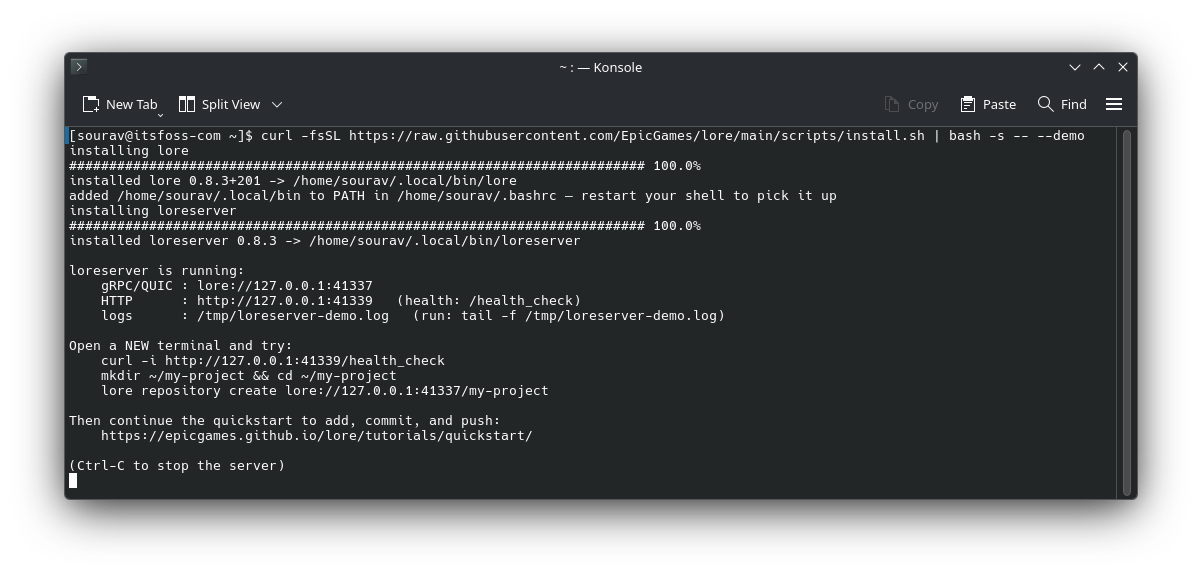
The installation process on Linux is as straightforward as executing:
curl -fsSL https://raw.githubusercontent.com/EpicGames/lore/main/scripts/install.sh | bash -s -- --demo
Furthermore, Epic has established a Discord community where developers can interface directly with the Lore engineering team. This level of openness suggests that Epic is not just "dumping code" into the wild but is actively seeking to foster a collaborative environment where Lore can be hardened and refined by the very people who will use it to build the next generation of digital experiences.
Conclusion
Lore represents a rare moment where a major industry player solves a systemic problem not just for their own profit, but for the benefit of the entire ecosystem. By recognizing that the requirements for modern digital production have outpaced the tools of the last two decades, Epic Games has laid the foundation for a new era of collaborative development. While the project is still in its infancy, its architectural focus on efficiency, binary handling, and open-source modularity makes it one of the most exciting technical releases of the year. Whether Lore becomes the new standard remains to be seen, but the industry now has a powerful, modern alternative to the status quo—and that is a victory for developers everywhere.