KolibriOS: A Featherweight Flashback Redefining Speed in a Bloated Digital World


The Relentless Pursuit of Instant Boot: Unpacking KolibriOS’s Radical Efficiency
In an era dominated by ever-expanding operating systems and the ubiquitous ritual of waiting for a computer to boot, the very concept of instantaneous access often feels like a relic of a bygone technological age. Modern machines, despite their prodigious processing power and vast reserves of RAM, routinely demand a patient 30 seconds or more to transition from inert hardware to a usable desktop environment. This pervasive delay has become an accepted "fact of life" for users across the globe, an unwritten rule that software will inevitably grow, becoming heavier and slower with each successive iteration. Yet, this narrative of relentless digital bloat finds a compelling and vibrant counter-argument in KolibriOS, a remarkable operating system that not only defies but actively shreds the expectation of protracted boot times.
KolibriOS emerges as a fascinating anomaly, a testament to what can be achieved when efficiency is elevated to the paramount design principle. For many veteran computer users, the lightning-fast responsiveness of KolibriOS evokes a profound sense of nostalgia, drawing direct comparisons to the legendary Commodore Amiga. The Amiga, a machine renowned for its pioneering multimedia capabilities in the 1980s and early 90s, achieved its rapid startup by largely housing its core operating system within Read-Only Memory (ROM). KolibriOS, while operating on entirely different architectural principles, delivers a similarly immediate experience, bringing users directly to a fully functional graphical desktop in what can only be described as a proverbial blink of an eye. This striking performance is not merely an incidental feature but the direct consequence of its foundational design: KolibriOS is meticulously crafted entirely in assembly language. This low-level programming choice allows for unparalleled control over hardware and memory, stripping away all non-essential overhead to achieve a footprint so minuscule it can comfortably run from a single floppy disk.
Born from the legacy of MenuetOS, KolibriOS represents a free and open-source fork, emerging after MenuetOS transitioned to a proprietary licensing model for its 64-bit version. This philosophical divergence underscores KolibriOS’s commitment to accessibility and community-driven development, positioning it as a unique proposition in the contemporary computing landscape. Its minimal resource demands – a mere 1MB of disk space, 8MB of RAM, and a 32-bit 586-class processor – make it an ideal candidate for resurrecting ancient hardware or for those simply curious about the outer limits of operating system efficiency. However, this pursuit of ultimate minimalism comes with a significant trade-off for the modern user: its integrated web browsers, while functional, lack support for HTTPS, rendering the vast majority of today’s encrypted internet inaccessible. While this immediately disqualifies KolibriOS as a conventional "daily driver" for general web-centric tasks, it simultaneously solidifies its identity as a specialized, high-performance platform for a specific set of applications and a fascinating subject for exploration and education.
A Legacy Forged in Assembly: The Genesis and Evolution of KolibriOS
The story of KolibriOS is inextricably linked to the broader narrative of lightweight operating systems and the enduring allure of assembly language programming. To fully appreciate its significance, one must trace its lineage back to its progenitor, MenuetOS.
The Rise of MenuetOS and the Assembly Imperative
MenuetOS was conceived and primarily developed by Ville M. Mikael Turunen, a Finnish programmer, in 2000. His ambitious goal was to create a fully functional, graphical operating system written entirely in assembly language. This was a radical departure from the prevailing trend of developing OSes in higher-level languages like C or C++, which, while offering greater portability and developer productivity, introduced layers of abstraction that inherently impacted performance and footprint. Turunen’s vision for MenuetOS was to demonstrate the raw power and efficiency achievable through direct hardware control, aiming for an OS that was compact, lightning-fast, and responsive.
Initially, MenuetOS was developed for the 32-bit x86 architecture and was freely available. It quickly garnered attention from a niche community of developers and enthusiasts fascinated by its technical prowess and unique approach. The sheer audacity of building an entire OS, including its kernel, graphical user interface (GUI), and core applications, from the ground up in assembly was a compelling demonstration of skill and dedication.
The Fork: A Divergence in Philosophy
As MenuetOS matured, Turunen began work on a 64-bit version. However, a pivotal decision was made: the 64-bit MenuetOS would transition to a proprietary license. This move, while understandable from a developer’s perspective seeking to commercialize years of intensive labor, clashed with the open-source ethos that many of its early adopters and contributors had embraced. The community, accustomed to the free and open nature of the 32-bit version, faced a crossroads.
It was this philosophical divergence that catalyzed the birth of KolibriOS. A group of dedicated developers, committed to the principles of open-source software and the continued development of a free, assembly-language-based OS, initiated a fork of the last freely available 32-bit MenuetOS code. This new project was christened KolibriOS, taking its name from the Russian word for hummingbird ("kolibri"), a fitting moniker for an operating system celebrated for its small size, speed, and agility.
Milestones and Community-Driven Development
Since its inception around 2004-2009 (the exact early transition period is somewhat fluid, with active development under the KolibriOS name solidifying in the latter half), KolibriOS has been a testament to collaborative, community-driven development. The project has seen continuous updates, bug fixes, and feature additions, all orchestrated by a decentralized team of volunteers.
Key milestones in its development include:
- Establishment of a robust community: Forums, wikis, and IRC channels became central hubs for coordination and knowledge sharing.
- Expansion of hardware support: While inherently limited by its assembly nature and specific architecture, efforts have been made to improve compatibility with various older hardware components.
- Development of an application ecosystem: Despite its small size, the community has built or ported a surprising array of applications, including games, utility tools, media players, and even development environments for assembly programming within KolibriOS itself.
- Continuous refinement of the GUI: While maintaining its retro aesthetic, the graphical interface has seen improvements in usability and stability.
- Regular releases: The project consistently pushes out new versions, indicating ongoing active development and a commitment to maintaining a functional and evolving system.
The chronology of KolibriOS is not one of corporate backing or massive funding, but rather a grassroots endeavor driven by passion, technical curiosity, and a shared belief in the power of minimalist computing. It stands as a living example of how a dedicated open-source community can sustain and evolve a complex software project against the backdrop of industry giants.
The Microscopic Marvel: Technical Prowess and User Experience
To truly grasp the essence of KolibriOS, one must delve deeper into its technical underpinnings and the unique user experience it offers. It’s a study in contrasts, blending archaic aesthetics with startling modern responsiveness, demonstrating that raw power isn’t always about gigahertz and gigabytes.

Minimalist Hardware Demands, Maximum Efficiency
The stated minimum system requirements for KolibriOS are nothing short of astonishing in the context of 21st-century computing:
- 1MB of disk space: This isn’t a typo. The entire operating system and a suite of core applications can fit within this minuscule allocation, making it ideal for ancient hard drives, compact flash cards, or even its iconic floppy disk boot.
- 8MB of RAM: A mere fraction of what even a single modern web browser tab demands, this memory footprint allows KolibriOS to run comfortably on machines from the late 1990s or early 2000s that would otherwise struggle with any contemporary OS.
- 586-class 32-bit processor: This refers to processors equivalent to or better than the Intel Pentium P5 (e.g., AMD K5, Cyrix 6×86), solidifying its compatibility with a vast range of vintage hardware.
When deployed on a modern machine, such as a ThinkPad from the 2020s, KolibriOS doesn’t just boot quickly; it snaps into existence. The transition from a cold start to a fully interactive GUI desktop is virtually instantaneous, a phenomenon that feels almost alien after years of progress bars and loading spinners. This responsiveness extends beyond boot-up: applications load "on a dime," appearing almost pre-cached, regardless of whether they’ve been accessed recently. This perceived speed is a direct consequence of its assembly language foundation and highly optimized kernel.
The Art of Assembly: A Deep Dive into Performance
The decision to write KolibriOS entirely in assembly language is its defining characteristic and the secret to its unparalleled efficiency. Assembly language provides direct, granular control over the processor’s registers and memory. This allows developers to:
- Eliminate overhead: No layers of abstraction, no complex runtime environments, no virtual machines. Every instruction is precisely what the hardware executes, leading to minimal CPU cycles per operation.
- Optimize memory usage: Memory is managed with extreme precision, avoiding bloat and reducing the working set size. This is crucial for operating within an 8MB RAM constraint.
- Fine-tune critical paths: Performance-critical sections of code, such as interrupt handlers or kernel routines, can be handcrafted for maximum speed.
While incredibly powerful for efficiency, assembly programming is notoriously complex, time-consuming, and difficult to maintain, requiring an intimate understanding of the underlying hardware architecture. This choice highlights the dedication of the KolibriOS developers to their core mission of ultimate minimalism and speed.
A Journey Back to the 90s: User Interface and Application Suite
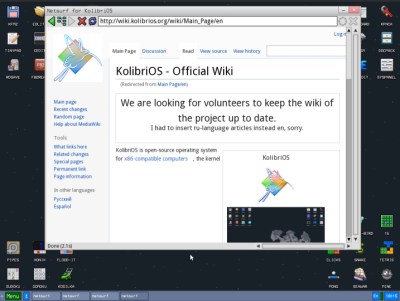
Upon booting, KolibriOS presents a graphical user interface that is immediately recognizable to anyone familiar with computing in the mid-to-late 1990s. There’s a distinct "pixelated look," devoid of the anti-aliasing and sophisticated graphical effects common in modern OSes. Windows have sharp, defined edges, and fonts are rendered without smoothing. This aesthetic, while retro, is also incredibly functional. It requires minimal GPU resources, further contributing to the OS’s overall responsiveness.
Despite its compact size, KolibriOS comes with a surprisingly rich suite of pre-installed software, catering to various needs:
- Games: A selection of classic-style games for entertainment.
- Emulators: Notably, DOSBox is included, providing an avenue to run a vast library of vintage DOS applications and games, effectively giving KolibriOS another dimension of utility for retro enthusiasts.
- Graphics Editors and Viewers: Basic tools for image manipulation and display.
- Internet Software: This includes the Webview and NetSurf web browsers. While functional for basic HTML pages, their significant limitation is the lack of HTTPS support. This means secure websites (the vast majority of the modern internet) are inaccessible, making general web browsing largely impractical.
- Assembly Software Development Tools: Reflecting its internal architecture, KolibriOS provides tools for developing applications in assembly language directly within the OS, making it an excellent platform for learning low-level programming.
- Utilities: A range of system utilities, file managers, and configuration tools.
The command-line interface (CLI) of KolibriOS offers an intriguing blend of influences. Commands often echo UNIX-style syntax, providing a familiar feel for Linux users, yet their output presentation can evoke memories of DOS. This hybrid approach underscores the system’s unique identity, borrowing effective paradigms where appropriate while maintaining its distinct core. The executables, a direct consequence of their assembly language genesis, are incredibly small, often measured in kilobytes rather than megabytes, a stark contrast to the bloated binaries of modern software. The only exceptions are larger ported applications like NetSurf or DOSBox, which carry their own inherent size.
The overall impression is of a mature, stable, and remarkably useful operating system. There are no crashes, no blue screens, just immediate, consistent performance. This level of polish in such a minimalist package is a significant achievement, proving that carefully engineered software can deliver a robust experience even with severe resource constraints.
Echoes of QNX and the Niche OS Landscape
The experience of using KolibriOS strongly echoes the legendary QNX demo floppy disk from the 1990s. QNX, a real-time operating system, famously showcased an entire OS, a functional GUI, and a web browser, all packed onto a single floppy. At the time, this was mind-blowing, a demonstration of extreme optimization. KolibriOS continues this tradition, proving that substantial functionality can be delivered within incredibly tight constraints.
While KolibriOS shares philosophical similarities with other lightweight OSes like Puppy Linux, Tiny Core Linux, or the aforementioned SliTaz (mentioned in the original article), it stands apart due to its assembly language foundation. Most other minimalist Linux distributions achieve their small size through careful selection of components and aggressive stripping down of standard Linux kernels and userlands. KolibriOS, by contrast, is built from the ground up, offering a truly unique, non-UNIX-like, and non-Windows-like computing experience.
The Ethos of Efficiency: Developer Insights and Community Vision
In the absence of traditional "official responses" from a corporate entity, understanding KolibriOS necessitates looking into the philosophy of its volunteer developers and the aspirations of its dedicated open-source community. Their collective efforts illuminate the motivations behind sustaining such a unique and technically challenging project.
The Developer’s Imperative: Why Assembly?
The primary motivation for developing and maintaining an operating system entirely in assembly language is multifaceted:
- Ultimate Control and Efficiency: Assembly provides the highest level of control over the hardware, allowing for extreme optimization in terms of speed, memory usage, and resource allocation. For developers who prioritize raw performance and minimal footprint above all else, assembly is the only true path.
- Educational Value: KolibriOS serves as an invaluable educational tool. For aspiring operating system developers, embedded systems engineers, or anyone interested in understanding how computers truly work at their most fundamental level, studying KolibriOS’s codebase offers unparalleled insights into low-level programming, kernel design, and hardware interaction.
- The Technical Challenge: For many, the sheer technical challenge of building a complex system like an OS in assembly is a powerful motivator. It’s a demonstration of mastery and a pursuit of programming purity.
- Preservation of a Paradigm: In an age where high-level languages dominate, KolibriOS keeps the art of assembly programming for entire systems alive, showcasing its potential and inherent elegance for specific applications.
These motivations are not driven by commercial gain but by a deep passion for computing fundamentals and a commitment to pushing the boundaries of software efficiency.
A Community Forged in Shared Vision
The KolibriOS community is the lifeblood of the project. Composed of programmers, testers, documentarians, and enthusiasts from around the world, this decentralized group collaborates primarily through online forums, wikis, and occasional chat channels. Their collective vision for KolibriOS includes:
- Stability and Reliability: A continuous effort to identify and fix bugs, ensuring the OS remains robust and dependable.
- Feature Expansion (within limits): While maintaining its minimalist core, the community works on developing new applications and improving existing ones, always with an eye towards efficiency.
- Documentation: A comprehensive wiki and user guides are maintained to help newcomers understand and utilize the system.
- Accessibility: Ensuring the OS remains free and accessible to anyone interested in exploring it.
The community operates on a meritocratic basis, where contributions are valued based on their technical quality and alignment with the project’s core philosophy.
Navigating the Inherent Challenges
Despite its strengths, KolibriOS faces significant challenges inherent to its design and the broader technological landscape:
- Developer Pool: The number of programmers proficient and willing to write system-level code in assembly language is significantly smaller than those working with higher-level languages. This limits the pace of development and the size of the contributing team.
- Hardware Compatibility: Modern hardware architectures are increasingly complex, and writing assembly drivers for every new component is an arduous task. KolibriOS inherently thrives on older, simpler hardware.
- Security and HTTPS: The most prominent challenge for its utility as a modern "daily driver" is the lack of HTTPS support. Implementing modern cryptographic protocols and secure browsing stacks in assembly is an incredibly complex undertaking. It would require significant development effort, potentially expanding the OS’s footprint, and demand ongoing maintenance to keep up with evolving security standards. From the community’s perspective, this is a known limitation, and while some might wish for it, the resources and complexity involved make it a monumental task that would fundamentally alter the project’s scope. It’s often seen as a trade-off for its extreme efficiency.
- Peripheral Support: Driver development for various peripherals (printers, advanced network cards, etc.) is also a constant challenge, further limiting its utility in a fully modern context.
The developers and community are acutely aware of these limitations. Their vision for KolibriOS is not necessarily to compete directly with mainstream operating systems as a universal daily driver, but rather to excel within its niche: as a platform for extreme efficiency, a tool for education, and a testament to the power of low-level programming.
Implications and the Enduring Relevance of Extreme Minimalism
The existence and continued development of KolibriOS carry significant implications, offering valuable lessons and carving out a unique niche in the vast digital ecosystem. It forces a re-evaluation of what constitutes a "useful" operating system and challenges the prevailing paradigm of ever-increasing software complexity and resource demands.
A Counter-Narrative to Digital Bloat
In an era characterized by "feature creep" and software bloat, where operating systems and applications consume ever-increasing amounts of memory, disk space, and processing power, KolibriOS stands as a powerful counter-narrative. It demonstrates that lean, efficient software is not only possible but can deliver an incredibly responsive and stable user experience. Its existence highlights a fundamental truth: much of the "progress" in mainstream computing comes at the cost of efficiency, with layers of abstraction, compatibility overhead, and often unnecessary features contributing to slower performance. KolibriOS reminds us of the elegance and speed that can be achieved when every byte and every CPU cycle is meticulously accounted for.
Niche Applications and Resurrecting Vintage Hardware
While not a universal daily driver, KolibriOS finds compelling utility in several specific niches:
- Vintage Hardware Revival: Its minimal system requirements make it an ideal candidate for breathing new life into older 32-bit machines (Pentium-era PCs and beyond) that would otherwise be considered obsolete. An old laptop or desktop, struggling under a lightweight Linux distro, could become surprisingly snappy and functional with KolibriOS.
- Emulator Platform: As the article notes, KolibriOS makes an excellent emulator platform. With DOSBox readily available, it can transform an old machine into a dedicated retro gaming or vintage software station, running applications that predate modern operating systems. The speed of the underlying OS enhances the experience of running emulated environments.
- Educational Tool: For students and enthusiasts interested in operating system development, assembly language programming, or computer architecture, KolibriOS offers a hands-on learning environment. Its compact and open codebase provides a tangible example of a complete OS built from the ground up.
- Embedded Systems (Potential): While not explicitly designed for it, the extreme minimalism and efficiency of KolibriOS make its core principles highly relevant to embedded systems development, where resources are severely constrained.
- Curiosity and Experimentation: For anyone fascinated by the capabilities of low-level programming and the pursuit of ultimate efficiency, KolibriOS offers a compelling platform for experimentation and exploration.
The "Daily Driver" Conundrum Revisited
The inability to support HTTPS is the Achilles’ heel that prevents KolibriOS from becoming a true "daily driver" for most modern users. The internet, in 2026, is overwhelmingly encrypted. Without secure web browsing, access to email, social media, online banking, news sites, and even Hackaday itself, is severely limited or impossible. This is not a minor inconvenience but a fundamental barrier to general-purpose utility.
However, this limitation doesn’t diminish its value. Instead, it reframes the definition of a "daily driver." For someone whose daily computing needs involve offline tasks, retro gaming, local document editing, or learning assembly programming on specific hardware, KolibriOS could be a daily driver within those parameters. It highlights that "daily driver" is not a monolithic concept but depends entirely on the user’s specific requirements.
The Enduring Appeal of Simplicity
Ultimately, KolibriOS represents an enduring appeal for simplicity and control in an increasingly complex digital world. It’s a testament to the power of fundamental computer science principles and the dedication of an open-source community. While it will never replace Windows, macOS, or mainstream Linux distributions for the average user, its existence serves as a valuable reminder of what’s possible when the pursuit of efficiency is paramount. For those with ancient hardware gathering dust, for the curious mind yearning to understand computing at its core, or for anyone seeking a break from the relentless march of digital bloat, KolibriOS offers a refreshing and lightning-fast journey back to a simpler, more responsive computing experience. It’s not just an operating system; it’s a philosophical statement, a tiny hummingbird demonstrating that sometimes, less truly is more. If you’ve got some vintage hardware and fancy something genuinely new yet profoundly retro, give KolibriOS a spin – you might just rediscover the joy of instantaneous computing.