AWS Revolutionizes Serverless Computing with the Launch of Lambda MicroVMs
In a significant expansion of its serverless ecosystem, Amazon Web Services (AWS) today announced the launch of AWS Lambda MicroVMs. This new compute primitive represents a fundamental shift in how developers handle multi-tenant, stateful, and untrusted code execution. By leveraging the battle-tested Firecracker virtualization technology—the same engine that powers AWS Lambda’s massive scale—AWS is providing developers with a dedicated, isolated, and stateful environment that eliminates the traditional trade-off between performance and security.
The introduction of Lambda MicroVMs targets a growing demand among software architects building AI-driven assistants, interactive sandboxes, and complex data analytics platforms. For the first time, AWS is offering virtual machine-level isolation with the operational simplicity of serverless, effectively bridging the gap between ephemeral functions and long-running virtual machines.
The Core Challenge: The Isolation-Latency Paradox
For years, developers working on multi-tenant applications—where end-users provide their own code or scripts—have faced a "trilemma." They needed to choose between three suboptimal paths:
- Virtual Machines (VMs): These offer the strongest security isolation but suffer from slow boot times, often measured in minutes. This latency is prohibitive for interactive user experiences.
- Containers: While faster to launch, their shared-kernel architecture introduces security risks when running untrusted, user-supplied code. Achieving "VM-grade" isolation in containers requires significant, complex, and costly hardening.
- Functions-as-a-Service (FaaS): While excellent for request-response patterns, traditional Lambda functions are inherently stateless and designed for short-lived execution. They struggle to maintain memory and disk state across interactive sessions, making them unsuitable for long-running processes or complex stateful applications.
The result has been a "hidden tax" on engineering teams. Developers were forced to build and maintain custom virtualization infrastructure—a task that requires deep expertise and distracts from core product development. AWS Lambda MicroVMs were designed specifically to dismantle this bottleneck.

How It Works: The Technology Under the Hood
At the heart of Lambda MicroVMs is Firecracker, the open-source virtualization technology built by AWS. Firecracker provides the minimalist, secure, and fast foundation necessary to run thousands of micro-virtual machines on a single physical host.
The "Snapshot and Resume" Paradigm
The architecture of Lambda MicroVMs moves away from the traditional cold-boot process. Instead, it utilizes an "image-then-launch" model:
- Initialization: Developers package their code (e.g., a Flask app or a data science library) into a Dockerfile and a zip artifact, which is uploaded to Amazon S3.
- Snapshotting: AWS Lambda spins up the environment, initializes the application, and captures a "snapshot" of the running memory and disk state.
- Instant Resume: When a user triggers an execution, the system doesn’t "boot" the OS; it restores the snapshot. This allows the application to be ready for traffic in near-instant time, even if the session requires significant pre-loaded resources.
Stateful Lifecycle Management
Unlike traditional Lambda functions that terminate upon completion, MicroVMs are designed for persistence. They support up to eight hours of total runtime. During periods of inactivity, the system can automatically suspend the MicroVM, saving the memory and disk state to a storage layer. When a new request arrives, the system resumes the state from that exact point, ensuring the end-user experiences zero interruption.
Chronology of the Development and Implementation
The path to Lambda MicroVMs has been a multi-year effort focused on refining the Firecracker stack. Since its inception, Firecracker has powered over 15 trillion Lambda invocations monthly, providing the operational maturity necessary to support this new offering.

- Phase 1 (The Foundation): AWS focused on optimizing the Firecracker snapshotting capabilities, allowing for rapid state serialization and restoration.
- Phase 2 (Developer Workflow): The team integrated the
lambda-microvmsCLI tools into the standard AWS development pipeline, ensuring that developers could treat MicroVMs as a first-class citizen alongside standard Lambda functions. - Phase 3 (Testing & Beta): AWS conducted extensive testing on the orchestration layer, ensuring that the transition between "suspended" (idle) and "running" (active) states happens transparently without breaking network connections or application logic.
- Phase 4 (Launch): Today, the service is generally available in key regions including US East (N. Virginia, Ohio), US West (Oregon), Europe (Ireland), and Asia Pacific (Tokyo).
Practical Application: A Hands-On Walkthrough
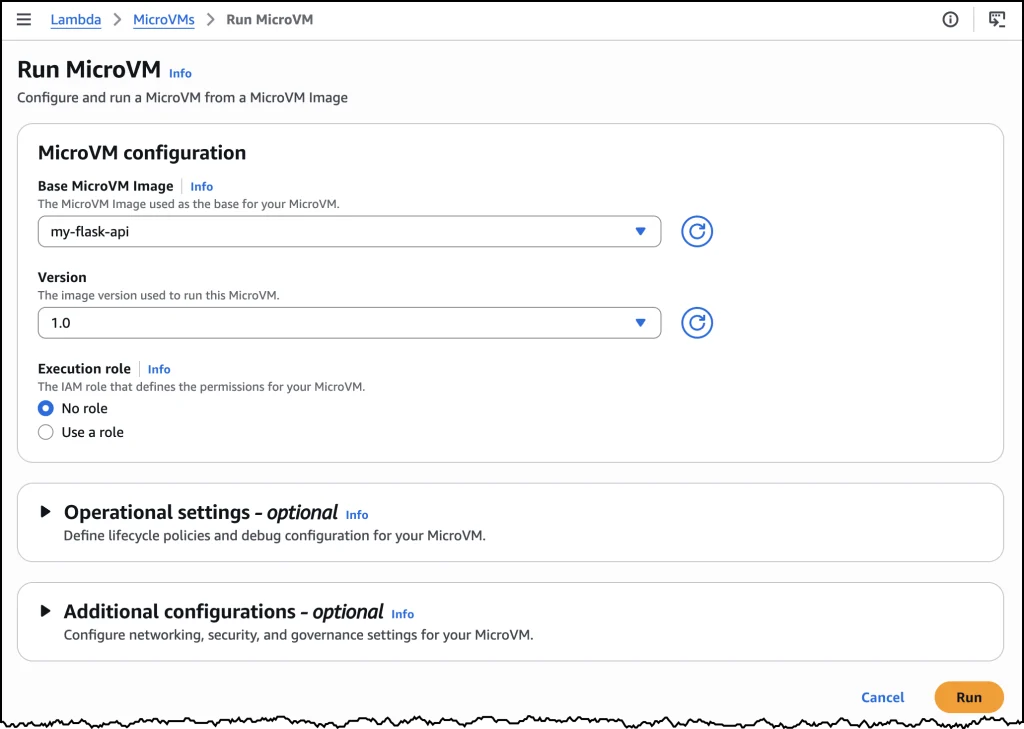
To demonstrate the capability, consider a standard Python-based Flask API. In the past, deploying this in a secure, multi-tenant environment would require managing an ECS cluster or a fleet of EC2 instances. With Lambda MicroVMs, the process is streamlined:
- Define the Environment: Create a Dockerfile specifying the environment (e.g.,
al2023-minimal) and install necessary dependencies. - Create the Image: Use the
aws lambda-microvms create-microvm-imagecommand. This triggers the background snapshot process. - Configure Idle Policies: Set the
maxIdleDurationSecondsto define when the environment should go to sleep. - Execute: When the first user connects, the MicroVM resumes from the snapshot, providing an instantly responsive API.
This workflow removes the need for managing underlying operating systems or scaling groups. The infrastructure is effectively "invisible."
Implications for the Industry
The release of Lambda MicroVMs has broad implications for several high-growth technology sectors:
1. The AI Coding Revolution
With the explosion of AI coding assistants, platforms need to safely execute user-provided code without compromising the host environment. Lambda MicroVMs provide the perfect sandbox: highly secure, easily disposable, and capable of maintaining the state of an entire development environment.

2. Interactive Data Science
Data scientists often work with large, ephemeral datasets. With MicroVMs, they can maintain a "warm" session where Python libraries and data models remain loaded in memory, avoiding the need to re-import large datasets for every interaction.
3. Cybersecurity and Vulnerability Scanning
Security tools that require scanning user-supplied code or binary artifacts can now leverage MicroVMs to execute these processes in total isolation. If a malicious payload is detected, it is trapped within the MicroVM, which can be destroyed immediately after the scan.
4. Gaming and Multi-player Servers
For games that allow users to script behaviors or build custom environments, MicroVMs offer a way to host these "user-worlds" efficiently. The stateful nature allows for long, uninterrupted gameplay sessions that go to sleep automatically when the player logs off, significantly reducing infrastructure costs.
Official Perspective and Future Outlook
AWS emphasizes that Lambda MicroVMs are not a replacement for traditional Lambda functions. Rather, they represent a "purpose-built" tool for a specific category of problems.
"Lambda Functions remain the gold standard for event-driven, request-response workloads," an AWS spokesperson noted during the launch. "However, the landscape of software development has shifted. Applications are becoming more interactive, more stateful, and more reliant on untrusted code execution. Lambda MicroVMs are our answer to that shift. We are effectively offloading the burden of virtualization management, allowing engineers to focus entirely on the code their end-users actually care about."
The service is currently limited to ARM64 architecture, supporting up to 16 vCPUs and 32 GB of memory per MicroVM. This provides a robust ceiling for even the most demanding applications, ranging from small interactive scripts to heavy-duty data processing engines.
As developers continue to experiment with this new primitive, the ecosystem is expected to evolve with more refined lifecycle hooks and better integration with existing CI/CD pipelines. For now, the message from AWS is clear: the future of serverless is not just about functions—it is about the secure, rapid, and stateful execution of complex compute environments.
Summary of Specifications
| Feature | Specification |
|---|---|
| Virtualization | Firecracker MicroVMs |
| Architectures | ARM64 |
| Max vCPU | 16 |
| Max Memory | 32 GB |
| Max Disk | 32 GB |
| Runtime Limit | 8 hours (total) |
| Availability | US-East, US-West, Europe (Ireland), AP (Tokyo) |
For developers looking to integrate this into their current stack, documentation is available via the Lambda MicroVMs Developer Guide, and pricing is integrated into the existing AWS Lambda billing structure, ensuring cost-efficiency by charging only for active and idle durations.