Protecting the Core: Why PostgreSQL’s max_slot_wal_keep_size Is a Non-Negotiable Production Setting

DATABASE ADMINISTRATION — In the high-stakes world of enterprise database management, few failures are as catastrophic as an uncontrolled disk exhaustion event. For years, PostgreSQL administrators lived under the shadow of a silent architectural risk: a single stalled replication consumer—whether a lagging physical standby or a broken logical subscriber—could cause the primary database’s Write-Ahead Log (pg_wal) to grow indefinitely.
Before PostgreSQL 13, there was no upper bound. The volume would swell until the underlying disk filled entirely, at which point the primary database would crash, taking the carefully protected replica down with it.
The introduction of the max_slot_wal_keep_size configuration parameter fundamentally rewrote this dynamic. Designed by Kyotaro Horiguchi and shepherded into PostgreSQL 13 by Álvaro Herrera, the parameter’s core design philosophy can be distilled into a single, pragmatic rule: It is better to kill a replication consumer than the primary database that feeds it.
Main Facts: Understanding max_slot_wal_keep_size
At its core, max_slot_wal_keep_size defines an upper limit on how much WAL data can be retained for a replication slot before that slot is forcibly invalidated and dropped. By default, this parameter is set to -1, meaning unlimited. In a production environment, leaving this at the default is a gamble with system stability.
How the Mechanism Operates
The configuration is context-sensitive (sighup), meaning administrators can adjust it dynamically without restarting the PostgreSQL instance. Measured in megabytes, the value dictates a distance rather than an absolute total disk consumption metric.
During every checkpoint, PostgreSQL evaluates the oldest restart_lsn across all active replication slots. If that point exceeds the current write position by more than the configured megabyte threshold, the retention horizon is pulled forward. Any slot whose restart_lsn falls behind that horizon is promptly invalidated.
Crucially, WAL is retained once globally, not once per slot. Ten slots do not cost ten times the disk space; rather, the parameter simply dictates how far behind the slowest consumer is allowed to fall before it is cut loose.
Chronology: The Evolution of Slot Safety and WAL Management
To understand why max_slot_wal_keep_size is so vital, it is helpful to look at how PostgreSQL has evolved to handle replication bottlenecks:
- Pre-PostgreSQL 13: WAL retention relied heavily on older mechanisms like
wal_keep_segments(later renamed towal_keep_size). If a subscriber failed catastrophically—such as an apply worker repeatedly crashing over a missing table schema—replication slots would pin the WAL indefinitely. Thepg_waldirectory would expand until disk space hit zero, triggering a hard crash of the primary server. - The PostgreSQL 13 Release (2020): Kyotaro Horiguchi’s long-gestating patch finally landed, introducing
max_slot_wal_keep_size. In the same release,wal_keep_segmentswas renamed towal_keep_size, clarifying the distinction between a global floor and a slot-specific ceiling. - PostgreSQL 17 and 18 Enhancements: Recent releases have refined the diagnostic tooling around slot invalidation. PostgreSQL 17 introduced explicit invalidation reasons like
'wal_removed', while PostgreSQL 18 added companion parameters such asidle_replication_slot_timeout, allowing administrators to automatically prune idle slots based on time as well as volume.
Supporting Data: Behind the Scenes of Slot Invalidation
When a slot breaches its safety threshold, the checkpointer process steps in. The exact behavior depends on whether a WAL sender (walsender) is currently attached to the slot:

- Idle Slots: The checkpointer logs an administrative warning:
LOG: invalidating obsolete replication slot "sub" DETAIL: The slot's restart_lsn 0/617AC38 exceeds the limit by 15225800 bytes. HINT: You might need to increase "max_slot_wal_keep_size". - Active Walsenders: The system first terminates the active walsender process (
terminating process X to release replication slot), drops the connection due to an administrator command, invalidates the slot, and reclaims the disk space.
Once invalidated, the slot remains in the pg_replication_slots catalog view with a wal_status of 'lost', an invalidation_reason of 'wal_removed', and a NULL restart_lsn. However, it continues to consume one of your available slots defined by max_replication_slots.
Understanding Slot Status Metrics
PostgreSQL exposes the health of replication slots through the pg_replication_slots view, categorized by the wal_status column:
reserved: The slot’s required WAL is comfortably within normal checkpoint retention limits.extended: The required WAL exceeds normal checkpoint bounds but remains underwal_keep_sizeormax_slot_wal_keep_size.unreserved: The limit has been breached, and the next checkpoint will trigger invalidation.lost: The slot has been invalidated, and its data has been purged.
Additionally, the safe_wal_size column provides a real-time gauge of how many bytes can still be written before a slot enters the danger zone. When max_slot_wal_keep_size is left at its default -1, this column evaluates to NULL, depriving operators of crucial predictive telemetry.
Official Responses & Architectural Implications
Database architects and core PostgreSQL contributors have long debated the trade-offs of automatic slot invalidation. The consensus is unequivocal: availability of the primary database must always supersede the persistence of a lagging replica.
Physical Standby vs. Logical Subscriber
The impact of invalidation varies dramatically depending on the replication architecture:
- Physical Standby: If a physical slot is invalidated, recovery is relatively painless. If the standby has access to a WAL archive via a
restore_command, it can catch up from the archive. If no archive exists, a quick re-clone of the standby brings it back online. - Logical Subscriber: Logical replication slots cannot be recreated at an arbitrary historical position. Once invalidated, a logical subscription typically must be dropped and entirely recreated, necessitating a fresh initial copy of every published table. This asymmetry must heavily influence how database administrators size the parameter.
Interaction with Other GUCs
Configuring max_slot_wal_keep_size requires careful balancing with other global update parameters (GUCs):
wal_keep_sizeas a Floor:wal_keep_sizeacts as a guaranteed minimum retention floor for all consumers. A slot is only invalidated if its required LSN falls behind the horizon after accounting forwal_keep_size. If both are configured, the effective limit is the larger of the two.- Segment Rounding: Because the parameter is converted to whole WAL segments (typically 16 MB each via integer division), setting a value below the segment size effectively rounds it down to
0. A value of0does not mean "off"—it means slots get no retention beyond immediate crash recovery. - Catalog Bloat: It is critical to note that
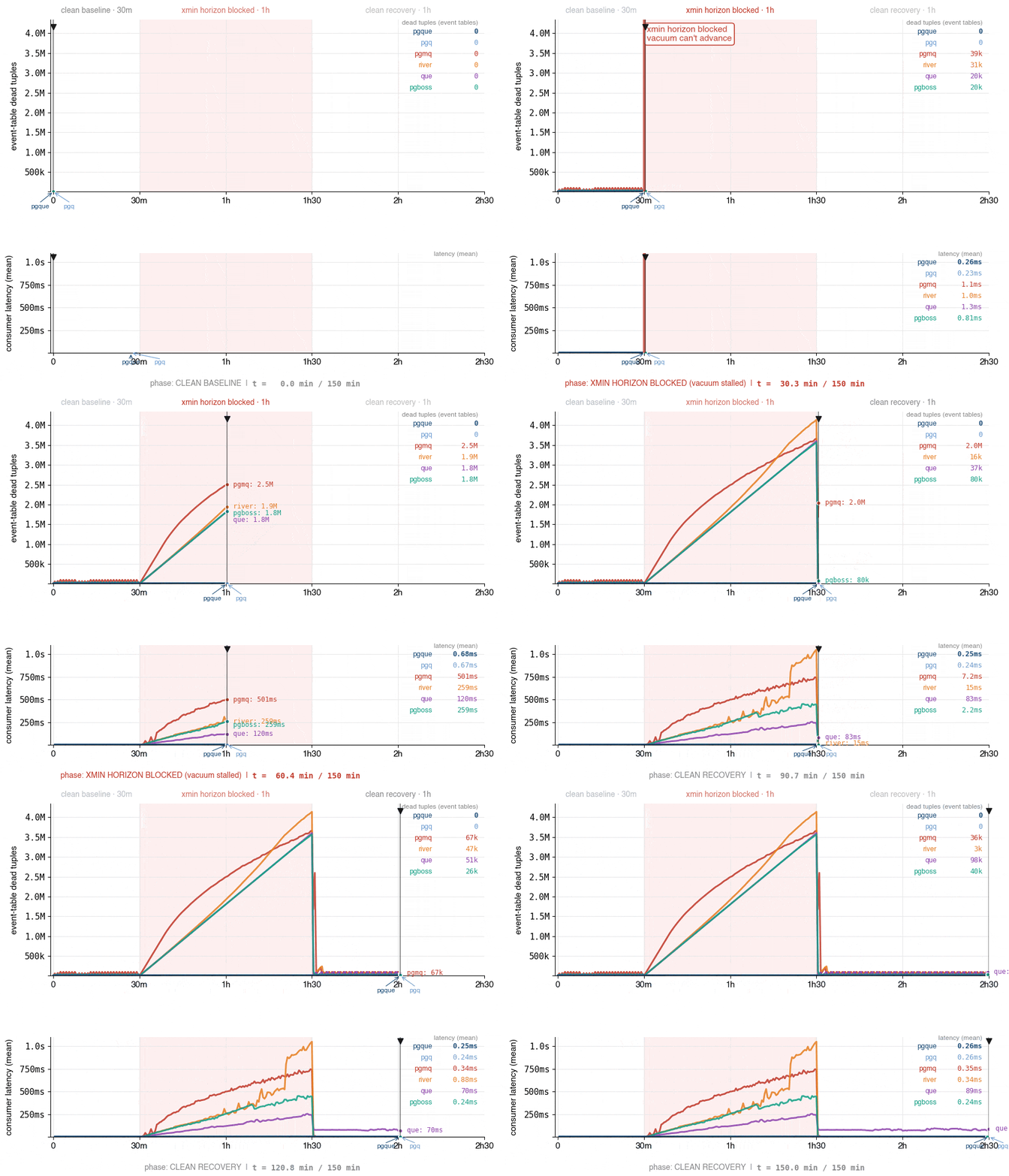
max_slot_wal_keep_sizegoverns WAL only. A dead logical subscriber will continue to pin transaction IDs (xminand catalogxmin) on the primary database, leading to severe catalog bloat and frozen transaction ID emergencies, even if the WAL itself is successfully reclaimed. Pair this setting withidle_replication_slot_timeoutto mitigate abandoned slots entirely.
Best Practices for Production Environments
Leaving max_slot_wal_keep_size at -1 in a production environment is an invitation to unmonitored disk failure. Administrators should follow a disciplined deployment strategy:
- Scope the Value: Set the parameter on every primary database and every cascading standby that feeds downstream consumers.
- Size Appropriately:
- The floor should accommodate a few hours of peak WAL generation, preventing transient network partitions or brief application locks from killing a replica prematurely.
- The ceiling should be dictated by the free space available on the
pg_walvolume, subtractingmax_wal_sizeand a safety margin for inter-checkpoint slack. - In practice, enterprise systems often find a sweet spot between 20 GB and 200 GB, depending on write throughput and recovery tolerance. Logical subscribers generally warrant a higher allocation due to the high cost of a full re-sync.
- Implement Comprehensive Monitoring: Set up automated alerts targeting the metrics exposed by PostgreSQL. Query the system view regularly to catch issues before they result in dropped slots:
SELECT slot_name,
       active,
       wal_status,
       pg_size_pretty(safe_wal_size) AS safe_headroom,
       pg_size_pretty(pg_wal_lsn_diff(pg_current_wal_lsn(), restart_lsn)) AS bytes_behind,
       invalidation_reason
  FROM pg_replication_slots;
Operations teams should page on-call engineers the moment wal_status transitions out of reserved into extended. If a slot hits lost, treat it as an operational incident requiring immediate intervention: drop the defunct slot, investigate the consumer, and rebuild the replication pipeline.
By taking proactive control of max_slot_wal_keep_size, database administrators transform PostgreSQL from a brittle system vulnerable to runaway storage consumption into a resilient, self-protecting enterprise platform.