OMRON Redefines Industrial Automation with the Launch of the S8NR IP67 Power Supply Series and S8R-BB DC Blocking Box
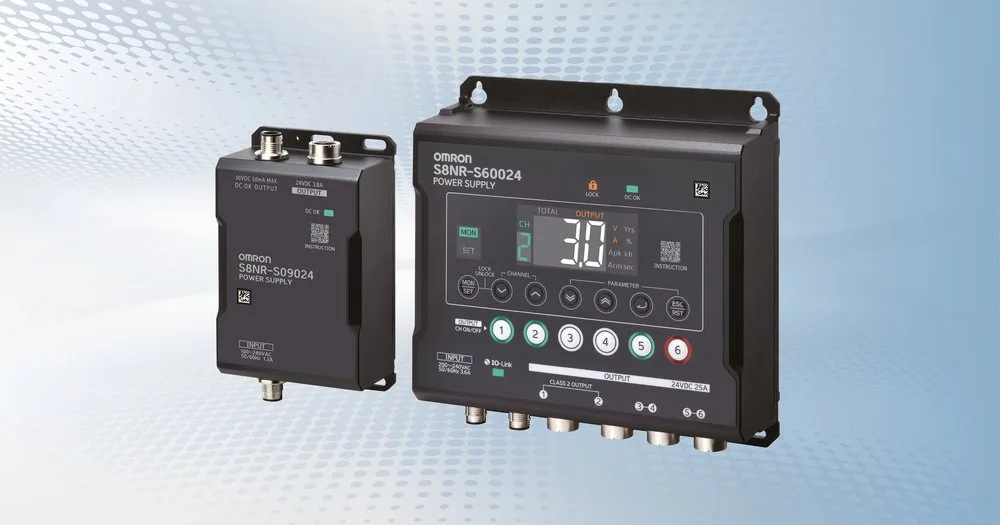
MILAN / CHICAGO — In a major development for industrial automation and smart manufacturing infrastructure, global automation leader OMRON has officially introduced its latest innovation in power distribution: the S8NR series of IP67-rated power supplies alongside the S8R-BB DC Blocking Box.
Engineered specifically for decentralized architectures, this new product lineup is designed for direct installation onto industrial machinery, entirely outside the traditional confines of the electrical control cabinet. By moving power conversion and protection closer to the point of load, OMRON aims to help machine builders and factory operators drastically reduce wiring complexity, optimize floor space, and embrace true Industry 4.0 predictive maintenance methodologies.
Main Facts: Decentralizing Power and Control
The cornerstone of this new release is the OMRON S8NR series, a robust family of IP67-rated, 24 V DC power supplies available in power ratings ranging from 90 W to 600 W. Designed to withstand harsh industrial environments—characterized by dust, moisture, and mechanical vibrations—these units eliminate the historical necessity of housing power conversion units within protected internal enclosures.
Complementing the power supplies is the newly developed S8R-BB DC Blocking Box. While the S8NR manages heavy-duty power distribution outside the cabinet, the S8R-BB extends the exact same decentralized philosophy to control circuits. Together, these two components allow engineers to complete both power and safety wiring entirely on the machine body, radically transforming how modern production lines are designed and wired.
Core Technical Highlights:
- Power Range: 90 W to 600 W at 24 V DC configurations.
- Integrated Multi-Output Protection: High-capacity models (360 W and 600 W) feature up to six individually protected outputs within a single device.
- Real-Time Diagnostics: Onboard digital displays and targeted status LEDs deliver immediate voltage, current, and alarm data.
- Advanced Connectivity: Native IO-Link communication enables seamless remote monitoring, configuration, and data acquisition.
- Predictive Diagnostics: Built-in algorithms monitor the state of internal electrolytic capacitors to forecast remaining service life.
- Rapid Deployment: Utilizes industrial Smartclick quick-connect systems to streamline mechanical and electrical assembly.
Chronology: The Evolution Toward Decentralized Automation
To understand the industry significance of OMRON’s latest release, it is helpful to examine the historical trajectory of industrial control panel design over the past three decades.
The Centralized Era (1990s – 2000s)
For decades, standard automation practice dictated the use of massive, centralized electrical cabinets. Every power supply, PLC, relay, and circuit breaker was meticulously housed inside large metallic enclosures to protect sensitive electronics from ambient factory hazards like coolant spray, metallic dust, and thermal swings.
While this approach protected internal components, it came with massive hidden costs: long runs of heavy copper cabling connecting the central cabinet to actuators, sensors, and motors scattered across large automated assembly lines; complex wire-tracing requirements during troubleshooting; and large footprints on the factory floor dedicated entirely to housing enclosures.
The Modular Shift (2010s)
As industrial machinery grew more modular, engineers began demanding localized control zones. The advent of IP67-rated distributed I/O blocks allowed signals to be gathered closer to sensors. However, power supplies remained stubbornly anchored inside the central cabinet. Stepping down AC mains voltage or distributing 24 V DC across long cable runs often introduced voltage drops, heavy copper requirements, and intricate sub-panel designs.
The Out-of-Cabinet Revolution (Present Day)
With the launch of the S8NR and S8R-BB series, OMRON represents the vanguard of a new industry paradigm: the fully decentralized electrical architecture. By engineering power supplies capable of operating reliably in harsh environments (IP67 compliance), OMRON bridges the final gap in machine decentralization. Power distribution, circuit protection, and safety management have officially moved from the back-panel inside the cabinet directly onto the machine chassis.
Supporting Data: Engineering Efficiency and Component Reduction
A close examination of the technical metrics reveals why the S8NR and S8R-BB combination represents a significant leap forward in engineering efficiency.
Footprint and Component Reduction
In a traditional 360 W or 600 W power distribution setup, providing individual channel protection typically required a primary power supply unit followed by a separate multi-channel electronic circuit breaker module, terminal blocks, and auxiliary safety relays inside an enclosure.
OMRON’s integration of up to six individually protected outputs directly into the 360 W and 600 W S8NR models collapses this hardware stack.
- Component Count: Reduced by up to 40% compared to traditional multi-module setups.
- Wiring Labor: Cut significantly due to the elimination of inter-module bridging jumpers and complex terminal strip wiring.
- Cabinet Real Estate: Slashes the required internal control cabinet volume, allowing for smaller, less expensive enclosures—or eliminating secondary sub-panels altogether.
Smart Connectivity and Data Density
Through integrated IO-Link communication, the S8NR series transforms passive power distribution into an active data node. Traditional power supplies were “black boxes” that offered little insight until a fuse blew or a voltage sag caused an unexpected system shutdown.
The S8NR continuously streams critical operational parameters:

- Output Voltage & Current Tracking: Engineers can monitor live load profiles per channel, identifying creeping inefficiencies or mechanical binding in actuators before they trigger hard faults.
- Threshold & Start-up Sequence Customization: Users can program precise start-up delays and current trip thresholds for each of the six outputs, preventing inrush current spikes from tripping supplies during complex machine initialization sequences.
Predictive Maintenance Metrics
Unscheduled downtime remains one of the single largest drains on manufacturing profitability. Power supply failures are frequently caused by the thermal degradation of internal electrolytic capacitors over time.
The S8NR integrates a dedicated predictive maintenance algorithm that continuously assesses capacitor health based on operating temperature and load history. By providing a clear warning when the internal components approach the end of their design life, the system enables maintenance teams to schedule replacements during planned facility shutdowns, completely avoiding catastrophic mid-shift failures.
Official Perspectives and Industry Response
While industrial automation vendors continually refine efficiency, OMRON’s product strategy centers heavily on addressing the compounding labor shortages and engineering bottlenecks facing modern machine builders.
Industry analysts note that machine builders (OEMs) are currently under immense pressure to deliver systems faster while managing rising material costs and a shortage of skilled electrical wiring technicians. Decentralized power solutions directly target these pain points.
"The introduction of the S8NR and S8R-BB reflects a fundamental shift in how machine builders approach electrical system architecture," noted an automation engineering specialist following the product announcement. "By taking bulky power distribution out of the cabinet and placing robust, intelligent IP67 units right where the work happens, OMRON is effectively handing hours of assembly time back to the manufacturer."
Furthermore, OMRON’s emphasis on Smartclick quick-connect technology highlights a broader industry trend toward tool-less or rapid-connect mechanical and electrical interfacing. By minimizing the reliance on manual screw terminals—which are prone to loosening under constant industrial vibration—the company is enhancing long-term field reliability while drastically accelerating initial commissioning times.
Implications for the Future of Smart Manufacturing
The widespread adoption of IP67 power supplies like the OMRON S8NR and control accessories like the S8R-BB carries far-reaching implications across several key domains of modern industry.
1. The Shrinking Control Cabinet
As power conversion, decentralized I/O, safety switching, and local logic move onto the machine frame, the role of the traditional electrical control cabinet is fundamentally changing. In many future machine designs, the cabinet will no longer serve as a dense maze of power distribution blocks, but rather as a streamlined hub primarily housing core PLC processors, safety controllers, and master network switches. This reduction in cabinet size translates directly into lower material costs, reduced shipping weights, and greater flexibility in factory floor layouts.
2. Enhanced Diagnostic Transparency via IO-Link
The integration of IO-Link into power supplies bridges the historic divide between operational technology (OT) power infrastructure and information technology (IT) analytics platforms. Plant managers are no longer blind to the health of their power rails. By feeding real-time diagnostic data—such as harmonic distortion, thermal load, and instantaneous channel currents—upward into SCADA and MES systems, facilities gain holistic visibility into machine health, moving closer to true autonomous maintenance environments.
3. Accelerated Commissioning and Modularity
For modular machine builders who ship systems in multiple transport sections, traditional hardwired cabinets require extensive, error-prone re-wiring on the end-user’s factory floor. By utilizing decentralized IP67 power distribution nodes connected via standardized industrial quick-connect cables, modular sections can be plugged together rapidly with minimal risk of wiring errors. This plug-and-play capability drastically reduces on-site installation and commissioning times, lowering total cost of ownership for the end customer.
4. Sustainability and Lifecycle Extension
Sustainability is increasingly a core metric in industrial procurement. By moving toward predictive maintenance—specifically through capacitor health monitoring—operators can avoid the premature replacement of entire power supply units while preventing the resource-intensive emergency repairs associated with sudden catastrophic failures. Furthermore, optimized copper cabling layouts reduce overall resistive losses, contributing to incremental energy savings over the operational lifespan of the machinery.
Conclusion
OMRON’s release of the S8NR IP67 power supply series and the S8R-BB DC Blocking Box marks a decisive step forward in the evolution of industrial electrical design. By challenging the convention of internal cabinet housing and introducing intelligent, multi-output protection with IO-Link connectivity, OMRON provides machine builders with the tools necessary to build cleaner, smarter, and more resilient automated systems.
As manufacturing facilities worldwide continue to pursue higher levels of modularity, data transparency, and operational efficiency, decentralized power architectures are poised to become the baseline standard for industrial automation.
For further technical specifications, CAD drawings, and comprehensive documentation regarding the S8NR and S8R-BB product lines, interested engineers and system integrators are encouraged to visit the official OMRON Industrial Automation website.