Beyond the Model: Why the AI Agent Layer is the New Frontier of Enterprise Architecture
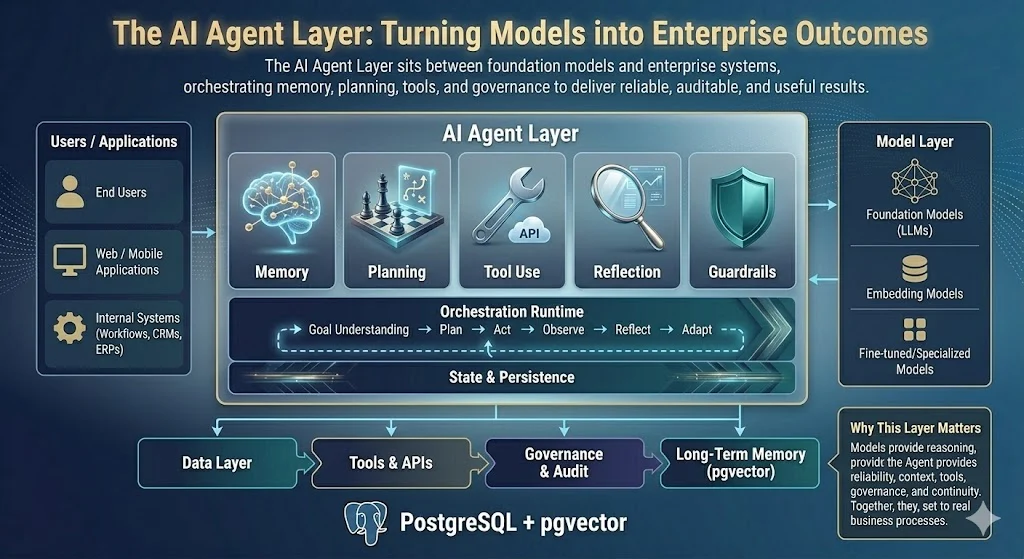
In the rapidly evolving landscape of enterprise technology, a silent shift is occurring. For the past two years, the corporate conversation around Artificial Intelligence has been dominated by the "Model Wars"—a relentless pursuit of the latest foundation models, measured by benchmarks, token costs, and reasoning capabilities. However, as organizations transition from exploratory "chat-with-your-data" demos to mission-critical production systems, a harsh reality has set in: the model is not the system.
While a Large Language Model (LLM) can synthesize text and mimic human reasoning, it lacks the structural scaffolding required to operate within the messy, highly regulated, and stateful environment of an enterprise. To bridge this gap, a new architectural paradigm has emerged: The AI Agent Layer. This middle-tier orchestration layer is rapidly becoming the most vital component for any organization looking to move beyond surface-level AI integration toward true intelligent automation.
The Core Problem: Probabilistic Models vs. Deterministic Business
The fundamental disconnect in modern AI deployment lies in the nature of the engine itself. LLMs are probabilistic—they are designed to predict the next token based on pattern matching. Business processes, conversely, are profoundly deterministic. A bank, a healthcare provider, or a supply chain manager requires 100% accuracy, strict adherence to access control policies, and a verifiable audit trail for every action taken.
When an AI system is exposed to real-world workflows, the "demo-to-production" gap widens. In a controlled demo environment, the context is curated and the tasks are narrow. In production, the system must navigate incomplete data, enforce complex permissions, integrate with legacy internal APIs, and remain compliant with shifting regulatory frameworks.
The AI Agent Layer acts as the bridge between these two worlds. It is the architectural tier responsible for memory management, planning, tool orchestration, and governance. Without this layer, companies are forced to bolt-on "glue code"—scattered, unscalable scripts that manage prompts and API calls—which inevitably collapses under the weight of enterprise complexity.
The Anatomy of the AI Agent Layer
To visualize where this layer sits, one must view the modern enterprise stack as a four-tiered architecture:
- Foundation Model Layer: The "brain" (LLM) providing reasoning and linguistic capability.
- AI Agent Layer (The Nexus): The "executive function" managing memory, tool selection, planning, and state.
- Data & API Layer: The operational backbone (Databases, Vector Stores, internal business APIs).
- Governance & Audit Layer: The "policy engine" (Access controls, compliance monitoring, and cost tracking).
The AI Agent Layer is the conductor of this orchestra. It determines when to retrieve data, which tool is appropriate for the task at hand, and how to verify the outcome against organizational policy. As organizations scale, this layer becomes a platform-level concern, ensuring that agents are not just "shadow IT" projects but governed, reliable components of the enterprise infrastructure.
Memory: The Foundation of Intelligent Continuity
The most significant hurdle in evolving from a chatbot to an agent is memory. Foundation models are stateless by design; they possess no inherent recollection of previous interactions. In an enterprise, where business continuity is the baseline, this is a fatal flaw.
Effective enterprise AI requires four distinct categories of memory, each demanding a different architectural approach:
- Session/Working Memory: Ephemeral data (minutes to hours) used for the current task, typically housed in high-speed caches like Redis.
- Episodic/Long-Term Memory: The history of past decisions, account interactions, and incidents. This requires durable, searchable storage.
- Semantic/Knowledge Memory: The organization’s static "source of truth," including product documentation, SOPs, and internal policies.
- Procedural Memory: The evolving rules of the business—approval chains, compliance checkpoints, and workflow logic—that must be version-controlled to satisfy auditors.
The Role of PostgreSQL and pgvector
While many organizations rush toward specialized "vector databases," enterprise architects are increasingly finding that the answer lies in extending existing, proven infrastructure. PostgreSQL, augmented with the pgvector extension, is emerging as the gold standard for long-term agent memory.
The advantage is twofold: relational integrity and semantic search. By storing vector embeddings alongside structured operational data, engineers can perform complex relational filters (e.g., "only retrieve documents authorized for the Finance department") before executing a semantic similarity search. This ensures that the agent’s "recall" is not just relevant, but compliant with existing data governance policies.
Planning: Converting Intent into Action
Memory provides context, but planning provides agency. An enterprise agent is useless if it cannot decompose a high-level directive—such as "reconcile the Q3 accounts"—into a logical series of steps.
Planning is the capability that allows an agent to:
- Decompose: Break down abstract goals into sub-tasks.
- Sequence: Determine the correct order of operations (e.g., check the database before calling the external API).
- Verify: Inspect the output of one step before proceeding to the next.
- Recover: Implement retry logic or human escalation when a tool fails.
This execution model is what separates a glorified document-summarization tool from a functional software agent. By integrating a planning framework, companies can build systems that don’t just "chat," but "do."
Implications for Enterprise Strategy
The shift toward an AI Agent Layer has profound implications for how organizations hire, build, and budget for AI.
1. From Prompt Engineering to System Engineering
The era of obsessing over "prompt tuning" is giving way to the era of system architecture. The most consequential decisions today are not about how to phrase a query, but about how to design the retrieval system, how to enforce schema constraints on agent output, and how to monitor the state of an agent’s reasoning process.
2. Governance as a Competitive Advantage
In the early days of AI, governance was seen as a barrier. Now, it is a feature. Enterprises that treat the AI Agent Layer as a governed platform—with built-in audit trails, versioned procedural memory, and clear access controls—will be able to deploy agents in highly regulated sectors where competitors cannot.
3. The Return of the "Backend" Engineer
The AI revolution is not just for data scientists. In fact, the challenges identified in this architectural transition—state management, transaction integrity, API connectivity, and database optimization—are the traditional bread and butter of the backend software engineer. The most successful AI teams of the next decade will be those that integrate deep AI model knowledge with the robust, battle-tested principles of enterprise software engineering.
Looking Ahead: The Roadmap to Production
The journey to an intelligent enterprise is a marathon, not a sprint. The four-part series of which this analysis is a part outlines the path forward:
- Part 1: Foundations (Foundations of the Agent Layer). Establishing the need for architecture over "model-centrism."
- Part 2: Capabilities (Tool Use and Reflection). Exploring how agents interact with the world through APIs and self-correction mechanisms.
- Part 3: Scale & Control (Multi-Agent Orchestration). Examining how to manage complex ecosystems where multiple specialized agents collaborate.
- Part 4: Production (Observability & Governance). Closing the loop with monitoring, ROI tracking, and the future of enterprise autonomous systems.
As we move forward, the "Agent Layer" will become the standard interface between humans and the vast, growing body of corporate data. By focusing on memory, planning, and governance today, enterprises are not just adopting a new tool; they are building the infrastructure that will define the intelligent, automated business of tomorrow. The model is merely the engine; the agent layer is the vehicle that drives the enterprise forward.