KryonOS Transforms ESP32 Microcontrollers into Reusable, App-Driven Computers
By Tech & Embedded Systems Desk
Published: October 2026
Main Facts
The landscape of Internet of Things (IoT) development and embedded systems engineering is undergoing a quiet revolution. For years, the standard workflow for deploying software onto microcontroller units (MCUs)—most notably the ubiquitous Espressif ESP32 and ESP32-S3 chips—has relied on a rigid, single-purpose paradigm. Developers write C or C++ code using frameworks like ESP-IDF or the Arduino IDE, compile a monolithic binary, and flash it directly to the chip’s flash memory. Every time a feature changes, a bug is fixed, or a new logic layer is introduced, the entire firmware must be recompiled and reflashed.
Enter KryonOS, an open-source operating system developed by engineer Haris16-code that fundamentally re-imagines what an ESP32 can be. KryonOS shifts the microcontroller away from a fixed-firmware device and turns it into a dynamic, reusable computing platform. By installing KryonOS onto an ESP32 or ESP32-S3 just once, developers and hobbyists alike can bypass the repetitive flashing cycle entirely. Instead, applications are written in JavaScript, installed, executed, and uninstalled dynamically—mirrors of how software is managed on a modern desktop computer or smartphone.
At the core of this operating system lies Duktape, a lightweight, embeddable ECMAScript 5.1 JavaScript engine that includes several more modern language features. Applications execute entirely within this runtime environment, granting each app roughly 90 KB of usable RAM. Because the apps run on top of the JavaScript engine rather than compiling straight to the bare metal, developers can rapidly prototype, distribute, and swap programs on the fly.
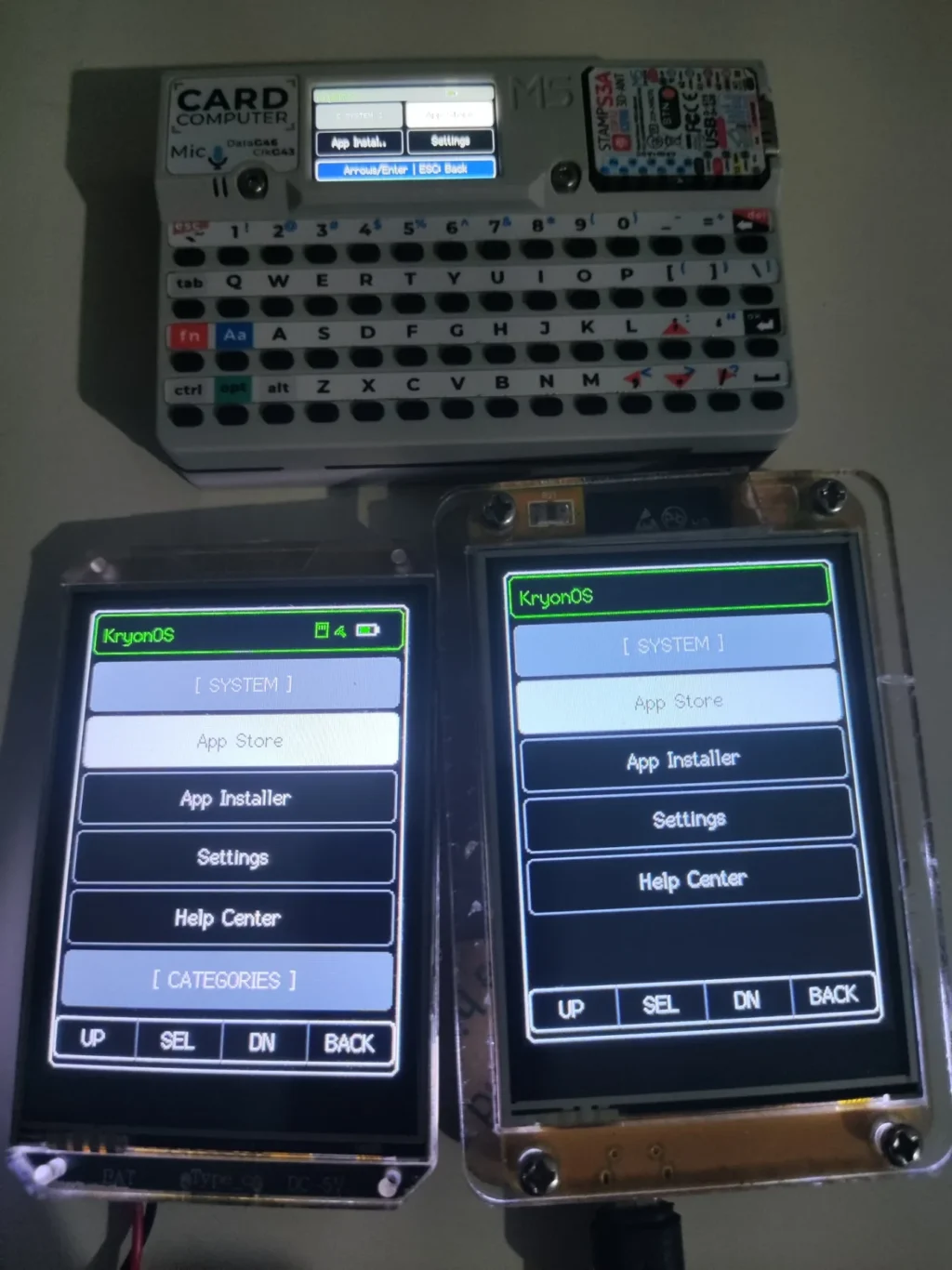
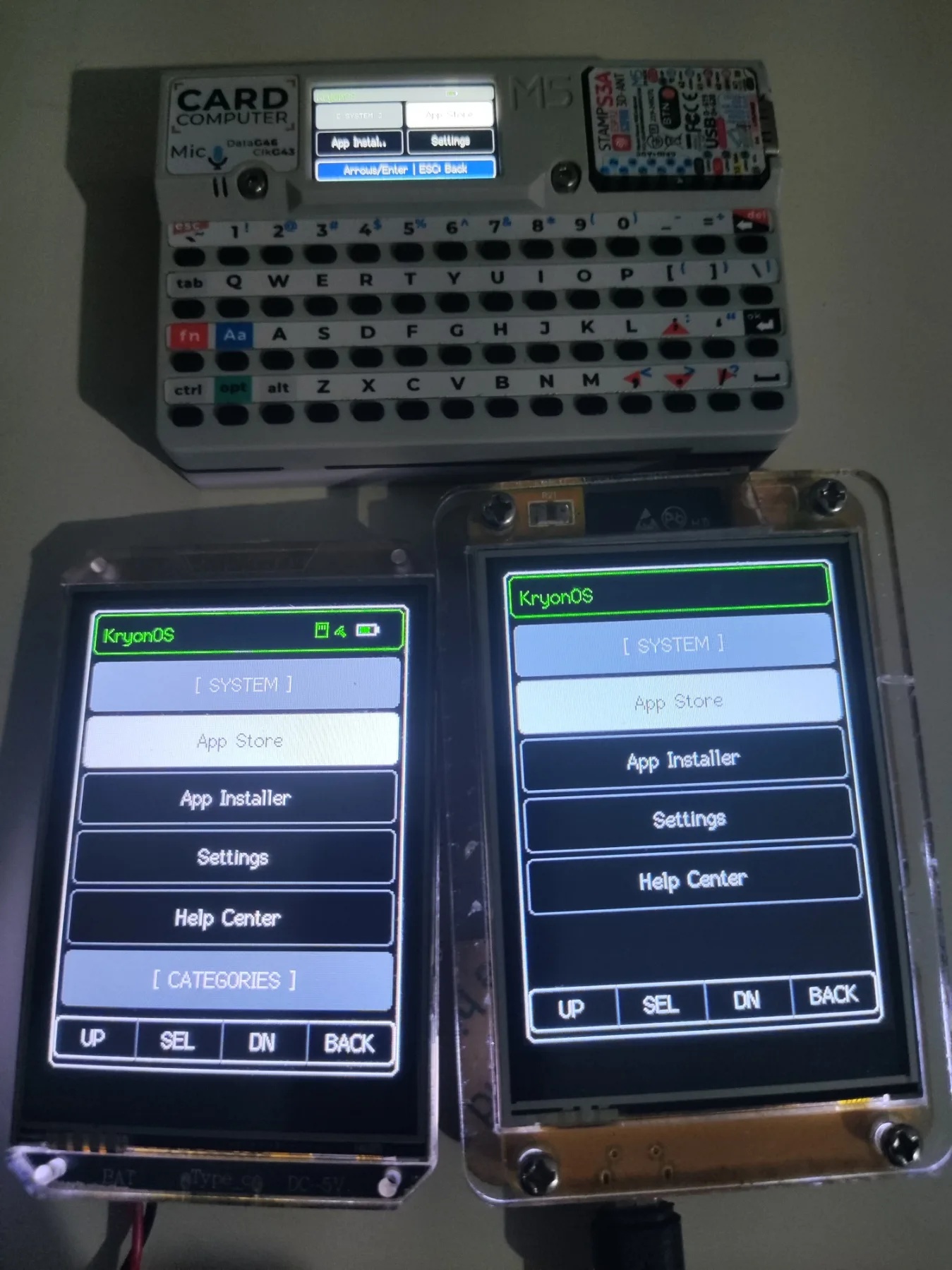
The ecosystem surrounding KryonOS is surprisingly mature for an open-source microcontroller OS. It features a complete desktop-style graphical user interface (GUI), a system launcher, a functional file manager, a cloud-connected App Store marketplace, and even native cloud integration services. Hardware abstraction is handled cleanly via a multi-board Hardware Abstraction Layer (HAL), allowing the operating system to stretch across a wide array of display controllers, tactile inputs, and peripheral configurations—including popular enthusiast hardware like the M5Stack Cardputer.
Chronology
To understand how KryonOS arrived at its current robust state—featuring advanced 3D rendering engines and secure Over-The-Air (OTA) update paths—it is helpful to look back at the evolutionary milestones of microcontroller software architecture.
Phase 1: The Bare-Metal and RTOS Era (Pre-2024)
Historically, microcontrollers were programmed with bare-metal C code or lightweight Real-Time Operating Systems (RTOS) such as FreeRTOS. While highly efficient for dedicated tasks—such as reading a temperature sensor and sending the data via MQTT—these systems lacked flexibility. Adding a new user interface element or changing display logic meant rewriting source files, managing memory allocations manually, and sitting through lengthy compilation cycles.
Phase 2: The Rise of Interpreted Languages on MCUs (2024–2025)
As chips like the ESP32 and ESP32-S3 became more powerful—featuring dual-core Xtensa processors, megabytes of external PSRAM, and built-in Wi-Fi and Bluetooth—developers began experimenting with interpreted languages. MicroPython and CircuitPython gained immense popularity, allowing users to run Python scripts directly on microcontrollers. However, running a full desktop environment with hardware-accelerated graphics, window management, and dynamic app stores remained an elusive goal due to performance overhead and memory constraints.
Phase 3: The Birth and Maturation of KryonOS (2026)
Haris16-code conceptualized KryonOS to bridge the gap between resource-constrained microcontrollers and high-level, application-driven computing.
- Early 2026: Initial iterations of the OS focused on establishing a stable JavaScript runtime on the ESP32 architecture, stabilizing Duktape integration, and carving out enough usable heap space to run interactive programs.
- Mid 2026: The introduction of the multi-board HAL allowed the OS to break free from proprietary hardware constraints, bringing support for various SPI-driven displays, touch controllers, and physical keyboards like the M5Stack Cardputer’s 56-key matrix.
- Late 2026: The project reached v2.0.0 with API Level 2, marking a major stabilization point. This release introduced critical production-grade features, including anti-rollback OTA updates, the Kryon3D rendering engine, and the establishment of cloud-backed ecosystems like KryonCloud and KryonBeam.
Supporting Data & Technical Architecture
KryonOS is not merely a novelty script running on an ESP32; it is a meticulously engineered operating system stack comprising several distinct layers, ranging from low-level hardware abstraction to high-level cloud services.
1. Hardware Abstraction Layer (HAL) & Display Support
The multi-board HAL is the glue that unifies disparate hardware designs under a single software umbrella. It abstracts the underlying pinouts, communication protocols, and board layouts, allowing KryonOS to operate smoothly across various configurations.
- Display Drivers: The HAL natively supports standard display controllers such as the ILI9341 (operating at 240×320 resolution over SPI) and the ST7789V2 (operating at 240×135 resolution over SPI). It also handles XPT2046 resistive touch controllers.
- Input Devices: For compact text entry and navigation, devices like the M5Stack Cardputer leverage integrated physical keyboards (such as its 56-key matrix).
- Storage and Expansion: The platform supports multi-bus SD card interfaces, utilizing the LittleFS filesystem for robust, wear-leveled data storage on flash memory and external cards. Developers seeking a turnkey hardware solution can easily pair these systems with standard 2.8-inch TFT resistive touch panels with built-in SD slots.
2. Graphics Rendering and Kryon3D Engine
Rendering smooth graphics on a microcontroller without a dedicated hardware GPU is notoriously difficult, often resulting in severe screen tearing and low frame rates. KryonOS solves this through double buffering coupled with mini-sprite support, ensuring that UI updates render cleanly without visual flicker.
Taking visual capabilities a step further, KryonOS introduces Kryon3D, an on-device 3D graphics engine written specifically for the platform. This engine is capable of processing:

- Wireframe models
- Shaded polygon meshes
- Dynamic camera positioning
- Real-time lighting calculations
- Environmental fog effects
To achieve acceptable performance on an ESP32 processor, the engine relies on FastMath, a mathematical utility library backed by a precomputed 360-degree Lookup Table (LUT). This bypasses the heavy trigonometric calculations that would otherwise bog down the Xtensa CPU cores.
3. JavaScript Hardware APIs
One of the most powerful aspects of KryonOS is that developers do not need to drop down into C or C++ to interact with physical sensors and peripherals. The JavaScript API Level 2 exposes direct hardware hooks, including:
- GPIO Control: Digital read/write and pin state management.
- I2C Bus Management: Device scanning and data transfers.
- PWM Generators: High-frequency pulse-width modulation for tone generation, audio, and motor control.
- Cryptography: Hardware-accelerated AES encryption and cryptographic hashing functions.
- Power Management: Battery voltage and status monitoring via the onboard Analog-to-Digital Converter (ADC).
4. Resilient Firmware Updates (Anti-Rollback OTA)
Updating firmware on remote or deployed IoT devices always carries the risk of a "bricked" device if power or Wi-Fi drops mid-transfer. KryonOS mitigates this risk with a bulletproof Anti-Rollback Over-The-Air (OTA) update mechanism.
- Updates rely on a two-level manifest system (
update.json). - Flashing operations occur in rigid 4 KB chunks.
- Each chunk undergoes rigorous MD5 integrity verification.
- The system includes an automatic bootloader recovery protocol. If an update is interrupted or fails verification, the board safely rolls back to the previous stable state rather than locking up.
For initial development and flashing, engineers use standard toolchains like PlatformIO and esptool.py running at high speeds (921,600 baud), or alternatively, the Espressif ESP Flash Download Tool.
Official Responses & Community Perspective
The open-source community has responded with immense enthusiasm to the release of KryonOS v2.0.0. Speaking on the project’s design philosophy, creator Haris16-code emphasized that the primary goal was to eliminate the friction inherent in modern embedded development.
"We wanted to give the ESP32 the versatility of a modern computing appliance," notes the project documentation and community briefs. "Developers shouldn’t have to compile a massive C++ binary just to change a UI button or read a sensor value. By establishing a stable, lightweight JavaScript runtime with direct hardware bindings, we unlock rapid prototyping and community-driven software sharing on hardware that people already own."
Early adopters and hardware modders working with devices like the M5Stack Cardputer have praised the fluidity of the desktop-style interface and the surprising capability of the Kryon3D engine. Educational institutions and maker spaces have also expressed interest, noting that teaching JavaScript-based application development on a $15 microcontroller is significantly more approachable for students than introducing complex C/C++ toolchains, memory management, and register-level programming.
Implications
The introduction and maturation of KryonOS carry significant implications for the future of hobbyist electronics, IoT edge computing, and rapid prototyping.
1. Democratizing Embedded Development
By abstracting away the low-level complexities of bare-metal C programming, KryonOS lowers the barrier to entry for software developers who want to build physical computing projects. Web developers, frontend engineers, and scripters who are fluent in JavaScript can now build interactive IoT devices, portable terminals, and smart home controllers without needing a degree in electrical engineering.
2. Shifting from "Firmware" to "Apps"
The traditional lifecycle of an IoT gadget involves buying a device, flashing a specific firmware, and living with the features the manufacturer provided. KryonOS introduces a paradigm shift where hardware is viewed as a blank canvas. With the integration of KryonCloud, the App Store cloud marketplace, and peer-to-peer communication protocols like the KryonBeam mesh messenger, microcontrollers are evolving into connected, modular computing nodes. Users can browse an app store, download a new utility or game directly to their ESP32 over Wi-Fi, and run it instantly.
3. Accelerated Prototyping for Enterprise and Makers
In commercial product development, time-to-market is everything. While production-grade devices will likely continue to rely on optimized C/C++ firmware for maximum energy efficiency and raw performance, KryonOS offers an incredible testbed for proof-of-concept designs. Engineers can use KryonOS to rapidly test user interface flows, sensor integrations, and cloud communication pipelines in a matter of hours rather than weeks.
As the open-source repository at GitHub (Haris16-code/KryonOS) continues to receive updates, contributions, and community modules, KryonOS stands as a testament to the growing power of microcontrollers—proving that with clever software architecture, even a modest ESP32 can act like a full-fledged computer.