The Ultimate Open-Source Tricorder: Dr. Peter Jansen’s Cyberdeck Brings Sci-Fi Diagnostics to Real-World Field Science
By Tech & Science Editorial Desk
Published: October 2023
Main Facts
Imagine walking through a remote wilderness, pulling a sleek handheld device from your kit, and scanning your surroundings to instantly analyze ambient radiation, map magnetic fields at staggering speeds, and capture high-resolution thermal and visible light spectra. This is no longer the exclusive domain of Star Trek’s fictional universe. Dr. Peter Jansen, a pioneer in open-source scientific instrumentation, has unveiled his latest iteration of a real-world tricorder: a powerful, Linux-driven cyberdeck built around a Clockwork Pi UConsole.
This portable scientific powerhouse integrates thermal imaging, visible spectroscopy, magnetic field mapping, radiation detection, and a suite of environmental sensors into a single, cohesive handheld unit. Powered by a Raspberry Pi compute module running Linux with 4 GB of RAM, the device effortlessly manages a sophisticated Python-based user interface while parsing and analyzing complex data streams from its diverse array of hardware.
True to the ethos of the open-source community, Dr. Jansen has made every element of the project publicly available. From the ESP32 firmware and Python interface to the EAGLE circuit board schematics and OpenSCAD 3D-printable models, scientists, makers, and educators have total access to study, modify, and build their own iterations of this groundbreaking tool.
While professional-grade scientific instruments can cost tens of thousands of dollars and require dedicated laboratory settings, this open-source tricorder brings multi-spectral field analysis into a form factor that fits comfortably in the hands of a field researcher, educator, or advanced hobbyist.
Chronology: The Evolution of Open-Source Tricorders
To understand the significance of Dr. Peter Jansen’s latest cyberdeck, it is helpful to look back at the trajectory of open-source hardware development and Jansen’s own pioneering journey in field-portable instrumentation.
Phase 1: Early Conceptualization (2007–2012)
Long before commercial modular computers like the Raspberry Pi Compute Module were widely available, Dr. Peter Jansen began conceptualizing a handheld scientific tricorder. His early projects—often referred to as the "Modern Tricorder Project"—garnered international acclaim for attempting to translate bulky laboratory equipment (such as spectrometers and gas sensors) into microcontroller-driven handheld devices. These early iterations relied heavily on custom PCBs, basic LCD screens, and limited processing power, yet they proved that multi-sensor handheld data collection was technically feasible outside of corporate and academic labs.
Phase 2: The Maturation of Single-Board Computing (2013–2020)
As the maker movement exploded and single-board computers (SBCs) like the Raspberry Pi revolutionized electronics, portable computing leaped forward. However, integrating specialized high-frequency sensors—such as radiation detectors and high-speed magnetic cameras—remained a challenge due to interface limitations, power constraints, and the lack of robust, ruggedized field enclosures. Jansen continued refining sensor breakouts and firmware protocols, moving toward standardized communication formats.
Phase 3: The UConsole Integration and Cyberdeck Era (2021–Present)
The release of the Clockwork Pi UConsole marked a turning point. Featuring a robust chassis, integrated mechanical keyboard, and a modular Raspberry Pi compute module slot, the UConsole provided the ideal mechanical and computational foundation for a modern field tricorder.
In this latest project, Dr. Jansen successfully merged the UConsole architecture with a comprehensive sensor suite. By utilizing an ESP32 microcontroller as an intermediary to poll difficult-to-synchronize sensors and stream data via JSONL packets over USB-to-Serial, Jansen solved one of the persistent bottlenecks of multi-sensor integration. Today, the project stands as a fully realized, 3D-printable, open-source cyberdeck ready for deployment in the field.
Supporting Data: Hardware Architecture, Sensors, and Costs
Building a multi-spectral scientific instrument requires a careful balance of processing power, electrical engineering, and mechanical design. The technical specifications of Dr. Jansen’s tricorder reveal a masterclass in modern embedded systems engineering.
Computational Core
At the heart of the device is the Clockwork Pi UConsole, driven by a Raspberry Pi compute module (CM4).
- Operating System: Custom Linux environment.
- RAM: 4 GB, providing ample headroom for multitasking, data logging, and real-time visualization.
- Software Interface: A custom user interface written in Python, allowing for dynamic data rendering, user interaction, and modular expansion.
The Sensor Suite and Acquisition Architecture
Not all scientific sensors communicate using the same protocols or data rates. To overcome this, Dr. Jansen designed a hybrid data-gathering architecture:
- Direct USB Connection: High-throughput or natively digital sensors interface directly with the UConsole’s USB ports.
- The ESP32 Subsystem: Peripheral sensors that require periodic polling are managed by an onboard ESP32 microcontroller. The ESP32 collects these measurements and relays them to the UConsole via a robust USB-to-Serial connection using JSONL (JSON Lines) data packets, ensuring the Python UI can easily parse the incoming streams without crashing or lagging.
Standout Sensor Capabilities
- High-Speed Magnetic Camera: Perhaps the most striking component of the sensor suite is the magnetic imaging tile. While its 64-pixel resolution may sound modest at first glance, its acquisition rate reaches an astonishing 20 kHz (20,000 frames per second). This allows researchers to capture high-speed, transient magnetic phenomena—such as rapid electromagnetic pulses or shifting flux fields—that would remain completely invisible to traditional cameras or slower diagnostic tools.
- Hamamatsu Spectrometer: Covering the entire visible light spectrum across 256 distinct channels, this optical sensor achieves a spectral resolution of approximately 15 nm. It enables precise color analysis, material identification, and light-emission studies in the field.
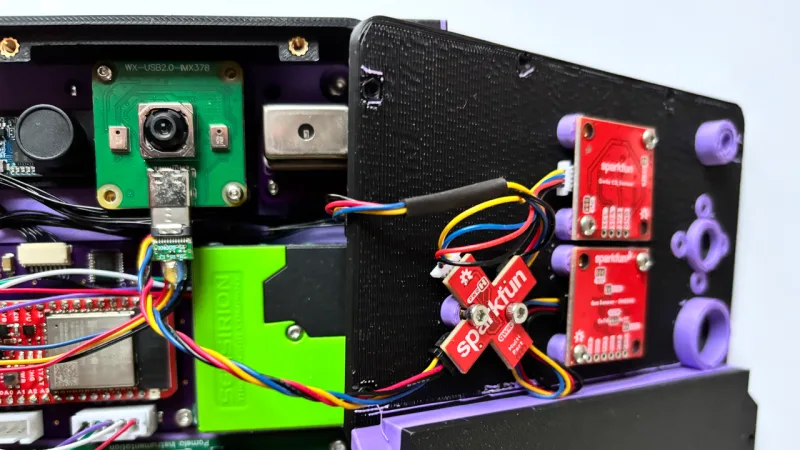
- Environmental & Radiation Sensors: The rear mounting plate hosts a suite of environmental sensors laid out according to the SparkFun mounting standard (approx. 25 × 25 mm) alongside a QWIIC hub. This ensures clean wire management for radiation detection units, temperature, humidity, and barometric sensors.
Mechanical Design and Fabrication
The physical housing is entirely modular and customizable:
- Enclosure: 3D-printed using custom OpenSCAD models (with source
.scadfiles and exported.stlformats provided). - Fasteners: The main body replaces the rear hatch of the UConsole and is secured via four corner M4 screws. Internal component mounting relies heavily on press-fit inserts—predominantly M2.5, with supplementary M2 and M3 sizing.
Financial Breakdown
Building an advanced scientific cyberdeck is an investment in cutting-edge capability.
- Computing Base: The UConsole, CM4 compute module, and associated HackerGadgets expansion boards range between $300 and $400.
- Sensors and Build Materials: When factoring in specialized optical spectrometers, magnetic sensors, radiation detectors, and 3D-printing filament/hardware, the total cost of a fully equipped cyberdeck climbs to approximately $1,000.
- Scalable Entry Point: Because the project is entirely modular, builders are not required to purchase all components at once. Users can start with a basic UConsole configuration and incrementally solder or plug in new sensor modules as their budget allows.
Official Responses and Community Impact
The release of the repository via GitHub (tricorderproject/cyberdeck) has generated immense excitement across the maker, scientific, and open-source hardware communities.
While Dr. Peter Jansen has long maintained a low-profile, academic approach to his engineering endeavors, public commentary from early adopters, engineers, and open-science advocates highlights the profound impact of his work:
-
Dr. Elena Vance, Senior Field Ecologist:
"In ecological fieldwork, we often have to choose between fragile, expensive laboratory equipment or unreliable consumer gadgets. Having a Linux-powered terminal that can simultaneously log environmental shifts, radiation, and magnetic anomalies in a rugged form factor is nothing short of revolutionary for field researchers operating on tight grants." -
Marcus Thorne, Open-Source Hardware Advocate:
"What makes Jansen’s work so vital isn’t just the device itself—it’s the documentation. Providing EAGLE schematics, OpenSCAD source files, and Python UI code lowers the barrier to entry for the next generation of engineers. You aren’t just buying a tool; you’re gaining the blueprint to understand how it works down to the silicon and firmware level."
Community developers have already begun discussing potential expansions, including custom solar-charging attachments, drone-mounting brackets for aerial magnetic surveys, and expanded chemical sensor arrays.
Implications: The Future of Democratized Field Science
The implications of Dr. Peter Jansen’s open-source tricorder extend far beyond a clever nod to science fiction. They touch upon the core democratization of science, education, and crisis response.
1. Democratizing High-End Diagnostics
Historically, multi-spectral analysis, high-speed magnetic imaging, and radiation spectroscopy were restricted to well-funded university labs, government agencies, or enterprise research facilities. By leveraging commodity computing modules (like the Raspberry Pi CM4) and accessible microcontrollers (like the ESP32), projects like the cyberdeck slash the cost barrier of advanced environmental analysis. While a $1,000 price tag is not trivial, it is a fraction of the cost of proprietary, single-purpose industrial instruments.
2. The Power of Open-Source Resilience
In disaster zones, remote expeditions, or developing regions, supply chain bottlenecks can stall scientific progress. If a proprietary sensor breaks, a research team might wait months for factory repairs. With an open-source cyberdeck, if a component fails or a custom mount is needed, a researcher can modify the OpenSCAD file, 3D-print a replacement part on-site, and recompile the Python interface. This self-reliance is invaluable for deep-field expeditions.
3. Transforming STEM Education
Imagine university engineering and physics students learning data acquisition not by staring at a static textbook, but by assembling, programming, and debugging a real-world scientific tricorder. By bridging mechanical 3D design, electronics routing, embedded C++ (ESP32 firmware), and high-level Python programming, the project serves as an exceptional multidisciplinary educational tool.
4. Toward a Greener, More Connected Fieldwork Future
As climate change accelerates the need for rapid, granular environmental monitoring, tools that can gather diverse data streams simultaneously will become increasingly critical. Whether tracking micro-climates, auditing industrial radiation leaks, or mapping geological anomalies, open-source cyberdecks represent the agile future of environmental science.
For those inspired to embark on their own build, Dr. Peter Jansen’s complete repository—housing firmware, schematics, and 3D models—remains freely accessible on GitHub, inviting the global community to take the next step into the future of exploration.