Streamlining Edge ECU Development: Vector and SCSK Launch Joint Evaluation Bundle for Renesas RL78/F2x Microcontrollers
TOKYO, JAPAN & STUTTGART, GERMANY — In a strategic move designed to accelerate the development of next-generation automotive electronic control units (ECUs), global embedded software provider Vector and prominent Japanese IT services and automotive software leader SCSK Corporation have announced the launch of a joint evaluation bundle.
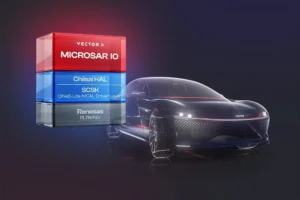
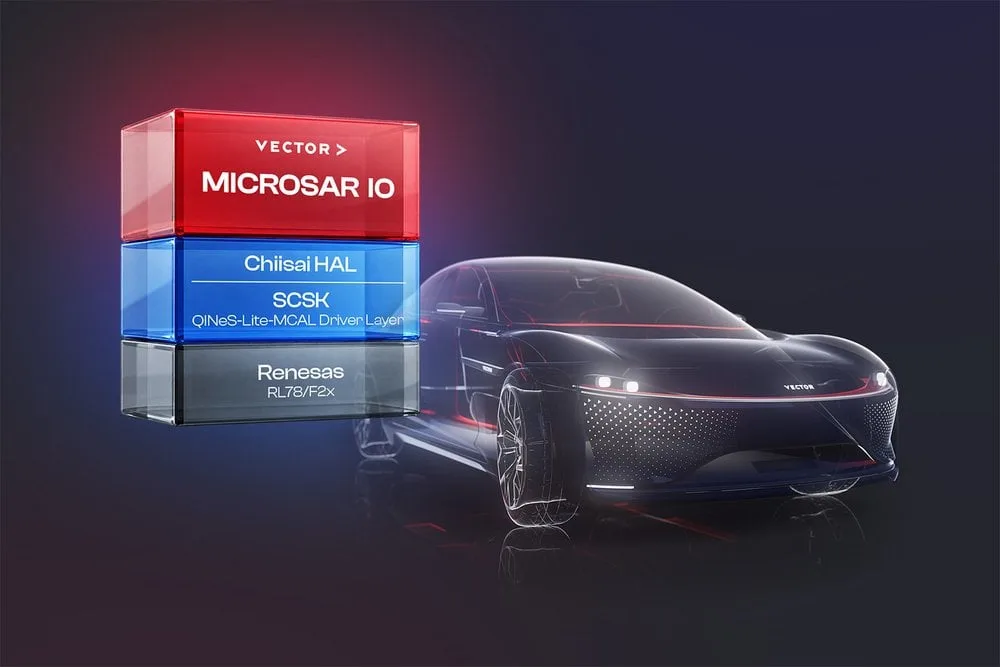
The newly released software package combines Vector’s specialized MICROSAR IO platform with SCSK’s QINeS-Lite framework and dedicated hardware drivers. Tailored specifically for the Renesas RL78/F2x family of microcontrollers, the pre-integrated solution is engineered to drastically reduce integration overhead, streamline configuration workflows, and expedite the evaluation phase for engineers developing resource-constrained sensor and actuator applications.
As the automotive industry pivots aggressively toward Software-Defined Vehicle (SDV) architectures, the demand for lightweight, highly efficient, and secure edge computing solutions has never been more acute. This collaborative offering addresses these emerging industry pressures directly, offering developers a robust, out-of-the-box foundation to bridge low-level hardware abstraction with high-level software modularity.
1. Main Facts
The core of the announcement centers on the technical integration of two established automotive software solutions to support Renesas Electronics’ versatile RL78/F2x 16-bit microcontroller lineup.
- The Partners: Vector, renowned globally for its AUTOSAR-compliant tools and embedded software components, has partnered with SCSK Corporation, a Tier-1-adjacent software provider and system integrator deeply entrenched in the Japanese automotive landscape.
- The Solution: A unified evaluation bundle combining Vector’s MICROSAR IO software—designed expressly for lightweight sensor and actuator systems—with SCSK’s QINeS-Lite automotive platform and specialized peripheral drivers.
- Target Hardware: The Renesas RL78/F2x microcontroller family, widely deployed in automotive body control, sensor nodes, and small actuators due to its low power consumption and high reliability.
- Core Benefits: Pre-integration eliminates the traditional friction of pairing third-party software stacks with vendor-specific hardware abstraction layers (HAL). This significantly reduces initial configuration time, lowers software complexity, and shrinks the overall time-to-market for developers working within tightly constrained memory and processing budgets.
- Availability: Automotive developers and embedded systems engineers can immediately request access to the joint MICROSAR IO evaluation bundle for Renesas RL78/F2x via Vector’s official web portal at www.vector.com/pr-bundle-microsar-io/.
2. Chronology of the Collaboration
The partnership between Vector and SCSK did not emerge overnight; rather, it is the culmination of years of parallel evolution in the automotive software sector, driven by the systemic shift toward distributed edge intelligence.
The Foundation of Edge Specialization
For decades, automotive microcontroller architectures relied on proprietary, highly customized codebases for basic sensors and actuators. However, as vehicle networks grew exponentially more complex with the advent of CAN, LIN, and Ethernet protocols, standardizing even the smallest ECUs became imperative. Vector developed its MICROSAR product line to meet the stringent demands of the AUTOSAR standard. Recognizing that heavy, full-scale AUTOSAR stacks were frequently too resource-intensive for microcontrollers with limited flash and RAM, Vector engineered MICROSAR IO specifically to service lightweight, peripheral-heavy nodes.
Concurrently, in the Japanese market, SCSK Corporation developed QINeS (Quality Innovation Network System) as a comprehensive software platform for automotive ECUs. As small ECUs and edge nodes began taking on more sophisticated tasks—such as localized diagnostics, basic security, and over-the-air (OTA) update capabilities—SCSK recognized the need for a scaled-down, agile variant. This realization led to the creation of QINeS-Lite, optimized specifically for compact edge applications.
Alignment and Integration
The convergence of Vector’s lightweight IO stack with SCSK’s QINeS-Lite framework began through joint customer engagements in the Asian automotive market, where both companies identified a recurring technical bottleneck: engineers were spending an inordinate amount of time manually integrating disparate middleware, writing custom hardware abstraction layers, and verifying basic driver compatibility for Renesas RL78/F2x chips.
Recognizing an opportunity to standardize this preliminary phase, engineering teams from Vector and SCSK initiated a formal joint development project. By aligning MICROSAR IO with QINeS-Lite and incorporating open-specification drivers based on the Chiisai standard, the two companies successfully created a unified evaluation bundle. This package bridges the gap between Vector’s software ecosystem and SCSK’s regional market expertise, providing a standardized baseline that is now globally accessible to automotive developers.
3. Supporting Data & Technical Architecture
To understand the value proposition of the Vector-SCSK evaluation bundle, it is necessary to examine the underlying technical architecture and the specific constraints of modern automotive edge nodes.
Resource-Constrained Microcontroller Realities
Microcontrollers like the Renesas RL78/F2x series operate in environments where every byte of ROM and RAM matters. They are typically deployed in distributed body electronics—such as door modules, mirror controls, seat adjusters, lighting systems, and localized sensor clusters. While these components perform localized physical tasks, modern vehicle architectures demand that they remain intelligent, diagnosable, and secure.
Component Breakdown
The joint evaluation bundle synthesizes three primary technological pillars:
+-------------------------------------------------------+
|                 Application Software                  |
+-------------------------------------------------------+
|  Vector MICROSAR IO (Lightweight Sensor/Actuator SW)  |
+-------------------------------------------------------+
|       SCSK QINeS-Lite Platform & Middleware           |
+-------------------------------------------------------+
|   SCSK Chiisai-Based Drivers (Hardware Abstraction)   |
+-------------------------------------------------------+
|        Renesas RL78/F2x Microcontroller Hardware      |
+-------------------------------------------------------+-
Vector MICROSAR IO:
Tailored specifically for sensor and actuator applications, MICROSAR IO provides a streamlined software platform that strips away the heavyweight overhead of traditional electronic control architecture while retaining essential communication and management features. It minimizes memory footprints and maximizes execution speed on constrained hardware. -
SCSK QINeS-Lite Platform:
Serving as SCSK’s lightweight automotive software platform for small ECUs, QINeS-Lite brings advanced capabilities to peripheral nodes. Historically, features like high-speed communication management, robust cybersecurity, secure OTA software flashing, and standardized diagnostics were reserved for domain controllers or central computers. QINeS-Lite brings these capabilities down to the edge, ensuring that even minor sensors and actuators comply with modern automotive cybersecurity and functional safety baselines. -
Chiisai-Based Hardware Drivers:
To connect the software layers to the physical silicon, SCSK provides specialized drivers based on the open Chiisai specification. These drivers complete the MICROSAR IO architecture by providing the precise hardware abstraction layer (HAL) required to interface seamlessly with the Renesas RL78/F2x peripheral set, ensuring predictable timing and reliable hardware access.
4. Official Responses and Industry Perspectives
Leadership from both Vector and SCSK have emphasized that this collaboration is more than just a software bundling exercise—it is a strategic alignment aimed at removing friction from the automotive supply chain.
Industry analysts note that as automakers increasingly demand standardized software interfaces to decouple hardware from software development, partnerships between established tool vendors (like Vector) and regional software architects (like SCSK) will become the primary mechanism for delivering turnkey solutions.
While formal executive statements accompanying the launch highlight the operational efficiencies gained by developers, technical stakeholders have pointed out the broader ecosystem benefits. By offering a pre-integrated baseline, Vector and SCSK are effectively lowering the barrier to entry for smaller Tier-2 and Tier-3 suppliers who may lack the internal resources to integrate disparate software stacks from scratch.
Furthermore, the choice of the Renesas RL78/F2x platform underscores the pragmatic nature of the release. Renesas remains a dominant force in automotive microcontrollers, and ensuring that cutting-edge edge software can run smoothly on these ubiquitous chips guarantees immediate utility for a vast segment of the existing automotive supply chain.
5. Implications for Software-Defined Vehicle (SDV) Architectures
The broader implications of the Vector-SCSK collaboration tie directly into the industry-wide transition toward Software-Defined Vehicles.
Overcoming the "Edge Bottleneck" in SDVs
In a traditional vehicle architecture, functions are hard-wired to dedicated, isolated ECUs. In an SDV architecture, vehicle functions are increasingly centralized into domain or zonal controllers, while peripheral nodes (sensors and actuators) act as intelligent data-gatherers and executors at the edge of the network.
However, a common misconception in early SDV planning was that edge nodes could remain simplistic, "dumb" hardware devices. Modern safety regulations, cybersecurity mandates (such as UN R155 and R156), and the necessity for predictive maintenance dictate that even the humblest sensor must be secure, updateable, and capable of high-speed diagnostic reporting.
The combination of Vector’s MICROSAR IO and SCSK’s QINeS-Lite directly solves this architectural contradiction. By providing a lightweight yet feature-complete software base for small Renesas microcontrollers, the evaluation bundle ensures that edge nodes can participate fully in the SDV ecosystem without bloating hardware costs or exceeding silicon memory limits.
Boosting Software Reusability and Future-Proofing
Another critical challenge in modern automotive engineering is software reusability. As vehicle platforms evolve across multiple generations, automakers and suppliers cannot afford to rewrite low-level software drivers and communication stacks for every new vehicle model.
The modular design of the joint evaluation bundle promotes high code reusability. Because the software layers are standardized and pre-tested against the Renesas RL78/F2x architecture, developers can port application code across different projects with minimal friction. This modularity reduces long-term maintenance costs and insulates engineering teams from underlying silicon supply chain volatility.
Conclusion and Next Steps
As automotive development cycles compress and software complexity continues to scale upward, solutions that eliminate integration busywork are invaluable. The joint evaluation bundle from Vector and SCSK Corporation provides a clear, practical pathway for engineers navigating the complexities of modern edge ECU design.
Developers and engineering teams interested in testing the capabilities of the MICROSAR IO and QINeS-Lite integration on Renesas RL78/F2x hardware can request the evaluation package directly through Vector’s website at www.vector.com/pr-bundle-microsar-io/, with comprehensive technical documentation and support available via www.vector.com/microsar-io.