Elevating Android Security: A New Era of Granular Device Intelligence
In a significant leap forward for the Android ecosystem, Google has officially launched the stable versions of the AndroidX Security State (v1.1.0) and Security State Provider (v1.0.0) libraries. This development marks a pivotal shift in how developers, enterprises, and original equipment manufacturers (OEMs) monitor, verify, and respond to the security posture of Android devices.
By moving away from the traditionally monolithic "Security Patch Level" (SPL) system toward a more granular, component-based verification model, these tools provide the transparency necessary to navigate the modern, modular landscape of mobile security.
The Core Transformation: Moving Beyond the Monolithic SPL
For years, the Security Patch Level (SPL) has been the primary metric for assessing whether an Android device is "up to date." While effective in a simpler era of software distribution, the modern Android ecosystem—characterized by rapid, modular updates delivered via Google Play system updates and diverse OEM-specific firmware—has outgrown the limitations of a single, global date stamp.
The New Architecture of Trust
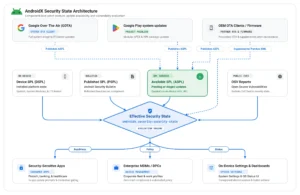
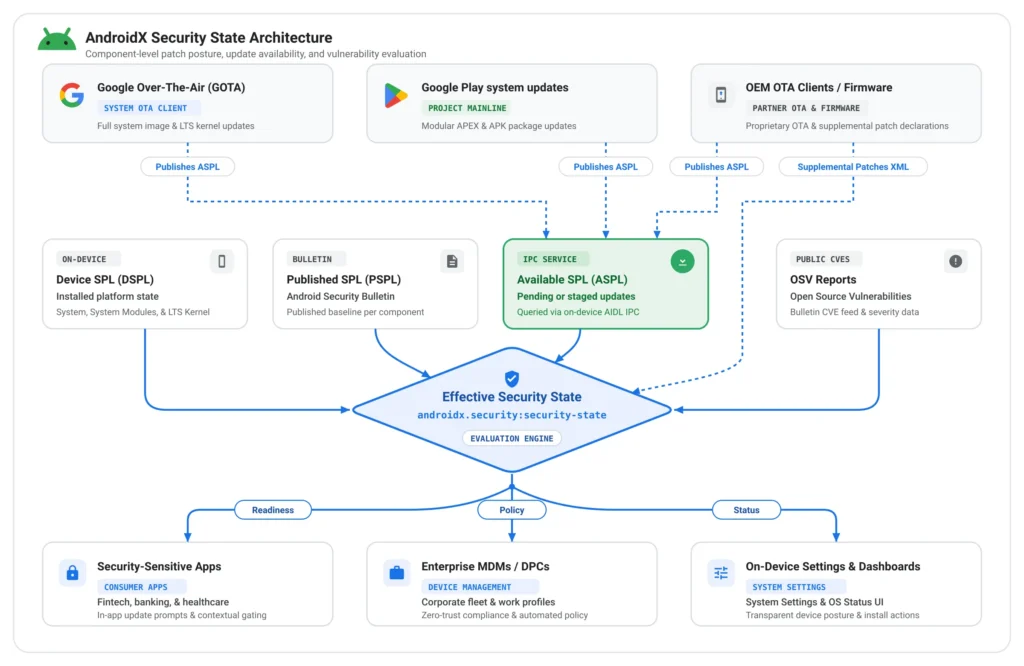
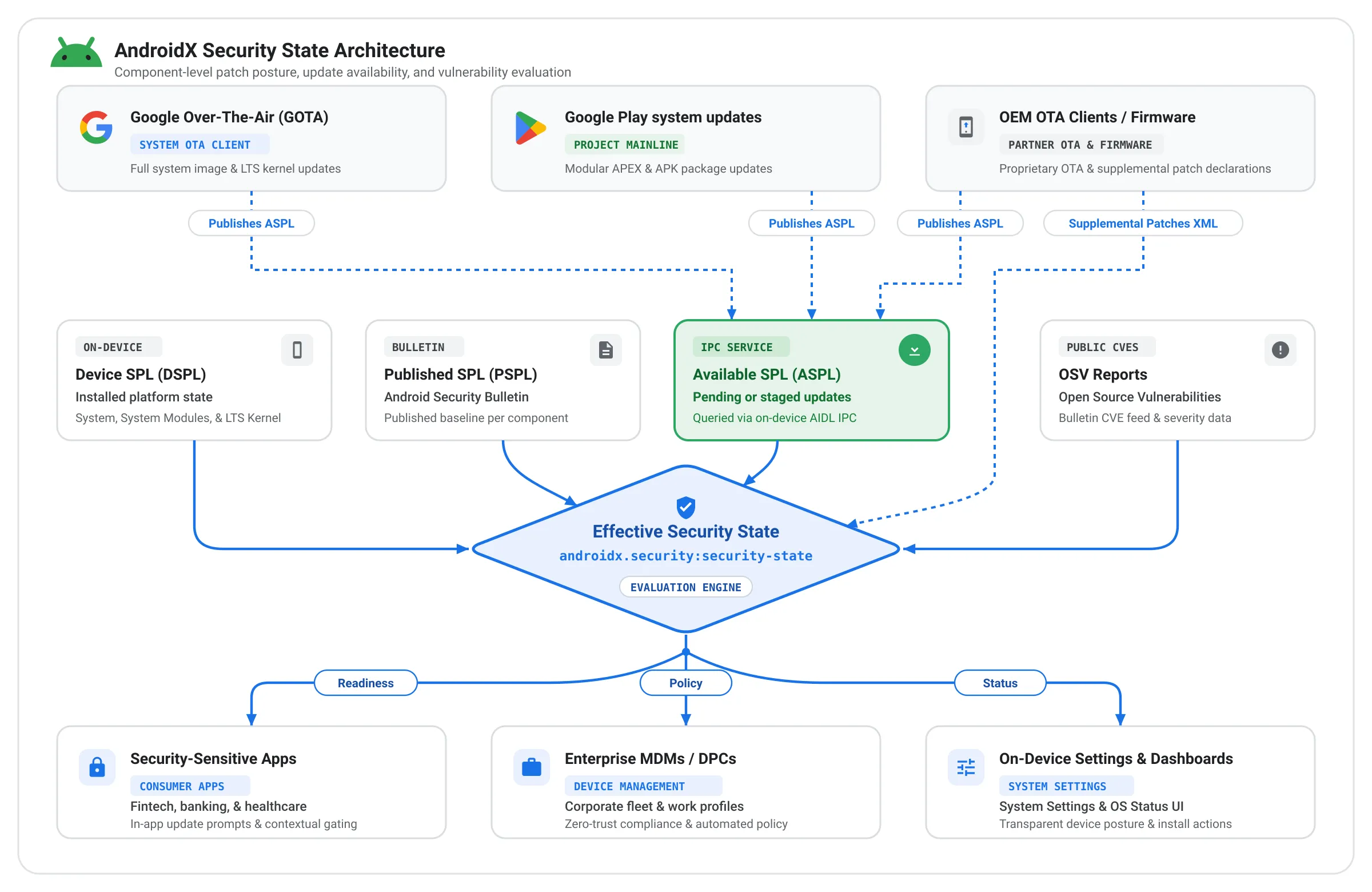
The introduction of the new Security State libraries allows for a much more precise diagnostic approach. Instead of relying on a single string to represent the entire device’s safety, the new libraries expose three distinct patch levels:
- DSPL (Device Security Patch Level): Represents the current state of the core firmware.
- PSPL (Platform Security Patch Level): Reflects the versioning of the core Android OS framework.
- ASPL (Available Security Patch Level): Indicates the state of updates that are staged and waiting to be installed.
By segmenting these levels, Google is enabling developers to move away from "all-or-nothing" security checks. An application, such as a high-stakes banking portal or a sensitive enterprise management tool, can now programmatically query the exact patch status of specific hardware or software components.
Chronology: The Path to Granular Visibility
The evolution of these tools did not happen overnight. It is the culmination of years of effort to modularize the Android operating system.
- Pre-2020: The Android security landscape was dominated by monolithic OTA updates. Developers had little visibility into the actual software state of a device beyond the manufacturer’s declared patch level.
- 2020–2022 (The Modularization Era): With the introduction of Mainline modules and Google Play system updates, Android moved toward a "decoupled" update model. This made it easier to push critical security patches without a full OS update, but it simultaneously made it harder for developers to track whether a device was truly protected against specific vulnerabilities.
- 2023 (Alpha Testing): Google began testing the Security State API, acknowledging that developers needed a standardized way to query these modular components.
- 2024 (The Stable Release): The release of Security State v1.1.0 and Security State Provider v1.0.0 represents the formalization of this standard, providing a stable interface for both client apps and OEM update clients.
Supporting Data: Why Component-Level Verification Matters
The necessity for this shift is backed by the increasing complexity of the Android software supply chain. When a critical vulnerability—such as a flaw in a Bluetooth driver or a memory-related issue in the graphics stack—is discovered, it may be patched via a specific module update rather than a full system-wide patch.
The Role of OSV Integration
The new libraries are designed to interface with the Open Source Vulnerabilities (OSV) database. By mapping device states against the Android Security Bulletin, the libraries can verify not just the date of the last update, but whether specific Common Vulnerabilities and Exposures (CVEs) have been mitigated.
This allows an application to perform a "Context-Aware Security Check." For instance, a fintech app can perform the following logic:
- Verification: Query the ASPL to see if a specific, high-risk NFC vulnerability has a pending update.
- Decision: If the patch is pending, the app can prevent the user from performing a high-value transaction until the update is applied.
- User Experience: Instead of a generic "Device Insecure" message, the app can provide a specific prompt: "Please install the latest system security update to enable contactless payments."
Official Perspectives and Industry Implications
For App Developers and Enterprises
For developers of security-critical applications, this is a game-changer. Historically, developers have had to make a trade-off between user convenience and security. By being overly strict, they alienate users with slightly outdated devices; by being too permissive, they risk potential exploitation.

These new libraries allow for a "risk-based" security posture. Enterprises managing fleets of devices can now use these APIs to ensure that all corporate-issued hardware meets specific compliance standards before allowing access to internal networks.
For OEMs and Update Clients
The Security State Provider library is arguably the most significant addition for the hardware ecosystem. Historically, OEMs had fragmented ways of reporting update status. Proprietary OTA clients often kept this data siloed.
The new standardizes this process by providing an Android Inter-Process Communication (IPC) mechanism. This allows third-party applications to query update availability in a uniform way, regardless of the device manufacturer. This creates a unified "source of truth" for security, reducing the overhead for developers and ensuring that users receive consistent, accurate information about their device’s health.
Future Implications: The Road Ahead
The integration of these libraries signals a maturing Android ecosystem where security is no longer an "invisible" background process but an active, queryable state.
1. Proactive Remediation
We are likely to see a shift toward "proactive" security. Rather than waiting for a monthly patch, applications can now nudge users to update the specific module that is vulnerable. This reduces the "window of exposure" that exists between the disclosure of a vulnerability and the installation of a full system OTA.
2. Standardizing Compliance
For highly regulated industries like healthcare or government contracting, these tools provide an auditable trail of security. Compliance officers can now request an app to log its security state check, proving that the device met the required patch levels at the time of a transaction or data access event.
3. Strengthening the "Chain of Trust"
By allowing the OS to communicate its state directly to the application layer, Google is effectively extending the "Chain of Trust" from the hardware level all the way up to the user-facing application. This creates a symbiotic relationship where the OS and the apps running on top of it work in tandem to create a hardened environment.
How to Get Started
For developers ready to integrate these tools, the path forward is clearly defined by Google’s latest documentation. The libraries are available through the AndroidX repository, and implementation follows a straightforward pattern:
- Dependency Addition: Include the
androidx.security.stateandandroidx.security.state.providerlibraries in yourbuild.gradlefile. - API Implementation: Utilize the
SecurityStateclass to query for specific patch levels (DSPL, PSPL, ASPL). - Feedback Loop: As these are new stable releases, Google is actively encouraging developers to contribute feedback via the Android Issue Tracker. This is a critical stage in the lifecycle, as the efficacy of these tools depends on the breadth of the community’s adoption.
Conclusion
The release of the Security State libraries is more than just a software update; it is an architectural milestone for Android. By breaking down the barriers of the monolithic Security Patch Level, Google has empowered the ecosystem to take a more granular, intelligent, and transparent approach to security. As threats evolve to target specific components, the ability to verify, report, and remediate at that same level of granularity is not just a benefit—it is an essential requirement for the future of mobile security.
Whether you are a developer securing a payment gateway or an enterprise IT administrator managing thousands of endpoints, these tools provide the visibility required to operate with confidence in an increasingly complex digital world. The transition may take time as manufacturers and developers adopt the standard, but the trajectory is clear: the future of Android is transparent, modular, and, above all, secure.