Scaling Security: How WhatsApp Revolutionized Authentication with Passkeys
In the landscape of modern digital communication, few platforms command the ubiquity of WhatsApp. Serving billions of users across vastly different socio-economic regions and technical infrastructures, the platform serves as a critical lifeline for personal and professional connection. However, with such massive scale comes a persistent challenge: how to provide seamless, high-speed access while ensuring ironclad security against increasingly sophisticated threats like account takeovers and credential theft.
The answer, as WhatsApp discovered in 2023, lies in the evolution of authentication: Passkeys. By moving away from traditional, phishable methods like SMS-based One-Time Passwords (OTP) and toward public-private key cryptography, WhatsApp has set a new industry standard for consumer-grade application security.
The Core Facts: Why WhatsApp Pivoted to Passkeys
The primary motivation for WhatsApp’s transition was to solve the "friction-security paradox." Traditional authentication methods—most notably SMS OTPs—are inherently flawed. They are susceptible to SIM swapping, phishing, and delivery delays, especially in emerging markets where network infrastructure may be inconsistent.

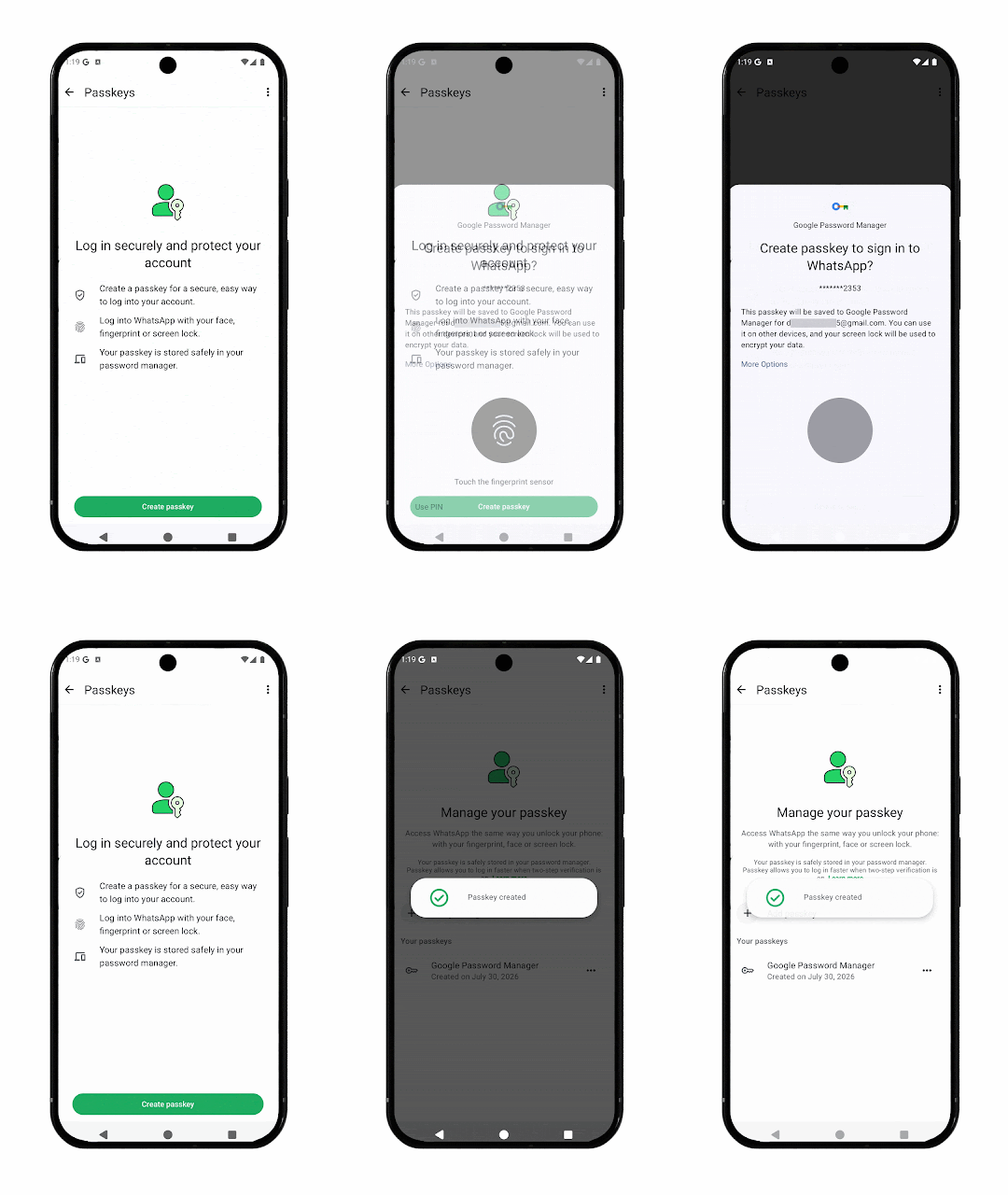
Passkeys resolve these issues by utilizing the device’s own biometric hardware (fingerprint or face unlock) or screen lock to prove identity. When a user creates a passkey, their device generates a unique cryptographic key pair. The private key remains securely on the device, while the public key is shared with WhatsApp’s servers. During login, the device uses the private key to sign a challenge from the server, confirming the user’s identity without ever transmitting a password over the internet.
For a platform as massive as WhatsApp, this isn’t just a security upgrade; it is a fundamental shift in user experience, turning a multi-step, error-prone login process into a single, effortless gesture.
Chronology: A Journey Toward Passwordless Security
2023: The Visionary Commitment
Recognizing the limitations of legacy authentication, the WhatsApp engineering team, in collaboration with Google, made the strategic decision to adopt passkeys. As one of the first global consumer applications to integrate this technology, the move was a calculated risk aimed at future-proofing the platform’s account recovery and access systems.

Development and Integration
Throughout 2023, the team worked to map out the implementation. Utilizing the Android Credential Manager API, developers sought to abstract the complexities of various credential providers into a unified interface. This was a significant engineering undertaking, as the team had to ensure the system functioned correctly across thousands of device models, ranging from budget Android phones with limited sensors to the latest high-end hardware.
Testing and Refinement
The rollout was not instantaneous. WhatsApp employed extensive A/B testing to refine the UI. Because passkeys were a novel concept for many users, the team had to design intuitive, context-aware prompts. By late 2023 and into 2024, the feature saw widespread adoption, proving that a biometric-first approach was viable even at the scale of billions of users.
Technical Architecture: The "Under the Hood" Mechanics
The robustness of WhatsApp’s passkey implementation relies on a sophisticated backend architecture built on Erlang, interacting with the Rust-based webauthn-rs library.

Server-Side Orchestration
The server architecture is divided into clear "Begin" and "Finish" sequences for both registration and authentication. This modularity allows the system to remain resilient to errors.
- Registration: The server issues creation options, validates attestation, and securely persists the public key.
- Authentication: The server orchestrates the login sequence, verifying the assertion signature and updating stored credentials if WebAuthn signals that a refresh is necessary.
Handling Edge Cases
A major hurdle was the sheer diversity of Android configurations. Developers had to account for:
- Devices lacking biometric sensors (falling back to PIN/Pattern).
- Inconsistent behaviors in older Android versions (pre-Android 13).
- Outdated Google Play Services.
To solve this, the team collaborated with Google to create a resilient API surface that gracefully handles exceptions, ensuring that even on older hardware, the user is never locked out.

Official Responses: Insights from the Engineering Frontlines
"What excites me most is the sheer scale of WhatsApp’s impact," says Mayank Manuja, an Android Engineer on the WhatsApp Registration and Access team. "Even a small improvement to WhatsApp touches billions of users worldwide."
The team’s perspective highlights the difficulty of building for a global audience. Success wasn’t just about implementing the FIDO2 standard; it was about ensuring that the social aspect of the technology—how a user perceives and trusts a "passkey" prompt—was handled with care. The collaboration with Google proved vital, as it allowed the team to leverage the Credential Manager API, effectively shielding the WhatsApp app from the fragmented nature of the Android ecosystem.
Implications: The Future of Digital Identity
The success of the passkey implementation has broad implications for the tech industry at large.

1. The Decline of SMS OTP
As WhatsApp and other major players continue to adopt passkeys, the reliance on SMS as an authentication vector will likely decline. This is a net positive for security, as SMS is inherently unencrypted and vulnerable to interception. By moving toward local device authentication, platforms are effectively neutralizing the most common vectors for credential theft.
2. A Blueprint for Cross-Platform Utility
WhatsApp’s decision to eschew fragile, Bluetooth-dependent cross-device transport mechanisms in favor of native platform integration (Google Password Manager/iCloud Keychain) serves as a blueprint for other developers. By allowing passkeys to live natively within the ecosystem’s password managers, the user experience becomes "platform-native," reducing confusion and increasing adoption rates.
3. Expanding the Scope
WhatsApp is already looking beyond initial sign-ins. The future of passkeys within the app includes:

- Sensitive Action Re-authentication: Using biometrics to approve high-stakes actions like changing security settings or accessing encrypted backups.
- Lower-Friction Creation: As biometric capabilities become standard even in entry-level smartphones, the "barrier to entry" for passkey creation will continue to vanish.
Best Practices for Developers Building at Scale
For developers looking to replicate WhatsApp’s success, the team offers several critical recommendations:
- Prioritize Context: Only prompt for passkey creation when the user is in a state of "positive engagement," such as after a successful manual sign-in or a security update.
- Graceful Degradation: Always provide a robust fallback. If a device cannot support a passkey due to software or hardware limitations, the user experience must remain fluid.
- Leverage Native APIs: Do not reinvent the wheel. Use the platform’s Credential Manager (or equivalent) to abstract the complexities of credential storage and retrieval.
- Monitor the Lifecycle: Passkeys are not "set and forget." Implement logic to handle credential revocation, rotation, and synchronization across devices.
- Educate the User: Because "passkey" is still a technical term for many, use clear, non-technical language to explain the benefits (e.g., "Use your fingerprint to sign in faster").
Conclusion: A More Secure Future
WhatsApp’s shift to passkeys is more than a technical upgrade; it is a paradigm shift. By embracing modern cryptography, the platform has managed to make its user base significantly more secure while simultaneously removing the frustrations of legacy authentication.
As we look toward a future where passwords become an obsolete artifact of early internet history, the work done by the WhatsApp and Google engineering teams stands as a testament to what is possible when scale meets innovation. The path forward is clear: authentication should be fast, invisible, and, above all, secure. Through the power of passkeys, that vision is becoming a reality for billions of users every day.

For developers interested in exploring these technologies, the Android Credential Manager documentation and public sample code on GitHub provide a comprehensive starting point for integrating modern, phishing-resistant authentication into your own applications.