Beyond the Binder: Redefining Peptide Discovery in the Age of Abundance
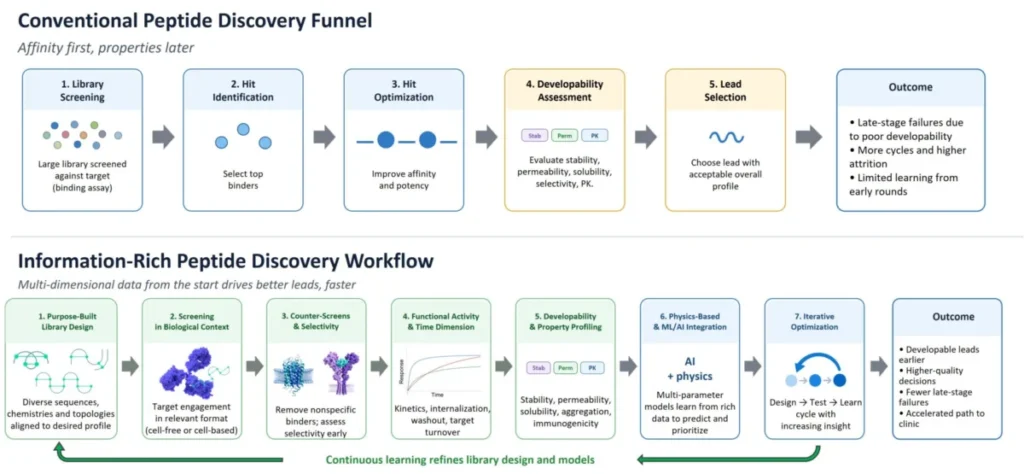
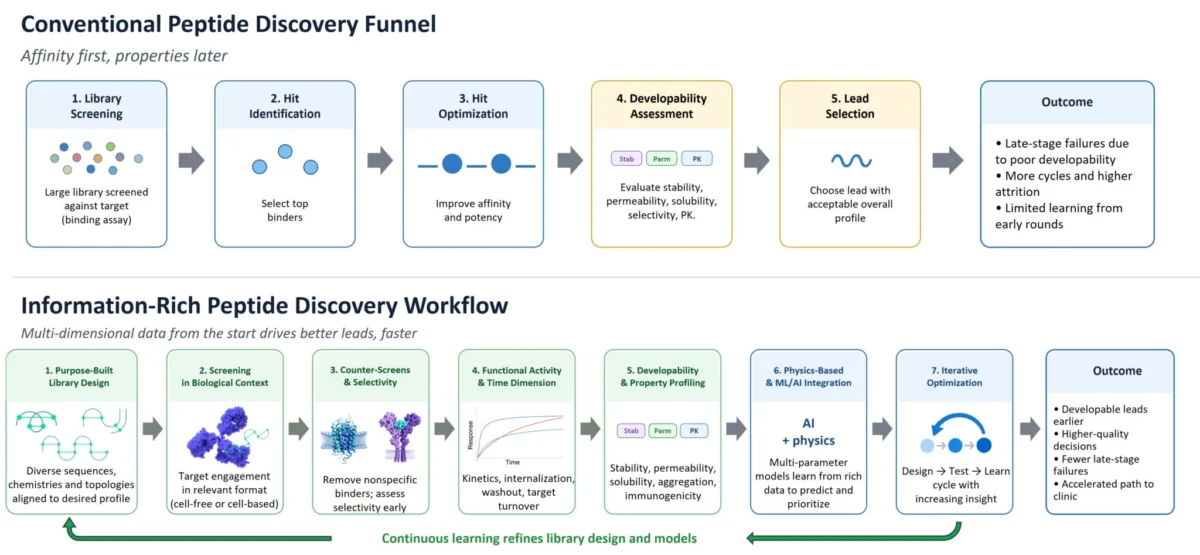
The landscape of drug discovery is undergoing a seismic shift. For decades, the primary objective of peptide screening was singular and unforgiving: identify the molecule with the highest affinity for a target. Today, as researchers gain the ability to synthesize massive libraries, incorporate noncanonical residues, and leverage generative AI, the field is entering an era of unprecedented abundance. Yet, a persistent bottleneck remains. By focusing almost exclusively on binding strength, many drug discovery programs are effectively running a marathon while ignoring the terrain, only to discover—too late and at great expense—that their "winner" lacks the solubility, stability, or cellular permeability required to become a therapeutic.
To evolve, the industry must pivot. The next frontier in peptide therapeutics will not be defined by choosing between computation and experimentation, but by designing discovery workflows that treat binding, permeability, and developability as a single, integrated design challenge.
The Illusion of the "Unbiased" Library
A fundamental misunderstanding often plagues early-stage discovery: the belief that a peptide library can be truly "unbiased." In reality, every library is a hypothesis in physical form. The choice of length distribution, residue alphabet, cyclization chemistry, and display format creates a rigid perimeter around the chemical space a team can explore. These parameters are not mere technicalities; they dictate whether a molecule can be synthesized, how it folds, and whether it can navigate the complex barriers of the human body.
Crucially, function in peptides is not an emergent property of sequence alone. Two peptides with near-identical residue compositions can exhibit vastly different pharmacologies based on subtle structural nuances—such as whether they are linear or cyclic, the positioning of a backbone modification, or the stereochemistry of a single amino acid. When programs rely on sequence-only analysis, they risk lumping together molecules that are chemically and pharmacologically distinct, obscuring the path to an effective drug.
Chronology of a Paradigm Shift
The shift toward an information-rich workflow is well-illustrated by recent successes in the field. In 2026, researchers demonstrated a more nuanced approach by screening a collection of 15,360 fully random, sub-kilodalton cyclic peptides against the Keap1-Nrf2 protein-protein interaction. Instead of simply pulling out the tightest binders and moving to optimization, the team employed an iterative design process that considered membrane permeability alongside target engagement from the outset.
The result was an inhibitor that not only bound its target but successfully navigated the intracellular environment to produce activity in living cells. This study serves as a bellwether for the industry: when binding and permeability are treated as connected design problems rather than sequential hurdles, the time from hit identification to lead candidate is significantly compressed.

Supporting Data: Why "Inactive" Is Not a Single Label
A central failure in modern drug development is the loss of negative data. The final "hit list" is often the most impoverished part of a dataset; it records the winners but discards the rich evidence of why thousands of other candidates failed.
In a robust pipeline, "inactive" should never be a catch-all label. A peptide might fail for a dozen different reasons:
- Synthetic intractability: It could not be produced in sufficient yield.
- Display failure: It did not properly present its binding surface.
- Pharmacological mismatch: It bound the target but lacked the necessary stability or membrane permeability.
- Nonspecificity: It bound to a purification tag or a hydrophobic surface rather than the intended epitope.
By collapsing these distinct failure modes into a single "negative" category, researchers inadvertently train their computational models on noise. Future-ready pipelines must maintain provenance—starting-library abundance, enrichment rates, and batch-specific behaviors—to ensure that machine learning algorithms learn the difference between a technical failure and a genuine biological dead-end.
Official Perspectives: Integrating Physics and Machine Learning
The debate between physics-based modeling and machine learning is increasingly viewed as a false dichotomy. According to industry leaders, such as Karsten Eastman, PhD, CEO and co-founder of Sethera Therapeutics, the most productive workflows use physics-based insights to define the boundaries of plausible chemical space, while machine learning identifies the next most informative experiments.
Physics-based calculations remain the gold standard for examining conformational ensembles and intramolecular hydrogen bonding, especially when data are sparse. Conversely, machine learning thrives on larger, structured datasets, allowing researchers to explore trade-offs that human intuition might overlook. A minor sacrifice in binding affinity, for example, may be the necessary price for a massive gain in solubility or serum stability. By examining these trade-offs directly, teams can stop optimizing for a "perfect" binder that is destined to fail in the clinic.
Implications for Future Drug Development
The implications for the pharmaceutical industry are profound. To move beyond the current limitations, discovery campaigns must be organized around a rigorous, five-pillar strategy:
- Define the Product Profile: Determine the target compartment and route of administration before the first screen. A peptide designed for the extracellular space has vastly different requirements than one intended for cytosolic access.
- Architecture as a Variable: Treat constraint, topology, and backbone composition as primary variables. Diversity of scaffold is as important as diversity of sequence.
- Establish an Assay Hierarchy: Implement early counterscreens and orthogonal binding assays to remove artifacts (e.g., tag-binders or hydrophobic aggregates) before they consume resources.
- Preserve Data Integrity: Treat "not detected" and "failed" as informative data points. Data provenance is the lifeblood of reliable computational modeling.
- Prospective Testing: Models must be tested on their ability to predict the next round of results, not just their ability to retroactively explain past data.
Incorporating the Temporal Dimension
Perhaps the most overlooked factor in current screening is time. Most assays provide a static "snapshot" of a molecule’s behavior. However, biology is inherently temporal. A peptide with a moderate equilibrium affinity but a slow dissociation rate (off-rate) often exhibits superior functional activity in vivo compared to a "tighter" binder that washes out of the target quickly.
Future workflows will incorporate time by design: increasing wash periods to select for slow off-rates, exposing candidates to serum or proteases to test for stability, and measuring cellular internalization at multiple time points. By shifting from a static "ranked list" approach to a "calibrated map" of chemical and biological landscapes, researchers can identify not just what binds, but what endures.
Conclusion: A Systemic Approach to Innovation
The era of abundance in peptide discovery is a double-edged sword. More data, more algorithms, and more synthesis capacity will not lead to more drugs if the underlying strategy remains tethered to the "strongest binder" fallacy.
The future belongs to organizations that treat their discovery platforms as integrated systems. By aligning physics-based modeling with high-throughput experimentation, and by valuing the nuance of negative data as highly as the success of a lead candidate, the industry can move beyond the "funnel" approach. The goal is no longer to find a winner in a pile of candidates; it is to understand the rules of the game well enough to engineer the next molecule with precision. As the science of peptide discovery matures, success will be measured not by the sheer number of hits, but by the ability to transform a hypothesis into a reliable, scalable, and effective medicine.