CISA Under Fire: Lawmakers Demand Answers Following Massive Credential Leak
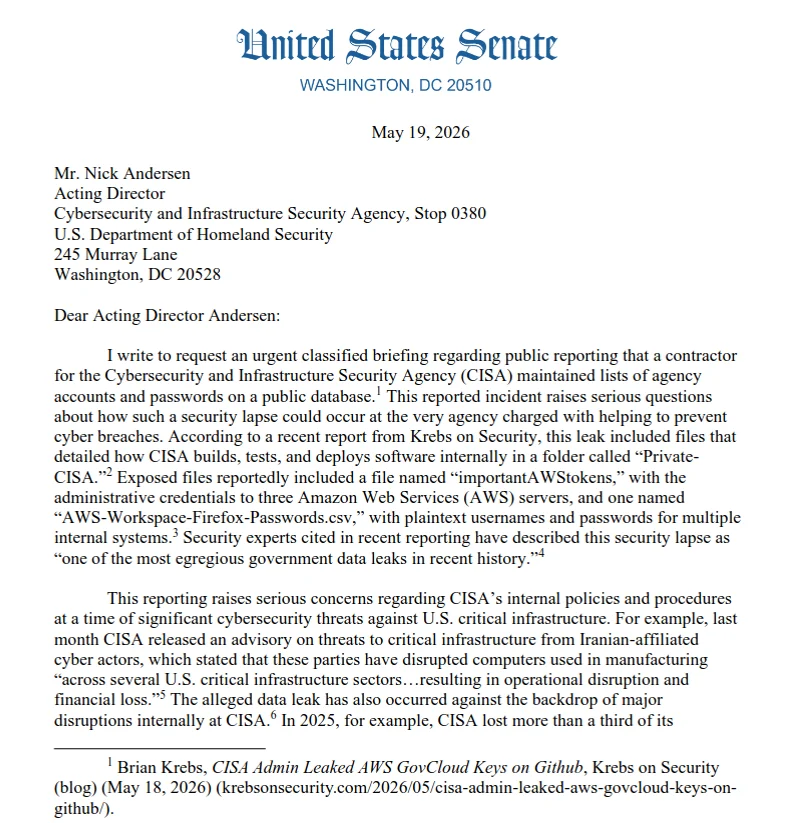
In a startling security failure that has rattled the foundations of the U.S. government’s primary cybersecurity defense agency, the Cybersecurity and Infrastructure Security Agency (CISA) is facing intense congressional scrutiny. The agency is currently scrambling to contain the fallout from a massive data exposure after it was revealed that a contractor intentionally published highly sensitive AWS GovCloud keys and internal agency credentials on a public GitHub repository.
The incident, which has been described by cybersecurity experts as a "roadmap" for state-sponsored adversaries, has prompted bipartisan outrage. Legislators are now demanding a comprehensive accounting of how an agency tasked with protecting the nation’s critical infrastructure allowed such a glaring security lapse to occur.
The Scope of the Breach: A Public "Scratchpad" of Secrets
The breach centers on a public GitHub profile titled "Private-CISA." Investigators discovered that a contractor, who possessed administrative access to the agency’s internal code development platform, had uploaded a cache of sensitive files to this public-facing account. The repository, which functioned as an informal "scratchpad" for the contractor to synchronize work between environments, contained plaintext credentials for dozens of internal CISA systems.
According to security analysts who reviewed the repository before it was taken offline, the contractor actively bypassed GitHub’s built-in security features, which are specifically designed to alert users or block the commit of sensitive credentials. By manually overriding these safety protocols, the contractor effectively hung the "keys to the kingdom" in a digital town square, visible to anyone with an internet connection.
A Chronology of the Exposure
The timeline of the incident suggests a protracted period of vulnerability that may have lasted for months.
- November 2025: Forensic analysis of the "Private-CISA" repository indicates that it was initially created during this period. It appears to have been used as a synchronization mechanism for the contractor’s workflows.
- Late April 2026: Experts from Truffle Security, including Dylan Ayrey, creator of the open-source secret-scanning tool TruffleHog, identified that the repository was updated with its most sensitive and critical secrets during this time.
- Mid-May 2026: The security firm GitGuardian identified the leak and notified CISA.
- May 18, 2026: The security news outlet KrebsOnSecurity publicly reported the breach, bringing the incident to national attention.
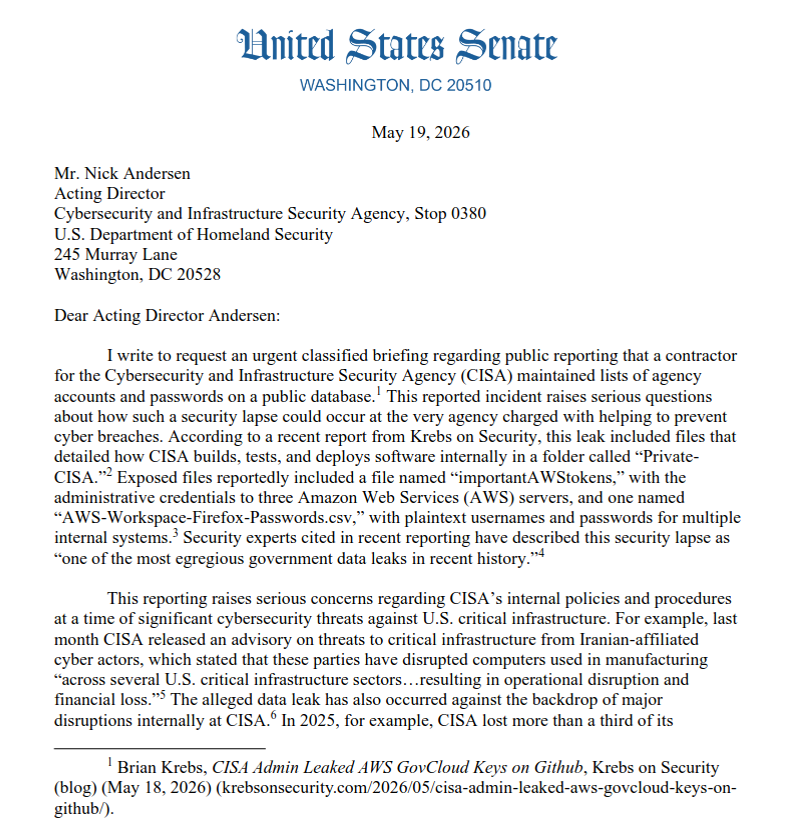
- May 19, 2026: Sen. Maggie Hassan (D-NH) and Rep. Bennie Thompson (D-MS) issued formal letters to CISA’s Acting Director, Nick Andersen, demanding an immediate investigation and transparency regarding the extent of the damage.
- May 20, 2026: Security researchers revealed that even after initial notifications, critical keys—including an RSA private key with deep administrative access—remained active and valid, potentially exposing the entire CISA-IT organization.
The "TruffleHog" Findings: A Direct Threat to CI/CD Pipelines
The most alarming aspect of the breach, according to Dylan Ayrey, involved an exposed RSA private key. This key granted access to a GitHub app owned by the CISA enterprise account and installed on the CISA-IT organization.
"An attacker with this key could have done significant damage," Ayrey noted in his analysis. "They could read source code from every repository in the CISA-IT organization, including private repositories. They could register rogue self-hosted runners to hijack CI/CD pipelines—the very systems used to automate software deployment—and modify administrative settings, including branch protection rules and webhooks."

For a federal agency, the hijacking of a Continuous Integration/Continuous Delivery (CI/CD) pipeline is a nightmare scenario. It allows an attacker to inject malicious code into trusted software updates, potentially turning the agency’s own tools into vectors for a supply-chain attack. While CISA reportedly invalidated this specific key after being prompted by KrebsOnSecurity on May 20, the delay in response remains a major point of contention.
Official Responses and Internal Turmoil
CISA has maintained a posture of containment. In a brief written statement, the agency asserted that "there is no indication that any sensitive data was compromised as a result of the incident." However, this claim is met with skepticism by many in the security community who argue that "no indication" of compromise does not mean "no compromise occurred."
The agency stated it is "actively responding and coordinating with the appropriate parties and vendors to ensure any identified leaked credentials are rotated and rendered invalid."
The context of this breach is complicated by the current state of the agency. Sen. Maggie Hassan’s letter highlights that the leak occurred while CISA is grappling with a significant internal reorganization. Reports suggest the agency has lost more than a third of its workforce and nearly its entire cadre of senior leadership following a series of forced retirements and resignations under the current administration. Critics argue that this "brain drain" has hollowed out the agency’s institutional knowledge and weakened its security culture, making it more susceptible to the type of human error that allowed this breach to occur.
Implications for Federal Cybersecurity
The bipartisan inquiry led by Sen. Hassan and Rep. Thompson signals that this incident will not be swept under the rug. Rep. Thompson, the ranking member on the House Homeland Security Committee, was particularly scathing in his assessment:
"We are concerned that this incident reflects a diminished security culture and/or an inability for CISA to adequately manage its contract support. It’s no secret that our adversaries—like China, Russia, and Iran—seek to gain access to and persistence on federal networks. The files contained in the ‘Private-CISA’ repository provided the information, access, and roadmap to do just that."
The "Human Problem"
Cybersecurity experts are divided on whether this can be solved through technology alone. James Wilson and Adam Boileau of the Risky Business podcast have argued that while technical controls can prevent some forms of accidental data leakage, they cannot solve the "human problem."
"This is a contractor who, of their own volition, decided to use a personal GitHub account to synchronize content from a work machine to a home machine," Boileau noted. "I don’t know what technical controls you could put in place given that this is being done presumably outside of anything CISA managed or even had visibility on."
This observation hits on a core vulnerability for all large organizations: the "shadow IT" problem. When employees or contractors prioritize convenience over security policy, they create blind spots that even the most sophisticated enterprise security tools struggle to monitor.
Conclusion: A Wake-Up Call
The CISA GitHub leak is more than a simple instance of poor credential management; it is a case study in the risks of modern software development. As agencies increasingly rely on cloud-native tools and external contractors, the surface area for potential attacks expands exponentially.
The fact that these credentials were exposed on a platform that is constantly monitored by both security researchers and adversarial threat actors suggests that it is highly probable that the information was discovered by malicious parties before it was secured. Whether those parties were state-sponsored intelligence agencies or independent cybercrime groups remains an open question—one that Congress is clearly intent on answering.
As CISA works to rotate its exposed secrets and address the systemic issues raised by the incident, the agency faces a difficult path to restoring its reputation. In the world of cybersecurity, the entity tasked with setting the standard for the nation must itself be beyond reproach. This incident serves as a stark reminder that even the most prominent watchdogs are susceptible to the same human vulnerabilities they are tasked with mitigating.