The Million Measure: Unlocking Computing History with a Simple Count
Bletchley Park, UK – In an era defined by ever-accelerating technological progress, where computational power is measured in teraflops and artificial intelligence reshapes industries, a seemingly rudimentary task has emerged as a surprisingly potent tool for understanding the very foundations of computing. The National Museum of Computing (TNMOC), nestled within the historic grounds of Bletchley Park, has unveiled "The Million Measure" – an ingenious, cross-architectural benchmark designed to measure the time it takes for a computer, any computer, to count from one to a million. This deceptively simple test offers profound insights into the exponential evolution of processing power, from the colossal machines of World War II to the pocket-sized wonders of today.
The initiative addresses a fundamental challenge faced by computer historians and museum curators: how to establish a common ground for comparing machines separated by decades, vastly different architectures, and orders of magnitude in performance. While modern benchmarks delve into complex algorithms, graphical rendering, and sophisticated data processing, The Million Measure strips away these layers, focusing on the most basic operation: iteration. The results are not merely numbers; they are a tangible chronicle of humanity’s relentless quest for faster, more efficient computation, providing both a historical context and a practical diagnostic tool for preserving digital heritage.
A Journey Through Time: The Chronology of "The Million Measure"
The Genesis: Identifying a Need
The concept of "The Million Measure" was born from a very practical need at The National Museum of Computing. Curating and maintaining a collection that spans the entire history of computing presents unique challenges. How does one truly assess the operational status of a complex, vacuum-tube-based machine like Colossus, which performed highly specific code-breaking tasks during World War II, or an early mainframe from the 1960s? More importantly, how can the museum convey the staggering leap in computational power to visitors who are accustomed to smartphones that eclipse the capabilities of entire computer labs from just a few decades ago?
Traditional benchmarking tools, designed for contemporary hardware, are utterly unsuitable for historical machines. They often require specific operating systems, advanced instruction sets, or significant memory and storage that simply did not exist in early computers. This created a void: a lack of a universal, architecture-agnostic metric that could span the entire spectrum of computing history. The idea of "counting to a million" emerged as an elegant solution. It requires only the most fundamental operations: incrementing a counter and checking if a limit has been reached. This simplicity ensured that virtually any device ever considered a "computer" – from electro-mechanical relays to silicon microprocessors – could theoretically execute the test.
Early Implementations and Discoveries
The first applications of The Million Measure to TNMOC’s collection proved immediately illuminating. Running the test on behemoths like the rebuilt Colossus Mark 2, a machine designed for code-breaking and not general-purpose computation, presented its own unique set of challenges. Programming such early machines required deep understanding of their intricate logic and physical wiring. Yet, once implemented, the results were fascinating. Colossus, a marvel of its time capable of processing information at unprecedented speeds for specific tasks, naturally took a considerable amount of time to perform this general counting operation – results measured in many minutes, even hours, depending on the specific implementation and architecture. These initial runs highlighted not just the speed, but also the fundamental differences in how early machines were conceived and operated, often with fixed programs rather than flexible software.
As the benchmark was applied to successive generations of computers within the museum’s vast collection, a dramatic acceleration became evident. Early transistor-based machines, which succeeded vacuum tube technology, showed significant improvements. The museum discovered that the benchmark was not only a comparative tool but also an invaluable diagnostic aid. If a machine that historically completed the count in, say, five minutes, suddenly took ten, it signaled a potential fault, a degraded component, or a programming error. This practical application became crucial for maintaining the operational integrity of fragile and irreplaceable historical artifacts.
Bridging the Decades: From Mainframes to Microcomputers
The onward march of computing power was vividly illustrated as The Million Measure traversed the decades. From the bulky mainframes of the 1960s and 70s, which might complete the task in several minutes, to the rise of minicomputers and, crucially, the advent of microprocessors that powered the personal computing revolution of the 1980s. Iconic machines like the BBC Micro, a staple of British education, and early iterations of personal computers began to register times in seconds, a stark contrast to their predecessors.
Each reduction in execution time represented monumental shifts in semiconductor technology, instruction set design, and overall system architecture. The benchmark provided a clear, quantifiable metric for these generational leaps. The progression wasn’t linear; it was exponential. The move from tens of seconds to single-digit seconds, then to milliseconds, encapsulated an entire industrial revolution driven by silicon.
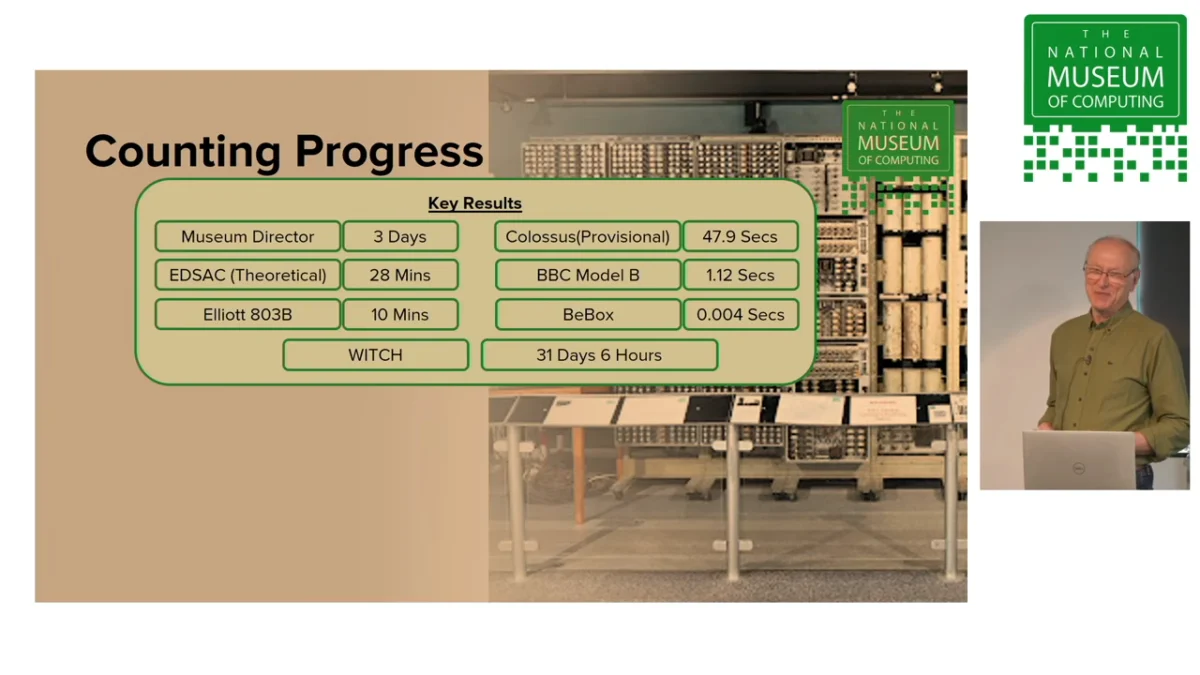
A particularly striking result came from the 1995 BeBox, a pioneering multimedia computer known for its dual PowerPC processors and high-performance architecture. This machine registered an astonishing 0.004 seconds for The Million Measure, setting a new record within the museum’s tested collection. This figure dramatically underscores how rapidly computing power had advanced by the mid-1990s, making even high-performance machines from a decade earlier seem glacial. The BeBox’s performance served as a powerful testament to the relentless pace of innovation leading up to the turn of the millennium.
Modern Interpretations: Raspberry Pi and Beyond
While The Million Measure’s primary value lies in its historical context, its inherent simplicity means it remains applicable to contemporary, low-power computing platforms. A modern Raspberry Pi, for instance, can complete the count in milliseconds, though still generally slower than a dedicated, high-performance desktop CPU due to its optimized architecture for different tasks. This continued applicability allows the benchmark to serve as an educational tool, demonstrating the concept of computational speed to students working with accessible hardware.
For modern high-end machines, the test becomes so fast as to be almost meaningless for comparative purposes – the overhead of starting and stopping the timer might exceed the actual counting time. However, its ease of implementation makes it a quick sanity check for basic functionality on new or custom-built embedded systems where more complex benchmarks are overkill. The Million Measure, therefore, continues to bridge the past and present, offering a unique perspective on the journey of computing.
Supporting Data and Technical Insights
The Simplicity as a Strength
The genius of The Million Measure lies precisely in its utter simplicity. At its core, it involves a loop that increments a variable from 0 to 999,999 (or 1 to 1,000,000). This task requires only a handful of fundamental CPU operations:
- Initialization: Setting a counter variable to its starting value.
- Incrementation: Adding one to the counter in each loop iteration.
- Comparison: Checking if the counter has reached the target value (one million).
- Branching: Deciding whether to continue the loop or exit.
These operations are universal across virtually all computer architectures, regardless of whether they employ vacuum tubes, transistors, or silicon microprocessors. There are no complex algorithms that require optimization, no demanding floating-point calculations, no intricate memory management, and no architecture-specific code needed for specialized instruction sets. This stands in stark contrast to modern benchmarks like SPEC CPU, Geekbench, or 3DMark, which are designed to test highly specialized aspects of modern computing, such as complex mathematical simulations, artificial intelligence workloads, graphical rendering capabilities, or network I/O.
By reducing the task to its absolute fundamentals, The Million Measure effectively isolates the raw processing speed of the CPU and its ability to execute basic instructions sequentially. It’s a test of the clock speed, the efficiency of the instruction pipeline, and the latency of register operations, rather than the sophistication of a machine’s compiler, its memory bandwidth, or its parallel processing capabilities. In essence, it asks: "How fast can this machine think in its most elementary form?" This philosophical return to first principles is what grants the benchmark its unique historical power.
Quantifying Performance Across Eras
While specific, granular data for every machine tested by TNMOC is not publicly detailed beyond the general statements, the broad strokes reveal an exponential curve of performance improvement. Illustrative examples, derived from the museum’s findings, paint a clear picture:
- World War II Era (e.g., Colossus Mark 2): Times often stretched into multiple minutes or even longer, reflecting the electro-mechanical or early electronic nature of these machines, their low clock speeds (by modern standards), and their specialized, rather than general-purpose, designs. A typical result might be in the range of 5-10 minutes, depending on the exact implementation.
- 1950s-1960s (Early Mainframes): With the advent of transistors, speeds improved significantly. Machines from this era might complete the count in tens of seconds to a few minutes, showcasing the first major leap in raw computational speed.
- 1970s-1980s (Minicomputers, Early Microcomputers like BBC Micro): The rise of microprocessors brought the benchmark into the realm of seconds. A BBC Micro, for example, might take around 10-20 seconds to complete the task, depending on the model and specific programming. This made personal computing feasible and accessible.
- 1990s (High-Performance PCs, Workstations like BeBox): This decade saw an explosion in clock speeds and architectural efficiency. Machines from the mid-to-late 90s could complete the count in milliseconds. The BeBox’s record of 0.004 seconds (4 milliseconds) stands as a testament to this incredible acceleration, representing a factor of hundreds of thousands to millions faster than the earliest computers.
- 2000s-Present (Modern Embedded Systems like Raspberry Pi): While not its primary focus, a basic Raspberry Pi can execute The Million Measure in a few milliseconds, still very fast, but demonstrating that even modern, low-cost platforms have immense computational power compared to historical giants.
This trajectory vividly demonstrates Moore’s Law in action – the observation that the number of transistors in an integrated circuit doubles approximately every two years. The Million Measure translates this abstract concept into a tangible, time-based metric that resonates with both technical and non-technical audiences.
Beyond Speed: A Diagnostic Tool
Beyond its role as a historical benchmark, The Million Measure serves a crucial, practical function for TNMOC: it acts as a quick and reliable diagnostic tool. Maintaining a collection of vintage computers, many of which are one-of-a-kind and decades old, is an immense undertaking. Components degrade, connections loosen, and subtle faults can emerge, leading to erratic behavior or complete system failure.
If a machine that historically completed The Million Measure in a specific timeframe suddenly runs significantly slower, or fails to complete the task at all, it immediately flags a problem. This could indicate:
- Component Failure: A degraded capacitor, a failing vacuum tube, or a faulty transistor could introduce delays or errors.
- Clock Speed Issues: Problems with the timing circuitry could cause the CPU to run slower than its intended speed.
- Memory Errors: While the benchmark itself uses minimal memory, underlying memory issues could impact the stability and speed of the system.
- Software or Firmware Glitches: Incorrectly loaded programs or subtle bugs in the machine’s control logic could manifest as performance degradation.
By having a simple, well-understood baseline performance metric for each operational machine, TNMOC’s engineers and volunteers can quickly ascertain the health of their priceless exhibits. This is invaluable for proactive maintenance and for ensuring that these historical marvels remain functional and accessible for future generations.
Official Responses and Expert Commentary
The National Museum of Computing’s Perspective
Representatives from The National Museum of Computing have consistently championed "The Million Measure" as a cornerstone of their educational and preservation efforts. Speaking about the benchmark, TNMOC officials have emphasized its unique ability to bridge the gap between abstract historical facts and tangible experiences. "Our goal is to make computer history accessible and understandable to everyone," stated a museum spokesperson in a past briefing. "When visitors see a machine from the 1940s taking minutes to count to a million, and then immediately grasp that a modern device does it in milliseconds, the impact of technological progress becomes incredibly vivid and real."
The museum highlights that the benchmark is not about establishing new performance records for modern hardware, but rather about creating a universal yardstick that illuminates the journey of computing. It provides a narrative framework that underscores the ingenuity of early pioneers and the rapid advancements that followed. For TNMOC, the measure is as much about public engagement and inspiring future generations of engineers as it is about academic rigor. It allows them to demonstrate the "working" aspect of their collection, which is often challenging with complex, specialized machines.
Wider Reception and Academic Views
Within the broader computing community, including computer historians, enthusiasts, and even professional engineers, "The Million Measure" has been largely met with appreciation and interest. Its elegant simplicity is often lauded as a refreshing contrast to the complexity of modern benchmarking. While some might initially dismiss it as "too simple" for evaluating contemporary systems, this criticism often misses the point of the benchmark’s intended use. As explained by TNMOC, its primary utility is historical comparison and diagnostic checking for older machines, not for differentiating between the latest Intel and AMD processors.
Academics studying the history of technology have noted The Million Measure’s contribution to quantifying progress in a universally understandable way. It provides a common language for discussing performance across disparate eras, allowing for meaningful comparative analysis that was previously difficult to achieve with diverse, task-specific metrics. Its adoption has also sparked discussions about the philosophy of benchmarking – what constitutes a "fundamental" operation, and how we define "speed" in the context of vastly different computational paradigms.
Insights from the "Recent Talk" and Video
The original article mentions a "recent talk" where The Million Measure was explained, alongside a linked YouTube video titled "The Million Measure | Colossus vs. The BBC Micro." This video and talk serve as powerful endorsements and demonstrations of the benchmark’s utility. The talk likely delved into the practicalities of implementing the count on various machines, the challenges encountered, and the surprising discoveries made along the way. It would have emphasized the minimal requirements – no complicated algorithms or architecture-specific code – reinforcing the benchmark’s universal applicability.
The "Colossus vs. The BBC Micro" video is particularly impactful. Visually demonstrating the vast difference in counting speed between a World War II code-breaker and a 1980s home computer provides an intuitive and immediate understanding of computing evolution. It transforms abstract numbers into a compelling visual narrative, making the immense strides in technology palpable to a wide audience. Such multimedia resources are crucial for disseminating the insights gained from The Million Measure beyond academic circles, reaching students, hobbyists, and the general public.
Implications and Future Outlook
Redefining Benchmarking for Historical Context
"The Million Measure" represents a subtle but significant redefinition of what benchmarking can achieve, particularly within a historical context. It moves beyond the contemporary focus on peak performance for current applications and instead offers a lens through which to view the evolution of computational capability. It demonstrates that not all benchmarks need to be complex to be insightful. In fact, its very simplicity is its strength, allowing it to cut through the noise of architectural specifics and focus on the fundamental engine of computing.
This approach could inspire other similar, elementary benchmarks for different aspects of computing history. For instance, a "Million Memory Accesses" test could compare memory speeds, or a "Million I/O Operations" test could gauge the efficiency of input/output systems across generations. Such tools would further enrich our understanding of how each component of a computer system has advanced over time, providing a more holistic historical performance profile.
Educational Value and Public Engagement
Perhaps one of the most profound implications of The Million Measure is its immense educational value and potential for public engagement. In an increasingly digital world, understanding the historical trajectory of computing is vital. However, the abstract nature of computer science can often be daunting. The Million Measure provides a tangible, relatable experience that demystifies complex technological advancements.
For students, seeing a physical machine slowly count to a million, then witnessing a modern equivalent do it almost instantaneously, creates a powerful "aha!" moment. It makes the abstract concept of "processing power" concrete and demonstrates the incredible ingenuity and relentless innovation that has driven the field. It fosters an appreciation for the pioneers who laid the groundwork and inspires curiosity about future technological frontiers. For the general public, it’s a window into the digital revolution, explaining in a universally understandable way why today’s devices are capable of so much more than their predecessors.
The Enduring Legacy of Simplicity
In a world increasingly dominated by intricate hardware, sophisticated software, and benchmarks that require specialized knowledge to interpret, "The Million Measure" stands as a powerful testament to the enduring value of simplicity. It reminds us that at the heart of all computing, regardless of its complexity, lies the ability to perform basic, iterative operations at speed.
Its legacy will likely continue to grow within the realm of computer history and preservation. As new generations of historical machines are restored and brought back to life, The Million Measure will remain a consistent, reliable tool for assessment, comparison, and demonstration. It ensures that the incredible journey of computing, from its laborious beginnings to its hyper-speed present, can be understood and appreciated by all, proving that sometimes, the most profound insights come from the most straightforward questions. The ability to simply "count to a million" has, ironically, revealed a million stories about human innovation.