The True Cost of ‘Free’ AI: Benchmarking the Real-World Electricity Expenses of Running Local LLMs
The open-source artificial intelligence community has long rallied behind a seductive premise: once you purchase a capable Graphics Processing Unit (GPU), running Large Language Models (LLMs) locally is essentially free. Free from subscription fees, free from data privacy concerns, and free from the recurring API usage charges levied by cloud giants like OpenAI, Google, and Anthropic.
However, a meticulous, hardware-level benchmark conducted by software engineer and researcher Arsen Apostolov reveals a more complicated economic reality. By mounting an energy meter to a dedicated local AI workstation, Apostolov proved that the operational expenditure (OpEx) of running local models can easily eclipse the cost of commercial cloud APIs.
In some cases, the electricity bill alone makes local hosting more expensive per token than paying for managed cloud services—and that is before accounting for the depreciation of thousand-dollar hardware.
1. Main Facts: The Real Price of Local Inference
Apostolov’s research challenges the "sunk cost" fallacy of local AI hardware by measuring the exact electrical energy consumed during active inference. The benchmark evaluated three local models of varying parameter sizes running on a standardized consumer workstation.
The primary findings of the experiment reveal a stark, non-linear relationship between model size, inference speed, and electricity costs:
- The Ultra-Lightweight Advantage: The smallest model tested,
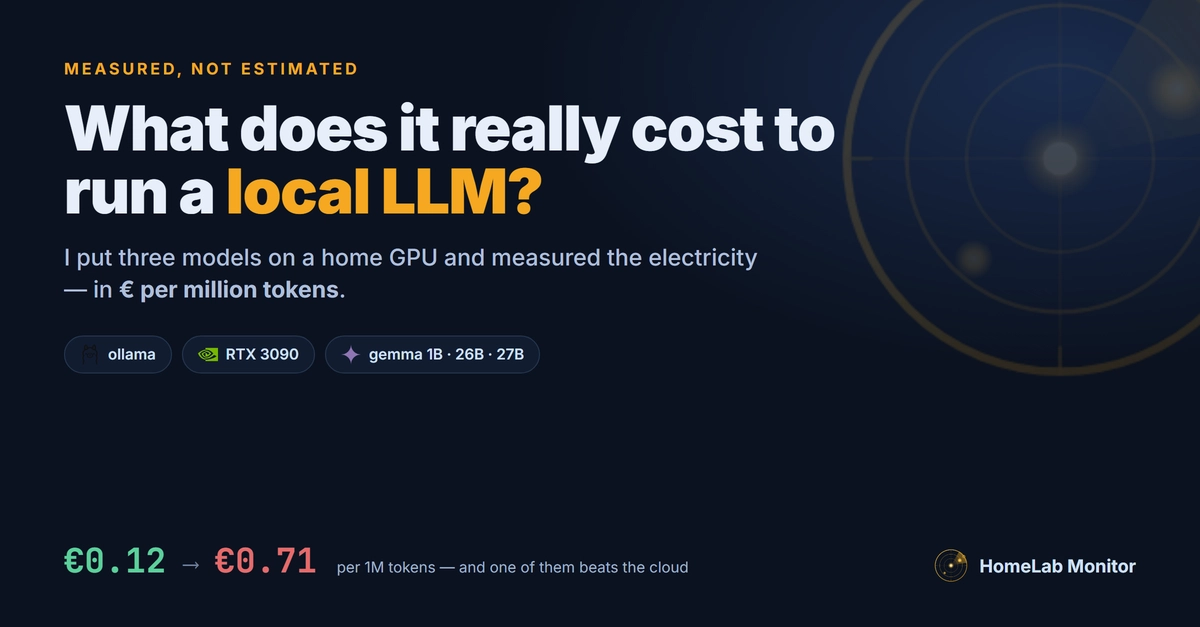
gemma3:1b, proved to be highly economical. It cost just €0.118 per million output tokens in electricity. Compared to a typical hosted "Flash-class" cloud API (which averages around €0.55 per million tokens), running this 1-billion-parameter model locally is approximately five times cheaper than using the cloud. - The Large Model Penalty: The economic equation flips dramatically when scaling up. The
gemma3:27bmodel consumed €0.706 per million output tokens in pure electricity. This makes local execution of a 27-billion-parameter model significantly more expensive than outsourcing the task to a commercial cloud provider, even before factoring in the purchase price of the hardware. - Architectural Efficiency Gains: A newer, mid-sized architecture,
gemma4:26b, demonstrated how rapid software and architectural optimization can reclaim efficiency. Despite having a parameter count close to the 27B model, it landed at €0.272 per million tokens—comfortably beating the pricing of standard cloud APIs while offering high-capacity reasoning locally.
+-------------------------------------------------------------+
|  INFERENCE COST PER MILLION TOKENS (EUR)                    |
+-------------------------------------------------------------+
|  gemma3:1b (Local)       | €0.118                           |
|  gemma4:26b (Local)      | €0.272                           |
|  Hosted Flash API        | €0.550 (Industry Average)        |
|  gemma3:27b (Local)      | €0.706                           |
+-------------------------------------------------------------+
2. Chronology and Experimental Methodology
To move past theoretical estimates and obtain empirical data, Apostolov designed a controlled, reproducible benchmarking pipeline. The entire experiment was executed on a single host machine running openSUSE Linux, powered by a single NVIDIA GeForce RTX 3090 with 24GB of VRAM—the gold standard GPU for prosumer local LLM execution.
The Testing Pipeline
The experiment was structured chronologically to isolate variables and ensure a level playing field for each model:
- Environment Preparation: The workstation was booted into a stable state with minimal background processes to prevent CPU or auxiliary GPU draw from skewing the results.
- The Workload Loop: Each model was subjected to an identical, high-intensity workload: generating exactly 256 tokens in a continuous loop for approximately 4 minutes.
- Model Execution: The models were served locally using Ollama, an open-source framework designed to run LLMs efficiently on local hardware.
- Telemetry Collection: Real-time power metrics were sampled directly from the system’s hardware management interface using the command-line utility
nvidia-smiat strict 10-second intervals. - Integration and Pricing: The power draw (measured in watts) was integrated over the exact duration of each run to calculate total watt-hours (Wh) consumed. This energy consumption was then multiplied by the developer’s actual dual-rate (day/night) electricity tariff to calculate the monetary cost in Euros.
To ensure the telemetry was precise, the testing script used a standard-library-only client to query Ollama’s API. By reading the precise metadata fields eval_count (the exact number of tokens generated) and eval_duration (the exact time spent generating those tokens), the benchmark established a flawless calculation of real tokens-per-second versus actual watts consumed.

3. Supporting Data: The Physics of Token Cost
To understand why local LLM costs scale so aggressively, one must look at the mathematical formula that governs the economics of local inference:
$$textCost per Token propto fractextSystem Power Draw (Watts)textInference Throughput (Tokens per Second)$$
When running a large model like gemma3:27b on a single RTX 3090, the GPU is pushed to its absolute limits. Because LLM generation is highly memory-bandwidth bound, a 27-billion-parameter model forces the GPU to constantly swap massive weight matrices through its VRAM.
This bottlenecks throughput, causing the tokens-per-second rate to drop significantly. Meanwhile, the GPU runs at maximum TDP (Thermal Design Power), consuming upwards of 350 to 400 watts.
- Low Throughput + High Wattage = High Cost: The
gemma3:27bmodel runs slowly and thirstily. Because it takes longer to generate each token while drawing maximum power, the energy cost per token skyrockets to €0.706 per million. - High Throughput + Moderate Wattage = Low Cost: The
gemma3:1bmodel easily fits into the GPU’s cache and VRAM. It generates tokens at lightning speed, allowing the GPU to complete the task quickly and return to a low-power state. This high throughput dilutes the energy cost, resulting in a nominal €0.118 per million.
The Missing Variables: CapEx, Idle Power, and Cooling
It is crucial to note that Apostolov’s figures represent the marginal GPU energy cost alone. In a comprehensive corporate or prosumer cost-benefit analysis, several hidden costs must be added to the local ledger:
- Capital Expenditure (CapEx) and Depreciation: An NVIDIA RTX 3090 or RTX 4090 costs between €800 and €2,000. Silicon degrades over time, especially under heavy compute loads. If a GPU is amortized over a three-year lifespan, the daily cost of ownership can easily dwarf the electricity bill.
- System Idle Draw: A local AI workstation rarely draws zero power. Even when idling, a high-end PC draws between 50 and 100 watts of power just to keep the OS, fans, and motherboard running.
- Thermal Dissipation (Cooling): Every watt of electricity pumped into a GPU is converted directly into heat. In warm climates or enclosed server closets, the air conditioning system must work twice as hard to remove that heat from the room, effectively doubling the operational electricity cost.
4. Industry Context and Perspectives
The findings from this benchmark arrive at a critical juncture in the AI industry. As cloud giants face mounting pressure to make their massive data centers profitable, they have aggressively slashed API pricing for smaller, highly optimized models (often referred to as "Flash" or "Mini" models).
+-----------------------------------------------------------------+
|  THE ECONOMIC TIPPING POINT                                     |
+-----------------------------------------------------------------+
|  Local small models (1B-8B)   --> Highly cost-effective         |
|  Local medium models (26B-32B)--> Competitive (under €0.30/1M)   |
|  Local large models (27B+)     --> Uneconomical vs. Cloud APIs   |
+-----------------------------------------------------------------+
Enterprise IT departments are increasingly caught between two competing paradigms:
The Case for Cloud APIs
Cloud providers benefit from massive economies of scale. By running inference on hyper-optimized clusters of NVIDIA H100s and custom ASICs (like Google’s TPUs or AWS Inferentia), they can batch requests from thousands of users simultaneously. This multi-tenant architecture ensures that their GPUs are always running at peak efficiency, driving the cost of token generation down to fractions of a cent.

The Case for Local Deployment
Despite the unfavorable energy-to-token ratio of larger local models, advocates for local AI argue that raw cost is not the only metric that matters. They point to several non-monetary advantages of local deployments:
- Data Sovereignty and Privacy: For industries handling sensitive medical records, proprietary codebases, or financial data, sending information to a third-party cloud API is a regulatory non-starter.
- Offline Capability: Local LLMs can run in remote environments, maritime vessels, or secure air-gapped facilities completely cut off from the internet.
- Zero Latency Overhead: For real-time applications, eliminating the network latency of a round-trip to a cloud server can justify the higher operational costs.
5. Implications: The Path Forward for Developers and Enterprises
Apostolov’s benchmark provides a sobering, data-driven framework for anyone designing AI-powered applications. It shatters the illusion of "free" local compute and forces developers to adopt a more calculated approach to infrastructure design.
1. The Death of the "One-Size-Fits-All" Local Model
Developers can no longer blindly deploy the largest model that fits in their VRAM and assume they are saving money. Instead, they must implement hybrid routing architectures.
In this setup, trivial queries (such as text formatting, basic classification, or simple data extraction) are routed to highly efficient local models like gemma3:1b. Complex reasoning tasks are either routed to highly optimized mid-sized local models (like gemma4:26b) or sent securely to cloud APIs where the cost-per-token is subsidized by hyperscale infrastructure.
2. The Urgency of Software and Architectural Optimization
The dramatic cost difference between gemma3:27b (€0.706/1M) and gemma4:26b (€0.272/1M) highlights the critical importance of model architecture. As model creators find ways to achieve high-quality reasoning with fewer parameters and better attention mechanisms, the economic viability of local AI will continue to improve.
Furthermore, techniques like quantization (such as GGUF or AWQ), which reduce the precision of model weights to save VRAM and increase throughput, are no longer just tools for fitting models onto cheaper GPUs—they are essential operational cost-saving measures.
3. A New Metric for AI Development: Tokens per Watt
As energy grids face unprecedented strain from the AI boom and carbon-neutral mandates become legally binding for enterprises, "Tokens per Watt" will likely emerge as a key performance indicator (KPI) for both software engineers and hardware manufacturers.
Ultimately, Apostolov’s benchmark proves that local LLMs are a viable, powerful tool—but they are far from a free lunch. In the rapidly evolving AI landscape, developers who fail to measure their power consumption will eventually find themselves paying a steep price for their "free" local intelligence.