Bridging Worlds: How CSS and TypeScript are Revolutionizing ESP32 UI Development
Main Facts
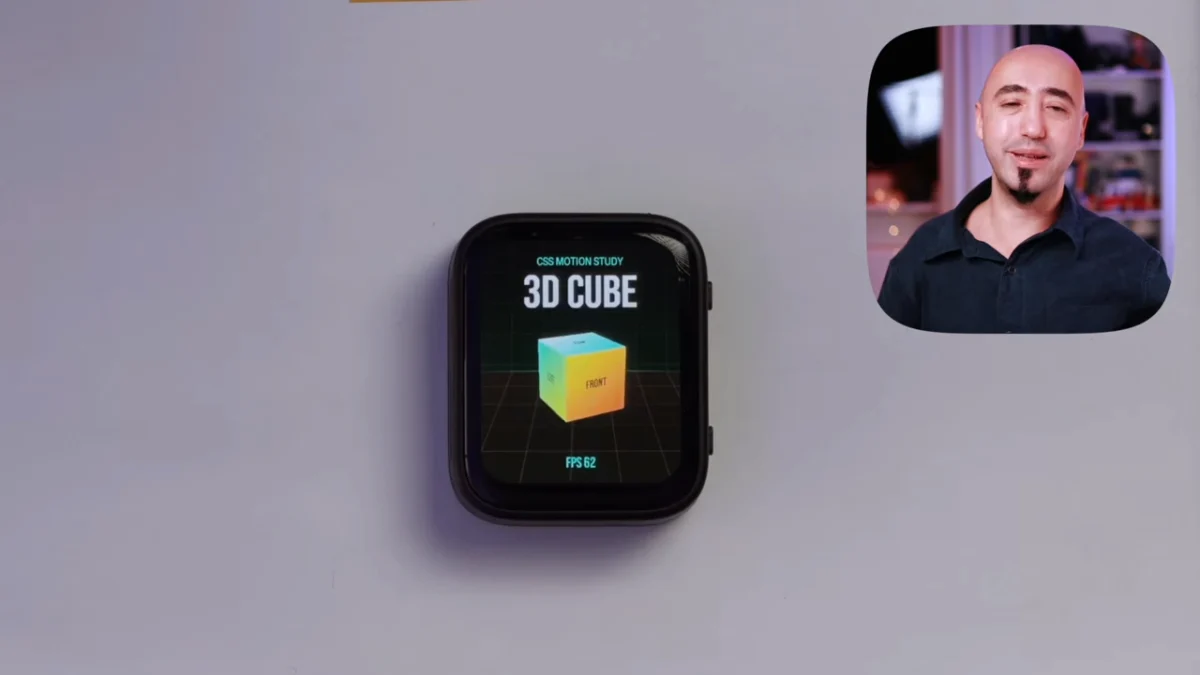
In a significant stride for embedded systems development, a novel framework known as the Gea stack has emerged, enabling developers to harness the power of familiar web technologies—CSS and TypeScript—to craft sophisticated user interfaces for the Espressif ESP32 microcontroller. This groundbreaking innovation bypasses traditional, often complex, embedded graphics libraries by compiling web-centric code directly into native C++ firmware, promising a dramatic simplification of UI creation for a wide array of Internet of Things (IoT) and embedded applications. The Gea team has compellingly demonstrated this capability by rendering a vibrant, full-color 3D cube animation on an ESP32-powered device, achieving a remarkably fluid 60 frames per second on a 410×502 AMOLED screen. This development signals a potential paradigm shift, democratizing high-quality UI design for resource-constrained hardware and opening doors for millions of web developers to enter the embedded space with their existing skill sets.
Chronology: The Evolution of Embedded UI and the Genesis of Gea
The journey towards simplifying user interface development on microcontrollers like the ESP32 has been a long and often challenging one. For years, crafting interactive displays for embedded devices typically involved deep dives into low-level C or C++ programming, manipulating pixel buffers, and managing complex graphics primitives with libraries like LVGL, uGFX, or custom-built solutions. While powerful, these methods presented a steep learning curve, particularly for developers accustomed to the rapid iteration and rich ecosystems of web or mobile application development.
The Espressif ESP32, since its introduction, has rapidly ascended to prominence as a cornerstone of the IoT and maker communities. Its dual-core processor, integrated Wi-Fi and Bluetooth, and competitive pricing have made it a go-to choice for everything from smart home gadgets to industrial sensors. This versatility, however, has been accompanied by a diverse, sometimes fragmented, software ecosystem. Developers could choose between the official ESP-IDF (Espressif IoT Development Framework), the more approachable Arduino IDE, or even higher-level languages like MicroPython, each offering distinct advantages and trade-offs in terms of performance, development speed, and ease of use.
Despite this array of programming options, the challenge of creating compelling, visually rich user interfaces remained a bottleneck. Traditional embedded UI development often demanded specialized knowledge of display drivers, memory management for graphics assets, and intricate state machines for interaction. For web developers, the transition from designing dynamic web pages with HTML, CSS, and JavaScript to the world of embedded C++ could feel like moving to an entirely different planet, often necessitating a complete retraining or the recruitment of specialized embedded graphics engineers.
Recognizing this gap, the team behind the Gea stack embarked on an ambitious project. Their motivation was clear: to bridge the chasm between the mature, efficient, and widely adopted web development paradigm and the burgeoning world of embedded systems. They sought to empower the vast community of web developers to leverage their existing expertise in CSS for styling and TypeScript for logic, thereby significantly lowering the barrier to entry for creating sophisticated embedded UIs.
The architectural decision to compile CSS and TypeScript directly into native C++ firmware is a critical aspect of Gea’s innovation. Unlike approaches that involve running a stripped-down browser engine or an interpreter on the microcontroller—which often incur significant performance and memory overheads—Gea’s compiler-based method aims for native execution speeds and minimal resource consumption. This approach positions Gea not merely as another graphics library, but as a transformative tool that redefines the development workflow for embedded user interfaces, promising the best of both worlds: web-like development agility with embedded-like performance. The journey has been one of ingenuity, tackling the inherent limitations of microcontrollers while aspiring to the expressive power of modern web technologies.
Supporting Data: The Technical Underpinnings and Performance Metrics
The Gea stack’s most compelling aspect lies in its ingenious architecture, which translates high-level web design languages into highly optimized, native machine code for the ESP32. At its core, Gea operates as a sophisticated transpiler and compiler. Developers compose their UI logic and styling using TypeScript and CSS, respectively. This human-readable, declarative code is then processed by the Gea toolchain, which parses the web-standard syntax and generates corresponding C++ code. This generated C++ code, specifically tailored for the ESP32’s architecture and peripherals, is then compiled by a standard C++ compiler into the final native firmware that runs directly on the microcontroller. This "compile-to-native" approach is crucial, distinguishing Gea from interpretive or virtual machine-based solutions that would struggle with the ESP32’s limited resources.
The efficacy of this approach is vividly demonstrated by the 3D cube animation. Running at a buttery-smooth 60 frames per second (FPS) on an ESP32, this performance benchmark is remarkable for a microcontroller costing as little as $3. The animation is rendered on a 410×502 AMOLED screen, a choice that highlights Gea’s capability to drive high-resolution, vibrant displays. AMOLED technology, known for its deep blacks, high contrast ratios, and wide viewing angles, often demands more sophisticated display drivers and efficient rendering pipelines. Gea’s ability to render complex 3D graphics—complete with full-color textures and even transparency on cube faces—at such a high refresh rate underscores the efficiency of its generated C++ code. The mention of a "performance penalty" for transparency is a common characteristic in graphics rendering on resource-constrained systems; alpha blending (mixing colors based on transparency values) requires additional computational steps and memory bandwidth compared to opaque rendering. However, the fact that transparency is supported at all, even with a minor performance hit, showcases Gea’s robust graphics capabilities.
While impressive, it is vital to contextualize Gea’s capabilities within its design philosophy. The developers openly state that this is "not a full browser engine," a critical distinction that manages expectations and clarifies its purpose. Several concessions were made to ensure optimal performance and resource utilization on the ESP32:
- Absence of
:hoverstates: Gea is explicitly "designed for touchscreen use." In a touch-centric interface, the concept of a mouse-driven:hoverstate is largely irrelevant. Interactions are typically tap, swipe, or pinch gestures. This design choice streamlines the rendering engine, removing unnecessary logic for mouse events and focusing resources on touch input processing and visual feedback. - Rasterized Fonts: Instead of dynamic vector font rendering, which can be computationally intensive and require significant memory for font data, Gea utilizes rasterized fonts. This means font characters are pre-rendered as bitmaps at specific sizes and styles. While this can lead to some pixelation if scaled aggressively, it drastically reduces the runtime processing load and memory footprint, making it a pragmatic choice for embedded systems where performance and memory are at a premium. Developers must pre-select the font sizes and styles they intend to use, optimizing for the target display.
- UI Tree Limited to 512 Nodes: A "UI node" can be conceptualized as an element in the interface, similar to a DOM element in a web page. The 512-node limit signifies a maximum complexity for the UI structure that the Gea engine can efficiently manage. While this might seem restrictive compared to sprawling web pages, it is a practical constraint for microcontrollers with limited RAM. For typical embedded applications—dashboards, control panels, simple menus—512 nodes offer ample room for creating functional and aesthetically pleasing interfaces without overwhelming the ESP32’s memory or processing capabilities. This limitation encourages efficient UI design and careful consideration of element hierarchy.
These design choices are not arbitrary limitations but rather intelligent optimizations that enable Gea to deliver high performance on a low-cost microcontroller. By focusing on the core requirements of embedded UIs (touch interaction, efficient rendering, constrained resources) and shedding the overhead of a full browser, Gea provides a powerful yet lean solution for a specific niche. The development workflow would likely involve a command-line interface (CLI) tool for compiling TypeScript/CSS into C++, integrated into a standard build system like CMake (common with ESP-IDF) or potentially a custom builder for Arduino projects. This integration ensures that web developers can leverage familiar coding paradigms while still producing firmware compatible with established embedded development toolchains.
Official Responses: Industry Reception and Ecosystem Integration
While specific "official responses" from industry giants regarding a nascent framework like Gea may not be immediately available, the broader implications for the embedded development ecosystem, particularly concerning Espressif’s platform, are profound and likely to be met with significant interest.
The Gea team’s vision is clearly aimed at a broad audience: primarily web developers who possess extensive knowledge of CSS for styling and TypeScript for application logic but may lack the specialized expertise in low-level embedded graphics programming. For this demographic, Gea represents a significant reduction in the barrier to entry into the embedded world. It allows them to transfer existing skills directly, accelerating prototyping and product development cycles. This strategic targeting could lead to an influx of new talent and creativity into the embedded space, potentially fostering a new generation of IoT devices with more polished and intuitive user interfaces.
From Espressif’s perspective, third-party innovations like Gea are generally viewed as a positive contribution to their ecosystem. Espressif has consistently promoted an open and versatile platform, encouraging a wide array of development approaches. Tools that expand the ESP32’s appeal to new developer communities only strengthen its market position and adoption rate. While Espressif itself offers its own development frameworks, the emergence of specialized tools that cater to specific developer preferences, such as web-centric programming, enhances the overall richness and attractiveness of the ESP32 ecosystem. It aligns with a broader industry trend of making hardware development more accessible and less intimidating.
The developer community’s reaction is likely to be multifaceted. Web developers are expected to embrace Gea with enthusiasm. The promise of using CSS and TypeScript to build embedded UIs, rather than grappling with C++ pointers and memory-mapped registers for display control, is highly appealing. It offers the potential for faster iteration, better design consistency (leveraging established web design principles), and a more enjoyable development experience. However, traditional embedded developers, steeped in the nuances of C/C++ and hardware-level optimization, might approach Gea with a mix of curiosity and cautious skepticism. Questions about potential hidden overheads, debugging complexities in the generated C++ code, and the extent of hardware control offered by Gea will naturally arise. The clear communication about Gea "not being a full browser engine" and its specific limitations (e.g., 512 UI nodes, rasterized fonts) is crucial in managing these expectations, positioning it as a specialized tool rather than a universal replacement.
In the competitive landscape of embedded UI frameworks, Gea carves out a unique niche. While established libraries like LVGL offer robust C-based solutions and comprehensive widget sets, they still demand a C/C++ development mindset. Other projects might attempt to run micro-web servers on the ESP32, serving basic HTML pages, but these typically involve rendering in a browser on a separate device, not natively on a local display. Gea’s direct compilation of web languages to native C++ for local display rendering is a distinct advantage, offering a blend of web development speed with embedded performance that few, if any, other solutions currently provide for the ESP32 specifically. This positions Gea as a significant player in democratizing sophisticated UI development for low-cost microcontrollers.
Implications: Reshaping the Landscape of Embedded UI and IoT
The advent of the Gea stack holds profound implications for the future of embedded UI development and the broader Internet of Things landscape. Its ability to bridge the gap between high-level web technologies and low-level hardware fundamentally reshapes how product designers and engineers approach user interfaces for connected devices.
Firstly, Gea heralds a significant democratization of embedded UI development. By enabling millions of web developers—who are fluent in CSS for styling and TypeScript for logic—to create interfaces for microcontrollers like the ESP32, the talent pool for IoT product development expands exponentially. This means that a startup or an individual maker can now design aesthetically pleasing, responsive UIs without needing to hire a specialized embedded graphics engineer, potentially accelerating time-to-market and reducing development costs. The web’s rich ecosystem of design patterns, UI/UX best practices, and component libraries can now, in principle, be leveraged for embedded applications, leading to more intuitive and visually appealing devices across various sectors.
Secondly, this innovation promises a paradigm shift for IoT product design. Currently, many IoT devices either forgo a local display entirely, relying on smartphone apps for interaction, or feature very basic, monochrome, or low-resolution interfaces due to the complexity and cost of embedded UI development. With Gea, smart home hubs, industrial control panels, wearables, and other connected devices can incorporate richer, full-color, and animated displays that enhance user experience and product differentiation. Imagine smart thermostats with fluid animations, connected kitchen appliances with intuitive touchscreens, or industrial sensors providing real-time data visualizations directly on a device, all built using familiar web development workflows.
The success of Gea could also pave the way for a new wave of "Web-on-Hardware" initiatives. While the term has been used before, Gea’s compile-to-native approach offers a compelling model. It suggests that similar compiler toolchains could emerge for other microcontrollers or specialized embedded processors, allowing web developers to target an even wider array of hardware platforms. This could foster a new sub-ecosystem of web-centric embedded tools, libraries, and frameworks, further blurring the lines between web, mobile, and embedded software engineering disciplines.
Furthermore, Gea’s existence could stimulate ecosystem growth around web-enabled ESP32 development. We might see the emergence of community-contributed CSS frameworks tailored for embedded displays, TypeScript component libraries optimized for resource-constrained environments, and development tools that integrate seamlessly with IDEs popular among web developers. This collaborative environment could lead to rapid innovation in embedded UI design patterns and best practices.
However, the journey ahead for Gea also presents challenges and opportunities for future development. While the current limitations (e.g., 512 UI nodes, rasterized fonts) are pragmatic choices for the ESP32, future iterations might explore optimizations to increase node limits, support vector fonts, or even introduce more advanced CSS features. Expanding hardware support beyond the ESP32 to other popular microcontrollers could also broaden its appeal. The robustness of the debugging experience for generated C++ code will be critical for developer adoption, as will comprehensive documentation and community support.
In conclusion, the Gea stack is more than just another graphics library; it represents a significant step towards unifying the diverse worlds of web development and embedded systems. By empowering web developers to build high-performance, visually rich user interfaces for low-cost microcontrollers, Gea is set to unlock a new era of innovation in IoT and embedded product design, promising a future where beautiful, interactive experiences are no longer exclusive to powerful computing platforms but are accessible even on the humblest of chips.