AWS Unveils "Continuous Modernization": A New Frontier in Autonomous Tech Debt Remediation
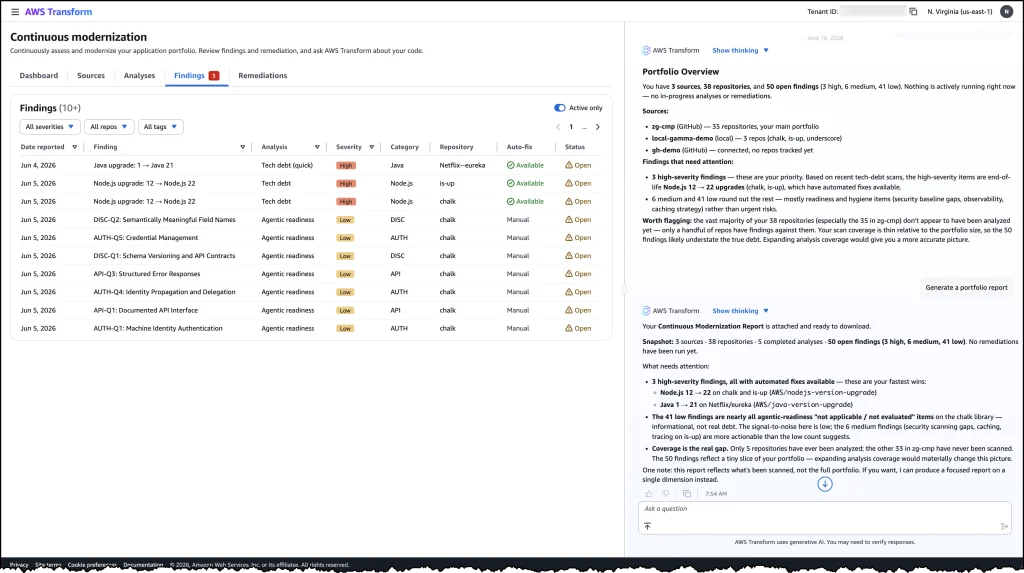
In a significant move to reshape how engineering organizations handle the persistent burden of technical debt, Amazon Web Services (AWS) has announced the preview of AWS Transform – continuous modernization. This new capability, integrated into the existing AWS Transform suite, promises to shift the paradigm of software maintenance from reactive, manual toil to a proactive, autonomous, and scalable workflow.
By automating the detection, prioritization, and remediation of code-level issues—ranging from deprecated frameworks to security vulnerabilities—AWS is positioning this tool as a vital solution for enterprises struggling to keep pace with the rapid acceleration of AI-assisted development.
The Core Mandate: Ending the "Toil Cycle"
For decades, the "tech debt tax" has been an accepted, if painful, reality of software engineering. Data consistently shows that engineering organizations allocate up to 30% of their total IT budget merely to maintaining existing codebases rather than building new features.
Historically, companies have addressed this by "stitching" together a fragmented ecosystem of point tools: one for dependency scanning, another for security vulnerabilities, and yet another for stylistic code quality. The result is a siloed, disjointed, and manual process. Developers are forced to switch contexts constantly, and platform leads are left relying on self-reported spreadsheets that lag behind the actual state of the code.
The arrival of AI-assisted coding agents has exacerbated this problem. While these agents have dramatically increased the velocity at which code is generated, they have also accelerated the accumulation of technical debt. Without a corresponding automation strategy for maintenance, organizations risk drowning in a sea of legacy dependencies and unpatched security risks. AWS Transform – continuous modernization is designed to provide the "ground truth" that leadership teams have lacked, offering an automated, continuous feedback loop that reconciles the state of the codebase against organizational standards in real time.
Chronology of Development: From Migration to Automation
The evolution of AWS Transform reflects the broader shift in cloud computing priorities. AWS Transform began as a specialized toolset designed to help enterprises navigate the "heavy lifting" of cloud migration—moving data centers, modernizing legacy Windows applications, and refactoring monolithic mainframe code.
However, AWS identified a critical gap: once an application is migrated, the work is never truly finished. Upgrading Java runtimes, swapping out deprecated libraries, and keeping pace with end-of-life (EOL) announcements became a perpetual maintenance cycle.
- Initial Phase (Foundational): AWS Transform focused on one-time migrations and major version upgrades, primarily targeting the infrastructure and architectural layer.
- Intermediate Phase (Integration): AWS began incorporating security and runtime maintenance, realizing that security vulnerabilities were often tied to aging dependencies.
- Current Phase (Autonomous Modernization): With today’s announcement, AWS has moved into the continuous, repository-level management space. By leveraging existing repository connections and integrating with the AWS ecosystem, the platform now offers a "set-and-forget" model for policy enforcement, effectively turning technical debt remediation into a background, automated process.
How It Works: Continuous Analysis and Autonomous Remediation
The technical architecture of the new AWS Transform capability relies on two primary pillars: Continuous Analysis and Autonomous Remediation.
Continuous Analysis
The platform scans repositories against configurable baselines. Unlike traditional static analysis tools that generate static reports, this system provides a real-time dashboard of an organization’s "debt landscape."
- Policy-Driven: Organizations can define their own "Golden Paths." Whether it is a requirement to move to a specific Java version or the deprecation of a non-compliant logging library, these requirements are codified as policies.
- Speed: Findings are generated in hours rather than the weeks required by traditional manual audit processes.
- Ground Truth: Because the tool scans source code directly, it eliminates the "lag" associated with manual status reports or outdated Jira tickets.
Autonomous Remediation
Once a policy violation is detected, the system does not simply flag it; it attempts to fix it.

- Automated PRs: The tool generates pull requests (PRs) for affected repositories. Each PR comes with a clear explanation of why the change is necessary, linking it back to the specific organizational policy.
- Feedback Loops: The system tracks the PR lifecycle. If a team merges the fix, the platform automatically updates its dashboard to reflect that the repository has returned to compliance.
- Custom Transformations: For unique, organization-specific libraries, teams can write custom remediation scripts, ensuring the automation scales across the entire enterprise stack.
Implications for Engineering Teams and Security
The introduction of this tool has profound implications for how engineering departments are managed.
Bridging the Security Gap
By integrating with AWS Security Agent, the new capability treats security vulnerabilities as a subset of technical debt. This is a critical development for DevSecOps. Instead of security teams operating in a vacuum, their findings are fed directly into the same prioritized list that developers use for routine maintenance. This alignment ensures that critical security patches are prioritized alongside routine library updates, reducing the overall attack surface of the enterprise.
Empowering Platform Teams
For platform engineers, this represents a shift from "compliance enforcer" to "policy architect." Instead of chasing developers to update dependencies, platform teams define the standards, and the automation handles the notification and remediation workflow. This frees up high-value engineering talent to focus on product-level innovation rather than the "undifferentiated heavy lifting" of framework maintenance.
Supporting Data: The Cost of Inaction
While specific enterprise metrics will vary, the industry-wide data supporting this launch is compelling. A recent analysis of mid-to-large-scale engineering organizations suggests that:
- 30% of IT Budgets are currently consumed by maintenance, a figure that remains stagnant despite advances in CI/CD pipelines.
- MTTR (Mean Time To Remediation): In organizations relying on manual audits, patching a library across 500 repositories takes an average of 45 days. Early testing of AWS Transform suggests that automated remediation can reduce this cycle to under 72 hours.
- Regression Rates: By standardizing remediation patterns, the tool reduces the "human error" factor that often leads to regressions during manual framework upgrades.
Official Perspective and Implementation
In its announcement, AWS emphasized that this tool is not meant to replace the developer, but to augment their capability. By handling the "drudgery" of dependency management, the system allows developers to maintain focus on the code that creates competitive advantage.
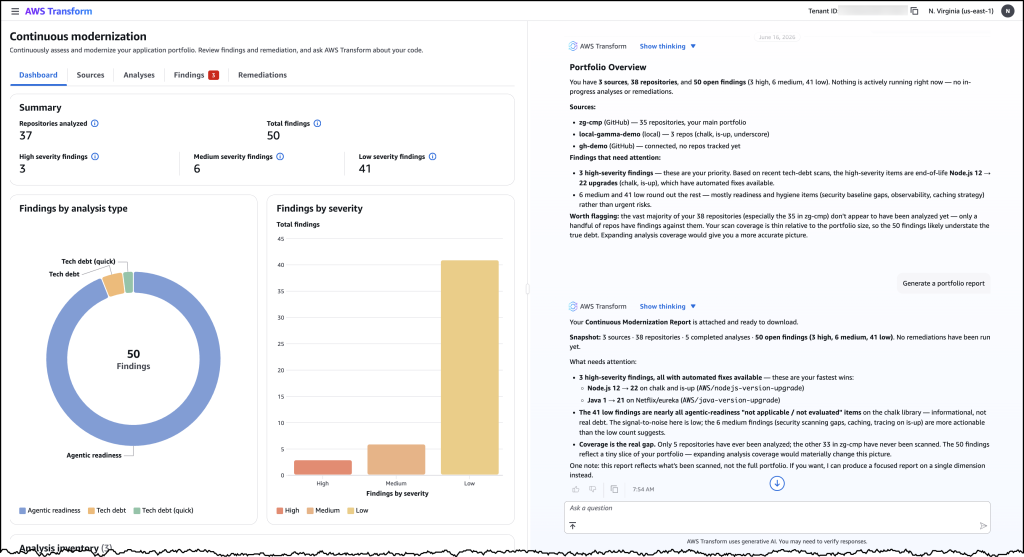
"Customers need a capability that detects, prioritizes, and remediates tech debt continuously, autonomously, and at scale," an AWS spokesperson stated. "With the preview of continuous modernization, we are giving teams the tools to stay current without the overhead of manual compliance tracking."
Getting Started
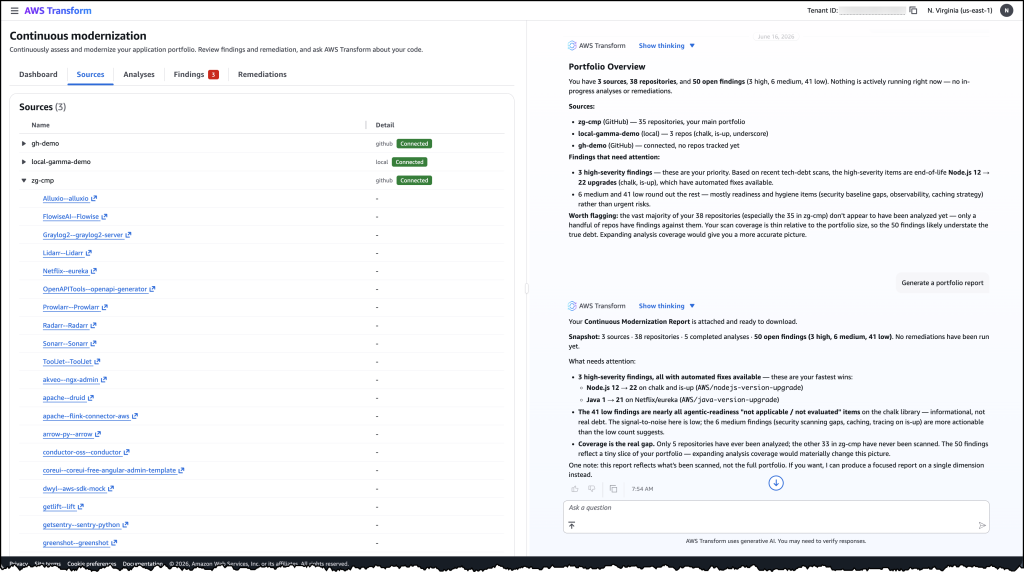
The tool is now available via the AWS Transform web application. The onboarding process is designed to be low-friction:
- Connect: Link the tool to your source control (e.g., GitHub).
- Analyze: Run an initial scan against default or custom policies.
- Remediate: Review the prioritized list of findings and launch a campaign to generate PRs.
- Monitor: Use the dashboard to watch as repositories move from "Non-Compliant" to "Compliant."
For organizations looking to integrate this into existing workflows, the service supports the Model Context Protocol (MCP), allowing it to interface with existing AI coding agents. This means that a developer using an AI assistant can be alerted to a tech debt issue in real-time, right within their IDE, and trigger the remediation immediately.
Future Outlook: The Rise of Autonomous Infrastructure
The preview of AWS Transform – continuous modernization signals a broader shift in the cloud landscape. We are entering an era where the infrastructure and the application code are managed as a single, self-healing entity.
As organizations move toward more complex, distributed architectures, the ability to manage technical debt at scale will move from a "nice-to-have" to a competitive necessity. Those who leverage autonomous remediation will be able to pivot faster, secure their applications more effectively, and ultimately, get more value out of their existing engineering talent.
For the average enterprise, the path forward is clear: as AI accelerates the creation of code, the maintenance of that code must become just as fast, just as smart, and just as autonomous. With this announcement, AWS has provided the blueprint for that future.