AWS Supercharges Amazon ECS: Introducing Ultra-Fast Auto Scaling with High-Resolution Metrics
In a major leap forward for cloud-native infrastructure management, Amazon Web Services (AWS) has announced a significant performance enhancement for the Amazon Elastic Container Service (ECS). By introducing high-resolution, 20-second metrics, AWS is drastically reducing the latency between traffic spikes and the automated provisioning of compute resources. This update, which applies across all ECS compute options—including AWS Fargate, ECS Managed Instances, and Amazon EC2—represents a paradigm shift in how developers maintain application performance during unpredictable demand surges.
Main Facts: The Shift to 20-Second Precision
At the core of this update is a fundamental change in the telemetry data that drives the Amazon ECS service auto-scaling engine. Historically, standard resolution metrics in Amazon CloudWatch operated on a 60-second cycle. While sufficient for many steady-state workloads, a minute-long delay in detecting a traffic spike can lead to request queuing, increased latency, or, in extreme cases, service degradation during the window between the surge and the activation of new container tasks.
By enabling 20-second high-resolution metrics, AWS has effectively tripled the frequency at which the auto-scaling engine evaluates the state of a service. This refinement ensures that the “decision loop”—the cycle of monitoring, evaluating, and triggering a scale-out event—is significantly tightened. The result is a more reactive, agile infrastructure that aligns more closely with the ephemeral nature of modern containerized applications.
Chronology of Infrastructure Evolution
To understand the magnitude of this improvement, one must look at the progression of auto-scaling within the AWS ecosystem.

The Era of Reactive Scaling (Early Days)
When AWS first introduced service auto-scaling for ECS, the primary focus was on basic thresholds. Administrators would set alarms based on CPU or memory usage. These systems were effective but relatively slow, relying on the standard 60-second or even 5-minute metric reporting intervals provided by CloudWatch. Scaling was reliable, but “bursty” traffic patterns often outpaced the infrastructure’s ability to respond.
The Integration of Predictive and Scheduled Scaling
Recognizing that reactive scaling alone was insufficient for large-scale enterprise applications, AWS introduced Predictive Scaling—which leverages machine learning to forecast traffic based on historical patterns—and Scheduled Scaling, which allows operators to preemptively add capacity for known events like product launches or marketing campaigns. These tools provided a proactive layer, but the reactive component remained tethered to the constraints of standard metric resolution.
The Modern Breakthrough: 20-Second Resolution
The current update marks the convergence of these strategies. By upgrading the reactive scaling engine to 20-second resolution, AWS has addressed the “last mile” of latency in container orchestration. This development, which became generally available as of this week, serves as the missing link that allows systems to handle sudden, non-predictable traffic spikes with the same speed and grace as they handle forecasted load.
Supporting Data: Benchmarking the Impact
The technical improvements provided by this update are not merely theoretical; AWS internal benchmarking demonstrates a dramatic improvement in operational efficiency. In controlled testing scenarios, the time required to detect a need for scaling and subsequently provision the necessary resources saw a massive reduction.

Scaling Trigger Latency
One of the most critical metrics for any auto-scaler is the “Time to Trigger.” Previously, the average time to trigger a scale-out event hovered around 363 seconds. With the new high-resolution metrics, this has been slashed to just 86 seconds. This represents a 76% improvement in responsiveness, or a 4.2x increase in speed.
Provisioning Throughput
Equally important is the “Total Time to Scale,” which encompasses the trigger, the orchestration of the new task, and the final readiness of the container to serve traffic. AWS reported that the total time to provision new tasks dropped from 386 seconds to 109 seconds—a 72% reduction, or 3.5x faster than previous standards.
For an application experiencing a rapid surge, these seconds are critical. By shortening the window of vulnerability by nearly five minutes, businesses can significantly reduce the likelihood of user-facing errors during high-traffic events.
Official Perspectives and Technical Implementation
According to Channy Yun, Principal Developer Advocate at AWS, the primary objective of this feature is to empower developers to maintain optimal performance without over-provisioning resources. By enabling more granular scaling, organizations can theoretically operate with a smaller “buffer” of idle tasks, thereby optimizing costs while maintaining high availability.
How to Implement the Change
The transition to high-resolution scaling is straightforward but requires explicit configuration.
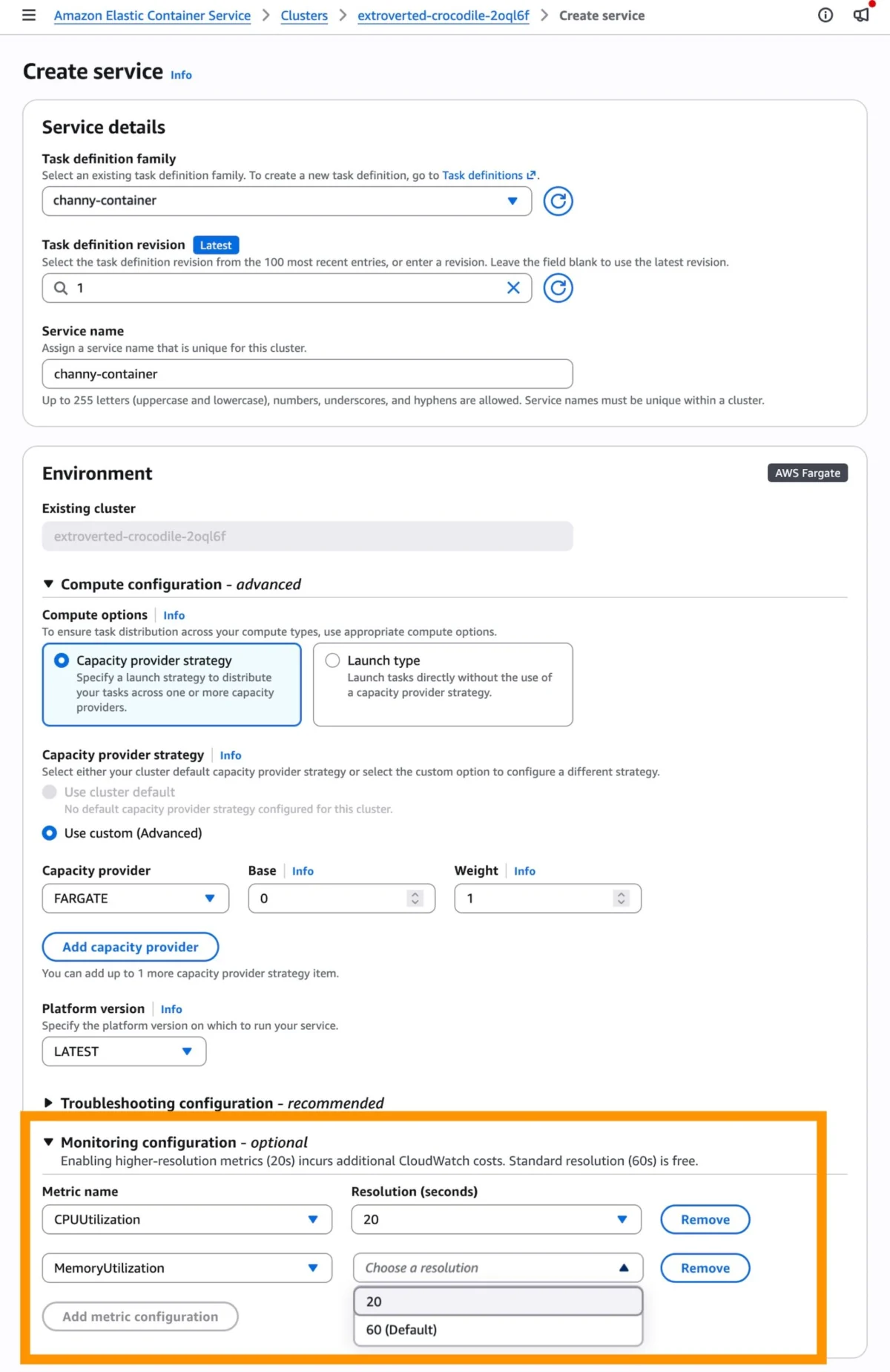
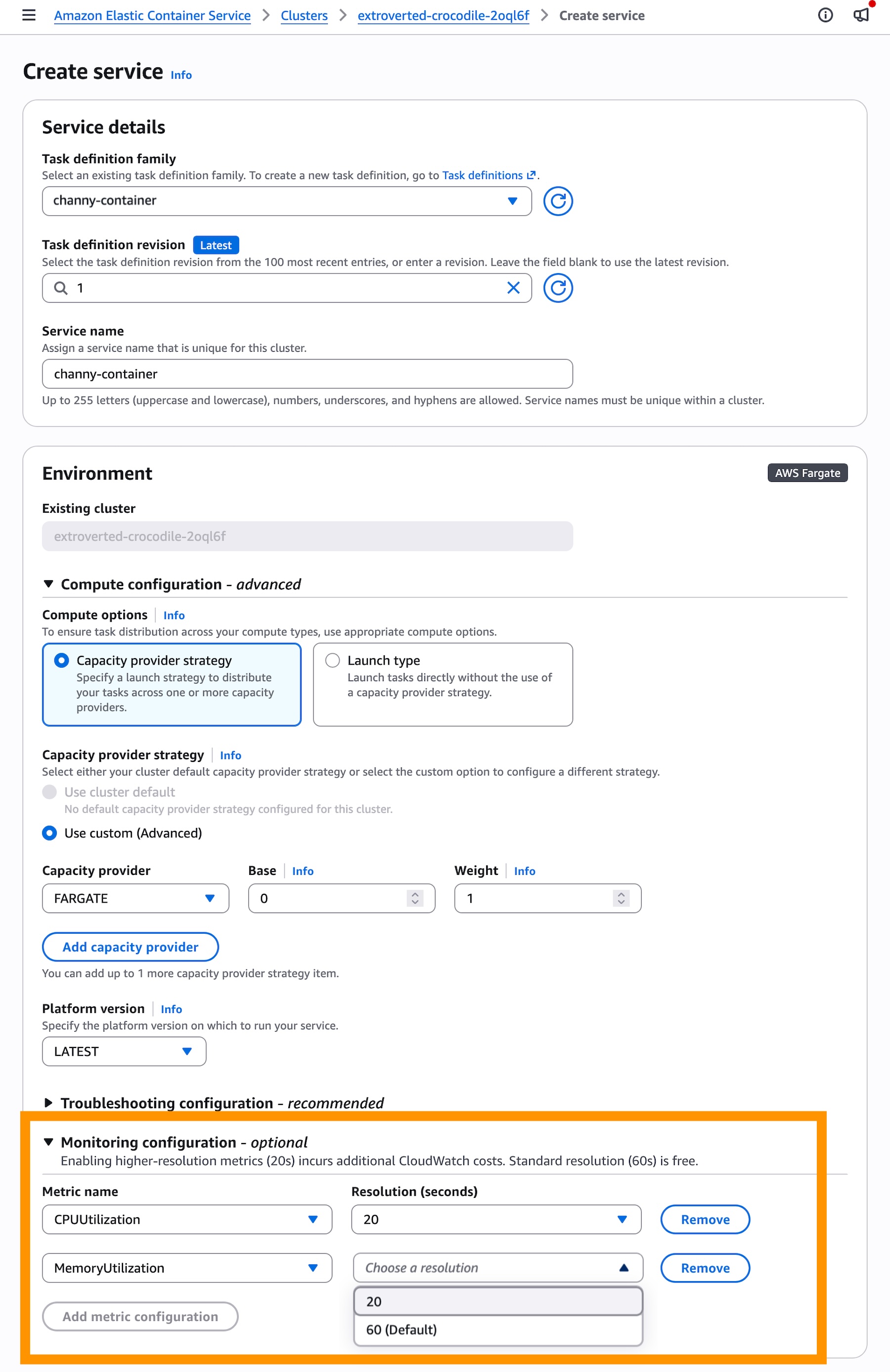
- Enablement: Users must first enable high-resolution metrics during the service creation or update process within the ECS console.
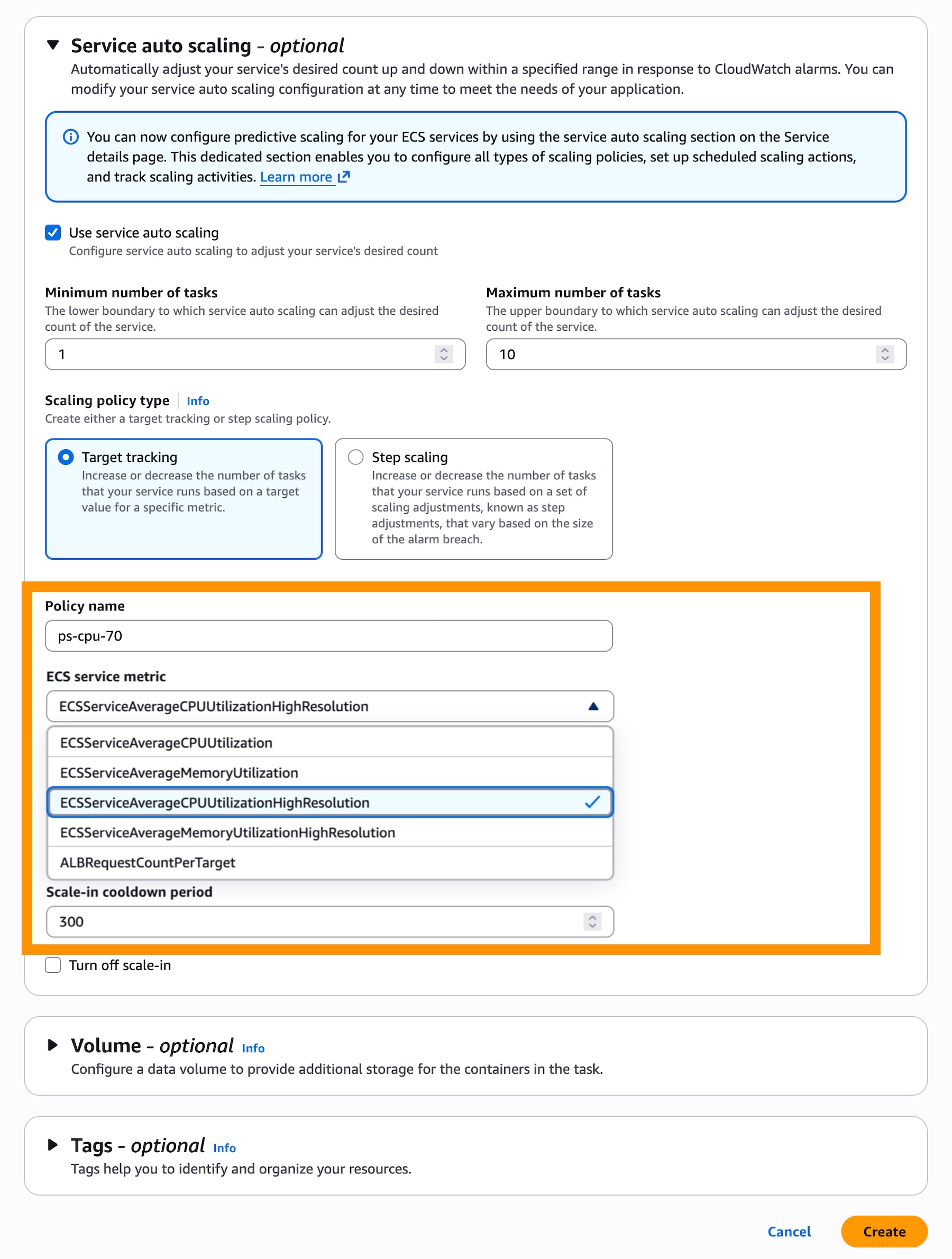
- Policy Selection: When configuring the target tracking scaling policy, users can now select specific high-resolution metrics, such as
ECSServiceAverageCPUUtilizationHighResolutionorECSServiceAverageMemoryUtilizationHighResolution. - Infrastructure Flexibility: This feature is universally available across AWS Fargate, EC2-based ECS clusters, and ECS Managed Instances, ensuring that organizations can utilize these benefits regardless of their underlying compute choice.
It is worth noting that while the feature itself is provided at no additional cost by AWS, the use of high-resolution metrics in Amazon CloudWatch does incur additional fees. Organizations are advised to evaluate their monitoring budgets, as the cost is proportional to the number of metrics and the frequency of data points.
Implications for the Industry
The shift to 20-second resolution auto-scaling carries profound implications for the future of cloud-native architecture.
Enhanced User Experience
For consumer-facing applications, such as e-commerce platforms or real-time gaming services, latency is synonymous with revenue. The ability to scale 3.5x faster means that traffic spikes—whether caused by a viral social media post or a sudden flash sale—can be absorbed by the infrastructure before the end-user perceives any performance degradation.
Improved Cost-Efficiency
There is often a misconception that "more monitoring" equals "higher costs." However, in the context of ECS, the opposite may be true. By scaling more accurately and quickly, organizations can avoid the "over-provisioning trap." If a service can scale up instantly when needed and scale down just as quickly when traffic subsides, the total number of compute hours purchased from AWS may actually decrease, offsetting the additional cost of the high-resolution CloudWatch metrics.
Pushing the Boundaries of Serverless
This update further blurs the line between traditional container management and serverless computing. As the "cold start" and "scaling latency" of ECS continue to shrink, the operational burden on DevOps teams to manually manage or predict capacity continues to diminish. The goal of "infinite, instantaneous scale" is closer than ever, moving from a marketing aspiration to an architectural reality.
Conclusion
The release of high-resolution auto-scaling for Amazon ECS is a testament to the ongoing maturation of container orchestration. By focusing on the temporal aspect of scaling—the time it takes to detect and act—AWS has provided a powerful new lever for developers to pull in their quest for highly available, cost-effective, and performant applications.
As businesses continue to migrate complex, state-critical workloads to the cloud, the ability to respond to environmental changes in seconds rather than minutes will be a key differentiator. With these new tools, AWS has not only improved the mechanics of ECS; it has redefined the standard for what developers should expect from their cloud infrastructure. For teams currently running high-traffic services on ECS, the move to 20-second resolution metrics is not just an optimization—it is a mandatory step toward modern, resilient cloud operations.