Strengthening Global Resilience: AWS Introduces Multi-Region Replication and Customer Managed Keys for Amazon Cognito
In the modern era of hyper-connected digital services, the tolerance for downtime has effectively reached zero. Whether it is an enterprise-scale microservices architecture, a burgeoning fleet of agentic AI applications, or high-traffic consumer mobile apps, the underlying authentication layer is the gatekeeper of trust. To address the critical need for business continuity, Amazon Web Services (AWS) has announced two significant enhancements to Amazon Cognito: Multi-Region replication and Customer Managed Key (CMK) support. These updates mark a fundamental shift in how developers can manage user identity and machine-to-machine (M2M) credentials across geographical boundaries.
The Evolution of Authentication Resilience
For years, developers have grappled with the "authentication bottleneck" during regional service disruptions. Until now, achieving high availability for user authentication required engineering teams to build, test, and maintain bespoke replication logic. This manual approach was not only resource-intensive but also fraught with security risks. The process of exporting and importing user data between AWS Regions often created vulnerabilities, exposing sensitive data to potential breaches and leading to inevitable data inconsistencies.
From a user experience perspective, the limitations of the past were stark. When a primary region faltered, users were frequently subjected to forced password resets, repeated authentication prompts, or total lockout—all of which degrade customer trust. For machine-to-machine communications, the friction was even greater, requiring the manual reconfiguration of app clients and the updating of OAuth-protected resources to accept tokens from secondary regional issuers.
By introducing native multi-Region replication, AWS is effectively moving the burden of synchronization from the developer to the service provider, ensuring that user profiles, credentials, and pool configurations are kept in lockstep without manual intervention.

A Chronology of the Update and Implementation
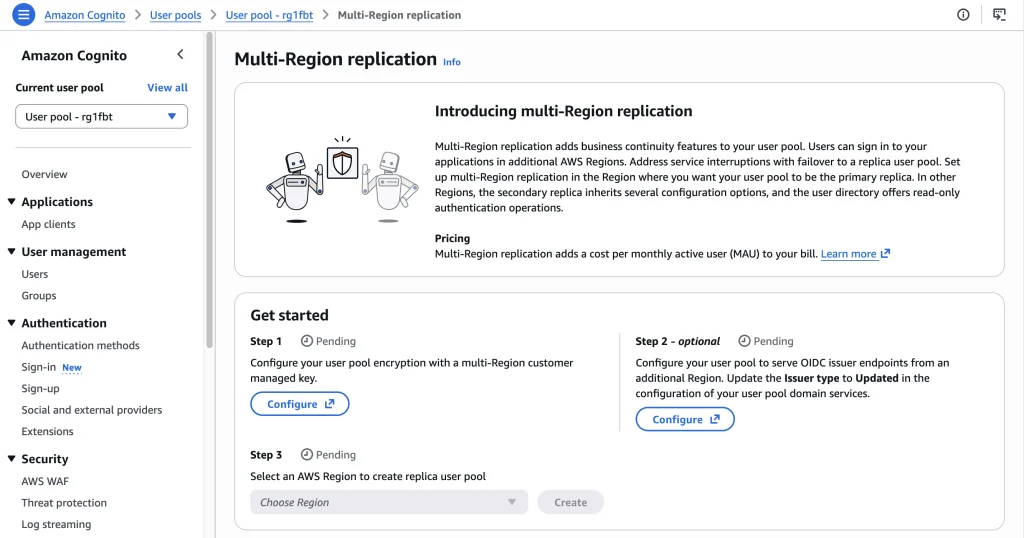
The implementation process for these new features has been designed with a "security-first" architecture, requiring a deliberate, three-step configuration flow within the AWS Management Console.
Phase 1: Establishing the Foundation with Customer Managed Keys
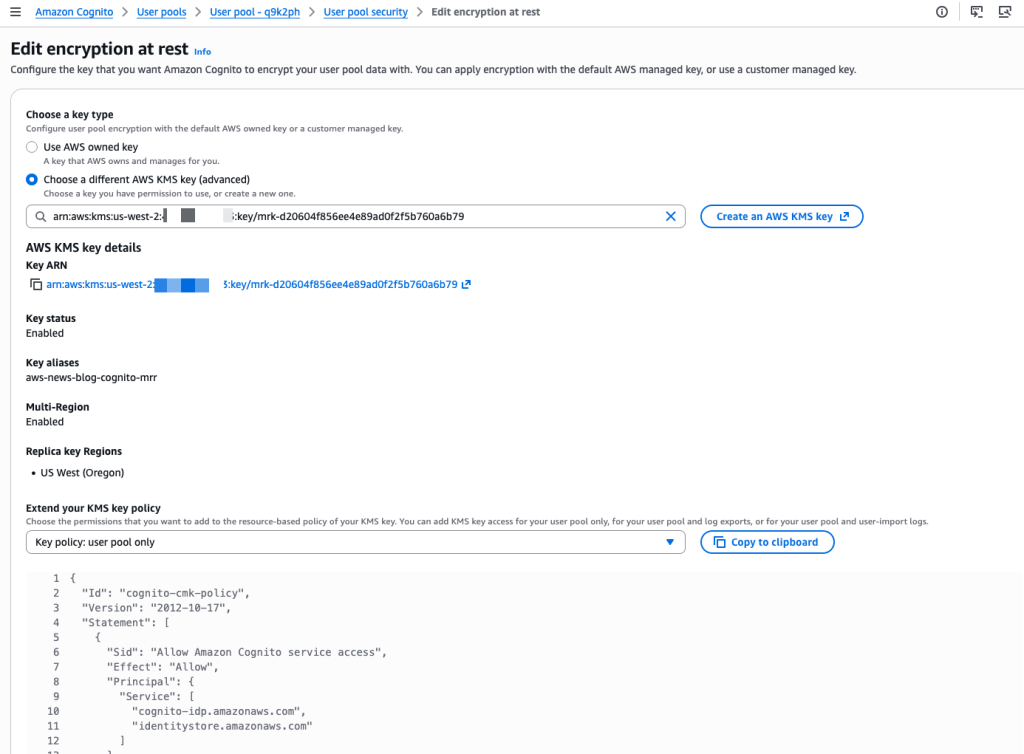
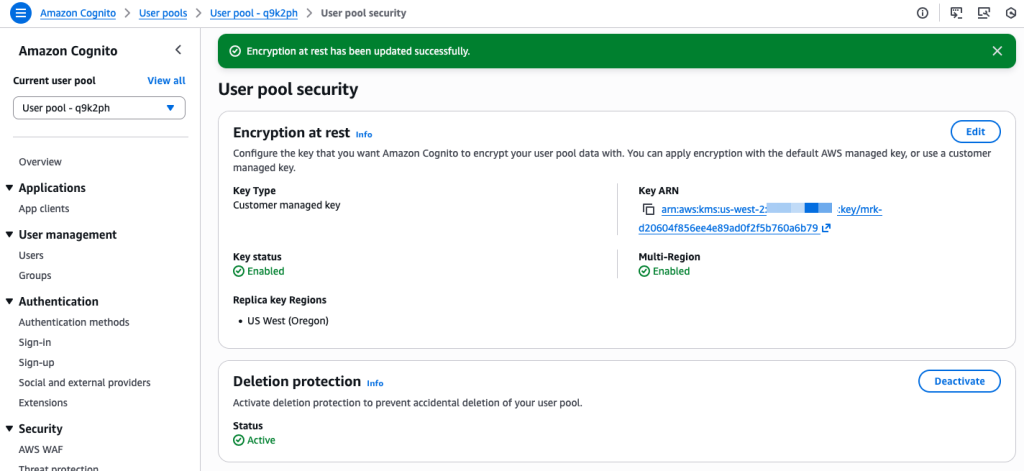
Before initiating replication, organizations must establish an encryption strategy using AWS Key Management Service (AWS KMS). By leveraging customer managed keys (CMKs), users gain granular control over their data encryption, which is particularly vital for organizations operating in highly regulated sectors such as fintech or healthcare.

The process involves:
- Creating a multi-Region CMK in AWS KMS.
- Updating the key policy to grant Amazon Cognito the necessary permissions to access the key.
- Validating the key configuration within the Cognito console to ensure seamless integration.
Phase 2: OIDC Issuer Configuration
The second phase involves updating the OpenID Connect (OIDC) issuer settings. This is a critical architectural change. Developers must update their client applications to point to the new regional endpoints. This step is not merely a configuration task; it requires a coordinated redeployment of server-side applications and, in the case of mobile applications, the submission of updates to the App Store and Google Play. Neglecting this step would result in routing failures, effectively nullifying the benefits of the new multi-Region setup.
Phase 3: The Replication Process
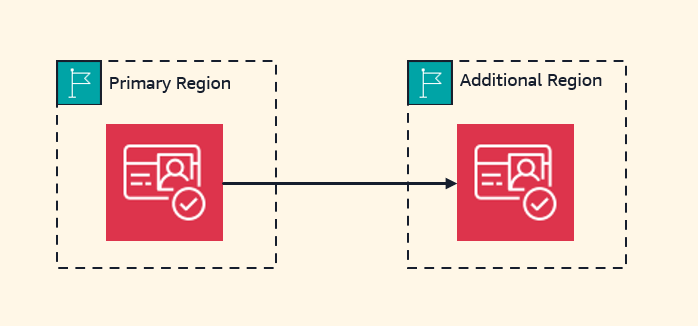
Once the encryption and endpoints are settled, the final step is selecting the target Region. The system then initiates a one-way replication from the primary to the secondary Region. During this transition, the secondary Region operates in a read-only capacity, focused exclusively on maintaining authentication continuity. Once the synchronization completes, the administrator manually activates the replica, at which point the system is ready to handle traffic.
Supporting Data: Resilience and Performance Metrics
The architecture of this new feature is built for high-performance failover. Because both the primary and secondary regions recognize access tokens issued by the other, currently signed-in users experience no interruption to their sessions during a failover event.
Operational Scope
- Authentication Methods: The replication supports a comprehensive suite of authentication flows, including social identity providers (Google, Apple, Facebook, Amazon), SAML, OIDC, and standard API-based authorization.
- Failover Logic: While the system handles the data, the decision-making process remains in the hands of the developer. Teams are encouraged to implement health checks—monitoring latency, error rates, and service-specific alerts—to determine when to trigger a DNS-based traffic shift to the secondary region.
- Regional Availability: The feature is currently deployed across a wide footprint, including US East (N. Virginia, Ohio), US West (Oregon, N. California), Asia Pacific (Mumbai, Seoul, Singapore, Sydney, Tokyo), Canada (Central), and multiple European regions, including London, Frankfurt, and Paris.
Official Perspectives and Strategic Implications
AWS developer advocates emphasize that this update is a direct response to the "agentic AI" and "microservices" explosion. As autonomous agents become more prevalent in backend workflows, the reliance on M2M authentication has surged, making the manual maintenance of identity secrets unsustainable.
Strategic Advantages for Developers
- Reduced Operational Overhead: By automating the synchronization of user pools, DevOps teams can reallocate time previously spent on building custom replication scripts toward building core business features.
- Regulatory Compliance: The integration with customer managed keys provides a "bring your own key" (BYOK) model that meets the stringent data sovereignty and encryption requirements of global regulatory frameworks.
- Seamless Failover: The ability to keep existing sessions alive during a regional event is perhaps the most significant improvement for end-user retention, effectively masking infrastructure instability from the consumer.
Considerations for Deployment
While the system is robust, it is not "set-it-and-forget-it." Developers must remain mindful of peripheral dependencies. For instance, Lambda triggers used for custom authentication flows, SMS/Email notification configurations, and AWS WAF (Web Application Firewall) settings do not automatically replicate. These must be manually configured in the target region to ensure the environment is a true mirror of the primary.

Pricing Structures and Business Impact
The service is available for customers using the Essentials and Plus tiers of Amazon Cognito. The pricing model for Multi-Region replication is structured as an add-on:
- For User Authentication: The cost is $0.0045 per monthly active user (MAU) per replica Region for Essentials tier, and $0.006 per MAU per replica Region for the Plus tier.
- For M2M Authentication: The add-on is a 30% surcharge on top of standard volume-based pricing for successful token issuance.
This tiered pricing structure allows businesses to scale their resilience efforts in direct correlation with their growth, ensuring that the cost of high availability remains predictable.

Conclusion
The introduction of multi-Region replication for Amazon Cognito represents a maturation of identity management in the cloud. By shifting the complexity of global data synchronization away from the developer, AWS is lowering the barrier to entry for building enterprise-grade, resilient applications.
For the modern developer, the takeaway is clear: as your application’s reach expands globally, your identity layer must be as geographically distributed as your traffic. With these tools, the industry moves one step closer to a future where regional infrastructure incidents are minor operational inconveniences rather than catastrophic business events. Developers are encouraged to visit the AWS Management Console to audit their current identity architecture and begin planning their transition to this more resilient model.