The Resurrection of an Icon: How TekkaSketch Modernizes a 60-Year-Old Toy
For over six decades, the Etch-a-Sketch has occupied a unique place in the pantheon of play. Since its introduction by André Cassagnes in 1960, the red-framed rectangular device has challenged children and adults alike to master its dual-knob interface. It is a tool of exquisite precision and frustrating finality: one errant twist of the dial, or a clumsy bump of the frame, and your masterpiece is lost to the void, requiring the frantic, rhythmic shaking of the chassis to clear the aluminum powder screen and begin anew.
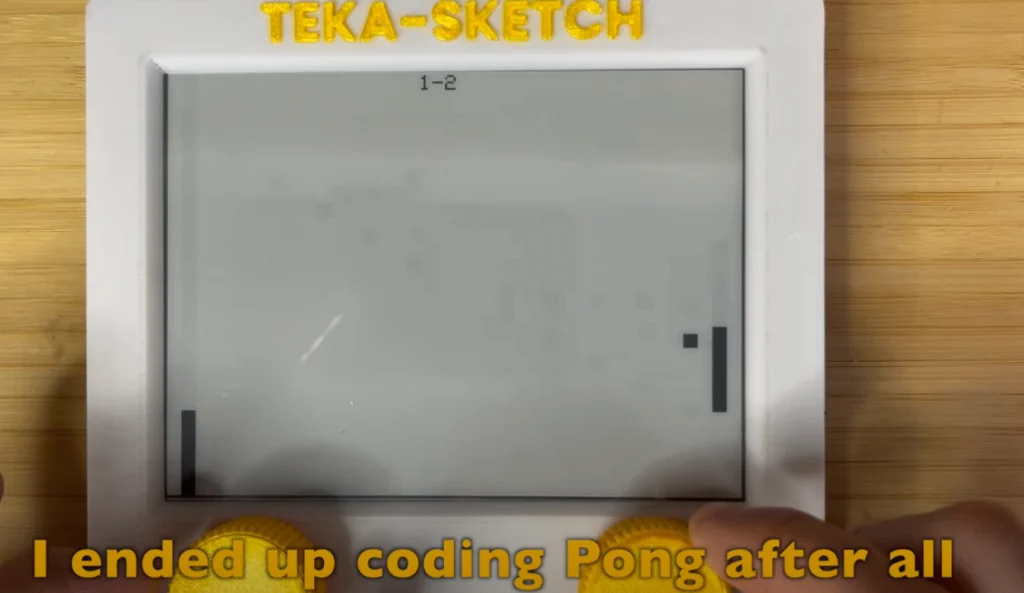
However, a revolutionary project known as TekkaSketch has emerged, effectively bridging the gap between mid-century mechanical simplicity and modern digital versatility. By integrating an E-Ink display, an ESP32 microcontroller, and precision encoders, the creators of TekkaSketch have not only solved the "undo" problem but have transformed a static drawing toy into a dynamic, interactive gaming platform.
Main Facts: The Anatomy of a Modernized Classic
At its core, the Etch-a-Sketch is a triumph of mechanical engineering. Its internal screen is coated with a thin layer of aluminum powder. When the user rotates the two knobs, a pulley system moves a stylus behind the glass, "displacing" the powder to reveal a dark line. It is not an additive process, but rather a subtractive one—a physical manifestation of negative space.
TekkaSketch preserves this tactile philosophy while stripping away the physical limitations of aluminum dust. The project’s hardware stack is a testament to minimalist engineering:
- E-Ink Display: Chosen for its high-contrast, paper-like appearance and low power consumption, the E-Ink screen perfectly mimics the visual output of the original toy.
- ESP32 Microcontroller: The "brain" of the operation, this robust chip manages the logic, sensor inputs, and display rendering.
- Rotary Encoders: These replace the traditional potentiometers of the original, providing digital precision that allows for finer control over the drawing stylus.
- Persistence of Vision: Because E-Ink technology allows for partial refreshes, the device can replicate the fluid drawing motion of the original, with the added benefit of indefinite image retention without power.
Chronology of Development: From Vacuum Dreams to Digital Reality
The road to TekkaSketch was not a linear path. The project began with a fundamental question: How can we implement an "undo" button on a device that relies on physical powder displacement?
Phase I: The Mechanical Exploration
Initially, the designers toyed with the idea of a micro-vacuum system. The vision was to selectively remove and reposition the aluminum powder using miniature suction tubes. This would have been a purist’s approach, maintaining the mechanical integrity of the original device. However, the sheer mechanical complexity—the risk of powder clumping, the power requirements for a vacuum, and the noise—eventually forced the team to abandon the project in favor of a more software-centric approach.
Phase II: The Snake Inspiration
Stuck on the drawing board, the team turned to the 1990s for inspiration. Specifically, the Nibbles.bas version of Snake became the guiding light. If the Etch-a-Sketch could move a stylus, it could move a pixel. This realization shifted the focus from "how to fix the powder" to "how to simulate the experience."
Phase III: The Prototyping Trials
The team experimented with several unorthodox solutions:
- Augmented Reality (AR): Using a smartphone mounted over the original Etch-a-Sketch to overlay digital graphics. While clever, it failed to provide the "standalone" experience that defines the toy’s charm.
- Transparencies: Printing fruit illustrations onto clear sheets to guide the drawing. This was ultimately deemed too limited for a dynamic drawing platform.
- Digital Integration: The final shift toward the ESP32 and E-Ink display proved to be the "breakthrough" moment. By replacing the internal mechanism with digital components, they could finally achieve the fluidity of movement and the "undo" functionality they had envisioned from the start.
Supporting Data: Engineering the User Experience
The technical success of TekkaSketch relies on overcoming the inherent lag associated with E-Ink technology. In standard E-Ink displays, the refresh rate is notoriously slow. To mitigate this, the designers utilized custom firmware to implement partial refresh cycles. This allows the display to update only the pixels changed by the movement of the stylus, rather than clearing the entire screen.
The Encoder Logic
One of the most significant challenges was the calibration of the rotary encoders. Because the physical knobs of an Etch-a-Sketch control X and Y axes, any difference in the "feel" or sensitivity between the two knobs could ruin the drawing experience. The ESP32 firmware includes a normalization algorithm that compensates for variations in encoder pulse density, ensuring that a diagonal line drawn with the device feels consistent regardless of which dial the user prefers.

The Snake Mode
Beyond drawing, the inclusion of Snake modes demonstrates the versatility of the interface.
- Single-player: A classic experience where one encoder controls the snake’s orientation.
- Two-player: A competitive mode utilizing both knobs to control two independent snakes. This requires the ESP32 to handle simultaneous interrupt signals from both encoders without latency—a task that pushes the limits of the ESP32’s real-time processing capabilities.
Official Perspectives: The Philosophy of "Nostalgic Innovation"
The creators of TekkaSketch view the project as a form of "remix culture." In a recent statement, the lead developer noted: "The goal was never to replace the Etch-a-Sketch, but to honor it. By bringing it into the digital age, we aren’t destroying the original; we are expanding the definition of what a drawing toy can be."
This perspective aligns with the growing "Maker Movement," which champions the idea that iconic objects should remain "hackable." By documenting the process and keeping the hardware stack accessible, the team encourages users to move beyond consumption and into the realm of creation.
Implications: The Future of Tactile Computing
TekkaSketch is more than just a novelty; it serves as a case study in the future of human-computer interaction (HCI). In an era dominated by flat, capacitive touchscreens, the TekkaSketch reminds us that tactile feedback matters. The physical resistance of a knob, the clicking of an encoder, and the grit of a dial are sensory inputs that touchscreens simply cannot replicate.
Expanding the Ecosystem
The potential for future functionality is immense. Because the device is powered by the ESP32, it could eventually feature:
- Connectivity: Bluetooth or Wi-Fi integration to "save" drawings to a cloud server or share them on social media.
- Expandable Libraries: The ability to download new "skins" or game modes, effectively turning the Etch-a-Sketch into a retro handheld console.
- Education: Teachers could use the device to teach coordinate geometry, as students move the knobs to plot points on an X/Y axis in real-time.
The Cultural Impact
The project also highlights the enduring power of retro design. We are currently witnessing a massive resurgence in interest regarding 20th-century analog technology. TekkaSketch sits at the intersection of this trend, proving that users are not necessarily looking for "more features," but for "better interactions."
By stripping away the clutter of modern smartphones and focusing on a singular, high-quality input method, TekkaSketch offers a meditative digital experience. It provides the "undo" button the world wanted, but it does so without sacrificing the deliberate, careful movement that makes drawing on an Etch-a-Sketch so rewarding.
Conclusion
The TekkaSketch project is a profound reminder that innovation is often about revisiting the past with a new set of tools. By synthesizing the tactile joy of an analog classic with the processing power of modern microcontrollers, the designers have created something that feels both ancient and futuristic.
Whether it is being used to sketch a portrait, play a high-speed game of Snake, or simply as a desk toy that refuses to let you lose your work, TekkaSketch succeeds because it respects its predecessor. It does not try to be an iPad; it tries to be a better Etch-a-Sketch. And in that, it succeeds brilliantly. As we look toward the future of toys and interactive hardware, the success of this project suggests that the most compelling technology may not be the one that does the most, but the one that feels the most human.