The Ultracluster GPU: [bitluni] Forges a New Path with 8,192 MCUs Towards a Distributed Graphics Future
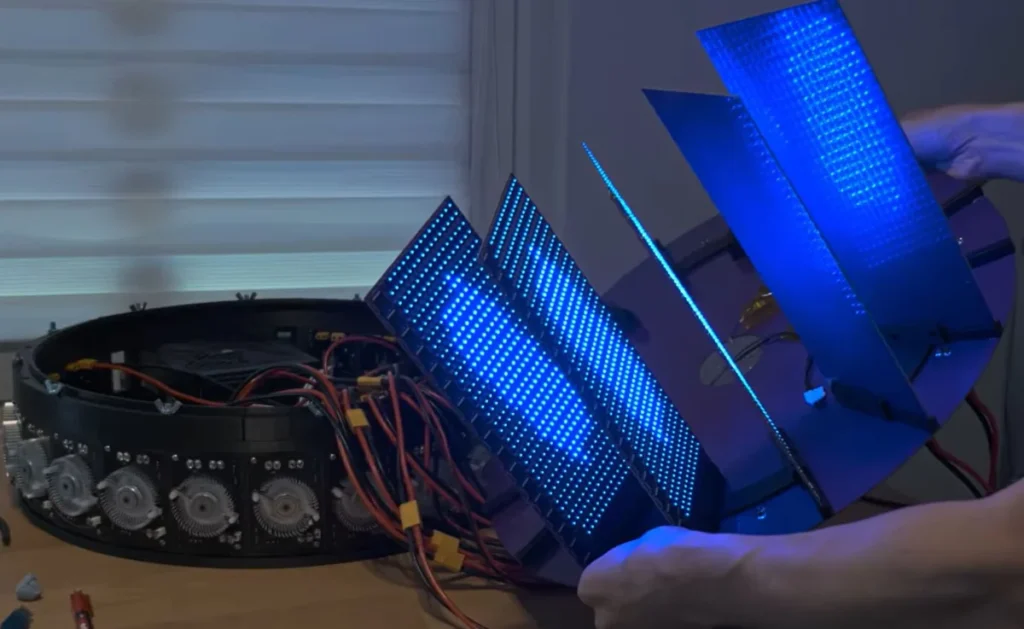
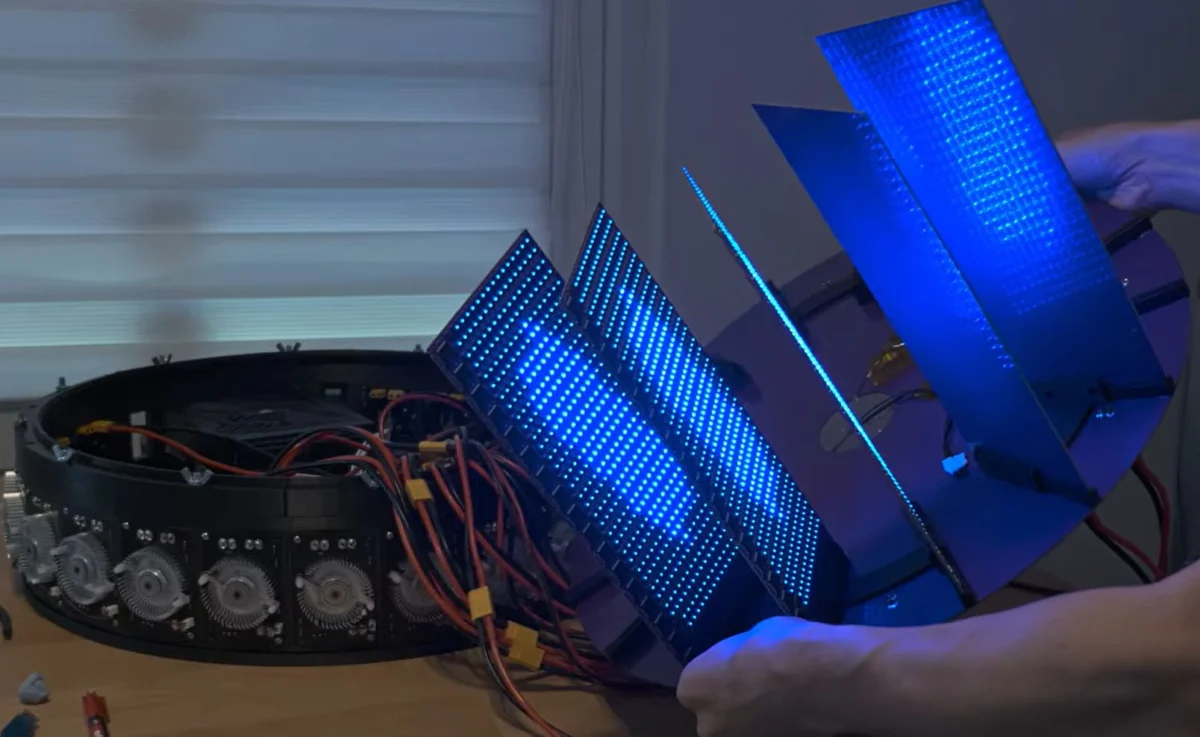
In an era dominated by monolithic, hyper-optimized graphics processing units (GPUs) from industry giants, a lone innovator is charting an entirely different course. Prolific hardware hacker and YouTube personality [bitluni] has embarked on an ambitious, perhaps even audacious, project: constructing a functional "GPU" from an astounding 8,192 individual microcontrollers (MCUs). This "Ultracluster GPU," as it’s been dubbed, represents a radical re-imagining of parallel processing, leveraging a massive array of low-cost, low-power components to tackle a challenge typically reserved for specialized silicon.
The undertaking defies conventional wisdom, opting for sheer numerical brute force and distributed intelligence over the concentrated power of a single, complex chip. By connecting thousands of humble CH570 MCUs on custom-designed printed circuit boards (PCBs) and developing bespoke firmware, [bitluni] is not merely building a curiosity; he is exploring the fundamental limits and possibilities of massively parallel, distributed computing in the context of graphics rendering. The initial prototype, a dazzling addressable RGB LED matrix, offers a tantalizing glimpse into a future where graphics might not be rendered by a singular, powerful engine, but by a "gaggle of cores," each contributing its modest computational might to a grander visual symphony.
Main Facts: A Glimpse into the Ultracluster
The core of [bitluni]’s latest magnum opus is a colossal cluster of 8,192 CH570 microcontrollers. These are not high-performance processors; rather, they are inexpensive, energy-efficient RISC-V based MCUs designed for embedded applications. Each CH570 features a QingKe 32-bit RISC-V core, capable of running at a maximum clock speed of 100 MHz. Their instruction set, RV32IMBC, supports integers, integer multiplication and division, bit manipulation, and compressed instructions, making them versatile for many basic computing tasks. Crucially, however, they lack advanced features such as atomic operations, vector processing units, or floating-point instructions – capabilities that are cornerstones of modern GPUs. This absence underscores the unique design philosophy behind the Ultracluster: achieve complex results through massive parallelization of simple operations.
The initial conceptualization involved dedicating one MCU per pixel, an idea that, while elegant in its simplicity, quickly exposed the immense scalability challenges. A seemingly modest QVGA resolution (320×200 pixels), requiring 64,000 MCUs, would translate into a prohibitive power draw of approximately 2 kilowatts (655.36 Amperes at 3.3V) and a component cost running into thousands of dollars. Recognizing this practical barrier, [bitluni] ingeniously adapted the concept: for the prototype, each of the 8,192 MCUs was directly coupled with its own RGB LED. This immediate visual feedback transforms the cluster into a sophisticated, highly customizable addressable RGB LED matrix, effectively creating a "pixel" for each MCU without needing to render to an external display. This approach serves as a crucial intermediary step, allowing the developer to test the inter-MCU communication, power delivery, and distributed firmware without the added complexity of a full video output pipeline.
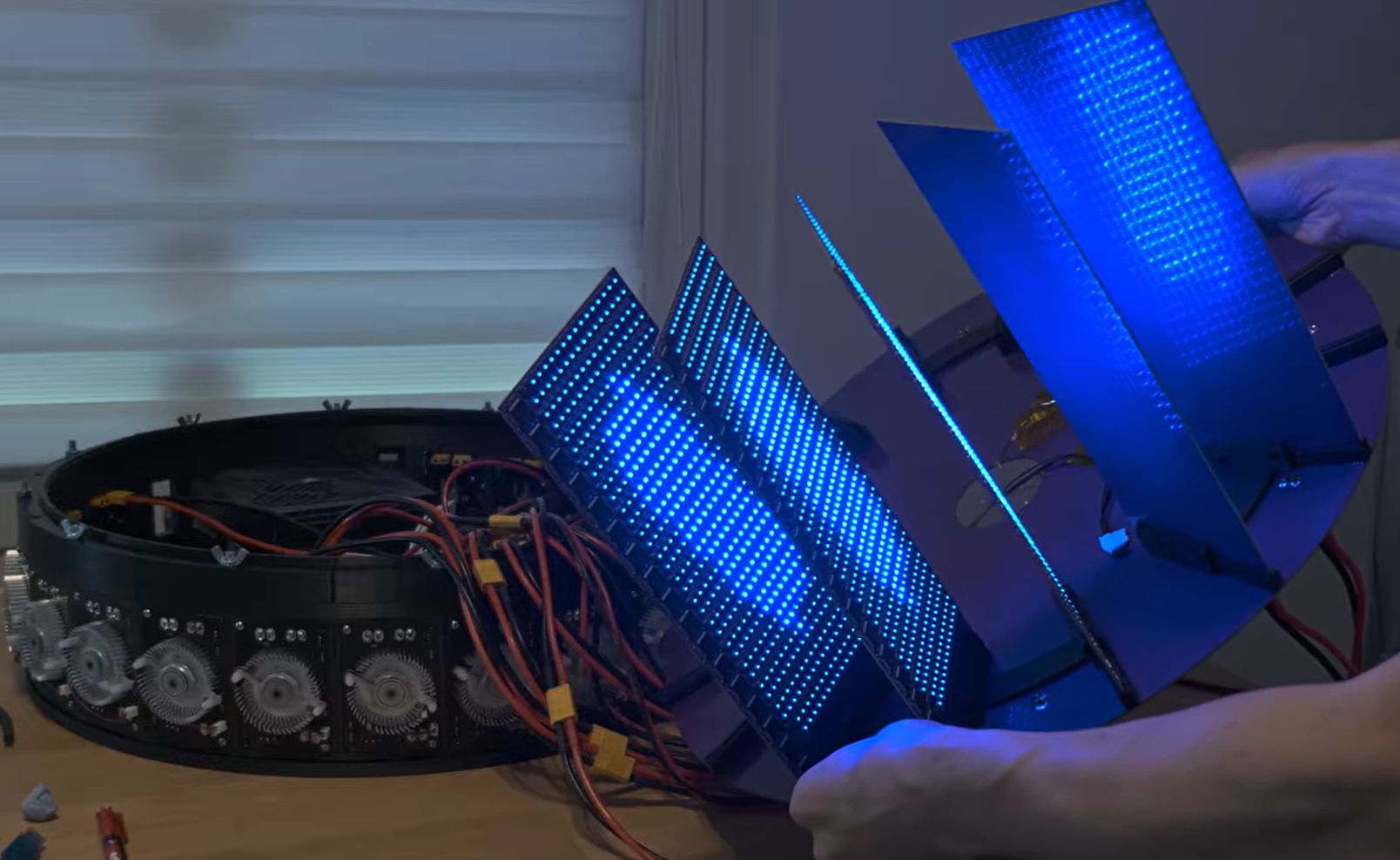
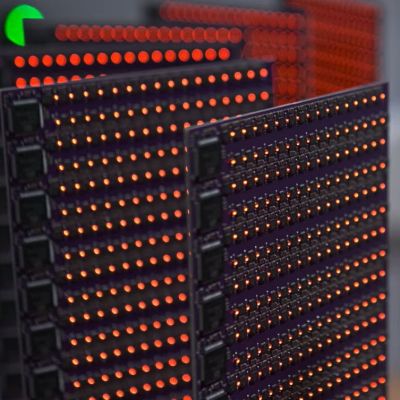
The physical architecture of the Ultracluster is a testament to modular design. To accommodate thousands of components, the system is segmented into multiple "blades," each a custom-designed PCB populated with a subset of the CH570 MCUs. These blades then connect to a central backplane, which facilitates communication and power distribution across the entire array. On each blade, a larger, more powerful MCU acts as a controller, managing the operations and data flow for its local group of CH570s. This hierarchical structure is essential for managing the complexity and ensuring reliable operation of such a vast number of interconnected processors. Powering this formidable array is a robust 3-kilowatt Corsair ATX power supply unit, which feeds into subsequent power stages to ensure stable and sufficient current delivery to all MCUs. The project, currently in its prototype phase, lays the groundwork for future expansions, with [bitluni] envisioning several more "levels" to be integrated to evolve this experimental cluster into something truly resembling a functional GPU capable of generating complex graphical outputs.
Chronology: A History of Parallel Ambition
[bitluni]’s Ultracluster GPU is not an isolated experiment but rather the latest, and certainly most ambitious, iteration in a series of projects exploring unconventional approaches to video and parallel processing. His work consistently demonstrates a fascination with pushing the boundaries of what can be achieved with readily available, often low-cost, embedded hardware.
His journey into distributed computing and graphics generation can be traced back several years. In 2023, he garnered significant attention for developing a "much better VGA from an ESP32." This project showcased his ability to extract surprisingly sophisticated video output from a single, inexpensive microcontroller, challenging perceptions of what embedded systems could achieve in the realm of display generation. It was a foundational exercise in bit-banging and timing-critical code, skills that undoubtedly inform the intricate firmware development required for the Ultracluster.
The following year, 2024, saw [bitluni] delve deeper into multi-core architectures with his "256-core RISC-V megacluster." This project was a direct precursor to the current Ultracluster, demonstrating his proficiency in designing systems that integrate a significant number of RISC-V cores. It likely involved grappling with challenges of inter-core communication, synchronization, and task distribution on a smaller, yet still substantial, scale. This experience would have been invaluable in scaling up to the current 8,192-core design.
By 2025, he had refined his approach further with a "160-core RISC-V board" designed as an M.2 coprocessor. This project highlighted a move towards more integrated and potentially practical applications of multi-core RISC-V arrays, suggesting an exploration of how such clusters could augment existing computing systems. The M.2 form factor implied an intention for a more compact and perhaps even consumer-accessible distributed processing unit.
The current 2026 "Ultracluster GPU" project, therefore, represents the culmination of these previous explorations. It synthesizes his expertise in low-level video generation, large-scale multi-core system design, and the practical challenges of power and communication. The initial conceptualization, where each MCU was envisioned as a pixel processor, emerged from this rich history of experimentation. The subsequent pivot to directly integrate RGB LEDs into each MCU for immediate visual feedback was a pragmatic adaptation, allowing the project to demonstrate tangible progress and validate the underlying distributed architecture before tackling the more complex challenge of driving an external display. This iterative and experimental process is characteristic of [bitluni]’s approach, continuously building upon past successes and learning from encountered limitations to push the envelope of hardware hacking.
Supporting Data: Deconstructing the Ultracluster’s Engineering
The sheer scale and unconventional nature of the Ultracluster GPU demand a closer look at the technical choices and inherent challenges. From the humble CH570 MCU to the intricate power delivery and software architecture, every element contributes to this grand experiment in distributed graphics.
The CH570 MCU: A RISC-V Canvas
The selection of the CH570 MCU is central to the project’s philosophy. Its primary appeal lies in its extremely low cost (approximately $0.10 per unit) and its adherence to the open-source RISC-V instruction set architecture. This makes it an ideal candidate for large-scale experimental projects where cost-per-node is a critical factor. The QingKe 32-bit RISC-V core operating at 100 MHz provides a modest but consistent processing capability.
However, the RV32IMBC instruction set reveals significant limitations for traditional GPU tasks. The "I" (Integer) and "M" (Integer Multiplication and Division) extensions are standard, as is "B" (Bit Manipulation) which can be surprisingly useful for low-level graphics operations like pixel manipulation or color space conversions. "C" (Compressed instructions) helps reduce code size, which is valuable for embedded systems with limited memory. What’s notably absent are floating-point units (FPU) and vector processing extensions. Modern GPUs rely heavily on FPUs for complex calculations in 3D graphics (e.g., vertex transformations, lighting, shader computations) and vector units for parallel operations on multiple data elements simultaneously.
For the Ultracluster, this means that any floating-point arithmetic must be emulated in software using fixed-point math, a computationally intensive process that significantly impacts performance. Similarly, vector operations, which are fundamental to parallel shader execution, must be broken down into scalar operations and distributed across multiple MCUs. This design choice inherently sacrifices per-core performance and efficiency in favor of massive parallelism, relying on the sheer number of cores to compensate for individual limitations. It also necessitates highly optimized, custom firmware that understands these constraints and efficiently distributes workloads.
The Architecture: Blades, Backplanes, and Controllers
To manage 8,192 MCUs, a highly modular and hierarchical architecture was imperative. The "blade" design is a common pattern in server and supercomputing clusters, adapted here for microcontrollers. Each blade PCB houses a group of CH570 MCUs, forming a local processing unit. The exact number of MCUs per blade is not specified but would be a critical design parameter, balancing density with power distribution and communication complexity.
These blades then plug into a "backplane," which serves as the central nervous system of the Ultracluster. The backplane provides common power rails and communication buses, allowing data to flow between different blades and to a central control unit (if present). This modularity is crucial for assembly, testing, and potential expansion or maintenance. If one blade fails, it can theoretically be replaced without disrupting the entire system.
Crucially, each blade also incorporates a "controller MCU" – likely a more powerful microcontroller than the CH570s. This controller MCU acts as a local orchestrator, managing the CH570s on its blade. Its responsibilities could include:
- Command Distribution: Receiving high-level graphics commands from a host system (or a master controller) and breaking them down into tasks for its local CH570s.
- Data Aggregation: Collecting results from its CH570s (e.g., rendered pixel data) and forwarding them up the hierarchy.
- Synchronization: Ensuring that the CH570s on its blade operate in a coordinated manner, especially for tasks that require inter-pixel dependencies.
- Local Resource Management: Managing power and communication for its group of CH570s.
The communication protocols between the controller MCU and its CH570s, and between the controller MCUs and the backplane, are critical. These could range from standard interfaces like SPI or I2C to custom high-speed serial links, designed to minimize latency and maximize throughput across thousands of nodes.
Power and Scalability: The Elephant in the Room
The discussion around power consumption for QVGA resolution (320×200 pixels) highlights one of the project’s most significant challenges. While a single CH570 MCU draws a modest 10 mA at 3.3V, scaling this up creates astronomical figures. For 64,000 MCUs, the total current draw would be 640 Amperes (64,000 0.01 A), resulting in a power consumption of approximately 2,112 Watts (640 A 3.3 V). This is equivalent to a powerful gaming PC or a small server.
The choice of a 3 kW Corsair ATX PSU demonstrates the recognition of this immense power requirement. ATX power supplies are designed for high efficiency and multiple voltage rails, making them suitable for such a demanding setup. However, distributing 640 Amperes at 3.3V across a large PCB array presents significant engineering hurdles related to trace width, voltage drop, and thermal management. Thick copper planes and robust power delivery networks are essential to prevent voltage sags and overheating.
Beyond the raw power figures, the comparison to commercial GPUs is stark. Modern GPUs deliver immense graphical performance for a fraction of the power required by a purely MCU-based array for the same resolution, primarily due to their highly optimized, specialized silicon (hardware accelerators for specific graphics tasks, deeply pipelined architectures, and vector processing units). The Ultracluster’s current iteration, with each MCU driving an RGB LED, sidesteps the power-intensive process of driving an external display, which would add another layer of complexity and power consumption. The question of whether the final version can achieve QVGA output "without needing more power than what a typical 230 V, 16A European outlet can provide" (which typically supplies around 3.6 kW) remains a critical, and likely challenging, goal.
Firmware: The Orchestrator of Thousands
The software that runs on each of the 8,192 MCUs, and on the controller MCUs, is arguably the most complex aspect of the project. Writing firmware for a single MCU is straightforward; orchestrating thousands to perform a coordinated graphics task is a monumental undertaking.
The firmware on each CH570 must be lean and highly optimized, given the limited resources (100 MHz clock, likely small RAM/Flash). It needs to:
- Receive Commands: Interpret instructions from its local controller MCU.
- Perform Pixel Calculations: Execute primitive graphics operations (e.g., setting color values, simple drawing algorithms) that contribute to its assigned pixel.
- Communicate: Send status or computed data back to the controller.
- Drive LED: Directly control its attached RGB LED.
The firmware on the controller MCUs would be even more sophisticated, handling tasks like:
- Workload Distribution: Dividing larger graphics tasks (e.g., rendering a frame, drawing a shape) among its group of CH570s.
- Inter-MCU Communication Protocol: Managing the communication bus to ensure data integrity and timely delivery.
- Frame Buffering (potentially): Temporarily storing pixel data before it’s displayed or forwarded.
- Error Handling: Detecting and potentially recovering from issues with individual CH570s.
Without vector or floating-point instructions, all graphics calculations must be done using integer or fixed-point arithmetic. This requires clever algorithms and careful optimization to achieve acceptable performance. For example, rendering a simple 3D scene would require each MCU to perform matrix multiplications and perspective divisions using only integer math, a significant computational burden. The challenge lies in distributing these tasks such that the collective effort results in a coherent, real-time graphical output.
Official Responses and Expert Commentary
While [bitluni]’s project is a testament to individual ingenuity rather than a corporate endeavor, its implications resonate within the broader fields of computer architecture, parallel computing, and the maker movement. There are no "official responses" from major GPU manufacturers like NVIDIA or AMD, primarily because the Ultracluster operates on an entirely different paradigm. However, the project invites expert commentary on its academic relevance and its stark contrast with mainstream industry practices.
From an academic perspective, projects like the Ultracluster GPU are invaluable. Computer architects and researchers in parallel computing are constantly exploring novel ways to scale performance and manage complexity. While commercial GPUs are highly specialized for specific graphics tasks and leverage billions of transistors on a single die, [bitluni]’s approach highlights the potential of fine-grain parallelism using commodity hardware. It presents a real-world, albeit experimental, case study in:
- Distributed Systems Design: How to manage communication, synchronization, and task distribution across thousands of independent nodes.
- Fault Tolerance: In such a large system, individual component failures are inevitable. How can the system be designed to degrade gracefully or reconfigure itself?
- Scalable Power Delivery: The challenges of delivering high current at low voltage to a vast array of components.
- Software-Defined Hardware: How custom firmware can transform a collection of general-purpose MCUs into a specialized accelerator.
A hypothetical computer architect might comment, "While economically unfeasible for mass production, [bitluni]’s Ultracluster is a fascinating exploration of cellular automata applied to graphics. It forces us to reconsider the fundamental building blocks of computation. Could such an architecture, perhaps with more optimized inter-MCU communication or custom instruction sets, find niches in specific, highly parallel, non-graphical applications like scientific simulations or specialized AI inference at the edge?"
From an industry perspective, the Ultracluster GPU serves as a powerful reminder of the divergent paths of innovation. Mainstream GPU manufacturers are driven by performance-per-watt, performance-per-dollar, and delivering cutting-edge features like real-time ray tracing and advanced AI acceleration. Their designs are the result of multi-billion dollar R&D efforts, leveraging advanced semiconductor processes and highly specialized intellectual property. The "Jensen Huang" (NVIDIA CEO) reference in the original article, while humorous, underscores this contrast. A consumer-grade GPU delivers orders of magnitude more performance, efficiency, and features than an MCU cluster could hope to achieve for gaming or professional graphics workloads, simply due to its fundamental design philosophy.
However, the project’s educational value cannot be overstated. It provides a tangible, open-source example for students and hobbyists to understand concepts like parallel processing, embedded system programming, and low-level graphics. It democratizes the process of building complex computing systems, proving that innovation isn’t solely confined to corporate labs. It inspires the maker community to tackle seemingly impossible challenges with creativity and perseverance. The project’s transparency and [bitluni]’s willingness to share his process through platforms like YouTube make it a powerful learning resource.
Implications: Beyond the Pixels
The Ultracluster GPU, despite its current experimental status, carries significant implications for the future of distributed computing, alternative hardware architectures, and the enduring spirit of the open-source community.
The Future of Distributed Computing and Graphics
[bitluni]’s project pushes the boundaries of what’s conceivable with distributed computing using off-the-shelf components. While not a direct competitor to commercial GPUs, it explores an extreme form of parallelism. This paradigm might not be suitable for mainstream gaming, but it could inspire alternative architectures for specialized tasks. Imagine future systems where processing elements are deeply embedded within a display itself, or where specific data processing tasks are offloaded to thousands of tiny, interconnected nodes, each optimized for a very specific, simple operation. This could lead to highly resilient systems, where the failure of a few nodes doesn’t cripple the entire system.
The very idea of a "GPU" constructed from thousands of general-purpose microcontrollers challenges the monolithic design philosophy of modern accelerators. It suggests that if individual processing units become cheap and energy-efficient enough, "gluing them together" in vast numbers could become a viable, albeit complex, alternative for certain applications where throughput trumps single-thread performance or where cost-per-node is paramount.
Alternative Architectures and Niche Applications
Beyond traditional graphics, the Ultracluster’s underlying architecture could find resonance in other domains requiring massive parallelism. Consider:
- Sensor Networks: A distributed array of MCUs, each capable of local processing and communication, could form intelligent sensor grids for environmental monitoring, smart cities, or industrial automation.
- Specialized Data Processing: Certain scientific simulations, cryptographic tasks, or even some forms of artificial intelligence (e.g., neural networks with simple activation functions) might benefit from such a fine-grained parallel architecture, especially if algorithms can be designed to minimize inter-node communication.
- Edge Computing: Deploying thousands of low-power MCUs at the "edge" of a network to perform localized data filtering or preliminary analysis could reduce the load on central servers and improve response times.
The absence of floating-point and vector units might be a limitation for general-purpose computing, but for highly specialized, integer-based tasks, this architecture could be surprisingly effective and energy-efficient on a per-operation basis.
The Spirit of the Maker Movement
Perhaps one of the most significant implications is the continued demonstration of the power and creativity within the hobbyist and open-source hardware community. Projects like [bitluni]’s Ultracluster GPU highlight that groundbreaking innovation isn’t exclusive to well-funded corporate R&D departments. Armed with curiosity, technical skill, and access to affordable components, individuals can conceive and execute projects that challenge conventional wisdom and inspire new ways of thinking.
This project embodies the hacker ethos: understanding how things work at a fundamental level, disassembling existing paradigms, and rebuilding them in novel ways. It fosters a culture of learning, sharing, and iterative improvement that is vital for technological progress. By sharing his process, [bitluni] not only documents his journey but also provides a blueprint and inspiration for others to explore similar ambitious undertakings.
The Long Road Ahead
The Ultracluster GPU is far from complete. The journey from an addressable RGB matrix to a true QVGA-capable GPU will involve overcoming immense challenges in firmware optimization, inter-MCU communication protocols, memory management across the cluster, and, crucially, managing power and thermal dissipation for such a dense array. The question of whether it can achieve its ambitious graphical output goals within practical power limits remains open.
Regardless of its ultimate graphical capabilities, [bitluni]’s Ultracluster GPU stands as a monumental achievement in experimental hardware engineering. It’s a testament to the idea that sometimes, the most insightful discoveries come not from following the established path, but from daring to "glue 8,192 MCUs together" and seeing what emerges. It’s a powerful reminder that in the vast landscape of computing, there are still countless frontiers to explore, driven by ingenuity, perseverance, and a healthy dose of audacity.