Securing the Digital Perimeter: A Comprehensive Analysis of Acunetix Web Vulnerability Scanner
In the modern digital economy, web applications serve as the primary interface between businesses and their customers. However, as these platforms grow in complexity, so does the surface area available to malicious actors. With cyberattacks evolving from simple defacements to sophisticated data exfiltration and ransomware campaigns, the necessity for robust, automated security auditing has never been higher. Among the various solutions available to security professionals, the Acunetix Web Vulnerability Scanner (WVS) remains a benchmark tool for identifying vulnerabilities such as SQL Injection, Cross-Site Scripting (XSS), and the broader spectrum of the OWASP Top 10 risks.

The Evolution of Web Security Auditing
The history of web vulnerability scanning is rooted in the "cat-and-mouse" game between developers and hackers. As early as the late 1990s and early 2000s, the emergence of dynamic content meant that static analysis was no longer sufficient. Acunetix was founded to address this specific gap in the market, providing an automated "black-box" testing approach that mimics the behavior of a real-world attacker.

By launching a battery of simulated attacks against an application, the tool evaluates the target’s defenses in real-time. Over the years, the software has evolved from a basic crawler into a sophisticated engine capable of interpreting complex JavaScript, handling authentication-heavy environments, and integrating with the latest DevOps CI/CD pipelines.

Hands-on Assessment: The Power of Automated Discovery
At the core of the Acunetix experience is its Scan Wizard, which streamlines the traditionally arduous task of security auditing. For security teams and developers, the process begins with the definition of a "Scan Profile."

Intelligent Scanning and Customization
One of the tool’s most critical features is its ability to perform intelligent reconnaissance. Before a scan commences, the engine fingerprints the web application to determine its underlying technology stack—whether it is built on PHP, ASP.NET, Java, or Ruby on Rails. This is not merely a convenience feature; it is a vital optimization step. By identifying the stack, the scanner avoids wasting time testing for vulnerabilities that are impossible on that specific architecture, thereby increasing the efficiency and speed of the audit.

Furthermore, users maintain granular control over their security posture. While the "Default" profile provides a comprehensive check against all known vulnerability classes, organizations with specific compliance requirements can tailor these profiles to focus on high-risk alerts or specific regulatory frameworks, such as PCI-DSS or HIPAA.

Handling Authentication and Complex Workflows
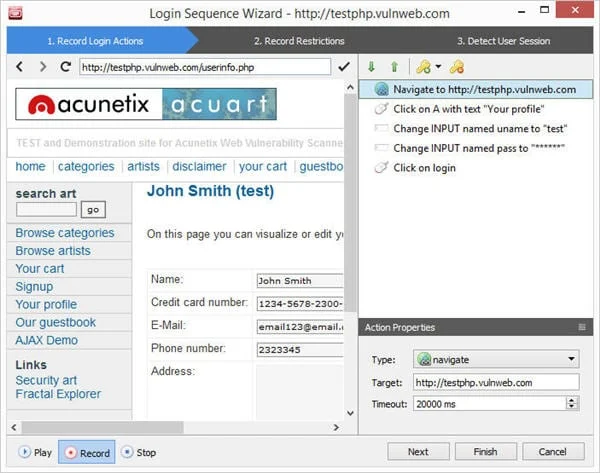
A common failure point for many automated scanners is the inability to navigate beyond login screens. Acunetix overcomes this through its "Login Sequence Recorder." Unlike older, cumbersome tools that require complex manual configuration, the Acunetix recorder allows a user to perform a manual login to the target site. The software records these actions and replays them during the scan, ensuring that the scanner remains authenticated throughout the entire process.

The tool also features advanced logic for maintaining session states. By identifying "Session Patterns"—the unique behavioral markers that distinguish a logged-in user from a guest—the scanner can automatically detect when it has been logged out and re-authenticate itself. This "set-and-forget" capability is a major differentiator, allowing for deep, authenticated scanning of restricted areas without human intervention.

DeepScan: Tackling the JavaScript Frontier
Modern web applications rely heavily on AJAX and client-side JavaScript, which poses a significant challenge to traditional scanners that only parse raw HTML. To solve this, Acunetix employs its proprietary "DeepScan" engine. This is, in effect, a headless browser integrated into the crawler. It allows the scanner to execute JavaScript, interact with DOM elements, and interpret single-page applications (SPAs) just as a modern browser would.

This level of integration is essential for detecting DOM-based XSS, a notoriously difficult vulnerability to identify. By providing a detailed stack trace of the payload’s journey through the browser’s DOM, Acunetix empowers developers to visualize the exploit path, drastically reducing the "Mean Time to Repair" (MTTR).

Interactive Application Security Testing (IAST) with AcuSensor
While black-box scanning is highly effective, it lacks visibility into the server-side code execution. Acunetix bridges this gap with "AcuSensor," an IAST component that is deployed within the server environment.

When installed, AcuSensor monitors the application from the inside out. For instance, when a black-box test triggers a potential SQL injection, the sensor can confirm the vulnerability by inspecting the backend database query directly. It can even pinpoint the exact file and line of code responsible for the flaw. This level of precision is transformative, shifting the security dialogue from "there is a problem somewhere" to "the error is on line 142 of user_auth.php."

AcuMonitor: Defending Against Out-of-Band Threats
Not all vulnerabilities are "immediate." Some, such as Blind XSS, SSRF (Server-Side Request Forgery), and Out-of-Band SQL Injection, require an intermediary service to report back to the scanner. This is where "AcuMonitor" comes into play. It operates as a background, transparent service that allows the scanner to detect vulnerabilities that occur asynchronously. Because these attacks often take place "out-of-band," they are invisible to standard monitoring tools. By leveraging AcuMonitor, organizations can identify these silent threats without having to manage their own external infrastructure.

Reporting and Compliance: From Technical Debt to Boardroom Metrics
For the C-suite and compliance officers, the raw data produced by a scanner is often overwhelming. Acunetix addresses this through a robust reporting engine.

- Executive Summaries: These reports offer a high-level view of an organization’s risk posture, suitable for non-technical stakeholders.
- Compliance Reports: These are pre-formatted to map vulnerabilities directly to industry standards, including the OWASP Top 10, SANS Top 25, and various governmental compliance requirements.
- Developer Reports: These provide granular, actionable data, including remediation advice and reference links to authoritative sources like OWASP.
By generating reports in multiple formats—PDF, HTML, and CSV—teams can seamlessly integrate security data into their existing project management and ticketing systems, such as Jira or GitHub.

Implications for Modern Security Operations
The integration of Acunetix into a Software Development Life Cycle (SDLC) has profound implications for enterprise security. By automating the discovery of vulnerabilities, organizations can:

- Reduce Human Error: Automated, repeatable scans ensure that no critical misconfiguration is missed during a release cycle.
- Accelerate Remediation: Features like "Retest" allow developers to verify a fix with a single click, immediately confirming that the vulnerability has been closed without needing to run a full-scale scan again.
- Shift-Left Security: By making the tool accessible to developers and QA teams during the development phase, bugs are identified and squashed before they reach production.
Conclusion: A Proactive Stance
In an era where a single vulnerability can lead to catastrophic data loss and reputational damage, the role of automated security testing is no longer optional. Acunetix Web Vulnerability Scanner provides a comprehensive, sophisticated, and highly efficient solution for organizations looking to fortify their digital assets.

Whether it is through the intelligent use of the DeepScan engine for modern web frameworks or the precise, server-side insights provided by AcuSensor, the tool manages to balance ease of use with the depth of analysis required by modern security professionals. As cyber threats continue to scale in volume and sophistication, tools that offer both visibility and actionable remediation are the bedrock of a resilient security strategy.

Frequently Asked Questions (FAQ)
Q: Is Acunetix better than manual penetration testing?
A: Acunetix is designed to augment manual testing, not replace it. While it excels at automating the repetitive, high-volume aspects of a security audit, manual penetration testing is still recommended for identifying complex business logic flaws that require human intuition.

Q: Does Acunetix support mobile applications?
A: Yes, the scanner includes features to identify mobile-specific vulnerabilities by allowing users to change User-Agent strings to mimic mobile devices, ensuring that mobile-responsive sites are tested accurately.

Q: How does Acunetix handle false positives?
A: Acunetix uses multiple validation techniques, including the use of sensors and out-of-band monitoring, to verify vulnerabilities before reporting them. This significantly reduces the noise of false positives, allowing security teams to focus on legitimate threats.