Jetpack Compose 1.12: A Paradigm Shift in Android UI Development
The landscape of Android development reached a significant milestone today with the official release of Jetpack Compose version 1.12. As part of the August 2026 stable channel update, this release represents a monumental leap in how developers approach graphical fidelity, state management, and architectural performance. By upgrading to the Compose Bill of Materials (BOM) version 2026.08.00, developers can now access a suite of high-performance APIs that bridge the gap between creative design and technical execution.
This release is not merely a collection of minor patches; it is a comprehensive overhaul of the framework’s core capabilities. From the introduction of advanced mesh gradients to the seamless integration of modern security standards like the Android Credential Manager, version 1.12 positions Jetpack Compose as the definitive standard for building robust, visually immersive, and highly performant applications on the Android platform.
Main Facts: The Core Pillars of the 1.12 Update
The 1.12 release introduces several key features that address long-standing developer requests for more expressive control over the UI.
- Advanced Visual APIs: The standout addition is the
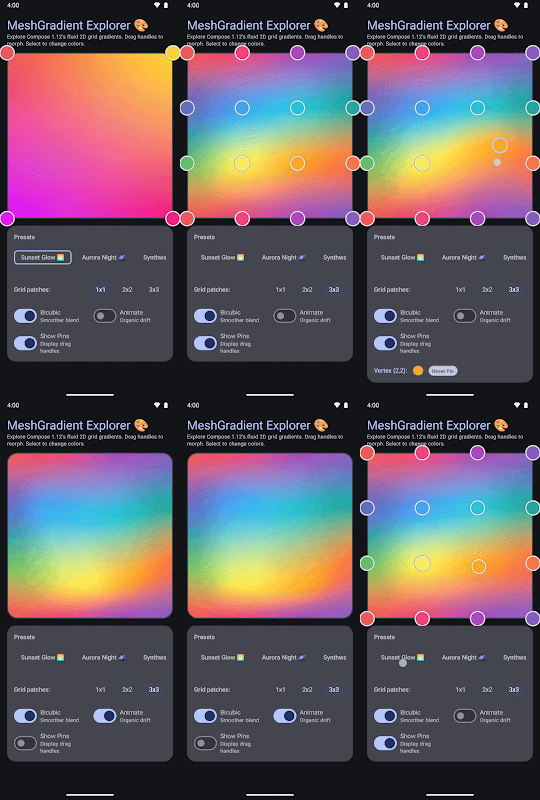
MeshGradientPainter, which allows for the creation of sophisticated, multi-point color gradients. Alongside this, the framework now provides full-pipeline support for Wide Color Gamut (P3) and High Dynamic Range (HDR) rendering. - Structural Layout Evolution: The experimental Grid component has received a major boost with the introduction of "Named Areas," allowing developers to define complex 2D layouts using semantic region names rather than cumbersome numeric indices.
- Performance Optimization: A new Keyed
SideEffectoverload provides a lightweight alternative toLaunchedEffectandDisposableEffect, boasting up to 90% faster performance in specific execution scenarios. - Enhanced Interactivity: Two-stage transitions, powered by
DeferredAnimatedContent, enable developers to implement predictive back gestures and complex, gesture-driven animations with ease. - Platform Integration: Native support for the Android Credential Manager is now baked into the
BasicTextFieldcomponent, simplifying the implementation of secure sign-in flows.
Chronology: The Journey to 1.12
The path to Compose 1.12 has been characterized by a relentless focus on stability and performance. Since the unveiling of the initial Compose vision at Google I/O, the Android team has followed a structured roadmap designed to transition the framework from a novel alternative to the primary UI toolkit for the ecosystem.

The development cycle leading up to this release saw a series of alpha and beta iterations that focused heavily on refining the "Styles API." While the Styles API remains experimental—reflecting Google’s commitment to "getting it right" before finalizing foundational architectural layers—the feedback loop from the developer community has been instrumental in shaping the current iteration. The transition to compileSdk 37 and the requirement for Android Gradle Plugin (AGP) 9.1.1 mark the culmination of a multi-year effort to modernize the underlying build environment, ensuring that Compose remains in lockstep with the latest advancements in the Android OS.
Supporting Data: Benchmarks and Performance Gains
Performance is the bedrock of user experience, and the 1.12 release demonstrates significant engineering progress in this domain. According to internal Google benchmarks, the "Time to Initial Display" (TTID)—the duration between launching an app and the first frame appearing on screen—has been optimized to be effectively indistinguishable from legacy View-based systems.
The introduction of the Keyed SideEffect is a prime example of data-driven optimization. By allowing side effects to be scoped to specific keys, the framework reduces unnecessary re-compositions and execution overhead. The reported 90% performance gain over LaunchedEffect and 20% over DisposableEffect provides developers with a powerful tool for maintaining 60fps (or 120fps) performance in data-heavy applications.
Furthermore, the new testing synchronization APIs—specifically those designed for composeTestRule—address the common pain point of flaky tests in asynchronous environments. By allowing developers to manually advance the main clock and run tests without redundant synchronization, the 1.12 release reduces test execution times, enabling faster CI/CD pipelines and more reliable deployment cycles.

Official Responses and Strategic Vision
The release of 1.12 signals a strategic shift in Google’s priorities. In official documentation and communication, the Android team emphasized that the focus is moving beyond basic UI construction toward "expressive and performant" application development.
"We are not just building a toolkit for layouts; we are building a foundation for the next decade of Android design," stated an engineering lead during the release rollout. "By enabling Wide Color Gamut and HDR, we are acknowledging that the hardware our users carry is capable of far more than traditional sRGB rendering. Compose 1.12 is the key that unlocks that potential."
Regarding the decision to keep the Styles API experimental, the team expressed a commitment to long-term stability. "The API surface area for design systems is vast. We would rather ship an experimental API that evolves with the community’s needs than a rigid, final API that fails to accommodate the diversity of Android design systems."
Implications for the Developer Ecosystem
For the average Android developer, the implications of this update are profound.

Breaking Changes and Migration
The jump to compileSdk 37 necessitates a migration to AGP 9.1.1. While this requires an upfront investment of time, it provides access to the latest compiler optimizations and platform features. Additionally, the deprecation of Modifier.onFirstVisible() in favor of Modifier.onVisibilityChanged() suggests a move toward more granular, event-driven UI updates, which will likely become the standard for scrollable and complex list-based UIs.
Design and Creative Freedom
The MeshGradientPainter is a game-changer for UI/UX designers. Historically, achieving organic, multi-point color gradients required custom drawing logic or heavy bitmap assets. By moving this into the framework, Compose 1.12 allows for dynamic, programmatically generated visuals that consume significantly less memory and adapt to different screen sizes and aspect ratios automatically.
Security and Usability
The integration of the Credential Manager into BasicTextField is a major win for both security and user convenience. By standardizing how apps request passwords, passkeys, and federated sign-ins, Google is effectively forcing a shift toward a more secure authentication paradigm. Developers can now implement high-security login flows with minimal boilerplate, reducing the barrier to entry for robust security practices.
Advanced Animation Logic
The move of DeferredTargetAnimation out of experimental status, coupled with the new interactive transition APIs, allows for the creation of "fluid" interfaces. Predictive back gestures, which allow users to see a preview of the previous screen before committing to a back action, are now much easier to implement. This is a critical feature for modern Android navigation, as it creates a sense of spatial continuity that users have come to expect from premium mobile experiences.

Looking Forward: A Call to Action
The release of Jetpack Compose 1.12 is a clear invitation for developers to revisit their UI architecture. Whether it is through adopting the new Grid layout for complex dashboards, utilizing the TextFieldState APIs for more manageable text input, or leveraging the new test synchronization tools to eliminate CI flakiness, there is value for every team in this update.
As the Android ecosystem continues to mature, Jetpack Compose remains the primary vehicle for innovation. Developers are encouraged to visit the official Jetpack Compose documentation to explore the new APIs and to engage with the engineering team via the Issue Tracker.
With 1.12, the barrier between a developer’s vision and the final on-screen result has never been thinner. The era of performant, high-fidelity, and secure Android UIs has officially arrived, and the tools provided in this release are the instruments that will define the user experience of tomorrow. Happy composing!