Native Distributed Fast Fourier Transform Arrives in TensorFlow v2 via DTensor
By Ruijiao Sun, Google Intern (DTensor Team)
Published in TensorFlow Technical Updates
Executive Summary: The Dawn of Native Distributed Signal Processing
In the rapidly evolving landscape of machine learning and high-performance computing, handling massive datasets often hits a fundamental hardware wall: device memory limitations. For domains relying heavily on signal processing—such as medical imaging, complex computer vision tasks, geophysical modeling, and large-scale generative networks—the Fast Fourier Transform (FFT) is an indispensable mathematical operation. Traditionally utilized for speeding up convolutions, extracting high-frequency features, and regularizing complex neural network models, the FFT becomes computationally prohibitive when datasets outgrow the physical memory confines of a single hardware accelerator, such as a Graphics Processing Unit (GPU) or Tensor Processing Unit (TPU).
To conquer this bottleneck, Google has officially introduced native support for the Distributed Fast Fourier Transform (Distributed FFT) in TensorFlow v2. Powered by DTensor, TensorFlow’s revolutionary distributed computing extension, this new capability allows developers to seamlessly compute Fourier Transforms across multiple accelerators without manually partitioning tensors or orchestrating complex low-level communication protocols. Building upon foundational academic research—specifically the pioneering work by Tianjian Lu outlined in the Google Research paper “Large-Scale Discrete Fourier Transform on TPUs”—this release bridges the gap between theoretical multi-node signal processing and accessible, high-level deep learning frameworks.
Chronology of Innovation: From Research Papers to Native API Integration
The journey toward native distributed signal processing in TensorFlow did not happen overnight. Understanding the significance of this v2 release requires looking back at the technological milestones that paved the way:
- The Theoretical Foundation: Early distributed computing models struggled to efficiently scale multidimensional transforms across sprawling clusters of hardware accelerators without incurring massive communication penalties. Researchers recognized that standardizing data layouts across distributed meshes was critical.
- The TensorFlow v1 Library Era: Following the findings of the Large-Scale Discrete Fourier Transform on TPUs research paper authored by Tianjian Lu, an initial implementation of a Distributed FFT algorithm was released for TensorFlow v1. However, this iteration was restricted to a specialized library format, requiring steep learning curves and intricate boilerplate code from engineers seeking to implement it in production environments.
- The Advent of DTensor: Recognizing the need for a unified approach to distributed execution, Google developed DTensor. By leveraging Single Program, Multiple Data (SPMD) paradigms, DTensor provided a uniform API capable of effortlessly handling both data parallelism and model parallelism.
- TensorFlow v2 Native Integration: Marking a major leap forward, the DTensor team integrated Distributed FFT directly into TensorFlow v2. Rather than relying on external, loosely coupled libraries, developers can now invoke distributed signal processing natively through standard API calls like
tf.signal.fft2d, seamlessly scaling computation across multi-GPU or multi-TPU configurations.
Architecture and Mechanism: Understanding DTensor and Distributed FFT
To fully appreciate how TensorFlow v2 handles distributed FFTs, one must examine the underlying mechanics of DTensor and the execution flow of distributed signal transformations.
What is DTensor?
DTensor is an advanced extension built directly into TensorFlow designed explicitly for synchronous distributed computing. Unlike traditional distributed training frameworks that require complex parameter servers or explicit collective communication primitives written by the end-user, DTensor abstracts these complexities using a Single Program, Multiple Data (SPMD) extension model.

Under this paradigm, a single, unified Python program is executed across multiple devices simultaneously. DTensor automatically fragments large global tensors into smaller local chunks—known as shards—and distributes them across a user-defined logical device topology, referred to as a mesh. This provides developers with a uniform API that seamlessly unifies traditional data parallelism and model parallelism patterns commonly deployed in massive machine learning architectures.
The Developer Experience: Seamless API Integration
One of the most remarkable aspects of TensorFlow v2’s new Distributed FFT implementation is its API design symmetry. Developers do not need to learn an entirely new set of functions to execute distributed transforms. The interface for a distributed FFT is identical to the traditional, non-distributed FFT operations already native to TensorFlow.
By simply passing a sharded tensor as an input into standard operations like tf.signal.fft2d, TensorFlow automatically routes the computation across the established mesh network. Consequently, the resulting output tensor is also gracefully sharded, maintaining memory efficiency throughout the pipeline.
import tensorflow as tf
from tensorflow.experimental import dtensor

# Set up physical and logical devices for execution
device_type = dtensor.preferred_device_type()
if device_type == 'CPU':
    cpu = tf.config.list_physical_devices(device_type)
    tf.config.set_logical_device_configuration(
        cpu[0], [tf.config.LogicalDeviceConfiguration()] * 8
    )
if device_type == 'GPU':
    gpu = tf.config.list_physical_devices(device_type)
    tf.config.set_logical_device_configuration(
        gpu[0], [tf.config.LogicalDeviceConfiguration(memory_limit=1000)] * 8
    )
dtensor.initialize_accelerator_system()

# Create a multi-dimensional distributed mesh topology
mesh = dtensor.create_distributed_mesh(
    mesh_dims=[('x', 1), ('y', 2), ('z', 4)],
    device_type=device_type
)

# Set up a distributed input Tensor using stateless normal distributions
input_tensor = tf.complex(
    tf.random.stateless_normal(shape=(2, 2, 4), seed=(1, 2), dtype=tf.float32),
    tf.random.stateless_normal(shape=(2, 2, 4), seed=(2, 4), dtype=tf.float32)
)
init_layout = dtensor.Layout(['x', 'y', 'z'], mesh)
d_input = dtensor.relayout(input_tensor, layout=init_layout)

# Execute distributed fft2d.
# DTensor automatically determines the most efficient memory layout for d_output.
d_output = tf.signal.fft2d(d_input)
Supporting Data and Performance Analysis
While the ability to process previously unmanageable datasets is a monumental victory for machine learning engineers, distributed computing inherently introduces performance trade-offs that must be carefully balanced.
Memory Capacity vs. Communication Overhead
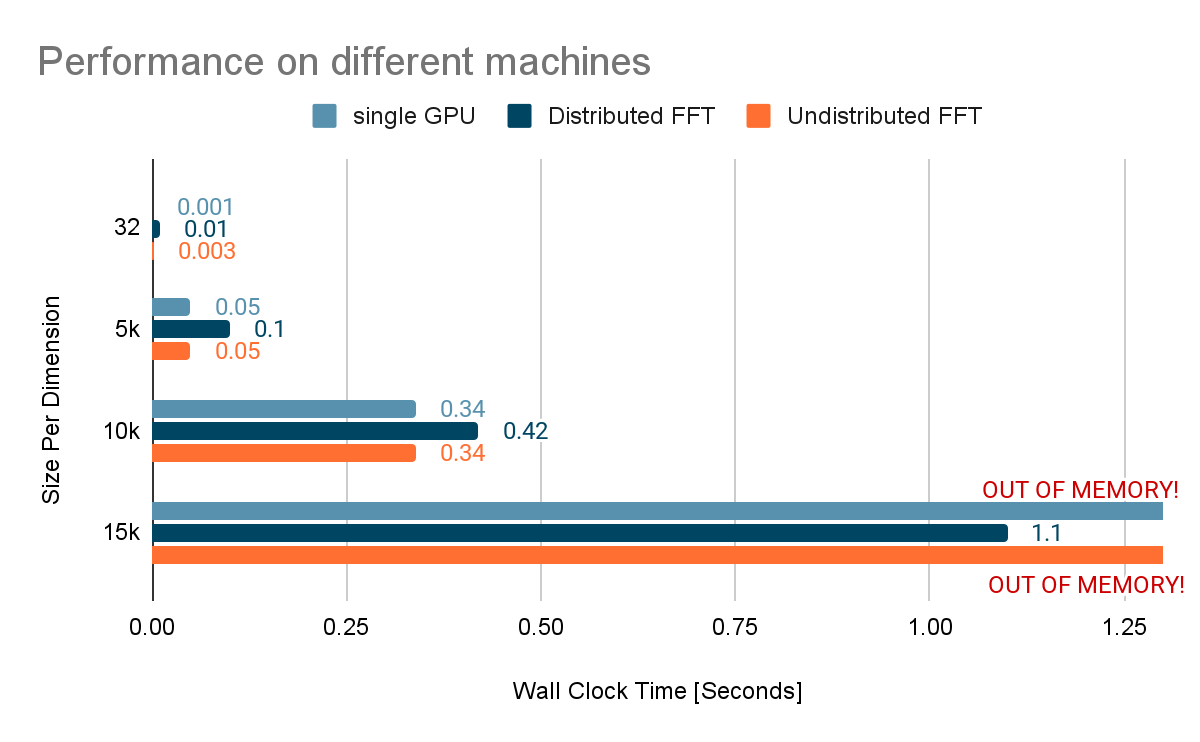
Empirical testing demonstrates that distributed FFT successfully bypasses single-device memory walls, empowering systems to process significantly larger datasets by pooling aggregate memory across multiple discrete accelerators. However, this architectural freedom comes at a cost: communication latency.
Because data must be actively transferred, transposed, and synchronized across various nodes within the mesh network, wall-clock execution time can be impacted compared to localized, single-device calculations—provided the dataset actually fits within that single device’s memory bounds.

Profiling the 10K x 10K Distributed FFT Experiment
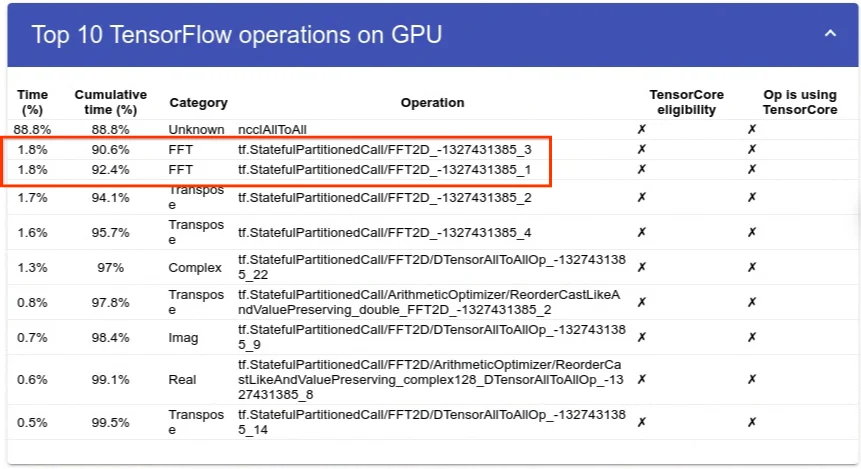
A granular look at profiling results from a 10K $times$ 10K distributed FFT experiment conducted on an 8x V100 GPU system reveals fascinating insights into where execution time is actually spent:
- The Algorithmic Approach: TensorFlow’s current distributed FFT implementation adopts a classic shuffle + local FFT methodology. This exact strategy is mirrored in other premier, high-performance distributed signal processing libraries, such as FFTW (Fastest Fourier Transform in the West) and PFFT (Parallel Fast Fourier Transform).
- Execution Breakdown: Remarkably, profiling data indicates that the two local FFT operations combined consume a mere 3.6% of the total execution time (approximately 15 milliseconds). In fact, this local computation phase runs roughly three times faster than a non-distributed
fft2doperation operating on isolated chunks. - The Bottleneck: The overwhelming majority of the total computing time is not spent calculating mathematical transforms, but rather on data shuffling. Specifically, communication primitives such as the
ncclAllToAlloperation account for the lions share of the processing timeline, highlighting the critical role that inter-GPU interconnect bandwidth (such as NVLink) plays in distributed workloads.
Official Perspectives and Industry Implications
The rollout of native Distributed FFT via DTensor has profound implications for the broader artificial intelligence and high-performance computing ecosystems.
Bridging AI and Scientific Computing
Traditionally, high-performance scientific computing (HPC) and deep learning frameworks operated in relatively isolated silos. HPC workloads heavily favored MPI-based libraries and explicit domain-decomposition strategies, while deep learning frameworks prioritized automatic differentiation and rapid prototyping on batched tensors.
By embedding native distributed signal processing directly into TensorFlow v2, Google is aggressively blurring these lines. Researchers working on physics-informed neural networks (PINNs), seismic wave propagation, MRI reconstruction, and ultra-high-resolution image generation can now leverage the full muscle of modern deep learning infrastructure without abandoning rigorous signal processing fundamentals.
Democratizing Multi-Accelerator Workflows
By handling the complexities of tensor sharding and layout propagation under the hood via DTensor, framework maintainers have significantly lowered the barrier to entry. Engineers no longer need to write custom message-passing interface (MPI) routines or manually split multidimensional arrays across device grids. This democratization of multi-accelerator programming accelerates research velocity and reduces the engineering overhead traditionally associated with scaling enterprise AI applications.
Future Roadmap and Next Steps
As the DTensor team points out, the current release represents only the foundation. Because TensorFlow has adopted a straightforward, elegant distributed FFT algorithm for its initial rollout, a wealth of optimization opportunities remain on the horizon to squeeze maximum performance out of hardware clusters.
Potential Performance Tuning Strategies
The engineering team has highlighted several avenues for future fine-tuning and algorithmic enhancement:
- Overlapping Communication and Computation: Implementing asynchronous execution pipelines where data shuffling (
ncclAllToAll) is overlapped with local matrix transformations to hide communication latency. - Optimized Layout Transformations: Refining automatic layout propagation heuristics so that DTensor can intelligently select mesh dimensions that minimize expensive transpose operations.
- Custom Hardware-Aware Primitives: Tailoring communication primitives specifically for upcoming generations of TPU interconnects and high-speed GPU topologies.
Call to Action for the Developer Community
Google’s DTensor team is actively encouraging the global developer and research community to test-drive the new Distributed FFT feature in TensorFlow v2.
Feedback, bug reports, and performance benchmarks are actively being collected via the official TensorFlow Forum. By engaging directly with core engineers, developers can help shape the future trajectory of native distributed signal processing in modern machine learning infrastructure.
Source: Google Developers Blog / TensorFlow Technical Updates.