Amazon Web Services Introduces Kubernetes Version Rollbacks for EKS: A New Safety Net for Cloud Infrastructure
Main Facts
In a move that promises to fundamentally change how organizations approach cloud infrastructure management, Amazon Web Services (AWS) has announced the official launch of Kubernetes version rollbacks for Amazon Elastic Kubernetes Service (Amazon EKS). Historically, upgrading a Kubernetes control plane has been a strictly "one-way door." Because open-source Kubernetes does not natively support control plane rollbacks, once an upgrade was executed, reversing the process was virtually impossible without complex manual rebuilding or restoring from backups.
The new feature acts as a native "undo button," empowering cluster administrators to reverse a Kubernetes version upgrade within a seven-day window if unforeseen compatibility issues arise. Unlike transitional holding states or emulated version approaches, Amazon EKS version rollbacks safely revert a cluster back to its exact, fully validated previous state that successfully ran in production.
Available immediately at no additional cost across all commercial AWS regions where Amazon EKS is hosted, the feature supports incremental rollbacks of one minor version at a time. It applies broadly to standard EKS clusters—regardless of whether administrators manage their own worker nodes or utilize fully managed setups—and includes specialized capabilities for clusters running EKS Auto Mode.
Chronology: The Evolution of Kubernetes Upgrades and the Road to Rollback
To understand the significance of AWS’s latest announcement, one must examine the rapid pace and inherent risks of the Kubernetes ecosystem over the last several years.
The Upstream Constraint
Open-source Kubernetes releases three minor versions per year. This aggressive cadence introduces a continuous loop of maintenance for engineering teams. Because the upstream architecture of Kubernetes lacks a native downgrade path for control planes, organizations have long faced a high-stakes scenario with every upgrade cycle.
While the wider Kubernetes community has made incremental progress—such as introducing KEP-4330 (Kubernetes Enhancement Proposal) to establish "emulated versions" to ease the transition—these mechanisms largely keep clusters in temporary, transitional holding states rather than true, production-proven past versions.
The Defensive Engineering Era
Faced with the high-risk nature of "one-way door" upgrades, enterprises managing hundreds or thousands of clusters developed elaborate, time-consuming safety mechanisms. Organizations routinely instituted:
- Extended bake periods in staging environments
- Staggered rollout groups to catch bugs before widespread impact
- Multi-layered automated sign-offs
- Upgrade cycles lasting several months per version
In highly regulated industries—such as finance, healthcare, and government—the fear of encountering an unrecoverable compatibility bug often caused IT leaders to delay upgrades entirely. Consequently, countless clusters became trapped on older versions, missing vital security patches and eventually bumping up against extended support timelines, creating significant operational and security liabilities.
The Breakthrough: Amazon EKS Version Rollbacks
Recognizing this industry-wide bottleneck, AWS engineered a native control plane and node rollback mechanism. By integrating safety checks, automated cluster insights, and dedicated cancellation APIs for managed infrastructure, AWS has effectively dismantled the one-way-door paradigm, transforming Kubernetes version upgrades into reversible, low-stress operations.
Supporting Data and Technical Architecture
The architecture of the Amazon EKS rollback feature is designed to balance operational speed with absolute workload stability. Reviewing the technical specifications reveals a robust framework built for enterprise-grade environments.

The Seven-Day Safety Window
Administrators have up to seven days following an upgrade to initiate a rollback. This window provides a practical timeframe for teams to surface hidden integration bugs, monitor application performance under production loads, and validate third-party controller compatibility.
Automated Readiness via Cluster Insights
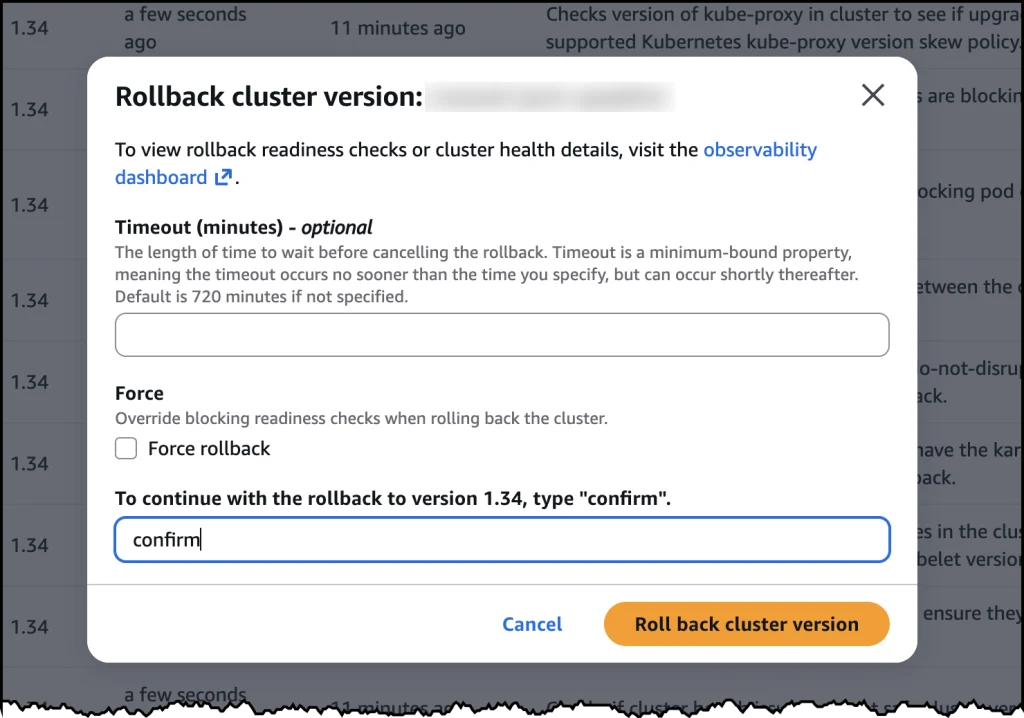
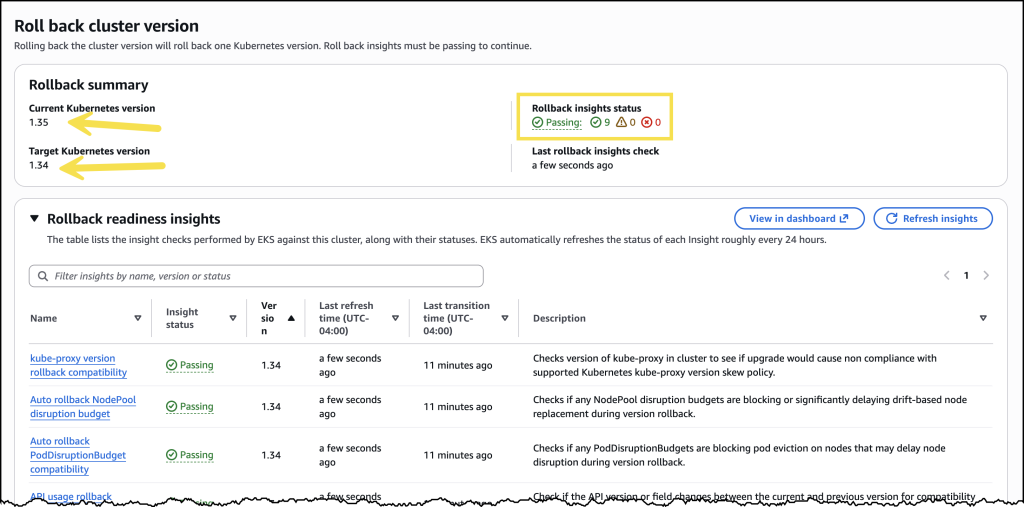
Before executing a command, Amazon EKS automatically evaluates the cluster’s rollback readiness through built-in cluster insights. This telemetry flags potential blockers—such as node version compatibility mismatches or outdated add-on dependencies—before they cause deployment failures.
- Safety First: By default, EKS respects these insights and guards against unsafe transitions.
- Emergency Bypass: For seasoned administrators who have already manually vetted their dependencies and require rapid action, a
--forceflag is available to bypass pre-flight checks.
EKS Auto Mode and Pod Disruption Budgets
For organizations utilizing EKS Auto Mode—which automates compute, networking, and storage provisioning for single-click, production-ready clusters—the rollback mechanism must orchestrate both the control plane and managed worker nodes simultaneously.
Because node rollbacks directly impact running workloads, AWS engineered the system to strictly respect Pod Disruption Budgets (PDBs). This ensures that scaling down or replacing nodes during a rollback does not inadvertently violate application availability requirements.
However, strict adherence to PDBs can sometimes lengthen the duration of a rollback. To address this, AWS introduced a dedicated Cancel API. If an administrator observes that a node rollback is proceeding slowly due to conservative PDB constraints, they can invoke the Cancel API, modify or temporarily loosen their disruption budgets to accelerate the process, and resume control over the migration path.
Official Responses and Industry Implications
The release of EKS version rollbacks has drawn significant attention from DevOps professionals, cloud architects, and enterprise IT leaders who have long struggled with the friction of Kubernetes lifecycle management.
Industry analysts note that this feature directly addresses the primary psychological barrier to keeping cloud infrastructure up to date. By eliminating the catastrophic risk profile of a failed control plane upgrade, AWS is expected to drive higher compliance rates across enterprise fleets. Organizations that previously delayed upgrades out of fear can now adopt a more agile, continuous update strategy.
Furthermore, because the feature is included at no additional cost—users pay only for standard EKS control plane fees and underlying compute resources—it democratizes enterprise-grade safety nets. Smaller development teams that lack the engineering bandwidth to build custom automated rollback scripts can now rely entirely on native AWS tooling.
Implications for Enterprise Operations
The introduction of Amazon EKS version rollbacks carries wide-ranging implications for security posture, operational overhead, and developer velocity.
1. Enhanced Security Posture
Because upgrades are no longer viewed as perilous, high-risk endeavors, security teams can push patches and minor version upgrades with greater frequency. Organizations can reduce their exposure window to known Common Vulnerabilities and Exposures (CVEs) without fearing that an unexpected regression will knock production systems offline permanently.
2. Reduction of Toil and Custom Tooling
Many sophisticated engineering organizations spent thousands of engineering hours building custom controllers, blue-green cluster topologies, and complex snapshot-and-restore workflows simply to simulate upgrade rollbacks. Native EKS version rollbacks render much of this bespoke glue code obsolete, allowing platform engineering teams to redirect their talent toward high-value application development rather than infrastructure plumbing.
3. Streamlined Compliance Audits
In regulated sectors, proving change-management safety and disaster recovery preparedness is a strict regulatory requirement. Having a native, fully supported mechanism to reverse a production Kubernetes upgrade within a validated seven-day window provides a clean audit trail and lowers compliance friction.
Getting Started
Kubernetes version rollbacks for Amazon EKS are generally available today across all commercial AWS regions. The feature supports all clusters running Kubernetes versions currently covered under EKS standard support and extended support.
To begin utilizing the feature:
- Navigate to the Amazon EKS console.
- Select a cluster that has undergone a version upgrade within the past seven days.
- Review the Cluster Insights tab to verify rollback readiness and check for node or add-on dependencies.
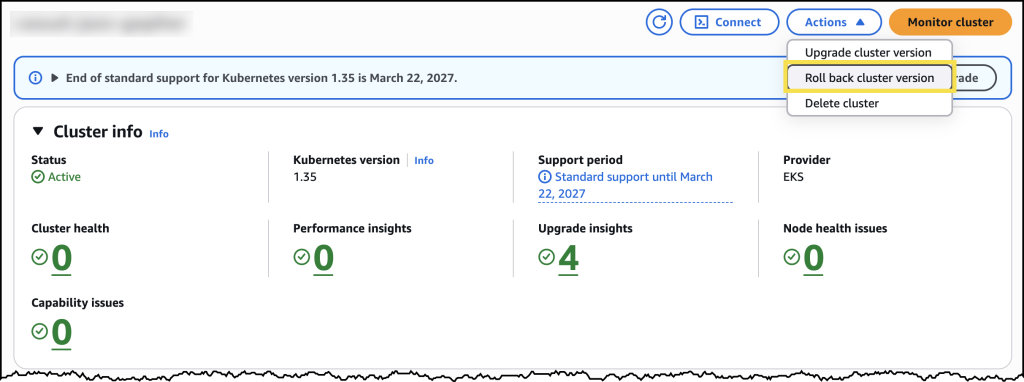
- Initiate the rollback process with a single click, observing real-time progress as the control plane—and, if applicable, EKS Auto Mode worker nodes—reverts gracefully to its previous operational version.
For deep-dive documentation, architectural best practices, and API specifications, administrators can consult the official Amazon EKS User Guide.