Scaling Next.js Beyond the Monolith: The Case for Modular Architecture and the Introduction of next-modular
Every Next.js project begins with a sense of immaculate order. Developers are greeted by a pristine folder tree, a handful of clean routes, and an architecture that is intuitive, maintainable, and frictionless. A developer can spin up a new page, write a server action, and wire up a component in seconds.
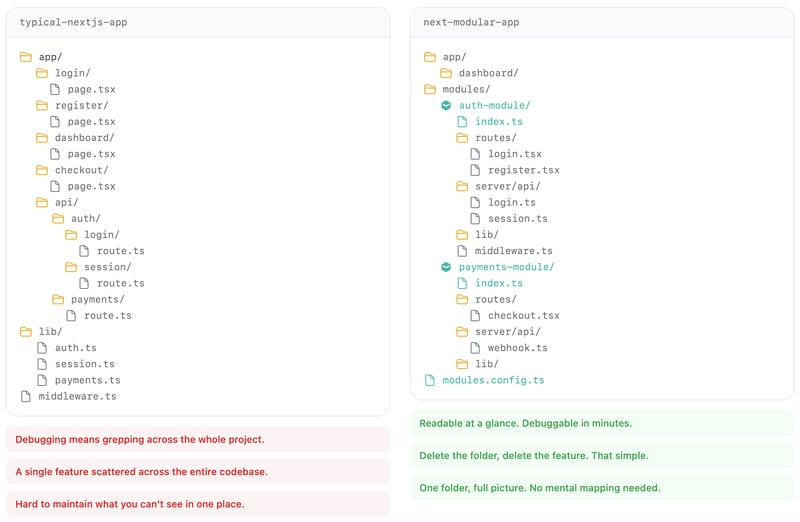
Then reality sets in. The startup grows, enterprise contracts demand new features, engineering teams expand, and the codebase scales. A year into production, that once-serene directory structure transforms into a sprawling web of deeply nested folders, scattered utility files, tightly coupled components, and API routes that are notoriously difficult to trace.
For years, developers working within the Next.js ecosystem have faced a painful architectural bottleneck as their applications grew. While frameworks like NestJS and Nuxt have long embraced modular design patterns that isolate feature logic, Next.js developers were traditionally left to choose between two heavy-handed extremes when scaling: Multi-Zones or Microfrontends. Both introduce massive operational overhead, complex build pipelines, and frustrating developer experiences.
Enter next-modular, a new open-source package designed to bridge this architectural gap. By bringing true modular architecture directly to Next.js, it offers a middle ground that promises to tame enterprise-scale codebases without forcing teams to abandon a unified deployment pipeline.
The Chronology of an App: From Clean State to Codebase Fatigue
To understand why architectural tooling like next-modular is capturing the attention of the web development community, one must trace the typical lifecycle of a scaling Next.js application.
Phase 1: Inception and Initial Traction
- Months 0–6: The application is lean. It utilizes the native Next.js
app/router effectively. Components are grouped by type (components/,hooks/,utils/), and a small engineering team can easily hold the entire application mental model in their heads.
Phase 2: The Scaling Tipping Point
- Months 6–18: Product requirements multiply. The engineering team scales from three developers to fifteen. Features like authentication, billing, checkout, dashboards, and user management begin to bleed into one another. Shared folders become a dumping ground. Global state management turns into a tangled web of prop-drilling and context provider hell.
Phase 3: The Architectural Crisis
- Months 18+: Code reviews slow to a crawl. Onboarding new engineers takes weeks instead of days. Automated AI coding assistants—increasingly vital to modern engineering workflows—begin to hallucinate or fail because they lack localized, contextual boundaries, attempting to parse hundreds of loosely connected files just to modify a single user-facing feature.
Faced with this architectural decay, teams historically reached for Multi-Zones to split their applications by URL paths, or microfrontends to break them down into browser-stitched runtimes. However, these solutions often created more problems than they solved.

Supporting Data & Architectural Comparison: Multi-Zones vs. Microfrontends vs. Modular
When scaling challenges peak, development teams evaluate architectural patterns based on configuration complexity, code sharing, build efficiency, and developer ergonomics.
| Architectural Dimension | Multi-Zones | Microfrontends | Modular Architecture (next-modular) |
|---|---|---|---|
| Primary Unit of Division | URLs / Separate Next.js Apps | Independent Runtime Apps | Feature Folders (In-App) |
| Operational Overhead | High (Multiple independent builds & servers) | Extreme (Runtime stitching, shared React plumbing) | Low (Single unified Next.js build) |
| Cross-Feature State & Context | Difficult (Requires complex URL/storage routing) | Painful (Requires custom event buses or shared runtime hooks) | Seamless (Direct in-app imports and React context sharing) |
| Navigation Experience | Full-page browser redirects between zones | Full-page browser redirects or complex iframe/module loaders | Instant, fluid client-side SPA routing |
| AI & Developer Ergonomics | Poor (Requires parsing multiple distinct repositories/apps) | Very Poor (Disconnected codebases compound AI context loss) | High (Self-contained feature folders isolate context cleanly) |
Dissecting the Failings of Multi-Zones
Multi-Zones architecture splits an application by URL, effectively running several autonomous Next.js applications behind a reverse proxy or root-level proxy that rewrites paths to simulate a cohesive single-page experience.
While this solves organizational gridlock by allowing isolated apps to exist side-by-side, it introduces profound operational friction. Each zone must be configured, built, deployed, and maintained independently. Furthermore, it fails to solve the internal code mess: an authentication zone is still a monolithic application internally, meaning its features remain just as scattered as before. Sharing state or context across zones requires cumbersome workarounds, and transitions between zones result in disruptive full-page browser reloads.
The Microfrontend Burden
Microfrontends take distributed architecture a step further, decoupling the product into entirely separate applications that are stitched together directly in the browser at runtime.
While theoretically liberating for massive enterprises with completely siloed departments, the hidden costs are severe. Sharing state, logic, and context across microfrontends requires brittle event architectures. Teams must meticulously hand-wire shared dependencies like React, otherwise, multiple copies of core libraries ship to the browser, severely degrading performance. Navigation remains trapped in full-page refreshes, and the massive machinery required to orchestrate the runtime makes debugging an agonizing endeavor.
The Modular Paradigm: A Smarter Middle Ground
Rather than splitting applications across servers or runtime boundaries, modular architecture partitions the codebase inside a single application, organized strictly by feature.

In a modularized Next.js app, a module is a self-contained, isolated directory containing everything a specific feature requires: its pages, API routes, database hooks, UI components, and business logic. This module then plugs cleanly into the core application via a single configuration entry point.
// modules/checkout/src/index.ts
import  defineModule, route  from 'next-modular';
import * as cart from './routes/cart';
import  checkoutHandler  from './server/api/checkout';

export const checkoutModule = defineModule(
  name: 'checkout',
  basePath: '/checkout',
  routes: [route('/cart', cart)],
  apiRoutes: [ path: '/checkout', handler: checkoutHandler ],
);
The Benefits of In-App Modularity
- Frictionless Code Reuse: Because a feature lives entirely within a single folder, reuse becomes trivial. Developers can copy a module into another project or publish it as an internal or public package. An authentication module built for product A can be dropped into product B with a single install command and a single line of configuration—no route rewiring or file hunting required.
- Enhanced AI Tooling Compatibility: Modern AI coding assistants thrive on localized context. When a feature’s entire footprint—from frontend views to backend API handlers—is encapsulated in one directory, LLMs can accurately read, debug, and write code without hallucinating dependencies scattered across a sprawling repository.
- Unified Deployments: Unlike Multi-Zones or microfrontends, modular applications ship as a single cohesive unit. There are no extra servers to provision, no fragmented CI/CD pipelines to monitor, and no complex runtime orchestration dependencies.
The Single Trade-Off
Transparency requires acknowledging limitations. The primary trade-off of modular architecture is the forfeiture of independent deployments. Because everything compiles into a single Next.js application, different engineering teams cannot push isolated releases on entirely separate schedules. For 95% of products, a unified deployment is ideal; however, if organizational structures strictly dictate that independent teams must deploy disparate parts of the system autonomously, microfrontends remain the appropriate choice.
Official Insights: Bridging the Framework Gap with next-modular
Recognizing that Next.js lacks out-of-the-box support for modular feature encapsulation, developers have long been forced into suboptimal workarounds. The next-modular package was engineered to solve this exact limitation, bringing patterns native to frameworks like Nuxt directly into the Next.js ecosystem.
How next-modular Operates Under the Hood
The package provides an elegant abstraction layer that sits comfortably alongside the native Next.js app/ router. It utilizes a combination of catch-all routing mechanisms and middleware proxies to dynamically direct page requests and API calls to their respective module handlers.
// modules.config.ts
import  myModule  from './modules/my-module/src';

export const modules = [
  myModule( enableFeature: true ),
];
Developers can adopt the pattern incrementally. There is no need for a massive, high-risk rewrite. An engineering team can migrate one feature at a time into a module folder while the rest of the application continues to run normally on standard Next.js routing.
Furthermore, initialization and module scaffolding are streamlined via a straightforward CLI:

npx next-modular init        # Initializes the project for next-modular support
npx next-modular create --name my-module # Scaffolds a new isolated feature module
Future Implications: A Public Plug-and-Play Module Registry
The ambitions behind next-modular extend far beyond project organization. The creator’s long-term vision mirrors the successful ecosystem built by Nuxt: establishing a vibrant, public registry of plug-and-play Next.js modules.
Instead of rewriting standard features like authentication, payment gateways, comment sections, or blog engines for every new application, developers will eventually be able to pull community-vetted, fully modularized packages directly into their Next.js projects with minimal configuration.
Conclusion: Reclaiming Maintainability in Modern Web Development
As the web ecosystem matures, the pendulum is swinging away from over-engineered distributed systems back toward cohesive, manageable application architectures. Multi-Zones and microfrontends solved real enterprise scaling problems, but they inflicted severe operational taxes on teams that simply wanted to keep their feature code clean.
By embracing modular architecture through tooling like next-modular, Next.js developers can finally achieve the best of both worlds: the raw performance and developer velocity of a unified monolithic deployment, paired with the architectural cleanliness, scalability, and reusability of feature-driven modular design.
For teams wrestling with scaling fatigue, sprawling folder trees, and bloated codebases, modularity offers a welcome path forward—proving that you don’t need to break your app apart to scale it up.