Beyond the Game Engine: How Therapeutic VR is Redefining Software Performance, Immersion, and Clinical Patient Comfort
By Sarah Lin
Technology & Healthcare Correspondent
In the rapidly evolving landscape of digital therapeutics, virtual reality (VR) has emerged as a transformative medium for behavioral health interventions. Yet, behind the promise of immersive therapy lies a demanding engineering reality. When developers transition from building video games to constructing clinical environments, the margin for technical error shrinks from a minor annoyance to a clinical barrier.
A recent engineering post-mortem from a development team building a virtual reality environment for de-addiction therapy reveals a profound paradigm shift in how digital spaces are engineered. The core finding is as simple as it is challenging: in clinical VR, the human user—often an individual navigating vulnerability, stress, or trauma—takes absolute precedence over graphical fidelity and technical complexity.
This article explores the technical trials, empirical discoveries, and human-centric design philosophies that emerged from building a therapeutic VR platform, examining how developers had to unlearn traditional game development habits to meet the rigorous demands of mental healthcare.
Main Facts: The Clinical VR Paradigm
The project at the center of these findings is designed for cue exposure therapy. In this therapeutic model, a patient enters a virtual environment that mirrors a familiar, high-risk setting—such as a place they might normally consume alcohol—while experiencing associated triggers under the direct supervision of a clinician. The objective is to practice refusal and coping mechanisms in a controlled, safe space.
On paper, the workflow mirrors high-end architectural visualization or game development. In practice, the stakes are fundamentally different.
- The User Context: Unlike gamers, who willingly tolerate high frame rates, complex control schemes, and occasional visual stutter, a patient in a therapeutic session is engaging in vulnerable clinical work. They are often first-time VR users.
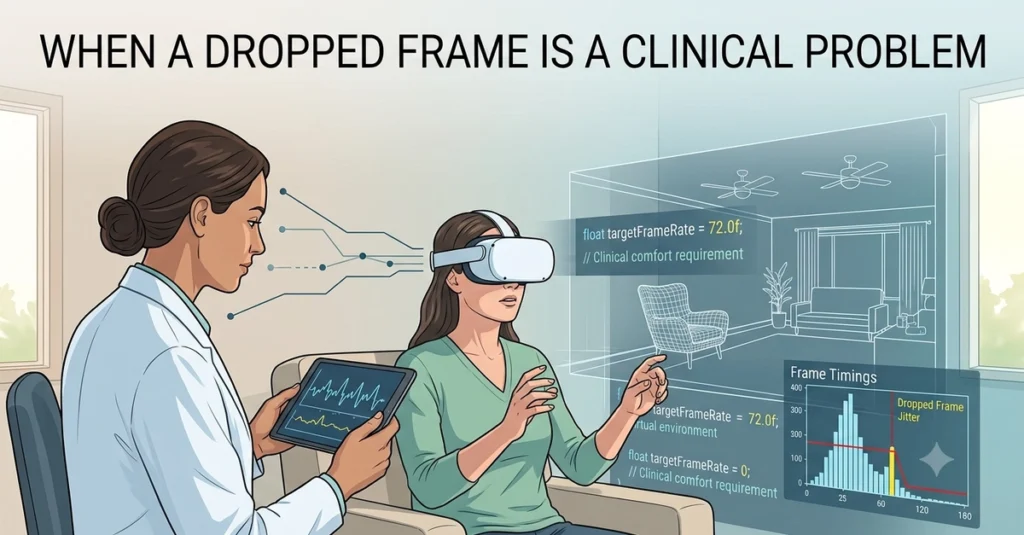
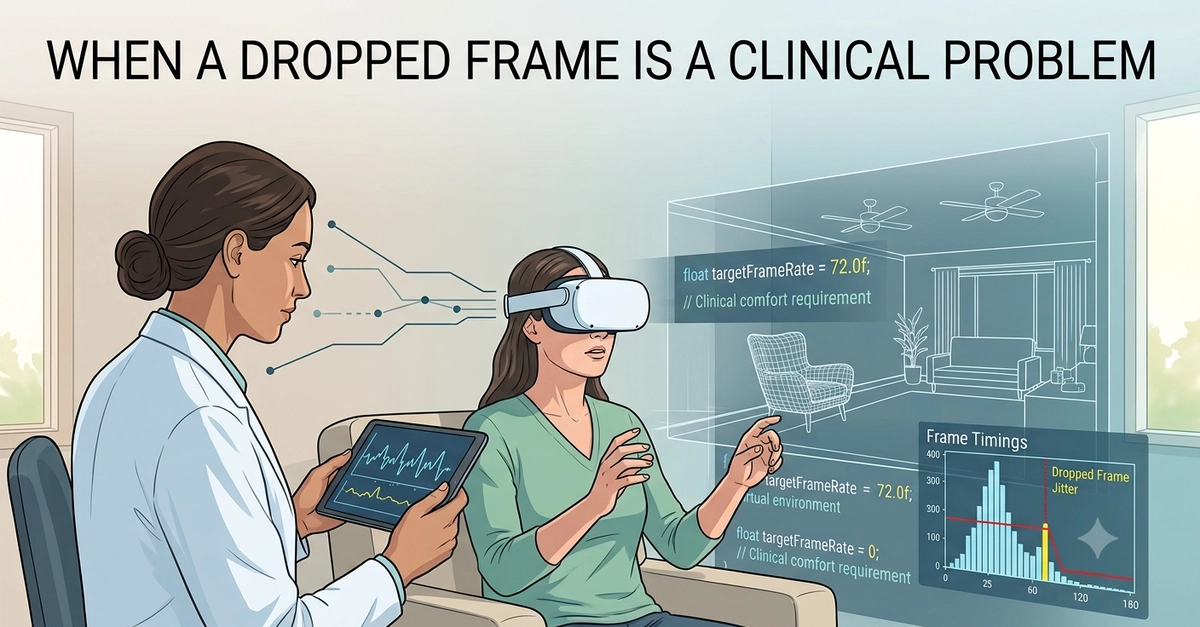
- The Physics of Sickness: A dropped frame that a gamer might barely notice can induce rapid vestibular disorientation and severe nausea in a clinical patient.
- The Tolerance Threshold: A single technical glitch—such as an unnaturally rotating fan, a floating light fixture, or a sudden stutter—can instantly break the psychological immersion, rendering the therapeutic exercise ineffective or uncomfortable.
Consequently, the engineering team evaluated every single technical and aesthetic decision through a singular, uncompromising lens: Does this make the experience better and safer for the person wearing the headset?
Chronology: The Evolution of a Therapeutic Pipeline
The development process was not a linear path of adding features, but rather a continuous sequence of trial, error, and radical technical revision.
Phase 1: Procedural Generation and Structural Logic
Initially, the team built environments manually, using standard 3D editors to place buildings, foliage, and lighting fixtures. However, because clinical feedback necessitated constant iteration, manual placement quickly became an unsustainable bottleneck.
To solve this, the developers shifted to a code-generated architecture. Under this new system, the entire environment—from foundation to roof trusses—was defined programmatically. For example, ceiling fans were no longer placed by hand; instead, their coordinates were tied directly to the structural math of the roof trusses. If the roof dimensions shifted, the fans adjusted automatically.
This programmatic approach also preserved the rationale behind design choices. When the team decided to make ceiling fans rotate slower than real-world counterparts to prevent user discomfort, that decision was embedded directly into the codebase. Six months later, incoming developers did not have to guess at arbitrary design choices; the system documented its own clinical reasoning.
Phase 2: Mitigating Motion Sickness and Spatial Discomfort
Motion sickness in VR occurs when visual stimuli indicate movement while the inner ear registers absolute stillness. Early testing revealed that traditional smooth-turning mechanics—where the virtual world continuously rotates around the user—frequently induced dizziness among novices.
The team implemented snap turning as a comfortable alternative, shifting the field of view in fixed, instantaneous steps rather than continuous sweeps. Crucially, rather than locking the application into a single mode, they built flexibility into the system, granting the supervising clinician real-time control over movement settings based on the patient’s individual tolerance.
A similar challenge arose with outdoor terrain. A completely flat yard felt artificial, resembling a low-budget video game level. However, introducing natural, rolling terrain caused the camera to bob up and down when walking—another trigger for vestibular discomfort. The engineering team resolved this by blending realism with clinical safety: the primary walking paths from the gate to the building were mathematically leveled to zero variation, while natural uneven terrain was relegated safely to the periphery of the environment.
Phase 3: Asset Optimization and the Reality of Standalone Hardware
One of the most surprising hurdles involved integrating third-party 3D assets into a standalone VR headset. A high-fidelity asset optimized for a powerful desktop computer can completely overwhelm a mobile VR processor.
In one notable test, a single downloaded strand of ivy contained an astonishing 766,823 triangles. Automated simplification scripts failed drastically: reducing the overall polygon count of a bush stripped away the foliage before the underlying structure, leaving the environment populated by barren, skeletal branches that looked worse than the original high-cost asset.
Faced with these hardware limitations, the developers abandoned heavy geometry entirely for complex flora. Instead, they rendered the ivy plants from multiple angles as flat, transparent images and mapped them onto simple planes. This visual trick reduced geometry costs to near zero while preserving a convincing illusion of depth from the user’s perspective.
Supporting Data & Technical Insights
The team’s empirical tracking of performance metrics uncovered several counter-intuitive truths about rendering optimization in standalone VR.
| Optimization Metric | Initial Assumption | Empirical Reality |
|---|---|---|
| Object Count vs. Polygon Count | Fewer objects always mean better performance. | Three large bushes performed better than nine small ones; draw calls and object separation heavily impact performance. |
| Asset Simplification | Automated polygon reduction is universally effective. | Blanket optimization budgets ruin organic assets; targeted, component-specific optimization is mandatory. |
| Lighting Overheads | Adding exterior lamps has a linear, predictable performance cost. | Reusing interior lighting helper scripts inadvertently doubled render costs, turning 5 new lamps into 10 heavy lights. |
| Thermal Performance | Frame rates remain stable across long testing sessions. | Prolonged device use (approx. 2 hours) causes thermal throttling, degrading frame rates independently of scene complexity. |
The 13.9-Millisecond Boundary
Standalone VR headsets demand strict adherence to frame-timing budgets—typically requiring a stable render time of 13.9 milliseconds per frame to prevent visual judder. By recording continuous frame telemetry, the team caught hidden performance leaks, such as legacy lighting helpers that forced maximum rendering costs onto exterior fixtures. Furthermore, they discovered that thermal degradation over extended sessions could artificially skew performance tests, proving that hardware conditions must be tightly controlled during quality assurance.
Implications: Principles for the Future of Clinical VR
The lessons learned during this de-addiction therapy project extend far beyond a single software build. They offer a foundational framework for developers entering the burgeoning field of medical and therapeutic extended reality (XR).
- User-Centric Empathy: Designers must recognize that the end-user is a patient, not a consumer. Anxiety, vulnerability, and medical conditions dictate that comfort must be the default operational state.
- Systematic Over Manual: Code-driven, programmatic environments allow for rapid iteration and maintain historical context, ensuring clinical teams can adapt simulations safely without breaking structural logic.
- Empirical Measurement Over Intuition: Developers cannot rely on visual intuition alone. Everything—from texture repetition scales (preventing brick textures from appearing the size of suitcases) to surface normals on corrugated metal—must be measured against real-world physics.
- Hardware Awareness: Testing must account for the physical realities of standalone hardware, including thermal throttling and strict frame-timing budgets.
Conclusion
The development of therapeutic virtual reality bridges two worlds that have historically operated under very different philosophies: the high-performance, escapist ethos of gaming and the rigorous, patient-first ethics of healthcare.
As this project demonstrates, when technology enters the clinical space, the metrics of success change entirely. The ultimate goal of a therapeutic VR environment is not to dazzle the user with hyper-realistic polygon counts or cinematic camera sweeps. Rather, it is to build an invisible, reliable digital bridge—one where the technology fades entirely into the background, leaving the patient free to focus on the singular, courageous work of healing.