TensorFlow Lite Unlocks Quadrupled CPU Inference Performance with New XNNPack Dynamic Range Quantization
By Alan Kelly, Software Engineer | Published by the TensorFlow Team
Main Facts: A New Milestone in On-Device Machine Learning
In a major leap forward for edge AI and on-device machine learning, the TensorFlow team has announced that XNNPack—the core CPU backend for TensorFlow Lite (TFLite)—now natively supports dynamic range quantization for its Fully Connected and Convolution 2D operators. Because central processing units (CPUs) deliver the widest reach for machine learning inference across the global hardware ecosystem, they remain the default and most critical target for TensorFlow Lite deployments.
By integrating dynamic range quantization into XNNPack, developers have achieved a remarkable quadruplication (4x) in inference performance compared to traditional single-precision (fp32) baselines. This technical breakthrough bridges a historic gap in edge computing: it allows sophisticated, AI-powered features—including resource-heavy architectures like Stable Diffusion and large language models—to run smoothly on older, lower-tier, and resource-constrained mobile devices without requiring specialized hardware accelerators like NPUs or dedicated GPUs.
The update, spearheaded by software engineers Alan Kelly, Frank Barchard, and Quentin Khan, is rolling out natively starting with TensorFlow 2.17. It has already begun powering core Google consumer features, including Gemini integrations, Google Meet enhancements, and Chrome OS real-time audio denoising.

Chronology: The Evolution of TensorFlow Lite Quantization
To understand the significance of this latest development, it is helpful to trace the chronological evolution of quantization strategies within the TensorFlow and TFLite ecosystems over recent years:
- The Single-Precision Era (fp32): Historically, machine learning models were trained and deployed using 32-bit floating-point precision. While offering maximum mathematical accuracy, fp32 models imposed massive memory footprints and heavy compute burdens, limiting complex AI execution largely to cloud servers or high-end flagship smartphones.
- The Introduction of Full Integer and Half-Precision (fp16) Formats: To combat hardware limitations, TFLite introduced full integer quantization (converting weights and activations to signed 8-bit integers) and half-precision floating-point (fp16) inference. While full integer models drastically reduced model size, they proved notoriously difficult to implement, requiring meticulous calibration via a representative dataset. Meanwhile, fp16 inference accelerated vectorized math on hardware with native half-precision support, though accuracy degradation remained a risk for sensitive models.
- November 2023: The TensorFlow team published landmark benchmarks demonstrating that half-precision inference could double on-device CPU inference performance on modern mobile architectures, establishing a strong foundation for mixed-precision deployment.
- Early 2024: Advanced on-device applications—such as large language models via MediaPipe and TFLite—highlighted an urgent need for efficient CPU execution paths that did not sacrifice developer velocity or model accuracy.
- Mid-2024 (Current Release): XNNPack Fully Connected and Convolution 2D operators receive full dynamic range quantization support. Combined with prebuilt binary integration in TensorFlow 2.17 and nightly builds, this update removes the barrier of representative datasets for quantized speedups, unlocking game-changing performance on standard consumer CPUs like the Armv9 Tensor G3 and Snapdragon 8 Gen 2.
Supporting Data: Benchmarks and Technical Deep Dives
The performance claims of the new XNNPack backend are backed by rigorous benchmark testing across various public computer vision and generative models.
Understanding Dynamic Range Quantization vs. Full Integer Quantization
In a dynamically quantized model, weights for Fully Connected and Convolution layers are compressed to 8-bit integers during the model conversion phase. However, unlike fully-quantized models where all tensors are locked into 8-bit integers, all other tensors remain in float32 format.
During runtime inference, floating-point layer activations are dynamically converted to 8-bit integers just before hitting the Fully Connected and Convolution operators. The quantization parameters—specifically the zero point and scale—are calculated on-the-fly for every single row of the activation tensor based on observed ranges. This dynamic calculation ensures that activations make full use of all 8 available bits, maximizing mathematical accuracy. Crucially, the output of these operators is emitted in 32-bit floating-point format, avoiding the quantization artifacts frequently introduced by rigid, statically calibrated fully-quantized models.

Architecture Optimization Across the Ecosystem
These dynamically quantized models bypass native TFLite fallback operators, routing instead through XNNPack’s highly optimized, architecture-specific assembly kernels. These optimized paths cover:
- ARM and ARM64 (including modern Armv9 cores found in the Pixel 8’s Tensor G3 and OnePlus 11’s Snapdragon 8 Gen 2)
- x86 platforms utilizing SSE, AVX, and AVX-512 instruction sets
- WebAssembly (Wasm) for web-based machine learning pipelines
Benchmark Insights: Outperforming Expectations
When comparing models converted via full float, full 8-bit integer quantization, and dynamic range quantization, unexpected performance dynamics emerged. Conventional wisdom suggests that full integer quantization should always outperform dynamic range quantization because all downstream calculations use fast integer arithmetic, avoiding the runtime overhead of converting float activations to 8-bit integers.
However, profiling via the TFLite Profiler revealed a surprising counter-narrative. In several tested computer vision and generative models, dynamic range quantization matched or even exceeded the speed of full integer quantization. This occurred because fully quantized models often suffered from "quantization artifacts"—sub-optimal performance paths triggered when the ratio of input and output scales fell outside narrow efficiency ranges due to an imperfect representative dataset.
Most notably, Stable Diffusion’s diffusion model—which could not even be converted to full integer quantization due to unsupported operators—successfully underwent dynamic range quantization, achieving up to a 6.2x speedup over the original float32 model.

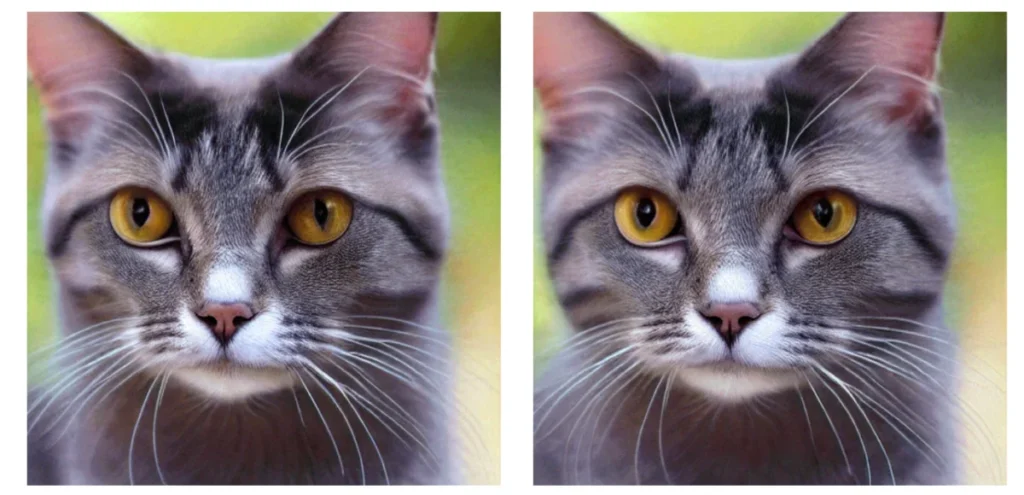
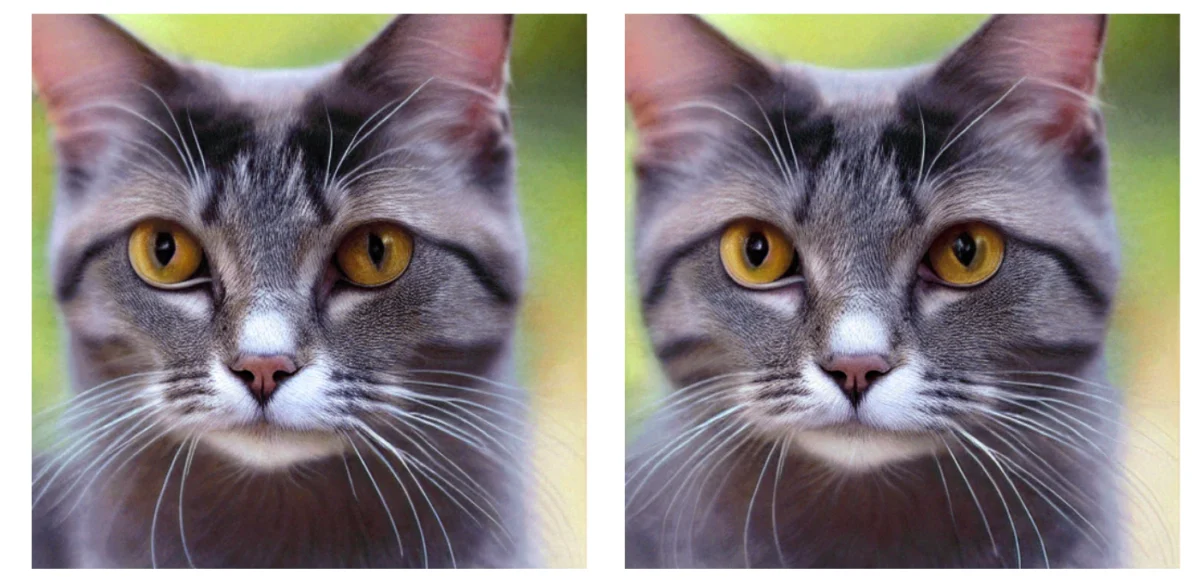
Furthermore, visual comparisons of generated images from the Stable Diffusion model using fp32 activations versus fp16 activations (seeded with identical random number generators) revealed zero perceptible degradation. The resulting feline portraits were completely indistinguishable, confirming that compute-intensive floating-point operations can safely leverage mixed-precision execution without sacrificing output quality.
Official Responses and Developer Integration
The TensorFlow engineering team emphasizes that accessibility was a primary design goal for this update.
"Full integer quantization is hard; converting models is difficult, error-prone, and accuracy is not guaranteed. The representative dataset must be truly representative to minimize quantization errors," noted software engineer Alan Kelly. "Dynamic range quantization offers an ideal compromise: the models are of similar size to fully-quantized models, and performance gains often match or exceed them without requiring a representative dataset."
How to Implement Dynamic Range Quantization
Integrating this feature into existing workflows requires minimal friction. Developers do not need to retrain existing models; they simply enable the optimization flag during model conversion:

import tensorflow as tf

converter = tf.lite.TFLiteConverter.from_saved_model(saved_model_dir)
# Enable dynamic range quantization
converter.optimizations = [tf.lite.Optimize.DEFAULT]
tflite_model = converter.convert()

with open('model_dynamically_quantized.tflite', 'f') as f:
    f.write(tflite_model)
Unlike full integer quantization, this process does not require a representative calibration dataset, making advanced model optimization accessible to non-expert developers and hobbyists alike. Starting with TensorFlow 2.17, dynamically quantized XNNPack inference is enabled by default in all prebuilt binaries.
Implications for the Future of Edge AI
The democratization of high-performance CPU inference has profound implications for the software development and mobile hardware industries:
- Extended Device Lifespans: By quadrupling CPU inference speeds, developers can deploy sophisticated features—such as real-time audio filtering, on-device translation, and generative AI features—to older smartphone generations (such as devices dating back to the Google Pixel 3 era and beyond) that lack dedicated neural processing hardware.
- Reduced Cloud Dependency: Processing complex workloads like Stable Diffusion locally on mobile and edge CPUs reduces cloud infrastructure costs for service providers while simultaneously enhancing user privacy and decreasing latency.
- Cross-Platform Uniformity: Because XNNPack supports everything from high-end ARM mobile chips to web browsers via WebAssembly, developers writing once in TensorFlow Lite can reliably scale high-speed AI inference across diverse user hardware footprints.
As this technology continues to roll out across Google’s broader product ecosystem and open-source channels, it establishes a new standard for efficiency, accessibility, and performance in edge machine learning.