Securing the Agentic Frontier: GitGuardian and Docker Partner to Bring Automated Secret Protection to AI Coding Workflows
SAN FRANCISCO & SEATTLE — As autonomous coding agents rapidly transition from experimental novelties to core pillars of everyday software development, the security landscape surrounding developer environments is undergoing a tectonic shift. To address the mounting threat of credential exposure in the age of generative AI, cybersecurity firm GitGuardian has announced a strategic partnership with Docker.
The centerpiece of this collaboration is the release of the GitGuardian Docker Sandbox Mixin Kit on Docker Hub. This integration automatically embeds GitGuardian’s industry-standard scanning tool, ggshield, and its specialized AI hooks directly into Docker’s isolated microVM-based sandboxes. By fusing environment-level boundaries with real-time, credential-aware threat detection, the partnership aims to provide a "paved path" that marries developer velocity with robust enterprise security.
Main Facts: The Intersection of AI Autonomy and Credential Security
Modern software development is experiencing an unprecedented evolution driven by AI assistants such as Claude Code, Cursor, Codex, and GitHub Copilot. These tools—frequently leveraged by both seasoned engineers and a rapidly expanding demographic of "citizen developers"—can execute complex, multi-step workflows, write code, run terminal commands, and interact with external APIs.
However, true autonomy requires access. To function effectively, an AI coding assistant must be able to read project files, inspect logs, and parse configurations. This operational necessity has drastically widened the software supply chain attack surface.

- The Core Partnership: GitGuardian has published an official Docker Sandbox Mixin Kit. This kit provisions
ggshieldand configures AI hooks out-of-the-box inside Docker Sandboxes. - Dual-Layer Defense: The solution tackles security from two distinct angles: environment isolation (provided by Docker Sandboxes via microVMs) and runtime credential inspection (provided by GitGuardian’s deterministic AI hooks).
- Targeted Threat Vectors: The integration focuses on protecting endpoints where developers frequently and inadvertently expose high-risk secrets—such as configuration files, local shell histories, Model Context Protocol (MCP) configurations, and AI agent caches.
Chronology: The Evolution of Developer Endpoint Risks
The journey toward securing agentic development environments has accelerated rapidly alongside the adoption of generative AI tools.
- Late 2023 – 2024: Generative AI coding assistants explode in popularity. Developers enthusiastically adopt tools like GitHub Copilot and Cursor, integrating them deeply into their local development workflows.
- Early Access Program Findings: As AI agents gain deeper local integrations, security researchers begin analyzing the vulnerability profile of developer machines. GitGuardian’s early access program reveals an alarming statistic: an average of roughly 150 secrets exist per developer endpoint, with high- and critical-risk credentials frequently leaking into local development directories.
- The Rise of Agentic Frameworks: Tools evolve from simple autocomplete extensions to autonomous agents capable of reading, writing, and executing shell scripts independently. Concurrently, researchers discover that roughly 40% of critical secrets discovered on developer endpoints appear inside AI tool directories and log files.
- Docker Introduces Sandboxes: Recognizing the systemic risks of running autonomous workloads on dense, credential-laden host laptops, Docker develops Sandboxes utilizing lightweight microVM technology to isolate agent execution.
- Present Day: GitGuardian and Docker formalize their partnership, releasing the Sandbox Mixin Kit to automate the deployment of security guardrails within isolated developer environments.
Supporting Data: The Hidden Dangers on Developer Endpoints
To fully grasp the significance of the GitGuardian-Docker partnership, one must examine the empirical data regarding local developer hygiene and AI tool behavior.
The Dense Credential Store Problem
Historically, enterprise security teams focused heavily on perimeter defense, CI/CD pipeline scanning, and public code repositories (like GitHub). However, the developer’s local workstation has increasingly become a massive, unmanaged shadow repository of secrets.
According to GitGuardian’s comprehensive research across developer endpoints:

- 150 Secrets per Endpoint: On average, a single developer laptop contains approximately 150 unique secrets (API keys, SSH keys, database credentials, cloud CLI profiles).
- The AI Proximity Risk: Approximately 40% of high and critical severity secrets discovered during endpoint scans were located within AI tool directories, chat histories, temporary workspace caches, and local log files.
When an autonomous AI agent is granted unrestricted access to a local machine, these files fall squarely within its reachable attack surface. If an agent inadvertently parses a file containing a cloud provider master key or a database credential during a debugging session, that sensitive data can be processed by the underlying language model or exposed via third-party telemetry.
Official Responses and Strategic Perspectives
Industry leaders from both organizations emphasize that security cannot rely solely on developer vigilance—it must be engineered directly into the tools developers prefer to use.
"GitGuardian is focused on securing the credential layer. We help teams discover what credentials exist, remediate the ones that pose risk, and prevent secrets from continually sprawling across the enterprise," representatives from GitGuardian noted regarding the launch. "That work, and the secrets layer itself, now includes the rapidly growing world of agentic development."
Security architects point out that asking developers to manually configure isolation parameters and secret scanners creates too much friction. Friction inevitably leads to shadow IT and bypassed controls.

By utilizing Docker’s concept of "Kits"—and specifically mixin kits—the partnership turns security compliance into a seamless, automated default. Instead of forcing developers to choose between speed and safety, the integrated stack delivers a secure environment that arrives fully equipped with the necessary diagnostic and protective tooling.
Implications for Enterprise Security and Development Teams
The integration of GitGuardian’s ggshield into Docker Sandboxes carries profound implications for how organizations approach compliance, software engineering productivity, and threat mitigation in the AI era.
1. Eliminating Friction Through "Paved Paths"
Platform engineering principles dictate that the most secure path should also be the easiest path. When security controls require manual configuration—such as reinstalling packages, updating proxy configurations, or manually executing secret scans—developers will often bypass them to meet aggressive deadlines.
The Docker Sandbox Mixin Kit acts as a paved path. When a developer spins up a sandbox environment, the security instrumentation is already present. The developer can let the coding assistant install dependencies, build applications, and run tests inside an isolated microVM without worrying about manual security setup.

2. Deterministic Checkpoints in Non-Deterministic Workflows
Large Language Models (LLMs) and autonomous agents are inherently non-deterministic; they can generate unexpected outputs or take unanticipated paths to solve a programming problem. GitGuardian introduces deterministic security checkpoints into this fluid environment through three distinct AI hooks:
- Prompt-Submission Hook: Before a prompt is transmitted to the AI model,
ggshieldscans it for secrets. If a developer attempts to paste a sensitive configuration file, credential, or debug log containing API tokens into the chat interface to solve an error, the hook blocks the prompt, displaying an alert so the secret can be scrubbed. - Pre-Tool-Use Hook: This hook intercepts actions chosen autonomously by the agent—such as file reads, shell command executions, or Model Context Protocol (MCP) requests. If an action threatens to expose or process a credential, the hook blocks execution.
- Post-Tool-Use Hook: Operating on the output side of tool interactions, this hook scans data returned from executions. If sensitive material appears in the tool output, GitGuardian triggers an immediate desktop notification, alerting the developer that credentials have entered the agent’s active memory stream.
3. Architecture of Isolation: MicroVMs and Host-Side Proxies
Docker Sandboxes solve the infrastructure side of the equation by executing coding agents inside isolated microVMs. This ensures that even if an agent behaves maliciously or is compromised, it lacks unrestricted access to the underlying host machine.
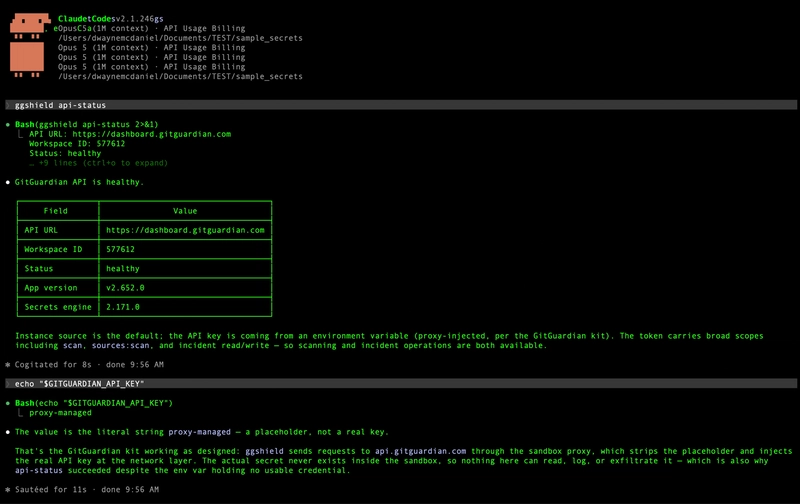
Furthermore, sensitive credentials can be maintained safely outside the microVM entirely. Using Docker’s host-side proxy architecture, credentials are injected only when an approved, verified request requires them. Coupled with GitGuardian’s API token management (via simple commands like sbx secret set gitguardian), the overall architecture drastically shrinks the blast radius of any potential security incident.
Getting Started and Future Outlook
For development teams and platform engineers looking to secure their AI workflows, adopting the integration is designed to be straightforward. By pulling the GitGuardian Mixin Kit from Docker Hub and configuring the environment variables, teams can instantly provision isolated sandboxes equipped with real-time secret detection.

Crucially, organizations that have not yet standardized on Docker Sandboxes are not left behind. GitGuardian’s ggshield AI hooks can be installed directly into native hook systems across popular environments including Cursor, Claude Code, Codex, and VS Code with GitHub Copilot.
As software development continues its rapid transition toward agentic automation, the partnership between GitGuardian and Docker establishes a vital blueprint: secure the environment, protect the credentials, and bake the guardrails directly into the developer’s daily workflow.