A New Foundation: Rust Compiler Approaches Historic Milestone with Next-Gen Trait Solver
After four years of intensive, behind-the-scenes development, the Rust programming language is on the cusp of its most significant architectural evolution since its initial release. The Rust compiler team has officially announced that the "next-generation trait solver" is now enabled by default in the nightly release channel. This milestone marks the beginning of the end for the compiler’s aging trait resolution logic, a fundamental component that dictates how the language handles types, traits, and complex generic constraints.
The transition to this new system represents more than just a refactor; it is a complete overhaul of the logic that powers Rust’s sophisticated type system. By replacing the mechanism used to prove where-clauses and normalize associated types, the compiler team is setting the stage for future language features that were previously deemed impossible to implement.
The Core Transformation: Replacing the Engine
At the heart of the Rust compiler lies the "trait solver." Whenever a developer defines a trait or uses generics, the compiler must "prove" that the types involved satisfy the necessary constraints. The existing solver, which has served the language since its inception, has become a bottleneck for modern requirements.
The next-generation trait solver is designed to be more robust, consistent, and extensible. It is the largest single structural change to the Rust compiler to date. By completely rewriting how the compiler interprets where-clauses and associated types, the team is effectively swapping out the "engine" of the language while the car is moving.
This change is not merely theoretical. It has already addressed over 200 known issues tracked on GitHub. These fixes range from obscure edge cases in type inference to significant bugs that have frustrated library authors for years. For the average user, this means that the compiler will finally "understand" certain complex generic patterns that previously resulted in cryptic error messages or erroneous failures.
Chronology: Four Years in the Making
The journey to this point has been a marathon of engineering discipline. The project, which officially began nearly four years ago, was born out of the realization that the old solver had reached its limits. The complexity of Rust’s type system—specifically the intersection of higher-ranked trait bounds, associated types, and opaque types—had created a "technical debt" that was becoming increasingly difficult to service.
- Initial Conception: The early phases focused on designing a system that could handle the recursive nature of Rust’s trait bounds more gracefully than the existing implementation.
- Proof of Concept: The team moved toward a "chalk-based" approach, experimenting with logic programming techniques to solve constraints. While the implementation evolved, the core goal remained: to create a solver that was sound, performant, and maintainable.
- The "Performance Sprint": Over the last year, and particularly in the final months leading up to this nightly release, the team shifted its focus toward performance parity. Because the new solver handles more complex logic, early iterations suffered from exponential compile-time regression. A dedicated team of contributors, including Nick Nethercote, Jana, Rémy Rakic, and Mira, spent thousands of hours optimizing the solver’s execution paths.
- Nightly Integration: With the recent move to enable the solver by default in the nightly channel, the project has entered its final validation phase. The goal is to catch regressions through community testing before moving toward full stabilization in the coming months.
Supporting Data: Performance and Reliability
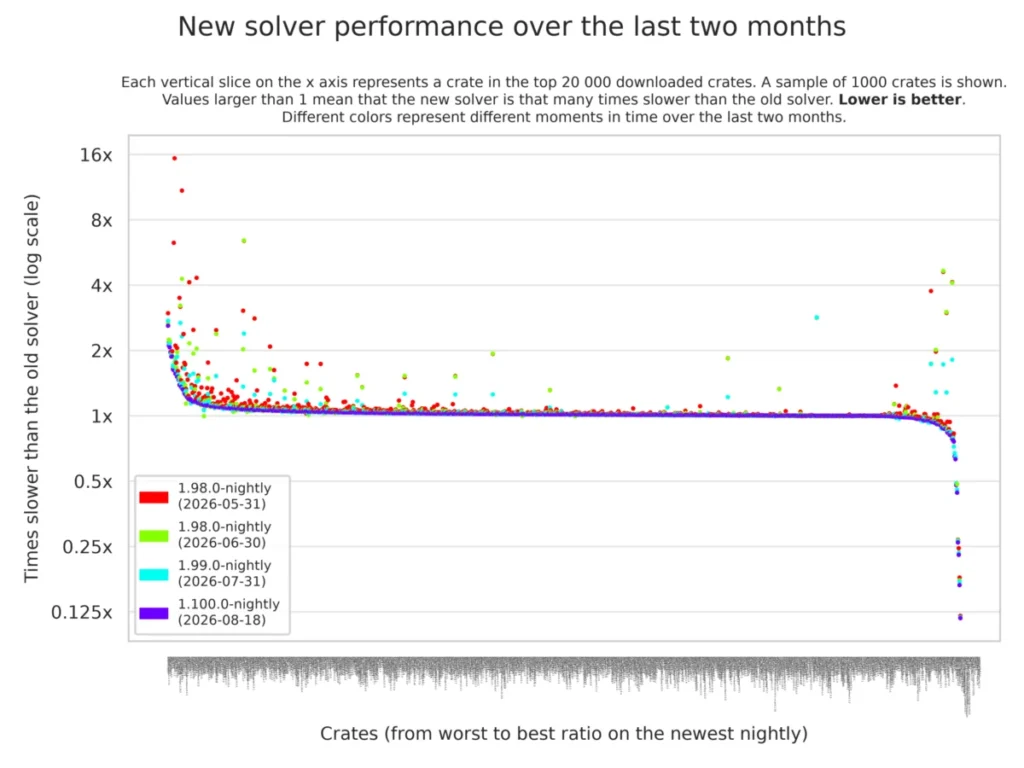
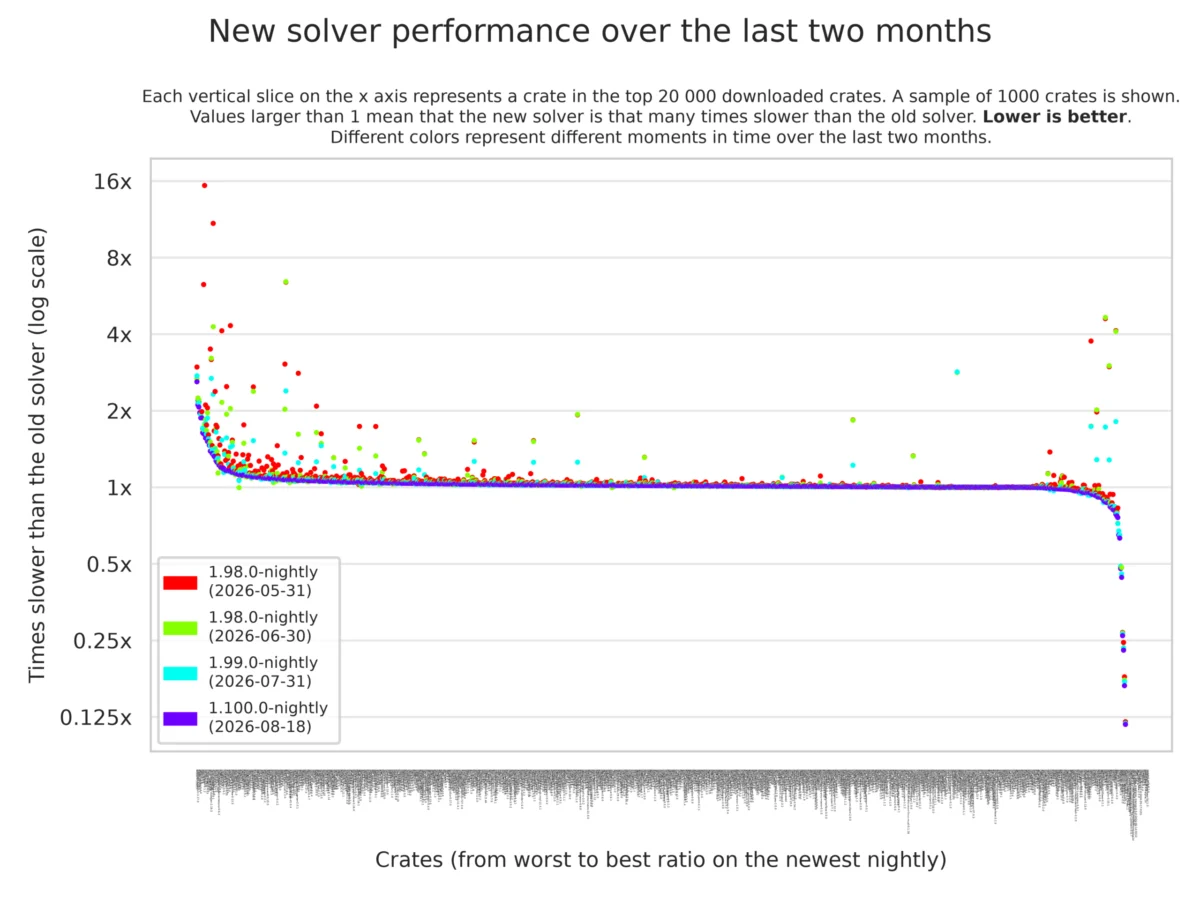
One of the primary concerns when replacing a core compiler component is the impact on compilation speed. The compiler team has been rigorous in its benchmarking, utilizing the top 20,000 crates on crates.io to measure the impact of the change.
The Performance Landscape
The data reveals a nuanced picture. While the vast majority of crates saw virtually no change in compilation speed, there were significant "outliers." Early in the development, some trait-heavy codebases saw massive slowdowns. However, the recent performance sprints have successfully brought these outliers back into alignment.
In some remarkable instances, the new solver is actually faster than the old one. The team highlighted a "Chess implementation in the type system" that previously caused the old compiler to hang indefinitely, but now completes in roughly one minute under the new solver. Similarly, the datafusion crate, a project known for its heavy reliance on complex traits, now compiles more than eight times faster with the new engine.
The Reliability Metric
The team has focused on "under-approximating" the number of fixed issues. With over 200 bugs already closed, the new solver is proving its worth as a more reliable and mathematically sound engine. By resolving the remaining "unsoundnesses" in the type system, the compiler is becoming more predictable, reducing the likelihood of "hidden" bugs that could manifest in production environments.
Official Responses and the Call to Action
The Rust compiler team is acutely aware that a change of this magnitude carries a risk of "breaking" user code. The new solver is more rigorous, which means it may refuse to compile code that previously relied on "accidental" or incorrect behavior in the old solver.
"This is an incredibly big change which results in a non-trivial amount of breakage," the team noted in their official release summary. "Most of these changes are intended improvements to type inference or the removal of undesirable behavior."
To mitigate this, the team is heavily relying on the community to test their projects using the rustup update nightly command. If developers encounter issues, they are encouraged to check the master tracking issue on GitHub. If the issue is not listed, they are urged to file a new report, including minimal reproduction cases.
For users who need to maintain compatibility with existing workflows, the compiler provides an "escape hatch." By using the flag -Znext-solver=coherence or updating the .cargo/config.toml file, developers can toggle off the new solver, allowing them to continue working while they resolve any incompatibilities.
Implications: What Lies Ahead
The stabilization of the next-generation trait solver is not the end of the road; it is a gateway to the next era of Rust development. By clearing away the limitations of the old system, the team is unblocking several long-awaited features that have been stalled in the design phase.
Unlocking Future Features
The new solver is a prerequisite for stabilizing:
- Type Alias Impl Trait (TAIT): This will allow developers to define opaque types in type aliases, significantly reducing boilerplate code.
- Return Type Notation (RTN): This will provide a cleaner, more expressive syntax for working with async traits and complex return types.
- Implicit Default Trait Bounds: Features such as
MoveandForgetwill finally be achievable, providing more granular control over how types are moved or dropped within the language.
A More Consistent Language
Perhaps the most significant long-term implication is the normalization of behavior. Previously, "special casing" was required to handle certain scenarios—such as return-position impl Trait (RPIT)—to prevent the old solver from breaking. With the new solver, these special cases can be removed, leading to a more consistent and predictable language specification.
For example, the new solver allows recursive function calls involving impl Trait that previously failed under the old system. This consistency makes the language easier to learn and harder to misuse.
Closing Thoughts
The transition to the next-generation trait solver is a testament to the longevity and ambition of the Rust project. By prioritizing long-term technical health over the path of least resistance, the Rust team is ensuring that the language remains a viable and powerful tool for the next decade. As the community moves toward full stabilization, the focus will remain on refining diagnostics and ensuring that the compiler remains as helpful as it is powerful.
"We’re excited to fully stabilize the next-generation trait solver soon," the team concluded, emphasizing that the collaboration between compiler maintainers and the broader open-source community is what makes these monumental shifts possible. The road ahead looks brighter—and significantly more efficient—for Rust developers worldwide.