By Tech & Data Science Editorial Desk Published in partnership with Machine Learning Industry Insights
Main Facts: Reinventing the Recommendation Engine
Music streaming has evolved far beyond static playlists and rudimentary genre-matching. In today’s hyper-personalized digital audio landscape, platforms must constantly anticipate and adapt to a listener’s fluid moods, context, and evolving preferences in real time. To solve this complex sequential decision-making puzzle, Spotify’s machine learning engineers have turned to an advanced branch of artificial intelligence: Reinforcement Learning (RL).
In a landmark technical initiative detailed by Spotify researchers Surya Kanoria, Joseph Cauteruccio, Federico Tomasi, Kamil Ciosek, Matteo Rinaldi, and Zhenwen Dai, the streaming giant has successfully built and deployed simulated listening environments utilizing TensorFlow and TF-Agents.
Rather than training untrained RL agents directly on live users—a practice fraught with the risk of degrading the listening experience—Spotify’s engineering team engineered a sophisticated model-based offline simulator. This ecosystem allows researchers to prototype, train, and evaluate sequential recommendation models safely and efficiently. The breakthrough culminated in the creation of a novel deep Q-Network variant called the Action-Head DQN (AH-DQN), designed specifically to tackle the massive, dynamic state and action spaces inherent to music recommendation.
Chronology: From Concept to Production-Scale Reinforcement Learning
The journey to integrating Reinforcement Learning into Spotify’s production stack required a meticulous, multi-phased engineering roadmap.
Phase 1: Identifying the Sequential Nature of Listening
Historically, music recommendation problems were treated as static classification or ranking tasks. However, Spotify’s data scientists recognized that listening to music is inherently sequential. Every track recommendation alters the user’s state, setting up a continuous feedback loop where past interactions dictate future preferences. To capture this dynamics, RL emerged as the theoretical framework of choice.
Phase 2: Selecting the Tech Stack
Integrating experimental algorithms into Spotify’s massive production architecture required careful technology selection. Because Spotify already heavily utilizes TensorFlow and its broader ecosystem—including TFX and TensorFlow Serving—the engineering team chose TF-Agents as their primary RL library. This choice ensured that experimental models could eventually transition into production systems with minimal friction.
Phase 3: Building the Offline Simulator
Training an RL agent requires a continuous stream of interactions, rewards, and environment states. Exposing millions of active users to an unstable, early-stage agent was out of the question. Consequently, the team set out to build a robust offline simulator. Leveraging TF-Agents’ flexible environment primitives, they integrated Keras-trained user models capable of predicting simulated listener satisfaction responses based on agent-generated track lists.
Phase 4: Designing the AH-DQN and Scaling Experiments
With the simulation environment operational, the team tackled the massive combinatorical complexity of playlist generation. Traditional slate recommendation models typically assume a single item selection, which fails when users interact with multiple tracks in a sequence. To overcome this, Spotify developed the Action-Head DQN. Following successful offline validations, live online experiments demonstrated a strong correlation between offline performance estimates and real-world results, unlocking large-scale RL adoption across the platform.
Supporting Data & Architectural Mechanics
The architecture powering Spotify’s offline simulator relies on a modular, highly extensible design pattern built on top of TF-Agents. Understanding how these components interact reveals the sheer scale of the engineering challenge.
The RL Loop and Model-Based Training
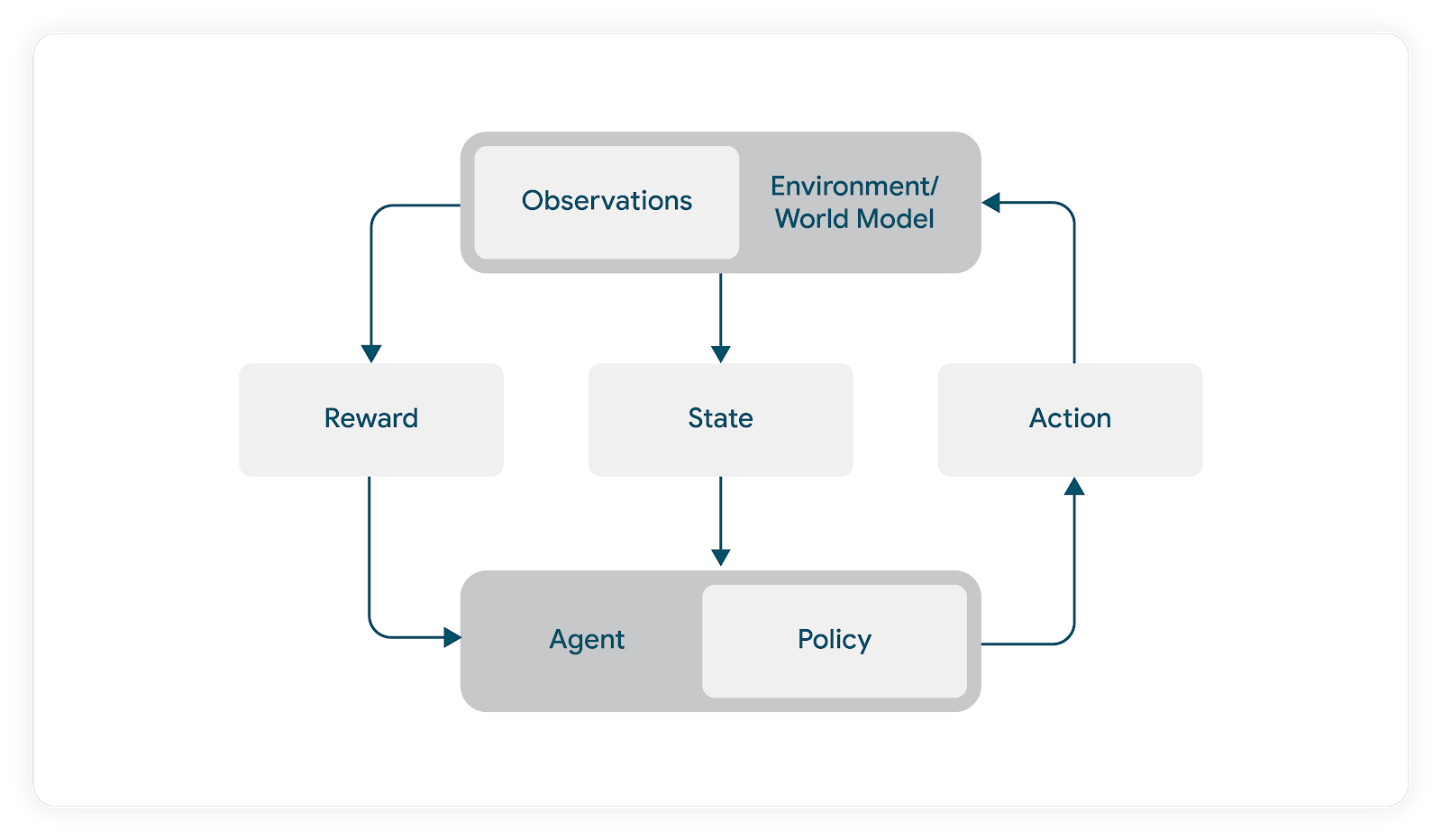
In standard RL, an agent observes the environment, takes an action based on a specific policy, and receives a reward and a new observation from the environment. In Spotify’s model-based formulation:
Observations encapsulate user session contexts and historical interactions.
Actions represent the strategy used to select tracks.
Rewards are generated not by real users, but by a serialized User Model designed and trained using Keras.
The Environment Abstraction Layer
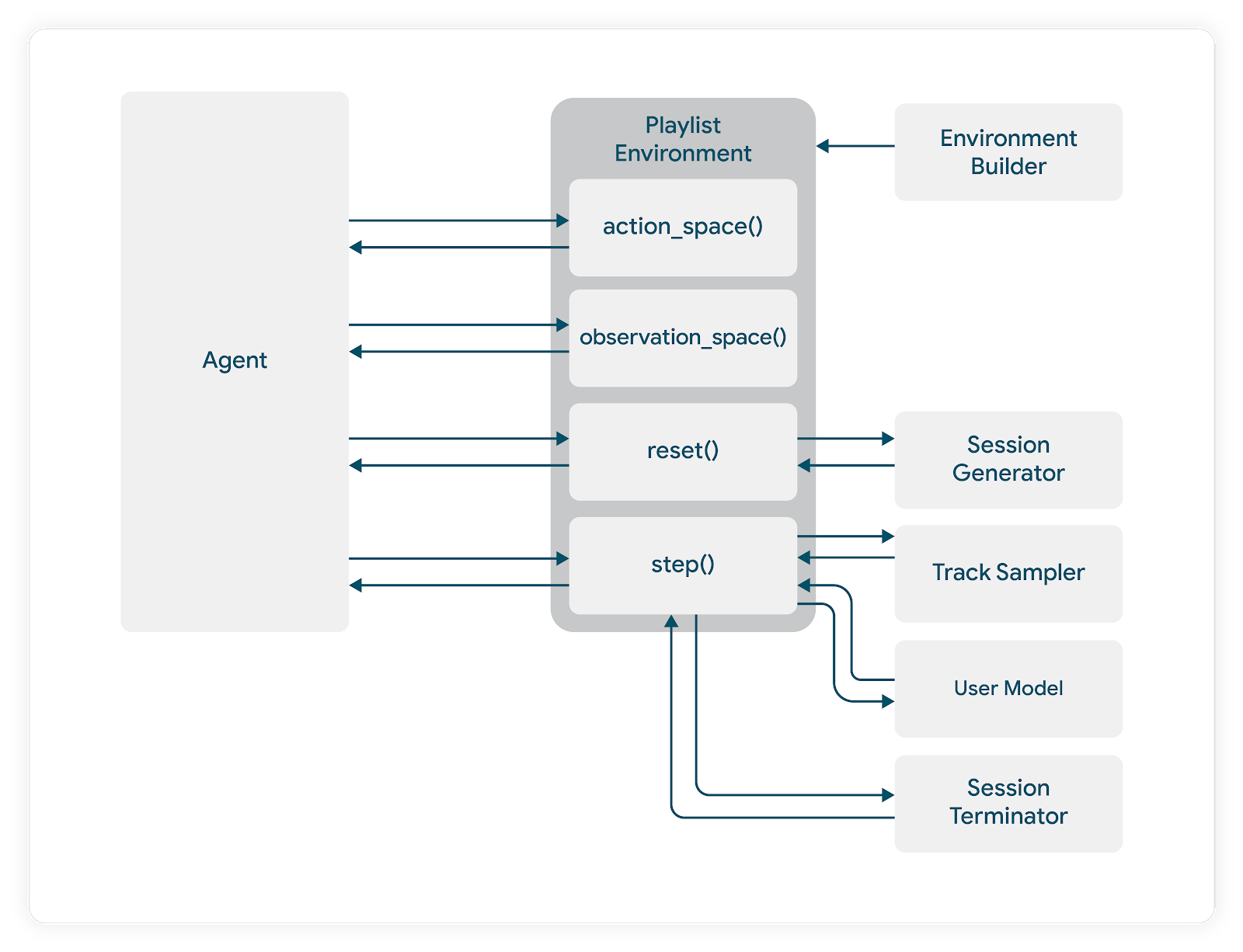
The engineering team structured their codebase around a core environment abstraction that dictates how listening sessions are initialized, stepped, and terminated:
To leverage the out-of-the-box training algorithms and replay buffers provided by TF-Agents, Spotify implemented a conversion pipeline. This involves three distinct layers:
Concrete Environment Definition: Custom environments like PlaylistEnvironment inherit from the core abstraction.
Environment Builder: A builder class instantiates the concrete environment using parameterized user models, track samplers, and episode samplers.
TF-Agents Wrapper: A specialized conversion class (TFAgtPyEnvironment) wraps the custom Python environment into a standard TF-Agents compatible format (py_environment.PyEnvironment), making it immediately usable for training loops.
The Action-Head DQN (AH-DQN) Breakthrough
Standard deep Q-networks struggle when applied to large action spaces where sequences of items must be selected dynamically. Spotify’s AH-DQN resolves this by evaluating the current state against each available action candidate, generating individual Q-values iteratively. The system selects the highest-scoring track, adds it to the playlist slate, and repeats the process until the playlist is fully constructed without recommending duplicate tracks.
Official Responses and Industry Insights
The success of this architecture has broad implications for the machine learning community, prompting academic and industry presentations—most notably at KDD 2023 by authors Federico Tomasi, Joseph Cauteruccio, Surya Kanoria, Kamil Ciosek, Matteo Rinaldi, and Zhenwen Dai.
While presenting their findings, the authors emphasized the critical importance of simulation fidelity. By establishing a rigorous pipeline where offline evaluation metrics mirrored online engagement, Spotify effectively bridged the gap between theoretical reinforcement learning and industrial-scale production systems.
Furthermore, the engineering team expressed profound gratitude to the broader open-source community:
"We’d like to thank all our Spotify teammates past and present who contributed to this work. Particularly, we’d like to thank Mehdi Ben Ayed for his early work in helping to develop our RL codebase. We’d also like to thank the TensorFlow Agents team for their support and encouragement throughout this project (and for the library that made it possible)."
Implications: The Future of Audio Personalization
The deployment of TF-Agents and custom RL architectures within Spotify marks a paradigm shift in how digital streaming platforms curate content. The implications of this technological leap span technical, business, and user-experience domains:
1. Risk-Free Algorithmic Innovation
By mastering model-based offline simulation, Spotify has created a sandbox where data scientists can iterate on aggressive, highly complex machine learning policies without risking user churn or degraded streaming experiences. This dramatically accelerates the research-to-production lifecycle.
2. True Long-Term Engagement Optimization
Traditional recommendation systems often optimize for short-term metrics (e.g., whether a user clicks a song within the first five seconds). Reinforcement learning, by design, optimizes for cumulative rewards over an entire sequential episode. This shifts Spotify’s algorithmic focus toward sustaining long-term user satisfaction, healthy listening variety, and deep session immersion.
3. A Blueprint for Industrial Reinforcement Learning
Applying RL to industrial-scale recommender systems has historically been bottlenecked by sample inefficiency and deployment risks. Spotify’s successful integration of TF-Agents with custom abstractions (such as the AH-DQN and modular track samplers) serves as an architectural blueprint for other tech sectors dealing with massive combinatorial action spaces—ranging from video streaming and e-commerce to dynamic ad placement.
As streaming services vie for listener attention in an increasingly crowded market, Spotify’s marriage of TensorFlow ecosystem tools and advanced reinforcement learning ensures that the soundtrack of tomorrow will be smarter, more adaptable, and more intimately tailored to human intent than ever before.