From Analog Icon to Digital Canvas: The Evolution of the TekkaSketch
For over six decades, the Etch-a-Sketch has stood as a bastion of analog creativity. Since its debut in the early 1960s, the red-framed device with its dual white knobs has challenged children and adults alike to master the art of the continuous line. Yet, for all its charm, the toy has always been plagued by a fundamental design flaw: permanence. To correct a single errant line, one had to sacrifice an entire masterpiece, shaking the frame to reset the aluminum powder—a process as destructive as it was iconic.
Today, a groundbreaking project known as TekkaSketch is effectively bridging the gap between mid-century mechanical design and 21st-century digital versatility. By reimagining the internal architecture of this childhood staple, developers have successfully integrated an “undo” function, digital fluidity, and even interactive gaming, all while preserving the tactile soul of the original device.
The Mechanical Genesis: Understanding the Original Mechanism
To appreciate the innovation behind TekkaSketch, one must first understand the mechanical genius of the original Etch-a-Sketch. At its core, the device is not a screen in the modern sense but a mechanical plotter. A thin layer of aluminum powder clings to the inside of a glass or plastic display. A stylus, controlled by a complex pulley system connected to two horizontal and vertical knobs, scrapes away the powder as it moves, creating the illusion of a black line against a silver background.
The "drawing" is actually a negative space—the absence of powder. This limitation is precisely what makes the device so difficult to refine. Because the system is entirely physical and non-electronic, implementing modern features like digital storage or corrective editing was, for decades, considered impossible without sacrificing the "magical" analog experience.
Chronology of Development: From Micro-Vacuums to E-Ink
The journey to modernize the Etch-a-Sketch was not a linear path. The creators of the TekkaSketch project spent years experimenting with various configurations to overcome the "all-or-nothing" reset limitation.
Phase I: The Mechanical Exploration
In the early research stages, the design team toyed with the idea of a micro-vacuum system. The concept was to selectively suction and redistribute the aluminum powder to erase specific lines. However, the mechanical complexity required to move a vacuum nozzle with the precision of a stylus proved to be a design dead-end. The weight, power consumption, and potential for internal mechanical failure rendered it impractical for a handheld toy.
Phase II: The Gamified Pivot
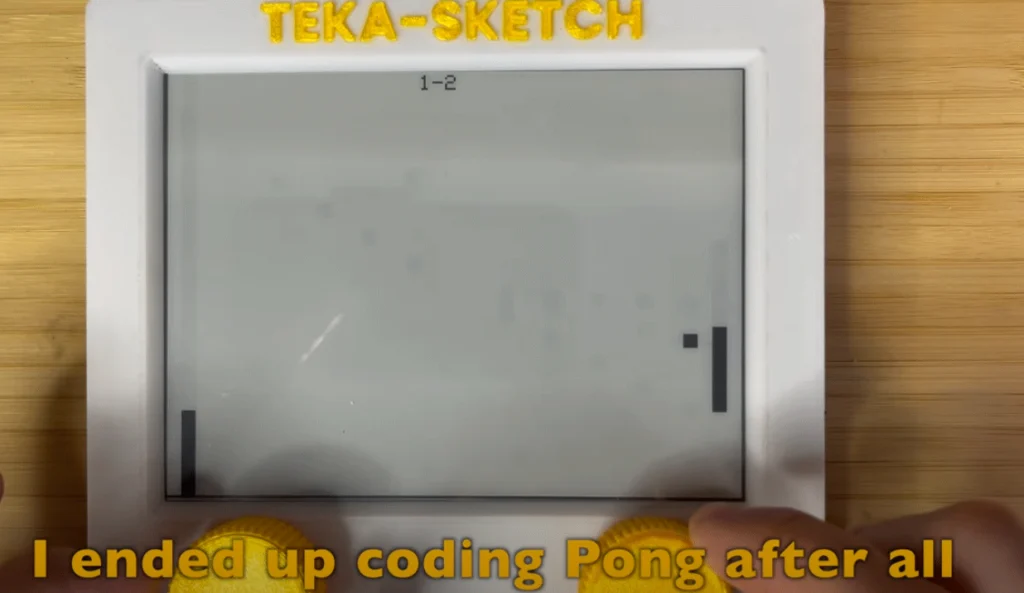
Stalled by mechanical limitations, the project shifted toward a different inspiration: the 1990s PC classic, Snake (Nibbles.bas). The team envisioned the Etch-a-Sketch as a game controller. Initial prototypes attempted to use augmented reality (AR) via smartphones, where a user would look through a screen at the physical device while graphics were overlaid digitally. Other iterations involved gear systems with rotary encoders and transparencies printed with fruit to simulate a game board. While these prototypes were intellectually stimulating, they failed to provide the fluid, seamless interactivity required to satisfy the user’s need for an authentic drawing experience.
Phase III: The Breakthrough
The final breakthrough occurred when the team decided to stop attempting to fix the internal powder mechanism and instead replace the display entirely. By swapping the glass-and-powder screen for a modern E-Ink display, the project gained the stability of digital memory with the low-power, paper-like aesthetic of traditional print. This screen is driven by an ESP32 microcontroller, which serves as the "brain" of the operation, paired with high-precision rotary encoders that mimic the haptic feedback of the original knobs.
Supporting Data and Technical Specifications
The technical architecture of the TekkaSketch is a masterclass in hardware-software integration.

- Processor: The ESP32 provides the necessary processing speed to handle real-time input from the rotary encoders, ensuring that the delay between turning a knob and seeing the line appear on the E-Ink screen is minimized.
- The Display: E-Ink technology was chosen specifically for its persistence. Because E-Ink consumes power only when changing the state of the pixels, a drawing remains visible on the device indefinitely, even if the battery is depleted or the unit is powered off.
- Software Logic: One of the most significant hurdles was the disparity in rotation speeds between the two knobs. The ESP32 firmware includes a proprietary algorithm that normalizes these inputs, ensuring that the "pen" moves with consistent velocity regardless of how fast or erratically the user turns the controls.
- Refresh Rates: While E-Ink is traditionally known for a slow refresh rate, the project utilizes partial refresh cycles. This allows for fluid line drawing while only updating the pixels affected by the stylus, effectively masking the latency inherent in the technology.
Official Perspectives: The Philosophy of "Analog-Digital"
In interviews regarding the project, the creators emphasized that the goal was never to replace the Etch-a-Sketch, but to evolve it. "There is a profound, meditative quality to the original device that simply isn’t present in a tablet or a smartphone," one lead engineer noted. "Our goal was to preserve the ‘analog weight’ of the knobs—that feeling of physical resistance—while removing the anxiety of making a mistake."
The team argues that the TekkaSketch represents a shift in how we perceive retro-tech. Rather than viewing old devices as obsolete, the TekkaSketch movement suggests that these objects serve as perfect physical interfaces for modern computing. By keeping the interface familiar, the project removes the steep learning curve often associated with digital tablets.
Implications for the Future of Interactive Play
The implications of the TekkaSketch project extend far beyond a single toy. It highlights a growing trend in "hardware hacking," where developers utilize high-end microcontrollers to breathe new life into legacy hardware.
Expanding Functionality
The inclusion of a "Snake" mode, where the knobs control the movement of a digital serpent on the screen, is just the beginning. The developers have already hinted at a two-player mode, where each knob controls a separate snake, turning a solitary drawing tool into a competitive platform.
The Future of Education and Creativity
Because the device is programmable, it could theoretically serve as an educational tool for teaching basic geometry, vector math, or even introductory programming. Imagine a device that allows a child to draw a shape, save it to an SD card, and then modify the coordinates using simple C++ or Python code. The TekkaSketch transforms the toy from a static creative tool into an open-source platform.
Sustainability and Longevity
In an era of disposable electronics and planned obsolescence, the TekkaSketch offers a refreshing alternative. By using E-Ink and durable hardware, the device is designed to last for years. The ability to perform firmware updates means that the device can grow with the user, gaining new games and features through software patches rather than requiring the purchase of a newer model.
Conclusion
The TekkaSketch project is a testament to the power of nostalgia when married to innovation. It respects the iconic design of the past while acknowledging the technical frustrations that kept it from achieving its full potential. By replacing the archaic aluminum powder with a crisp E-Ink display and an ESP32 engine, the creators have not only saved a classic toy from the dusty shelves of history but have also created a new, robust platform for digital expression.
Whether used as a simple digital notepad, a retro gaming console, or a sophisticated educational tool, the TekkaSketch demonstrates that the future of technology doesn’t always involve larger screens and more pixels. Sometimes, the most advanced innovation is found by looking back at the simple, tactile joys of the past and giving them the digital heartbeat they always deserved. As the project continues to evolve, it invites us to reconsider our relationship with the objects we touch, proving that with enough creativity, even the oldest tools can become the most advanced.