Breaking the Memory Barrier: TensorFlow Introduces Native Distributed FFT via DTensor
In the high-stakes world of modern machine learning and scientific computing, the ability to process massive datasets is the ultimate competitive advantage. As neural networks grow deeper and image-based datasets scale into the gigabyte and terabyte ranges, researchers frequently encounter a "memory wall"—a physical limitation where a single GPU or TPU simply lacks the VRAM to hold the data required for complex signal processing.
Today, Google’s TensorFlow team has announced a significant breakthrough: native support for Distributed Fast Fourier Transform (Distributed FFT) through the DTensor API. This development marks a pivotal shift in how researchers can perform signal processing tasks on distributed hardware, effectively bypassing the memory constraints that have historically throttled large-scale research.
The Significance of Fast Fourier Transform (FFT)
The Fast Fourier Transform (FFT) is the backbone of modern digital signal processing. By converting signals from the time or spatial domain into the frequency domain, it enables a variety of critical computational operations. In the context of machine learning, FFT is not merely an auxiliary tool; it is a fundamental component for speeding up convolutions, extracting sophisticated features, and serving as a mechanism for model regularization.
However, the efficacy of FFT is inherently tied to the size of the data being processed. In traditional, non-distributed implementations, the entire input tensor must reside within the memory of a single hardware accelerator. As models demand higher resolution imagery and more complex input data, this requirement has become a bottleneck. When a tensor exceeds the capacity of a single accelerator, the system crashes, leaving researchers to resort to suboptimal workarounds or smaller, less accurate models.
Chronology of Development: From Research Papers to Native Support
The journey toward a native distributed FFT solution in TensorFlow began long before its current integration into DTensor.
The Foundational Research
In previous years, Google Research identified the need for scaling Fourier Transforms as a critical requirement for high-performance computing. This culminated in the publication of the paper, “Large-Scale Discrete Fourier Transform on TPUs,” authored by Tianjian Lu. This seminal work provided the theoretical framework and a library-based implementation for TensorFlow v1. While revolutionary for its time, the v1 implementation was cumbersome, requiring specialized setup and external dependencies that were not seamlessly integrated into the core TensorFlow ecosystem.

Integration into TensorFlow v2
The transition to TensorFlow v2 brought a renewed focus on usability and standardizing distributed computing patterns. Recognizing the fragmentation caused by the v1 approach, the DTensor team—led by developers like Ruijiao Sun—began the transition to a more unified paradigm. By leveraging the DTensor API, the team moved away from bespoke library implementations toward a native, first-class citizen status for distributed FFT. This change ensures that developers can now access distributed FFT capabilities using the same intuitive APIs they use for standard, non-distributed operations.
Understanding DTensor: The Architectural Engine
At the heart of this advancement lies DTensor, an extension to the TensorFlow framework designed specifically for synchronous distributed computing.
DTensor utilizes the Single Program, Multiple Data (SPMD) extension. This architectural choice is critical because it allows the developer to write code as if it were for a single device, while the underlying DTensor framework automatically handles the distribution of tensors and computation across a cluster.
By offering a uniform API, DTensor abstracts the complexity of data and model parallelism. For researchers, this means that the transition from a single-GPU prototype to an eight-GPU production cluster is now seamless. The "sharding" of tensors—the process of breaking a large data object into smaller, manageable chunks spread across multiple devices—is now handled under the hood by the framework, rather than through complex manual orchestration.
Implementation: Seamless Integration for Developers
One of the most compelling aspects of the new update is the simplicity of its implementation. The API interface for distributed FFT is identical to the existing, non-distributed tf.signal.fft2d ops.
Example Workflow
To utilize this feature, a user simply initializes a distributed mesh—a logical grid of devices—and creates a sharded tensor. Once the layout of the input tensor is defined, passing it into the standard tf.signal.fft2d function triggers the distributed execution.

# Simplified Workflow
mesh = dtensor.create_distributed_mesh(mesh_dims=[('x', 1), ('y', 2), ('z', 4)], device_type=device_type)
init_layout = dtensor.Layout(['x', 'y', 'z'], mesh)
d_input = dtensor.relayout(input_data, layout=init_layout)
d_output = tf.signal.fft2d(d_input)
Because the output of a distributed FFT is also a sharded tensor, it can be passed directly into subsequent layers of a machine learning model without the need for gathering or re-shaping data on a single host.
Supporting Data: Performance and Trade-offs
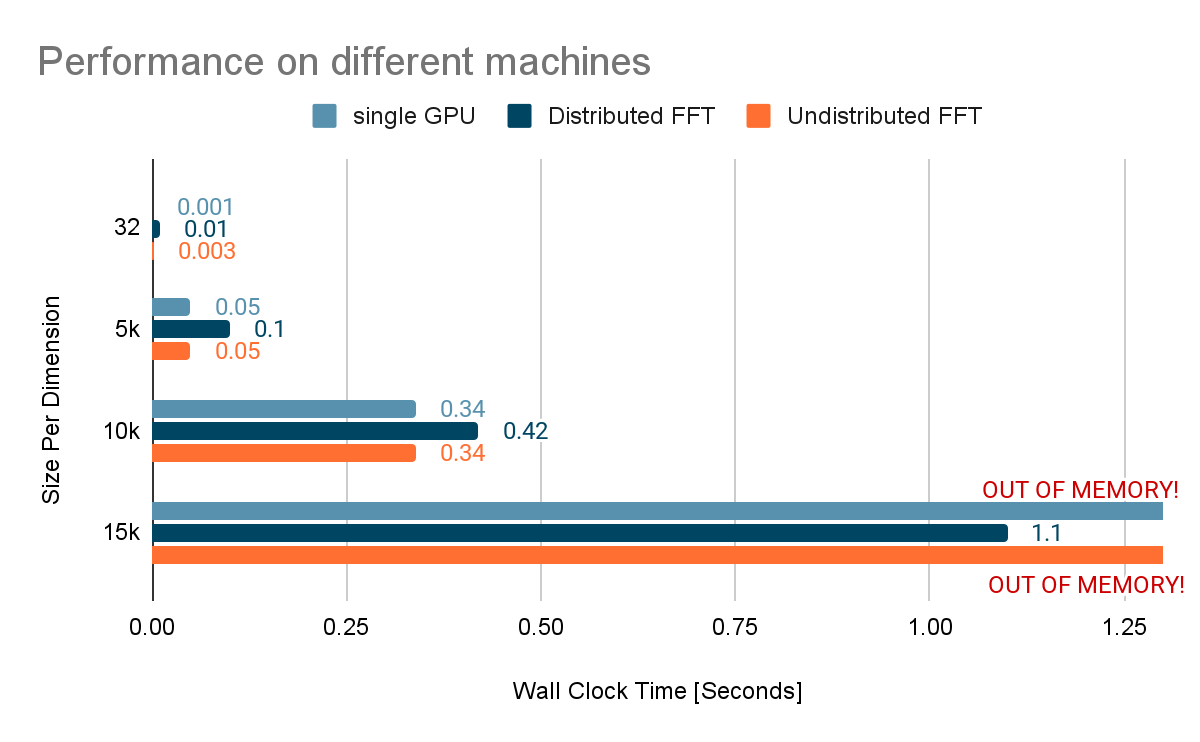
To validate this implementation, the Google team conducted extensive performance profiling on an 8xV100 GPU system. The results provide a fascinating look at the trade-offs inherent in distributed computing.
The Memory vs. Communication Trade-off
The experiment demonstrated that while the distributed FFT successfully processes data that would otherwise exceed the memory of a single GPU, it does not come without a "communication tax."
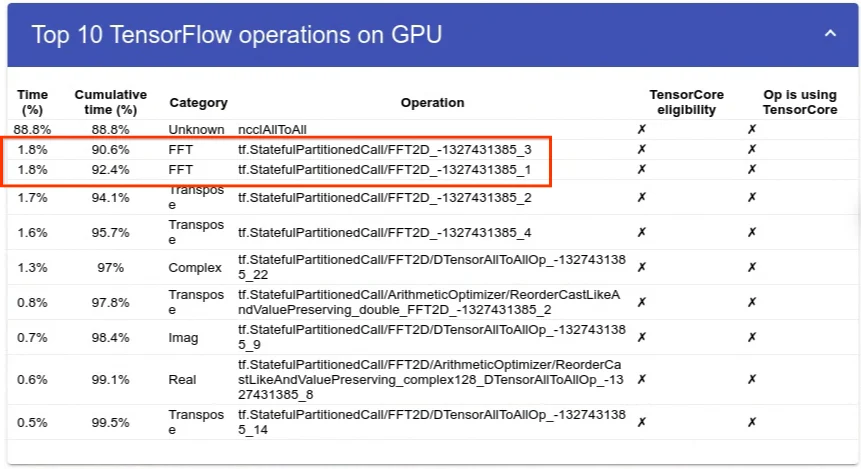
In the 10K*10K FFT experiment, the actual computation of the FFT—the "local" work performed on each GPU—was surprisingly efficient. In fact, the two local FFT operations took only 3.6% of the total wall-clock time (approximately 15ms), which is roughly one-third of the time required for a non-distributed fft2d call on a single device.
However, the remaining majority of the processing time is consumed by data shuffling. Because the FFT is a global operation, parts of the data must be moved between devices to complete the transform. In the TensorFlow implementation, this is handled by the ncclAllToAll operation. The data reveals that the overhead of moving this data across the interconnect is the primary driver of latency in distributed signal processing.
Implications for Optimization
The profiling result highlights a clear path forward for optimization. Since the local math is already extremely fast, future iterations of the algorithm will focus on overlapping communication with computation, optimizing the AllToAll collective, and perhaps utilizing advanced hardware features like GPUDirect RDMA to further minimize the latency inherent in data shuffling.
Official Response and Community Feedback
Google’s intern on the DTensor team, Ruijiao Sun, emphasizes that this is only the beginning. By adopting a "simple shuffle + local FFT" approach, the team has established a baseline that matches the efficacy of industry-standard libraries like FFTW and PFFT, but with the added benefit of native integration into the modern ML stack.
The TensorFlow team is now actively soliciting feedback via the TensorFlow Forum. The goal is to gather real-world use cases to determine where the performance bottlenecks are most severe and to prioritize future optimizations. Whether it is improving the communication topology for different mesh sizes or refining the automatic layout strategies, the team is positioning the community as a co-developer in the evolution of this tool.
Implications for the Future of AI Research
The release of native Distributed FFT for DTensor has profound implications for the research community:
- Democratization of Large-Scale Signal Processing: Researchers who do not have access to massive, specialized supercomputers can now perform complex Fourier-based operations on standard multi-GPU clusters.
- Model Architecture Innovation: By removing the memory barrier, architects can experiment with larger input sizes for vision transformers and high-resolution spectral analysis models that were previously impossible to train.
- Standardization: The shift toward native support reduces the reliance on "hacky" custom libraries, leading to more reproducible and stable research codebases across the industry.
As machine learning continues to push into domains involving higher-dimensional data and real-time signal analysis, the ability to distribute the workload is no longer a luxury—it is a necessity. With this latest update, TensorFlow has signaled its commitment to ensuring that the tools of the future are as scalable as the data they are intended to process.