Decoding the Abyss: How DBeaver’s New AI Assistant is Transforming SQL Debugging
In the high-stakes world of database administration, there is a recurring nightmare known to many: the "tossed-over-the-fence" query. It arrives via a ticket or a frantic Slack message—a block of SQL code that is incomprehensible, obfuscated, or generated by an ORM (Object-Relational Mapping) tool that seems to have a penchant for chaos.
For years, database administrators (DBAs) and developers have spent hours manually triaging these queries, breaking down complex joins and window functions, and trying to decipher the intent of the original author. However, the landscape of database management is shifting. With the release of version 26.1.2, DBeaver has integrated an AI Assistant directly into its free, open-source Community Edition, offering a powerful lifeline for those staring down the barrel of a multi-hundred-line SQL script.
The Evolution of Database Management
To understand the significance of this update, one must first appreciate the complexity of modern data environments. A few years ago, the only tools at a DBA’s disposal were their own analytical skills, documentation, and perhaps a rudimentary query plan visualizer.
The introduction of Artificial Intelligence into database IDEs (Integrated Development Environments) represents a paradigm shift. DBeaver, long the industry standard for open-source database management, has recognized that as data schemas grow more complex, the human ability to parse them manually is becoming a bottleneck. By integrating AI, DBeaver is not merely offering a convenience; it is democratizing the ability to maintain and optimize complex database infrastructures.

The Problem: Obfuscation and Complexity
Why are queries so hard to read? The reasons vary. Sometimes, it is the result of developers trying to be "clever" with non-standard syntax. Other times, the culprit is an ORM, which often generates bloated, repetitive code that no human would ever write by hand.
Then, there are the "production monsters"—queries featuring multiple Common Table Expressions (CTEs), nested subqueries, and complex window functions. When a query is written by a developer who has since left the company, or by an automated tool that prioritizes performance over readability, the resulting code can be a genuine "head-scratcher."
Integrating AI into the Workflow: A Chronology of Access
The implementation of the AI Assistant in DBeaver 26.1.2 is designed for seamless integration into existing workflows. Users do not need to export their data or copy-paste into external browser-based AI tools, which can often pose security risks.
Accessing the Assistant
- Opening the Interface: In DBeaver 26.1.2, the AI Assistant is located directly on the main menu under the ‘AI’ tab. This placement is strategic, ensuring it is always within reach during an active database session.
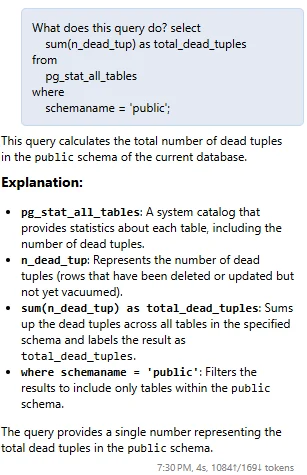
- Prompting: Once the interface is active, the user is presented with a standard chat prompt. The most effective starting point is the simple inquiry: "What does this query do?"
- Engine Selection: Users currently have the flexibility to utilize powerful models like OpenAI’s
gpt-4o. This allows for high-level reasoning capabilities that go beyond simple pattern matching.
Case Study: From Simple to Sublime
The utility of this tool can be measured by how it handles increasing levels of SQL complexity.

- The Baseline: A simple query—such as one identifying "dead tuples" in a PostgreSQL environment—is child’s play for the AI. It instantly identifies the intent and provides a plain-English summary.
- The Intermediate Challenge: When faced with a query containing multiple CTEs and window functions—like a report identifying the top 10 films by category based on rental revenue—the AI performs a structural breakdown. It explains the purpose of each CTE and how the
row_number()function is used to rank the data. - The "Weeds": The true test of the tool is the deep, nested subquery. When presented with a query that uses nested subqueries for counting and summing, often written with vague column aliases (e.g.,
RevCntr1), the AI remains capable of synthesizing the logic. It deconstructs the obfuscation and explains the business objective, saving the engineer from a potential headache.
Supporting Data: Why AI Analysis Matters
The shift toward AI-assisted SQL analysis is supported by the increasing "schema fatigue" observed in the software engineering industry. Studies on developer productivity suggest that up to 30% of a DBA’s time is spent on maintenance and understanding legacy queries rather than architecture or optimization.
By automating the "translation" phase of SQL debugging, DBeaver is enabling teams to:
- Reduce Mean Time to Resolution (MTTR): Issues involving performance bottlenecks can be identified faster because the logic of the query is clarified immediately.
- Bridge the Knowledge Gap: Junior developers can use the AI as an educational tool, learning how complex SQL functions operate by seeing the AI’s step-by-step breakdown.
- Maintain Security: By keeping the AI integration within the DBeaver environment, organizations can better control data access, compared to pasting production queries into public-facing AI chatbots.
Official Perspectives and Industry Implications
The integration of an AI Assistant into a free, open-source tool like DBeaver is a strong statement from the developers. It suggests a future where AI is not a premium, "enterprise-only" feature but a core component of developer tooling.
While some purists argue that developers should know their code inside and out, the reality of modern microservices and complex data pipelines makes this increasingly difficult. The AI does not replace the DBA; rather, it acts as a force multiplier. It provides the "first draft" of an explanation, allowing the engineer to spend their time on optimization, security, and architectural improvements.

Implications for the Future
The implications for the database industry are threefold:
- Standardization of Documentation: As AI becomes better at explaining complex code, teams may find that they don’t need to manually document every stored procedure or view, as the AI can generate a human-readable explanation on demand.
- Increased Code Quality: When a developer knows their query will be easily explained by an AI, they are more likely to write cleaner, more maintainable SQL, knowing that "clever" code will be laid bare by the assistant.
- Shift in Skill Sets: The role of the DBA is evolving from a gatekeeper of syntax to a curator of performance and data integrity. The focus shifts from "how do I read this" to "is this the most efficient way to achieve this result?"
Conclusion: A New Era for SQL
The "tossed-over-the-fence" query will likely remain a part of the IT experience for the foreseeable future. However, the sting of receiving such a ticket is significantly reduced when you have a sophisticated, context-aware AI assistant sitting in your IDE.
DBeaver’s inclusion of this feature in the Community Edition 26.1.2 is a landmark development. It acknowledges that the complexity of modern data is not going away, but our tools for managing that complexity are finally catching up. Whether you are dealing with a simple count or a convoluted mess of nested subqueries and obscure aliases, the AI Assistant provides a clear path forward. For the modern engineer, this isn’t just about saving time—it’s about regaining control over the codebase, one query at a time.
As we move forward, it is clear that the integration of AI into database management tools will continue to deepen. For now, DBeaver has set the bar high, and the rest of the industry would be wise to take note. The abyss of complex SQL may still be deep, but at least now, we have a map.