Defying Gravity in the Kitchen: Brainiac75 Explores Induction Levitation with Community Insights
MAIN FACTS
In a captivating blend of scientific inquiry, engineering ingenuity, and community collaboration, the YouTube channel Brainiac75 has once again pushed the boundaries of home experimentation, demonstrating the fascinating phenomenon of magnetic levitation using a common induction cooktop. Building upon an earlier successful — albeit somewhat volatile — demonstration, the latest series of experiments delves deeper into the principles of Lorentz force-induced levitation, guided by a torrent of innovative suggestions from his global audience. The objective remains clear: to levitate various random objects, ideally without them melting into a molten puddle, departing for orbit, or posing a significant hazard to anyone nearby. This iterative process, documented meticulously, not only highlights the practical application of complex physics but also underscores the power of crowd-sourced scientific exploration.
The core principle at play involves the generation of eddy currents within conductive, non-ferromagnetic materials placed within the rapidly alternating magnetic field of an induction cooker. These eddy currents, in turn, generate their own magnetic fields, which interact with the primary field of the cooker, resulting in a repulsive force—the Lorentz force—that can overcome gravity and induce levitation. While the initial experiments provided a thrilling spectacle, they often came with considerable risks, including extreme heat generation and unpredictable object trajectories. The latest endeavor, directly incorporating viewer feedback, seeks to refine the process, explore new materials and configurations, and ultimately achieve more stable and safer levitation, moving the demonstration from a precarious stunt to a potentially viable physics class experiment.
CHRONOLOGY: An Iterative Journey Towards Controlled Levitation
The journey into induction levitation by Brainiac75 is a compelling narrative of scientific curiosity, trial, and error, significantly propelled by an engaged online community. The chronology of these experiments reveals a progressive refinement of techniques and a deeper understanding of the underlying physics.
The Genesis: Initial Forays into Induction Levitation (Pre-Viewer Suggestions)
The foundation for the current series of experiments was laid in an earlier video, which quickly garnered significant attention for its dramatic demonstrations of objects levitating above an induction cooktop. In this initial phase, Brainiac75 successfully demonstrated the basic principle of magnetic levitation using the Lorentz force. Objects, primarily made of conductive materials like aluminum, were placed on the cooktop, and upon activation, would often jump, spin, and briefly hover.
However, these early experiments were characterized by their uncontrolled nature and inherent dangers. The induction cooktop, designed for efficient heating of ferromagnetic cookware, was being repurposed for a task it was not intended for. This led to several critical challenges:
- Intense Heat Generation: The rapid induction of eddy currents invariably generated significant heat within the levitating objects. This heat was often sufficient to cause material deformation, melting, or even ignition of surrounding materials.
- Unstable Levitation: The levitation was often sporadic and unstable, with objects frequently crashing back down, spinning out of control, or even being ejected from the cooktop’s surface.
- Safety Concerns: The combination of high temperatures, flying objects, and powerful electromagnetic fields presented clear safety risks, limiting the practical applications and replicability of the experiments.
Despite these challenges, the initial video served its purpose: it captivated an audience and ignited a discussion. The comment sections and forums buzzed with theories, explanations, and, most importantly, a wealth of suggestions on how to improve the process, mitigate risks, and achieve more stable levitation. This outpouring of community engagement set the stage for the subsequent, more methodical, and safety-conscious exploration.
Responding to the Crowd: The Viewer Suggestions Phase
Recognizing the invaluable resource of his dedicated audience, Brainiac75 embarked on a new series of experiments explicitly designed to test viewer-submitted hypotheses and modifications. This marked a pivotal shift from exploratory demonstration to community-driven scientific inquiry. The goal was no longer just to achieve levitation, but to understand why certain modifications worked or failed, and to refine the process towards greater control and safety.
-
Layered Aluminium Foil Rings: The Mass Hypothesis
One of the most common and intuitive suggestions was to increase the mass and conductivity of the levitating object. Viewers proposed creating thicker, multi-layered aluminium foil rings, reasoning that more material would lead to stronger eddy currents and thus a more potent Lorentz force, translating to higher or more stable levitation.Brainiac75 meticulously followed these instructions, starting with a single-layer ring and progressively adding layers. While the initial single-layer rings offered some, albeit brief, levitation, the results with increased layers were unexpected and enlightening. Adding two or three layers showed little noticeable improvement in levitation height or stability. Crucially, when the number of layers reached four or more, the induction cooktop often refused to activate altogether.
This outcome highlighted a critical aspect of induction cooker technology: its inherent safety mechanisms. Most induction cookers are designed to detect the presence of a suitable ferromagnetic target (like an iron or steel pan) before activating their full power output. A thick, purely non-ferromagnetic aluminium ring, despite its increased mass and conductivity, did not provide the necessary magnetic coupling to trigger the cooker’s operation. This demonstrated that simply increasing mass and conductivity in a non-ferromagnetic object isn’t enough; the interaction with the cooker’s detection system is equally vital.
-
Alternative Conductive Materials: Aluminium and Copper Tapes
Another set of suggestions revolved around experimenting with different forms and materials for the conductive objects. Aluminium and copper tapes, known for their high electrical conductivity and ease of manipulation, were proposed as alternatives to the foil rings. The idea was to create various configurations – coils, flat spirals, or layered strips – to optimize the generation of eddy currents.Brainiac75 attempted several configurations with both aluminium and copper tapes. Despite the promising theoretical conductivity of these materials, the experimental results were largely unsuccessful. The tapes, often thin and with limited surface area in the configurations attempted, struggled to generate sufficient eddy currents to produce a noticeable levitating force. Moreover, the adhesive backing on some tapes could interfere with direct electrical contact or introduce unwanted resistance, further diminishing their performance. This phase underscored the importance of not just the material’s conductivity, but also its geometry and volume in effectively interacting with the induction field.
-
The Persistent Challenge of Heat: Melting CDs and Water-Filled Cans
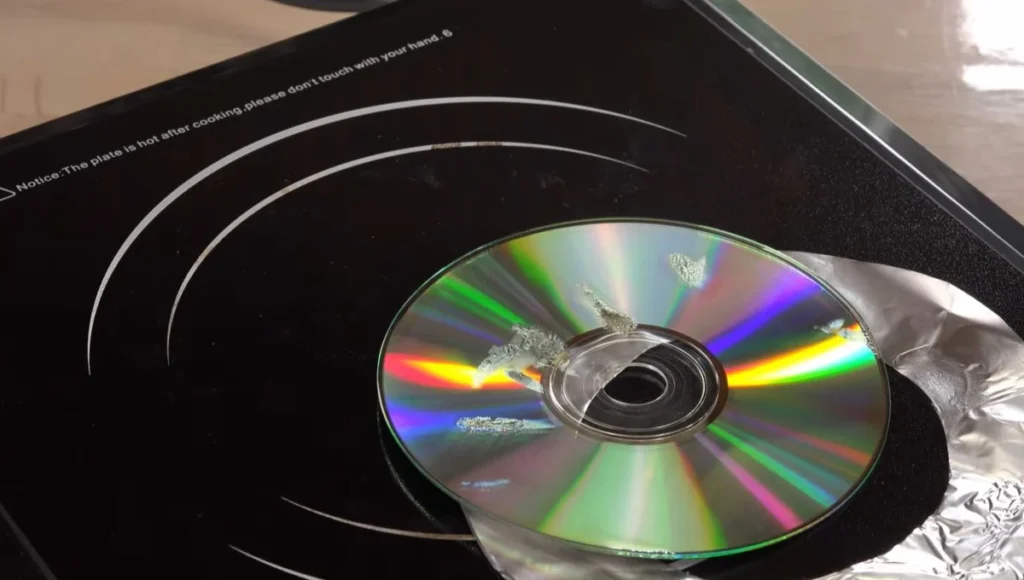
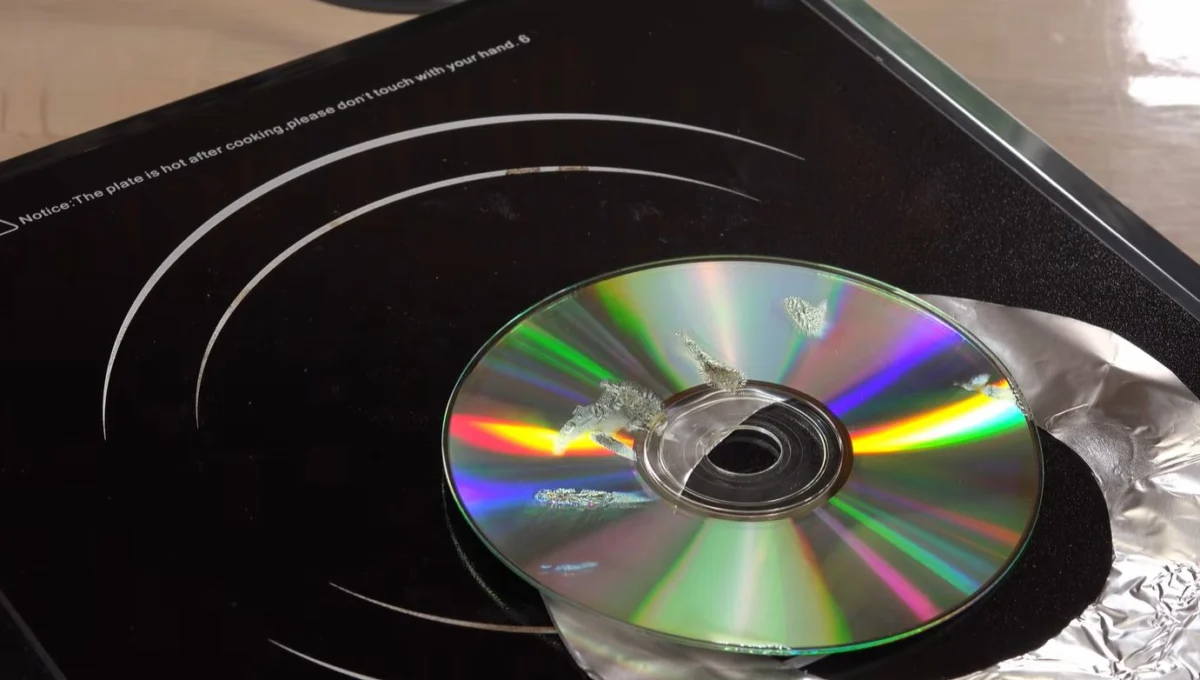
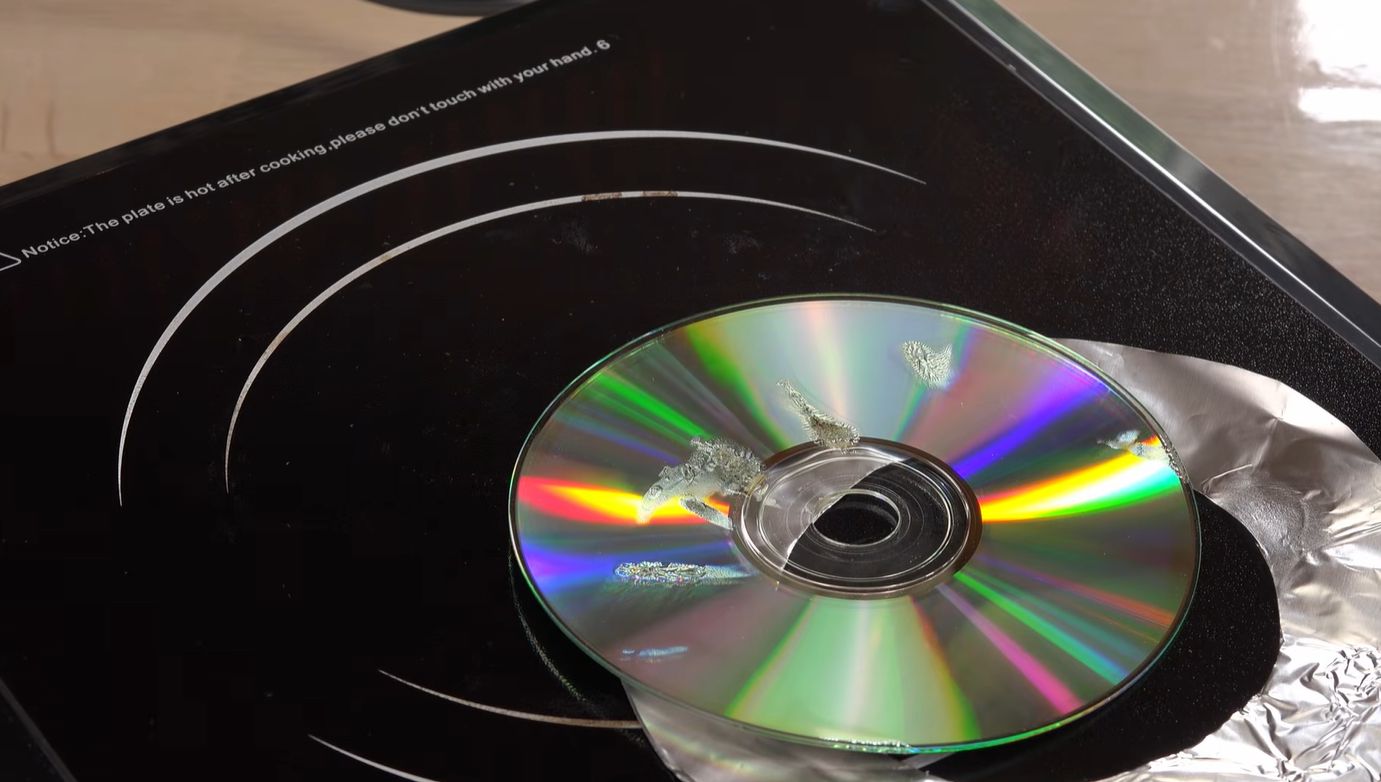
Throughout these experiments, the issue of heat generation remained a constant and significant challenge. The energy transferred from the induction cooktop to the conductive object wasn’t solely converted into kinetic energy for levitation; a substantial portion was dissipated as heat due to the inherent electrical resistance of the materials.This became dramatically evident at one point when a compact disc (CD), used in conjunction with aluminium foil, melted due to the intense temperatures generated. This stark incident served as a powerful reminder of the destructive potential of uncontrolled induction heating.
To combat this, viewers suggested using water-filled aluminium cans. The rationale was sound: water has a high specific heat capacity, meaning it can absorb a significant amount of thermal energy before its temperature rises dramatically. The water would act as a heat sink, theoretically extending the duration of levitation before the can itself became dangerously hot or deformed.
While the water-filled cans did indeed provide some thermal buffering, they only offered a temporary reprieve. The levitation time was extended, but ultimately, the constant energy input from the cooker would eventually heat the water to boiling, and the can itself would still reach dangerously high temperatures, potentially leading to steam explosions or structural failure if the experiment were prolonged. This highlighted the fundamental energy conversion aspect: unless energy input could be precisely controlled, significant heat generation was unavoidable.
-
Cooktop Limitations: The "Full Blast or Off" Conundrum
A major revelation during these trials was the limitation of the original induction cooktop itself. Brainiac75 discovered that his model operated on an almost binary system: either full power or completely off. There was no granular control over the output power, which meant objects were constantly subjected to maximum energy input. This made sustained, stable, and safe levitation exceedingly difficult, as the maximum power output invariably led to rapid heating and violent levitation, often ejecting the objects.
A Breakthrough: The New Induction Cooker and Controlled Levitation
The realization of the cooktop’s limitations prompted a crucial upgrade. Brainiac75 acquired a new induction cooker, specifically chosen for its advertised capability of "constant output" and variable power levels. This acquisition proved to be a game-changer.
With the ability to ramp down the power to more reasonable levels, the experiments entered a new phase of control and predictability. It was with this new cooktop, operating at lower, adjustable power settings, that Brainiac75 finally achieved "reasonably static levitation results without immediate conflagration or molten metal splatter risk." The objects could now hover more stably, with significantly reduced heat generation, allowing for longer observation periods and safer handling.
This breakthrough was not just about better equipment; it was about understanding the system’s parameters. The ability to fine-tune the power allowed for a delicate balance between the Lorentz force required for levitation and the unwanted heat generated. This transition from violent, high-power demonstrations to controlled, low-power hovering marked a significant step forward in making induction levitation a more manageable and educational phenomenon. The experiment had successfully been "downgraded to something potentially safe enough to play around with in a physics class," a testament to the iterative process and the invaluable feedback loop with the community.
SUPPORTING DATA: The Science Behind the Spectacle
To truly appreciate Brainiac75’s experiments, it’s essential to delve into the supporting scientific principles that govern induction levitation. This isn’t just a parlor trick; it’s a tangible demonstration of fundamental electromagnetism.
1. Induction Cooktops: The Source of the Field
An induction cooktop operates on the principle of electromagnetic induction. Beneath its ceramic glass surface are coils of copper wire. When an alternating electric current flows through these coils, it generates a rapidly oscillating magnetic field. This field extends a few centimeters above the cooktop’s surface.
2. Eddy Currents: The Induced Loops of Electricity
When a conductive material (like aluminum or copper) is placed within this oscillating magnetic field, the changing magnetic flux induces circulating electric currents within the material itself. These are known as eddy currents. According to Faraday’s Law of Induction, a changing magnetic field through a conductor creates an electromotive force, which drives these currents.
3. Lorentz Force: The Levitating Push
These eddy currents, flowing within the conductive object, generate their own magnetic fields. Crucially, according to Lenz’s Law, these induced magnetic fields always oppose the change in the original magnetic field that created them. This opposition leads to a repulsive force between the magnetic field of the induction cooker and the magnetic field generated by the eddy currents in the object. This repulsive force is known as the Lorentz force. If this Lorentz force is strong enough to overcome the gravitational pull on the object, levitation occurs.
4. Material Properties: Conductivity and Ferromagnetism
- Conductivity: The efficiency of eddy current generation is directly proportional to the electrical conductivity of the material. Highly conductive materials like copper and aluminum are ideal. Poor conductors will generate weak eddy currents and thus insufficient Lorentz force for levitation.
- Ferromagnetism: This is where induction cookers have a specific requirement. While levitation relies on non-ferromagnetic conductors, most commercial induction cookers are designed to work primarily with ferromagnetic materials (like iron or steel pots and pans). Ferromagnetic materials interact strongly with magnetic fields, allowing the cooker to "sense" the presence of cookware and activate its heating elements. Purely non-ferromagnetic objects, especially thin ones, might not be detected, preventing the cooker from turning on. This explains why Brainiac75’s multi-layered aluminum foil rings failed to activate the original cooktop.
5. Energy Conversion and Heat Dissipation
A critical aspect highlighted by the experiments is the significant heat generation. While eddy currents are essential for levitation, the electrical resistance of the conductive material converts some of the electrical energy into thermal energy (Joule heating). This is why the levitating objects get "pretty hot" and can even melt a CD or cause water to boil. The efficiency of levitation versus heating depends on the material’s resistivity, the frequency and strength of the magnetic field, and the object’s geometry. Minimizing heat while maximizing levitation force is a constant challenge in these experiments.
6. Geometric Factors
The shape and dimensions of the levitating object play a crucial role. Rings, discs, or containers with closed loops are more effective at generating strong, circulating eddy currents than flat sheets or irregularly shaped pieces. The larger the area encompassed by the eddy current loop, the greater the magnetic flux change, and thus, the stronger the induced current and subsequent Lorentz force.
By understanding these principles, the experimental outcomes—from the failure of multi-layered foil to the success with a controlled-output cooker—become scientifically explicable, transforming mere observation into valuable learning.
OFFICIAL RESPONSES: Expert Commentary and Safety Guidelines
While these experiments are the domain of independent creators, the principles and dangers involved warrant consideration from scientific and safety perspectives. There are no "official responses" from regulatory bodies specifically on levitating objects with kitchen appliances, but we can extrapolate expert commentary and general safety guidelines.
1. Educational Institutions and STEM Outreach:
From an educational standpoint, such demonstrations, when properly controlled, are invaluable. Physics educators and STEM outreach programs would likely commend Brainiac75’s work for its ability to:
- Demystify Complex Physics: Induction levitation offers a tangible, visual demonstration of electromagnetic induction, eddy currents, and the Lorentz force – concepts often challenging for students to grasp from textbooks alone.
- Foster Curiosity: The "wow" factor of levitation is a powerful hook, inspiring students to ask "how?" and "why?", thereby initiating deeper scientific inquiry.
- Promote Experimental Learning: Brainiac75’s iterative approach, incorporating feedback and troubleshooting, mirrors the scientific method. This teaches the importance of experimentation, observation, and refinement.
- Community Engagement: The involvement of viewers in suggesting experiments highlights the collaborative nature of science and engineering.
However, any integration into a formal educational setting would come with stringent safety protocols. A physics teacher, for example, would ensure:
- Supervision: All experiments are conducted under direct adult supervision.
- Protective Gear: Safety glasses, heat-resistant gloves, and appropriate clothing are mandatory.
- Ventilation: Adequate ventilation to disperse any fumes from melting materials.
- Fire Safety: Fire extinguishers and non-flammable surfaces are readily available.
- Containment: Measures to prevent objects from flying off the cooktop.
- Reduced Power: Emphasizing the use of controlled power levels, similar to Brainiac75’s second cooktop, to minimize hazards.
2. Safety Organizations and Consumer Product Safety:
From a safety perspective, organizations like the Consumer Product Safety Commission (CPSC) or workplace safety bodies would caution against unsupervised or untrained individuals attempting such high-power experiments with unmodified consumer appliances. Their concerns would include:
- Burn Hazards: The extreme temperatures generated pose a significant risk of severe burns.
- Fire Risk: Melting plastics, igniting paper products, or overheating metallic objects can easily lead to fires. The incident of the melting CD is a stark reminder.
- Electrical Hazards: Modifying or misusing electrical appliances can lead to electrical shocks or damage to the appliance itself, creating further risks.
- Projectile Hazards: Unstable levitation can turn objects into dangerous projectiles.
- Electromagnetic Field Exposure: While typically not a primary concern for short-term, low-level exposure from a kitchen appliance, high-power, prolonged exposure to strong alternating magnetic fields could be a consideration for sensitive individuals or if equipment is improperly shielded.
The shift from a "general hazard to anyone standing in the same room" to "potentially safe enough to play around with in a physics class" is a critical distinction. This implies a controlled environment, trained personnel, and strict adherence to safety protocols, rather than a casual home experiment. The acquisition of a new induction cooker with variable power output was a crucial step in aligning the experiment with safer practices.
3. Engineering and Material Science Experts:
Experts in these fields might offer insights into:
- Material Selection: Discussing the optimal conductivity, specific heat capacity, and melting points for various levitation scenarios.
- Geometric Optimization: Analyzing how coil design, object shape, and size influence the efficiency of levitation and heat generation.
- Thermal Management: Suggesting advanced cooling techniques (e.g., forced air, liquid cooling, phase-change materials) to extend levitation time and enhance safety.
- Advanced Induction Systems: Comparing kitchen cooktops to industrial induction heaters or dedicated magnetic levitation systems, highlighting the differences in frequency, power, and control mechanisms.
In essence, while Brainiac75’s experiments are a fantastic example of grassroots innovation, any "official response" would underscore the need for scientific rigor, detailed safety planning, and a deep understanding of the underlying physics to prevent potential harm. The transformation of the experiment from a high-risk demonstration to a more controlled, educational tool is precisely the kind of evolution that experts would endorse, provided safety remains paramount.
IMPLICATIONS: Beyond the Kitchen Counter
The captivating demonstrations by Brainiac75, moving from precarious stunts to controlled scientific inquiry, carry significant implications across various domains, from education and public engagement to advanced technological applications.
1. Revolutionizing STEM Education and Public Engagement:
Perhaps the most immediate and impactful implication of Brainiac75’s work is its profound potential in STEM (Science, Technology, Engineering, and Mathematics) education.
- Hands-On Learning: These experiments provide a powerful, hands-on method to teach abstract concepts like electromagnetism, Faraday’s Law, Lenz’s Law, eddy currents, and the Lorentz force. Witnessing objects defy gravity due to invisible forces is far more engaging than theoretical explanations alone.
- Fostering Curiosity and Problem-Solving: The iterative process, including the successes and failures, teaches critical thinking and problem-solving. Students learn that scientific discovery is rarely linear and often involves trial and error, just as Brainiac75 iterated through viewer suggestions.
- Democratization of Science: Platforms like YouTube, where Brainiac75 shares his work, democratize scientific exploration. They empower individuals with curiosity and basic tools to conduct experiments that were once confined to specialized laboratories, inspiring a new generation of scientists and engineers.
- Community-Driven Innovation: The integral role of viewer suggestions highlights the power of collective intelligence and open science. It demonstrates how a global community can contribute to refining experimental design and understanding.
2. Advancements in Magnetic Levitation (Maglev) Technologies:
While a kitchen induction cooker is a far cry from a full-scale maglev train, the underlying principles are shared. Brainiac75’s experiments offer a simplified, accessible model for understanding the forces at play in more complex systems:
- High-Speed Transportation: Maglev trains, which use powerful electromagnets to levitate above guideways, eliminate friction, allowing for incredibly high speeds and energy efficiency. Continued research into stable and efficient levitation, even at a small scale, contributes to the knowledge base for these systems.
- Contactless Manufacturing and Handling: In industries like semiconductor manufacturing or precision engineering, contact between components can cause contamination or damage. Magnetic levitation offers a solution for contactless handling, transport, and processing of delicate materials and components. This could range from levitating silicon wafers during processing to moving molten metals without physical contact.
- Vibration Isolation: Magnetic levitation can be used to isolate sensitive equipment from vibrations, crucial in fields like microscopy, metrology, and advanced manufacturing where even minuscule disturbances can compromise results.
3. Innovations in Industrial Heating and Material Science:
Induction heating is already a cornerstone of many industrial processes, but these experiments subtly underscore its versatility and challenges:
- Metallurgy and Foundry Applications: Induction furnaces are used to melt and refine metals. Understanding the precise control of power and frequency, as demonstrated by Brainiac75’s new cooker, is vital for efficient and safe operation in these large-scale applications.
- Containerless Processing: For highly reactive or high-purity materials, traditional crucibles can introduce contamination. Magnetic levitation allows for "containerless processing," where molten materials can be levitated and manipulated without touching any physical container, preserving their purity. Brainiac75’s ability to levitate objects without them "melting into a puddle" (or at least, with less risk of it) touches upon this concept.
- Material Characterization: Studying how different materials respond to varying magnetic fields and frequencies can provide insights into their electrical and magnetic properties, aiding in the development of new alloys and composites.
4. Safety Engineering and Appliance Design:
The challenges faced, particularly with uncontrolled heating and the "full blast or off" nature of the initial cooktop, have implications for safety engineering:
- Smart Appliance Design: The limitations of consumer induction cookers in sensing non-ferromagnetic loads highlight a potential area for future appliance design. Cookers with more sophisticated load detection and finely granulated power control could be safer and more versatile, even for their intended purpose.
- Risk Assessment: The dramatic incidents (like the melting CD) serve as vivid case studies for risk assessment in experimental setups, emphasizing the importance of understanding energy transfer and material properties.
5. The Future of Independent Research and Open Science:
Brainiac75’s work is a testament to the thriving ecosystem of independent researchers and content creators. This phenomenon indicates:
- Accessibility of Tools: With increasingly affordable sensors, microcontrollers, and even specialized equipment, sophisticated scientific experiments are becoming accessible outside traditional institutional labs.
- Global Collaboration: The internet facilitates real-time, global collaboration, allowing individuals from diverse backgrounds to contribute their expertise and ideas.
- Accelerated Discovery: The rapid iteration cycle, fueled by community feedback, can potentially accelerate the pace of discovery and innovation, albeit on a smaller scale.
In conclusion, Brainiac75’s journey from a captivating, if somewhat chaotic, demonstration to a more refined and controlled experiment with induction levitation is far more than just a viral video. It’s a microcosm of the scientific process itself – driven by curiosity, refined through iteration, and enriched by community collaboration. The implications extend well beyond the kitchen counter, touching upon the future of education, advanced technology, and the very spirit of open scientific inquiry in the digital age.