E-Ink Reimagined: Wenting Zhang Unlocks 60 Hz Refresh Rates, Paving the Way for a New Era of Monitors

A long-standing limitation of E-ink displays – their notoriously slow refresh rate – has been shattered by a groundbreaking innovation from engineer Wenting Zhang. Challenging the pervasive belief that E-ink’s inherent technology was the bottleneck, Zhang has demonstrated that the true limitation lay in the display controllers, not the electrophoretic ink itself. This revelation has culminated in the development of the Modos Flow, a fully open-source, user-repairable 13.3-inch portable E-ink monitor capable of a fluid 60 Hz refresh rate, making it a viable and eye-friendly alternative to traditional computer screens.
The Dawn of High-Refresh E-Ink: Main Facts
For years, E-ink technology has been synonymous with static, eye-friendly displays primarily found in e-readers. Its key advantages, such as exceptional readability in direct sunlight, low power consumption for static images, and a paper-like viewing experience, were consistently overshadowed by its glacial refresh rates, making it unsuitable for dynamic content like video or general computing. However, this paradigm has been fundamentally shifted by the pioneering work of Wenting Zhang.
Zhang’s exhaustive research revealed that the perceived slowness of E-ink was not an intrinsic technological flaw but rather an engineered limitation rooted in the design of its display controllers. These controllers, historically optimized for the minimal demands of e-readers, were intentionally constrained to align with low-power, limited-interface devices, thus inadvertently stifling the display’s true potential. By developing a custom, high-performance controller, Zhang has successfully unlocked E-ink’s capacity for rapid image updates, achieving a crisp 60 Hz refresh rate.
This breakthrough is not merely a theoretical exercise; it has manifested in a tangible product: the Modos Flow. This 13.3-inch portable E-ink monitor is designed to function as a primary or secondary computer display, offering a high-resolution, low-latency viewing experience previously thought impossible for E-ink. Crucially, the Modos Flow embraces an open-source ethos, both in its hardware and software, and is designed for user repairability, championing sustainability and community engagement in an industry often characterized by proprietary systems. The monitor is currently available for pre-order through Crowd Supply, offered in both monochrome and color versions, signaling a new chapter for E-ink technology.
A Journey from Limitation to Liberation: Chronology of Innovation
The evolution of E-ink technology, from its inception to Wenting Zhang’s revolutionary Modos Flow, is a testament to persistent innovation and the questioning of established norms. For decades, E-ink displays carved out a niche primarily within the e-reader market. Devices like the Amazon Kindle and Barnes & Noble Nook leveraged E-ink’s reflective nature to mimic the appearance of ink on paper, providing a comfortable reading experience with exceptional battery life. This success, however, inadvertently pigeonholed the technology.
The design philosophy for these early E-ink implementations was dictated by the constraints of their intended applications: low-power consumption for extended battery life, simple interfaces for dedicated reading tasks, and processors that prioritized efficiency over speed. To accommodate these factors, E-ink display controllers were deliberately designed with high latency and slow refresh rates. The logic was sound for e-readers, where page turns were infrequent, and static text was the primary content. There was no perceived need for rapid updates, and optimizing for speed would have introduced unnecessary power draw and complexity.
Wenting Zhang’s journey to redefine E-ink began not with an ambition to revolutionize display technology broadly, but with a more focused, practical challenge. Zhang sought to integrate an E-ink display into a personal laptop build. It was during this phase that the inherent limitations of existing E-ink interfaces became a significant hurdle. The available drivers and controllers were simply not designed for the more dynamic requirements of a general-purpose computing device. This initial frustration sparked the realization that a custom controller was necessary, not just to connect the E-ink panel, but to unlock its latent capabilities.
As Zhang delved deeper into the custom controller development, it quickly became apparent that the potential extended far beyond merely enabling a laptop connection. Initial tests with accelerated refresh rates yielded surprisingly positive results, challenging the long-held assumption about E-ink’s intrinsic slowness. This early success served as a powerful validation, indicating that the technology itself was capable of much more than its commercial implementations suggested.
The momentum gathered, leading to a pivotal moment in 2024 at the renowned Hackaday Supercon. Zhang delivered a highly anticipated talk titled "How to Make E-ink Go Fast," where the underlying principles and preliminary achievements of the custom controller were publicly unveiled. The presentation detailed how optimizing the control signals and data pathways could dramatically reduce refresh times, offering a glimpse into a future where E-ink could rival traditional displays for certain applications.
Building on the enthusiasm and technical validation from the Supercon, the project advanced rapidly from a proof-of-concept to a full-fledged product development initiative. This extensive journey involved a meticulous process of optimization, requiring countless hours of engineering to fine-tune the delicate balance between visual appearance and responsiveness across various display modes. E-ink, by its nature, can suffer from ghosting artifacts with rapid updates, and overcoming this while maintaining a clear image required significant algorithmic innovation.
The development path, however, was not without its formidable challenges. Beyond the complex technical hurdles of crafting a bespoke controller and optimizing firmware, the project encountered the common vicissitudes of hardware development: unexpected delays, supply chain disruptions, and the intricate dance of securing components. Zhang also recounted "wasteful vendor shenanigans," a euphemism likely referring to uncooperative suppliers, inflated costs, or quality issues that plague many independent hardware projects. Despite these setbacks and what Zhang described as "bad timing" – a likely reference to market conditions or unforeseen global events – the team persevered.
The culmination of years of dedicated research, development, and problem-solving is the Modos Flow. Launched with an open-source philosophy, the 13.3-inch portable E-ink monitor represents a significant leap forward, transforming E-ink from a niche display technology into a versatile option for mainstream computing. Its current availability through Crowd Supply marks the transition from an ambitious engineering project to a commercially viable product, ready to redefine user expectations for E-ink.
The Engineering Behind the Breakthrough: Supporting Data
The core of Wenting Zhang’s innovation lies in a profound understanding of E-ink’s operational mechanics and the strategic re-engineering of its control systems. Traditional E-ink panels operate by manipulating microscopic charged particles (pigments) suspended in a clear fluid, which move to the surface to form pixels under the influence of an electric field. The black and white particles (or colored particles in advanced versions) are bistable, meaning they retain their position and image without continuous power, contributing to E-ink’s ultra-low power consumption for static displays.
The inherent slowness historically attributed to E-ink was not due to the physical movement speed of these particles, which can react quite quickly, but rather to the way these movements were orchestrated by the display controllers. Standard E-ink controllers, designed for e-readers, implement complex waveform sequences to ensure precise particle placement, minimize ghosting (residual image from previous frames), and maximize image quality. These waveforms, while effective for static images, are computationally intensive and time-consuming, leading to refresh rates typically in the range of fractions of a hertz to a few hertz.
Zhang’s breakthrough involved identifying that these long, complex waveforms were not strictly necessary for all display modes, especially when prioritizing speed. By designing a custom controller, Zhang was able to:
- Optimize Waveform Generation: Instead of relying on generic, slow waveform sequences, the custom controller can generate highly optimized, application-specific waveforms. For dynamic content, simpler, faster waveforms can be employed, accepting a slight trade-off in absolute image purity for significantly increased speed.
- Parallel Processing and Faster Data Transfer: Traditional controllers often have limited internal processing power and slower interfaces for data transfer from the host device. Zhang’s controller likely incorporates faster microcontrollers and more efficient data bus architectures, allowing it to process display data and issue commands to the E-ink panel much more rapidly. This reduces the bottleneck between the computer’s GPU and the E-ink panel.
- Intelligent Refresh Algorithms: The Modos Flow likely employs adaptive refresh algorithms. For rapidly changing content (e.g., scrolling, video), it might use a faster, partial refresh mode that updates only the necessary pixels, potentially introducing minor ghosting but maintaining fluidity. For static content, it can revert to a slower, full refresh mode to ensure pristine image quality and eliminate ghosting. This intelligent switching between modes is crucial for balancing responsiveness with visual fidelity.
- High-Resolution Support: The ability to drive a 13.3-inch high-resolution panel at 60 Hz implies significant bandwidth and processing power within the controller. This goes beyond the capabilities of typical e-reader controllers, which handle much lower resolutions and refresh rates.
The Modos Flow’s specifications—a 13.3-inch display with a 60 Hz refresh rate—place it firmly in the category of conventional computer monitors in terms of performance, while retaining E-ink’s unique advantages. The project’s commitment to being fully open-source is a significant data point in itself. This means the schematics, firmware, and possibly even the custom controller’s design files are made public, allowing other developers and enthusiasts to understand, modify, and build upon Zhang’s work. This collaborative approach accelerates innovation and provides a level of transparency rarely seen in commercial display products.
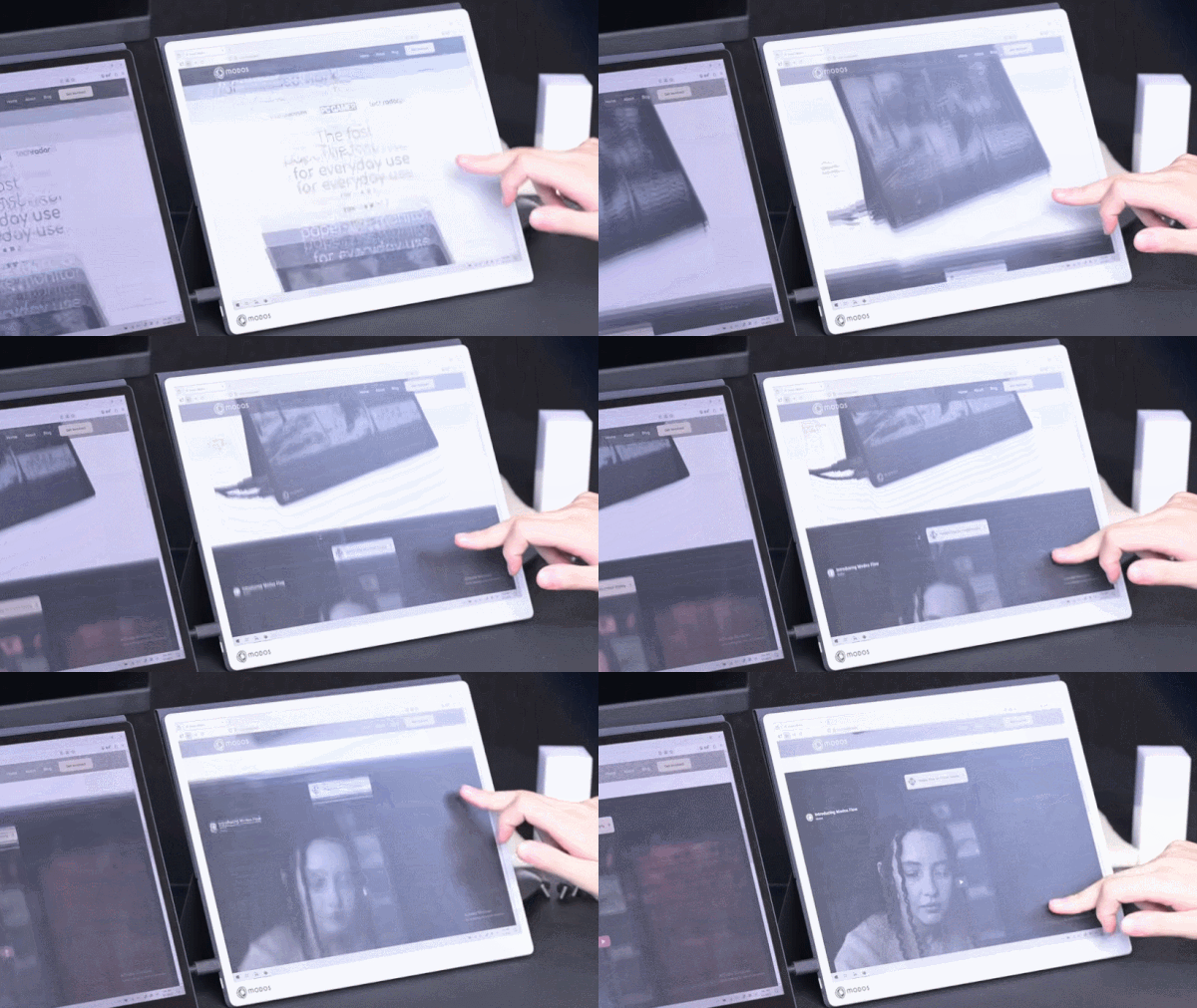
Furthermore, the emphasis on user repairability tackles another critical issue in modern electronics. By designing the Modos Flow with readily replaceable components and accessible internal architecture, Modos Tech is promoting a longer product lifespan and reducing electronic waste. This aligns with a growing consumer demand for sustainable and maintainable devices. The availability of both monochrome and color versions through Crowd Supply also highlights the versatility of this new E-ink paradigm, catering to different user needs and preferences. While color E-ink traditionally faces even greater refresh rate challenges, the Modos Flow’s successful implementation suggests similar controller optimizations have been applied.
The Vision from the Innovator: Official Responses and Philosophy
While direct quotes beyond the initial article’s summary are limited, Wenting Zhang’s journey and the Modos Flow project offer clear insights into the innovator’s perspective and the philosophy underpinning this breakthrough. The narrative points to a tenacious problem-solver driven by a desire to overcome perceived technological barriers.
Zhang’s initial motivation, stemming from the practical need to integrate an E-ink display into a laptop, speaks to a user-centric approach. It wasn’t an abstract pursuit of speed, but a practical application that revealed the underlying limitation. The subsequent realization that "a custom controller could do considerably more than E-ink was known for" underscores a keen ability to question assumptions and push boundaries.
The detailed account of the "long" development path, fraught with "optimization and feature work… crafted from scratch," highlights the immense dedication required. Zhang’s acknowledgment of "usual hassles of development and bad timing" and "wasteful vendor shenanigans" paints a candid picture of the entrepreneurial struggle. This transparency resonates with the open-source community, where such challenges are often shared and collaboratively addressed. It suggests a pragmatic individual who confronts obstacles head-on and learns from them.
The Modos Flow itself embodies Wenting Zhang’s core philosophy. The decision to make it "fully open-source" and "user-repairable" is not merely a feature; it’s a statement. It reflects a belief in democratizing technology, empowering users, and fostering a collaborative ecosystem. In a world dominated by closed ecosystems and planned obsolescence, Modos Tech stands out by offering a product that encourages understanding, modification, and longevity. This approach extends the product’s lifespan, reduces electronic waste, and fosters a deeper connection between users and their devices.
"Our goal was not just to make E-ink fast, but to make it accessible and sustainable," a representative from Modos Tech might articulate, echoing the project’s values. "We believe that users should have the freedom to understand, repair, and even improve the technology they own. The Modos Flow is a testament to what’s possible when you challenge conventional wisdom and empower a community."
The choice to offer both monochrome and color versions through Crowd Supply also indicates a strategic understanding of the market and user needs. While monochrome E-ink offers the purest "paper-like" experience and potentially faster refresh for certain tasks, color E-ink expands the monitor’s utility for graphical interfaces and broader computing tasks. This dual offering demonstrates a commitment to providing versatile solutions that cater to a wider spectrum of preferences and applications, all while maintaining the core benefits of E-ink.
Reshaping the Landscape: Implications and Future Outlook
The implications of Wenting Zhang’s work and the Modos Flow are far-reaching, promising to reshape perceptions and applications of E-ink technology across various sectors. This breakthrough is not merely an incremental improvement; it represents a paradigm shift that unlocks E-ink’s potential beyond static e-readers and signage.
For E-ink Technology: This innovation fundamentally alters the narrative surrounding E-ink. No longer can its slow refresh rate be cited as an inherent, insurmountable flaw. This opens the floodgates for further research and development into E-ink panel manufacturing itself, potentially leading to even faster and higher-quality displays as controller technology continues to advance. It validates the potential for E-ink to be a serious contender in dynamic display markets.
For Users and Accessibility: The most immediate and significant impact will be on users. Many individuals suffer from eye strain, headaches, or digital fatigue when working for extended periods on traditional emissive LCD or OLED screens. A 60 Hz E-ink monitor offers a non-emissive, reflective display that mimics paper, dramatically reducing eye strain. This could be a game-changer for students, writers, programmers, and anyone whose profession demands long hours in front of a screen. Furthermore, for individuals with certain visual sensitivities or conditions, E-ink could provide a more accessible and comfortable computing experience. The portable nature of the Modos Flow also suggests new possibilities for mobile productivity with reduced digital eye fatigue.
For the Computing Industry: The Modos Flow challenges the established dominance of LCD/OLED in the monitor market. While E-ink may not replace these technologies for all applications (e.g., high-fidelity gaming or professional video editing), it creates a compelling alternative for general productivity, coding, document work, and reading-intensive tasks. This could spur other manufacturers to invest in high-refresh E-ink solutions, fostering innovation and competition. We might see E-ink integrated into more laptops, specialized workstations, or even public information displays where eye comfort and low power consumption are paramount.
For Open-Source Hardware and Sustainability: The Modos Flow serves as a powerful testament to the efficacy and importance of the open-source hardware movement. It demonstrates that complex, cutting-edge technology can be developed and commercialized outside of traditional corporate structures, driven by individual ingenuity and community collaboration. The commitment to user repairability aligns perfectly with growing calls for sustainable electronics, reducing e-waste and extending product lifecycles. This model could inspire other hardware developers to adopt similar principles, promoting a more ethical and environmentally conscious approach to technology production.
Environmental Impact: While a 60 Hz E-ink display will consume more power than a static e-reader, it is likely to remain significantly more energy-efficient than a comparable LCD or OLED monitor for many common computing tasks, especially those with predominantly static content (text documents, web browsing). The "bistable" nature of E-ink means it only consumes power when the image changes, not to maintain it. This energy efficiency, coupled with user repairability, contributes positively to the overall environmental footprint of computing.
Future Possibilities: Looking ahead, Zhang’s work could pave the way for a variety of new E-ink products:
- E-ink Laptops: Imagine entire laptops with E-ink screens, offering unparalleled battery life and eye comfort.
- Larger E-ink Monitors: Scaling up the technology for desktop workstations could become feasible.
- Specialized Industrial and Medical Displays: Where specific viewing conditions or low power are critical.
- Educational Devices: E-ink tablets or whiteboards with dynamic capabilities could revolutionize learning environments.
Wenting Zhang’s Modos Flow is more than just a new monitor; it’s a proof-of-concept that redefines the boundaries of a well-established technology. By meticulously dissecting and overcoming a long-standing technical bottleneck, Zhang has not only created an innovative product but has also opened a new frontier for E-ink, promising a future where eye comfort and sustainable design are at the forefront of display technology. The era of truly dynamic E-ink has arrived, and its implications will resonate for years to come.