From "Dort" to Defendant: The Collapse of the Kimwolf Botnet Empire
OTTAWA, Canada — The digital reign of one of the most prolific cybercriminals in recent history has come to an abrupt end. On Wednesday, Canadian authorities apprehended 23-year-old Jacob Butler—known in the shadowy corners of the internet by the alias “Dort”—following a high-stakes international investigation into the creation and management of Kimwolf. This massive Internet-of-Things (IoT) botnet, which enslaved millions of devices worldwide, was the engine behind a series of record-shattering distributed denial-of-service (DDoS) attacks that crippled infrastructure and targeted private researchers and security firms alike.
Butler, a resident of Ottawa, now faces a grueling legal battle spanning two nations. Following his arrest by the Ontario Provincial Police (OPP) pursuant to a U.S. extradition warrant, Butler remains in Canadian custody. He faces severe criminal charges in Canada, including unauthorized use of a computer and mischief in relation to computer data, while concurrently facing a U.S. federal indictment in the District of Alaska for aiding and abetting computer intrusion.
The Anatomy of the Kimwolf Botnet
Kimwolf was not merely a tool for disruption; it was a sophisticated, self-propagating ecosystem designed to exploit the inherent security flaws of the modern, connected home. Unlike traditional malware that targets workstations or servers, Kimwolf specifically hunted for “firewalled” devices—digital photo frames, web cameras, and smart-home appliances—that users mistakenly believed were shielded from the broader internet.
By leveraging a critical security vulnerability, Kimwolf was able to spread with unprecedented speed, effectively turning millions of mundane household items into a unified, malicious weapon. Once enslaved, these devices were either integrated into the botnet to launch record-breaking DDoS attacks or rented out to other cybercriminals through “DDoS-for-hire” services.
The scale of the operation was staggering. According to the U.S. Department of Justice (DOJ), Kimwolf was tied to DDoS attacks peaking at nearly 30 Terabits per second—a figure that represents a new, grim benchmark in internet history. The botnet is alleged to have issued more than 25,000 individual attack commands, causing financial losses that, for some organizations, exceeded one million dollars per incident.
A Chronology of Chaos and Capture
The downfall of "Dort" was not an overnight success, but the culmination of a months-long campaign of forensic investigation, digital cat-and-mouse games, and international cooperation.
The Rise of the Botmaster (Late 2025 – Early 2026)
Throughout late 2025, Kimwolf began to dominate the IoT threat landscape. It aggressively competed with three other major botnets—Aisuru, JackSkid, and Mossad—for control over the same pool of vulnerable devices. During this period, Butler’s alias, “Dort,” became a fixture on cybercrime forums and encrypted messaging platforms like Telegram and Discord.
The Turning Point: February 2026
In February 2026, the investigative arm of KrebsOnSecurity published a breakthrough report identifying Butler as the individual behind the Dort persona. By meticulously mapping his digital footprint—including email addresses, forum registrations, and public server posts—researchers were able to link the handle to Butler’s real-world identity.
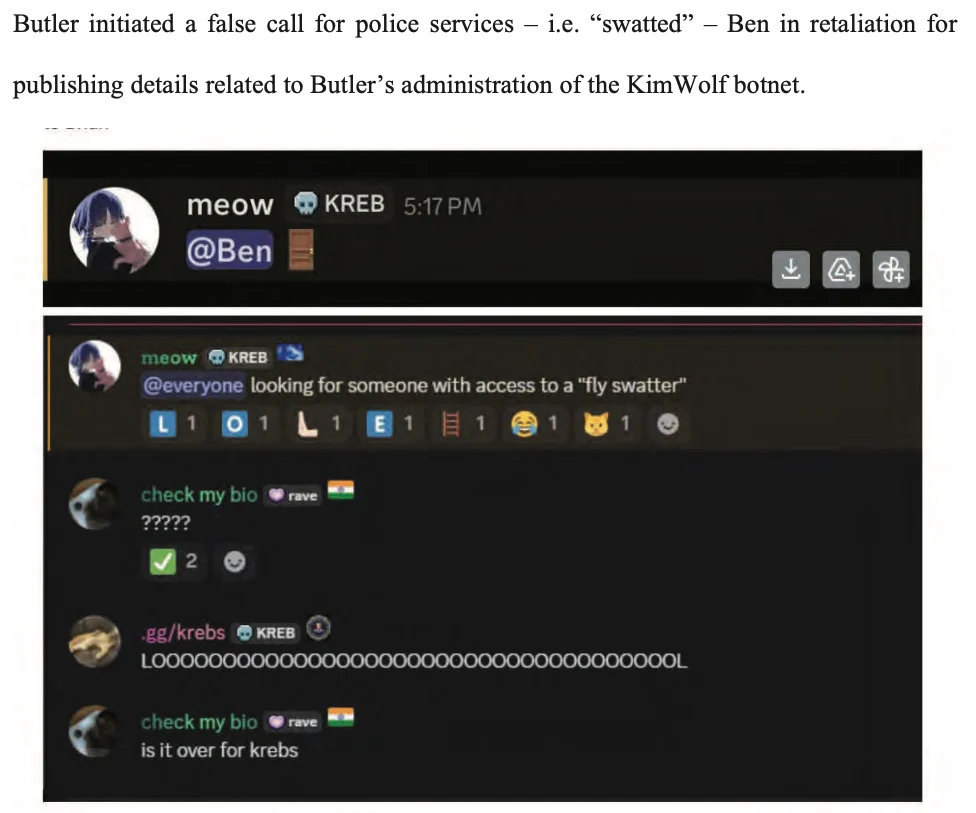
Rather than retreating, Butler responded with aggression. He launched a campaign of harassment, including DDoS attacks, doxing, and swatting against the security researchers who had unmasked him. This period of retaliation included at least two documented swatting incidents targeting the founder of Synthient, a security startup that had played a key role in developing patches for the vulnerability Kimwolf exploited.
The March Crackdown
The tide turned decisively on March 19, 2026. In a coordinated multi-national operation, U.S. and international law enforcement agencies seized the technical infrastructure powering Kimwolf and its three primary competitors. Simultaneously, the Ontario Provincial Police executed a search warrant at Butler’s Ottawa residence, seizing multiple devices and documentation that would later prove central to the criminal complaint filed in Alaska.
The April Disruption
Building on the momentum of the March raids, the U.S. Department of Justice collaborated with European authorities in April to dismantle nearly four-dozen DDoS-for-hire services. While the full list of seized domains remained under seal due to administrative complexities, the DOJ confirmed that at least one of these services had deep operational ties to Butler’s Kimwolf network.
Supporting Data and Evidence
The criminal complaint unsealed in the District of Alaska paints a picture of a suspect who was as technically capable as he was careless regarding operational security. Despite his proficiency in building a multi-million-device botnet, Butler frequently failed to bifurcate his professional and criminal lives.
Investigators connected Butler to the administration of Kimwolf through a combination of:
- IP Address Forensics: Logs tracking the administration of the botnet’s command-and-control (C2) servers.
- Transaction Records: Financial trails linking the monetization of the botnet to accounts held by Butler.
- Digital Messaging: Conversations captured via legal process that detailed his intent and his coordination with other cybercriminals.
- Hardware Seizure: Physical evidence recovered during the March 19 raid in Ottawa that corroborated the digital evidence found on the network.
The Defense Criminal Investigative Service (DCIS) also became involved in the case due to the botnet’s brazen attacks on Internet address ranges assigned to the U.S. Department of Defense. This elevated the investigation from a matter of cyber-vandalism to one of national security interest.
Official Responses and the Human Cost
The arrest has brought a sense of closure to the security community, which had been under constant pressure from Butler’s tactics. Ben Brundage, the founder of Synthient, expressed his relief during an interview following the unsealing of the complaint. “Hopefully, this will end the harassment,” Brundage remarked, noting that the swatting attacks had created a climate of fear for his team and his family.
The Department of Justice, in its official statement, emphasized the gravity of the charges. "These attacks resulted in financial losses which, for some victims, exceeded one million dollars," the DOJ noted. The agency also publicly thanked the various technology companies and private researchers who assisted in the investigation, acknowledging that the private sector’s ability to identify and patch the vulnerabilities Kimwolf exploited was instrumental in curbing the botnet’s reach.
Implications for the Future of IoT Security
The case of Jacob Butler serves as a sobering reminder of the fragility of the “Internet of Things.” As household devices become increasingly powerful and interconnected, they offer a vast, largely unsecured attack surface for malicious actors.
The Kimwolf saga highlights three critical implications for the future:
- The Shift Toward Private-Public Partnerships: The successful dismantling of Kimwolf was only possible because private security firms like Synthient worked in tandem with the FBI and international police forces. This model of cooperation is likely to become the standard for addressing global, large-scale cyber threats.
- The Persistence of the “DDoS-for-Hire” Economy: While the DOJ’s April seizure of dozens of domains was a significant blow, the appetite for DDoS services remains high. The case demonstrates that as long as there is a market for temporary, massive-scale disruption, individuals like Butler will find lucrative incentives to build and maintain these infrastructures.
- The Need for "Security by Design": The vulnerabilities that Kimwolf exploited are often the result of manufacturers prioritizing ease-of-use and rapid time-to-market over robust security protocols. Regulators are increasingly looking at mandatory security standards for IoT devices to ensure that consumer products cannot be weaponized against the global internet.
As Butler awaits his hearing, scheduled for late May, the global security community remains vigilant. The Kimwolf botnet may be offline, but the underlying vulnerabilities—and the actors willing to exploit them—remain a persistent challenge. For now, however, the "Dort" era is over, and the legal system will decide the ultimate price for his digital empire.